
Osaka is easy to enjoy, but it is also easy to mis-plan.
A hotel that looks central may add two transfers to every day. “Namba Station” can mean different railway facilities. A route that looks efficient on a map can become a long underground walk with luggage. None of these problems will ruin a trip, but together they can drain the time and energy you wanted to spend on Osaka itself.
The solution is not a minute-by-minute itinerary. It is a small set of decisions made in the right order.
Osaka travel tips for first timers: the quick answer
| Decision | Good first choice | Check before committing |
|---|---|---|
| Where to stay | Namba for food and evenings; Umeda for transport and day trips | The exact station entrance and airport route |
| How to ride | Use an ICOCA card for ordinary trips | Operator, line, destination, and any separate reserved ticket |
| How to plan | One area cluster per half-day | Walking distance and station exits, not just map pins |
| What to book | Fixed-date or capacity-limited experiences | Cancellation rules and whether the rest can stay flexible |
| What to carry | Phone data, battery, some cash, and a second payment method | Ticket-display requirements and offline backups |
If those five decisions are sound, the rest of the itinerary becomes much easier.
1. Choose your base by the trip you are actually taking
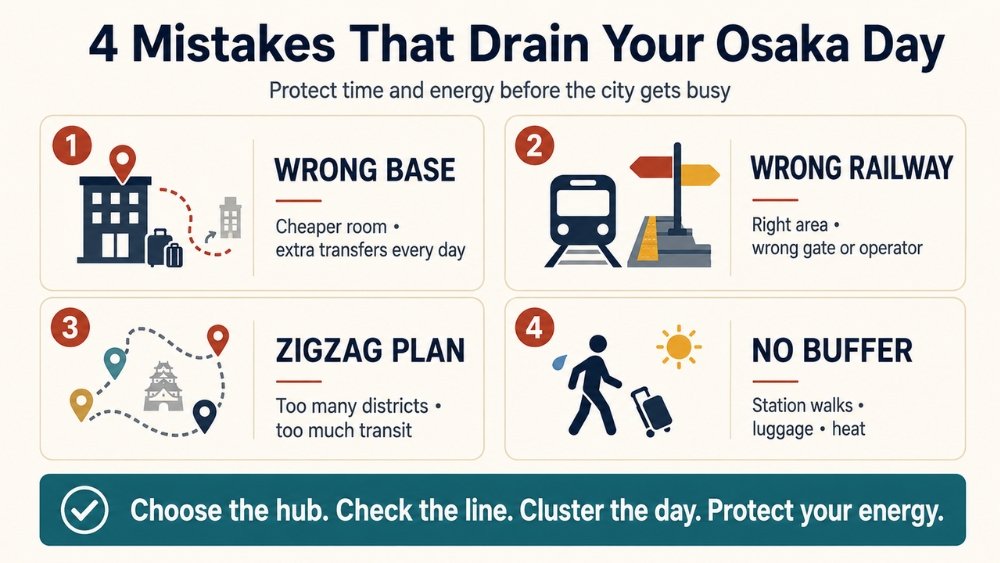
The best Osaka base is not simply the hotel closest to Dotonbori or the cheapest room near a station. It is the place that reduces the journeys you expect to make repeatedly.
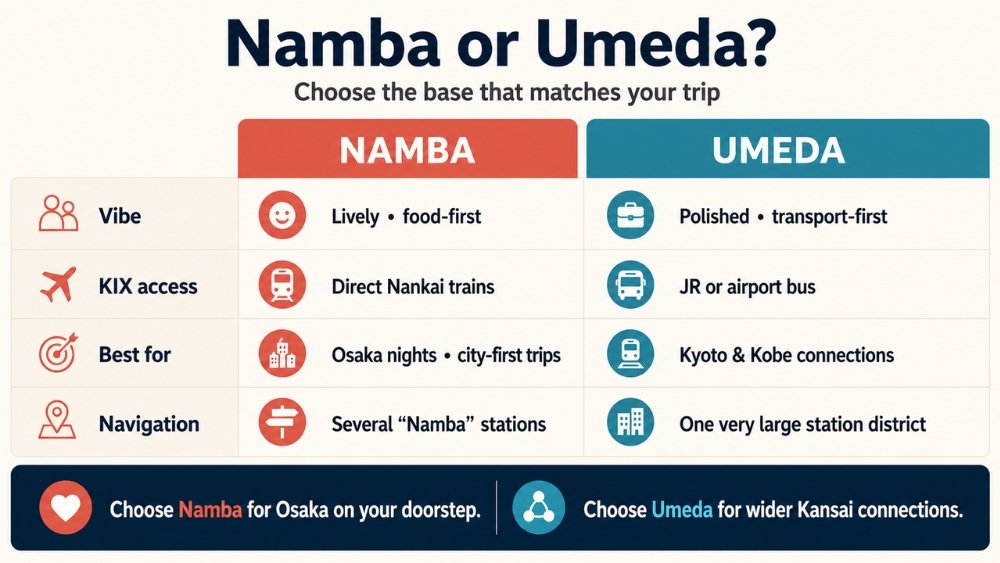
Namba or Umeda?
| Choose | Best when your trip emphasizes | Main trade-off |
|---|---|---|
| Namba | Dotonbori, Shinsaibashi, food, nightlife, and direct Nankai access from Kansai Airport | “Namba” covers several operators and station facilities, so the exact entrance matters |
| Umeda / Osaka Station | Kyoto or Kobe day trips, JR connections, department stores, and a transport-first base | The station district is very large and may take time to cross |
Namba Station on Google Maps
Osaka Station on Google Maps
Read the full Namba or Umeda comparison before choosing between the two. Then check the walking route from the correct station entrance to the hotel—not only the straight-line distance.
When Tennoji or Shin-Osaka makes more sense
Tennoji can work well when you want a less intense base with practical JR and Metro links, especially if the southeast side of the city fits your plan. Shin-Osaka is useful when repeated Shinkansen journeys are the priority. For a city-first visit, however, it may put your evenings farther from the Osaka experiences you came to enjoy.
A slightly cheaper room is not a saving if it creates extra transfers every morning and night.
2. Choose your Kansai Airport route from your hotel backward
Do not start by asking, “What is the fastest train from KIX?” Start with, “Which station is easiest for my hotel?”
| Hotel area | First route to compare |
|---|---|
| Namba | Nankai Railway |
| Umeda / Osaka Station | JR service or airport limousine bus |
| Tennoji | JR service |
| Shin-Osaka | JR service that reaches Shin-Osaka on the current timetable |
If a bus appears simpler for Umeda, confirm the current destination and boarding terminal on the official Kansai Airport bus page.
The fastest vehicle can still produce the slowest door-to-door journey if it leaves you at the wrong hub or adds a difficult transfer with luggage. Check the arrival station, the final transfer, and the walk to the hotel.
Passengers arriving at Kansai Airport Terminal 2 should also allow for the free shuttle to the Terminal 1/Aeroplaza rail area. The airport currently gives a journey time of about 7–9 minutes. Confirm the latest route and service information on the official Kansai Airport train-access page.
For a step-by-step comparison, use the Osaka Map guide to getting from Kansai International Airport to Osaka. Recheck schedules close to departure, particularly for a late arrival or early flight.
3. Save the station, line, and exit before you move
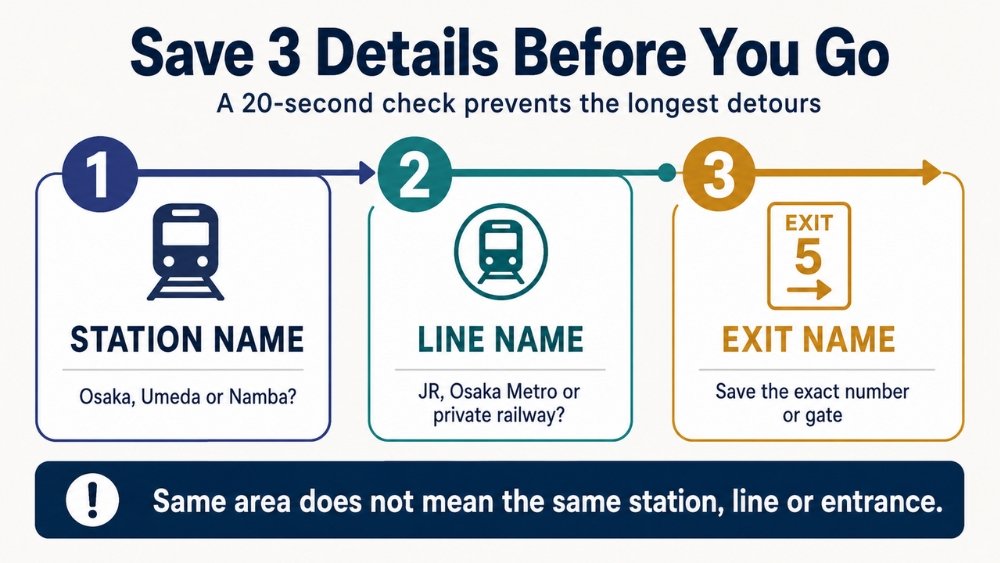
“Go to Namba” is not enough information. Osaka’s transport network includes JR, Osaka Metro, Nankai, Hankyu, Hanshin, Kintetsu, and other operators. Nearby stations may share an area name without sharing the same gate.
Before leaving a hotel, restaurant, or attraction, save three details:
- Station name: the exact station, not only the district.
- Line or operator: JR, Osaka Metro, Nankai, Hankyu, or another railway.
- Exit or gate: the number or named gate closest to the destination.
On the platform, confirm both the line and the train’s destination. Two trains can use the same platform area but serve different stopping patterns or branches.
The official Osaka Metro route map is useful before the trip. For the practical boarding sequence, read How to Ride the Osaka Subway. If Umeda is part of the plan, save the separate guide to navigating Osaka Station without stress.
4. Use ICOCA for ordinary rides—but know what it does not replace
ICOCA removes much of the friction from ordinary urban travel. Load value, tap at the gate, and let the system deduct the fare. It can also be used on participating buses and at shops displaying the IC symbol, as explained in the official JR-West ICOCA guide.
What it does not do is choose the right railway or automatically include every reserved seat, limited-express surcharge, airport product, or attraction ticket. Check whether a separate ticket is required before boarding a special service.
For normal sightseeing days:
- keep enough balance for the next few rides;
- use the same card to tap in and out;
- do not pass one card back and forth between travelers;
- keep any separate reserved ticket with you.
The Osaka Map ICOCA guide for Osaka explains purchase, use, and common mistakes in more detail.
An IC card is the simple default for paying ordinary fares. A sightseeing pass is a separate calculation.
5. Plan Osaka by area, not by attraction
A list of famous places can create a poor itinerary. Osaka Castle, Dotonbori, Shinsekai, Umeda, and the bay area may all look close on a zoomed-out map, but moving between them repeatedly adds platforms, exits, and underground walking.
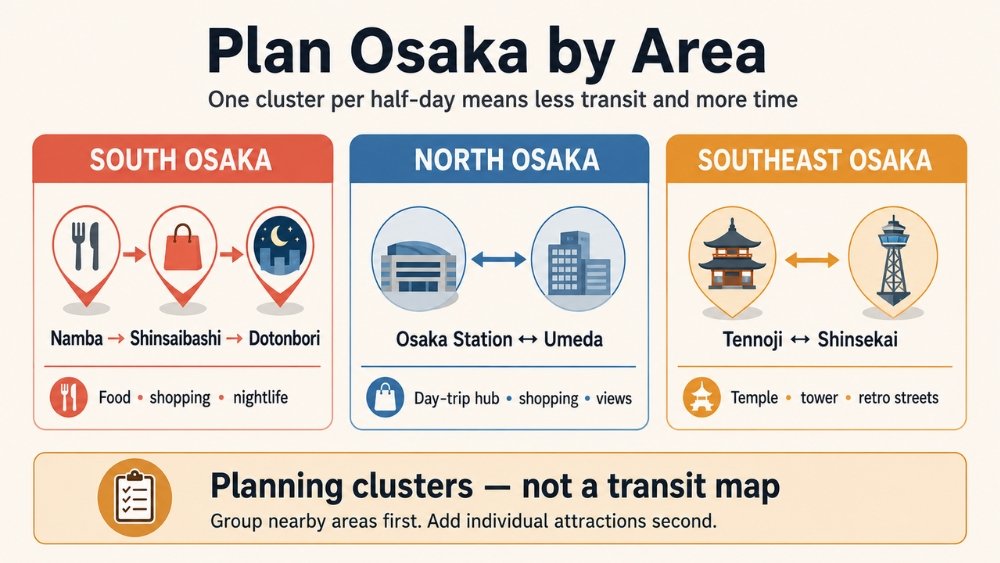
Build each half-day around one cluster.
| Cluster | Natural sequence | Good for |
| South Osaka | Namba → Shinsaibashi → Dotonbori | Food, shopping, nightlife, and an easy evening finish |
| North Osaka | Osaka Station ↔ Umeda | Department stores, city views, transport connections, and day-trip departure |
| Southeast Osaka | Tennoji ↔ Shinsekai | Temple, park, tower, and retro streets |
These are planning clusters, not a substitute for a transit map. Start with the area, add one or two priorities, and then check the actual walking route.
For a ready-made framework, see the first-time route guide for Osaka. The Osaka Minami guide shows how Namba, Dotonbori, and Shinsaibashi fit together.
6. Reserve the scarce parts and keep the ordinary parts flexible
Overbooking makes Osaka feel like a sequence of deadlines. Booking nothing can leave a fixed-date priority unavailable. The useful distinction is scarcity.
Usually worth reserving
- a dated attraction that can sell out;
- a small or popular restaurant that accepts reservations;
- a special experience with limited capacity;
- reserved transport during a busy travel period;
- anything the trip would feel incomplete without.
Usually safe to leave flexible
- ordinary subway rides;
- casual restaurants with many nearby alternatives;
- department-store browsing;
- convenience-store stops;
- neighborhood walks and secondary food ideas.
Before confirming a restaurant, read its cancellation policy and save the confirmation. If plans change, cancel through the booking link or contact the restaurant as soon as possible. Policies vary, and late cancellations, changes in party size, or no-shows may trigger a fee.
If the booking was made through TableCheck, you can check any applicable cancellation fee in the confirmation email or reservation screen. Whatever booking method you use, do not assume that failing to arrive counts as a cancellation.
Is the Osaka Amazing Pass worth it?
Do not count every advertised benefit. Count only the paid attractions you genuinely plan to visit and the transport you would otherwise buy on the same day. A pass works best when the included places form a coherent route; it is less persuasive when it encourages extra travel merely to “get value.”
Use the Osaka Map Amazing Pass review to test the pass against your itinerary. At the booking stage, recheck the current price, validity, included facilities, and ticket instructions; these details can change, so do not rely on an old screenshot or saved list.
If your plan includes several paid attractions and multiple rides in one day, compare the current Osaka Amazing Pass options on Klook before you buy.
7. Choose food by area and time, not by a viral checklist
Osaka’s food reputation can make first-time visitors plan every meal before they arrive. That often creates unnecessary backtracking and queues.
Use a simpler method:
- Choose the area you will already be exploring.
- Keep one priority dish or restaurant.
- Save two nearby alternatives.
- Let the final choice depend on hunger, queue length, weather, and energy.
The Osaka food street guide helps match food areas to the rest of the day. It is more useful than crossing the city for a single item that has many good alternatives.
Convenience stores are valuable support, not a failure of planning. They can cover breakfast before an early departure, water during a hot day, a quick snack between areas, or a simple meal when the group is too tired for another queue.
Keep the must-eat list short enough that Osaka can still surprise you without forcing a sentimental story onto every meal.
8. Carry some cash and a second way to pay
Many hotels, chain stores, and larger restaurants accept cards or contactless payment, but acceptance is not universal. A smaller restaurant, older machine, local counter, or particular top-up process may still require cash.
There is no universal amount every traveler should carry. The sensible setup is:
- some yen for small or unexpected payments;
- a primary card;
- a second payment method stored separately;
- a quick balance check before a long day.
Do not wait until a payment fails to discover that both cards are in the same lost wallet. Do not assume a familiar card brand will work at every machine.
If you need more yen, Seven Bank lists supported overseas-issued cards and ATM locations. Check the card and fee details before relying on one network; even a displayed card logo does not guarantee that every issued card will be accepted.
9. Keep your phone connected and your backup offline
Osaka is much easier to navigate when the phone can load a route, translate an address, and display a current ticket. Choose an eSIM, physical SIM, roaming plan, or pocket Wi-Fi that fits the device and group. Before buying an eSIM, confirm that the phone is unlocked and that the exact model supports it. Osaka Map compares practical choices in the Japan travel eSIM guide.
Before a full sightseeing day:
- save the hotel name and address;
- download an offline map for central Osaka;
- screenshot non-dynamic reservation details;
- carry a charged power bank;
- keep the accommodation phone number somewhere accessible.
Do not assume every digital ticket works from a screenshot. Display rules differ by product, so check the ticket instructions while you are connected and save only the non-dynamic details for offline backup. Connectivity and battery are part of the ticket plan, not optional extras.
10. Treat station time and luggage as part of the itinerary
Map apps estimate train time better than they estimate human time inside a major station. Finding the right gate, crossing an underground complex, using a lift, and collecting luggage can add much more than expected.
For an unfamiliar major station, a 15–30 minute buffer is reasonable editorial planning—not a railway rule. Add more when traveling with children, large bags, limited mobility, or a fixed departure.
Luggage also changes the route. Coin lockers are useful, but the size you need may be occupied at a busy station. Storage counters and delivery services provide a backup: Yamato Transport lists baggage-storage and same-day delivery counters in Osaka, with destinations, cut-off times, and availability varying by counter. Hotel-to-hotel forwarding may also be possible, but confirm the arrangement with both properties and the delivery operator.
On arrival and departure days:
- confirm when the hotel will hold bags;
- identify a backup locker area or delivery option;
- keep the first or final activity near the relevant hub;
- avoid carrying luggage through Dotonbori or a crowded shopping street if it can be stored first.
The detailed Osaka Station guide is worth saving before a transfer there.
11. Build around heat, rain, and energy
Weather changes how long a station exit, exposed street, or crowded queue feels. A plan that works in mild conditions may become exhausting in summer heat or persistent rain.
Check the forecast, then check Japan’s official heat-risk and WBGT information on hot days. Adjust the route rather than treating the original schedule as a promise.
A resilient day has:
- one or two anchor activities;
- an indoor fallback in the same area;
- a place to sit or eat without another long transfer;
- enough slack to stop early without losing the entire plan.
Department stores, underground shopping areas, museums, cafés, and covered arcades can provide useful pauses when they fit the route. The Osaka rainy-day itinerary example shows how to regroup rather than abandon the day.
Energy is a planning constraint, not a character test. Protecting it usually produces a better evening.
12. Follow the flow—then leave the main strip
Good manners in Osaka are mostly about not interrupting other people’s movement.
- Wait beside train doors and let passengers exit first.
- Move away from the gate before stopping to check the phone.
- Keep calls and loud conversation off crowded trains.
- Hold bags so they do not block the aisle.
- Follow signs and staff instructions when a platform is busy.
These habits match Osaka Metro’s passenger guidance on luggage, phone calls, loud conversation, and stopping near ticket gates.
Old travel advice often says that people in Osaka stand on the right side of an escalator. Do not treat that as a current safety rule. Osaka Metro’s escalator campaign asks riders to stand still, avoid walking, and hold the handrail. Follow the signs at the place you are using.
Outside transport, the same practical rule applies: notice the space around you, follow posted instructions, and correct a small mistake calmly. Courtesy matters more than performing a perfect version of local life.
The same awareness improves sightseeing. Dotonbori’s main canal strip is worth seeing, but the busiest point is not the whole district. Continue into side streets, nearby arcades, Hozenji, or the wider Minami area when the crowd begins to dominate the experience. Osaka Map’s guide to exploring Dotonbori beyond the crowds gives a practical next step.
Your five-minute Osaka checklist
Before the trip, confirm:
- Base: Namba, Umeda, or a deliberate alternative
- Airport route: chosen for the hotel, not only the train
- Transport: ICOCA ready; special tickets checked separately
- Stations: exact station, line or operator, and exit saved
- Plan: one area cluster per half-day
- Reservations: scarce priorities booked; ordinary time left flexible
- Backup: data, battery, offline map, cash, and second payment method
- Conditions: luggage plan, forecast, and heat risk checked
Make the city simpler before adding more
The most useful Osaka travel tips are not about squeezing in another attraction. They reduce friction before it starts.
Choose the right hub. Check the railway details. Keep nearby places together. Reserve only what is genuinely scarce. Protect the phone, payment options, luggage plan, and energy that make the day work.
Once those foundations are in place, use the first-time route guide for Osaka to turn them into a realistic route.