You can try zazen in Osaka without joining a retreat or travelling deep into the countryside. The best choice depends less on which temple looks most famous and more on three practical questions: Do you need English guidance? Can you attend an early public session? Can you manage the route to the meditation hall?
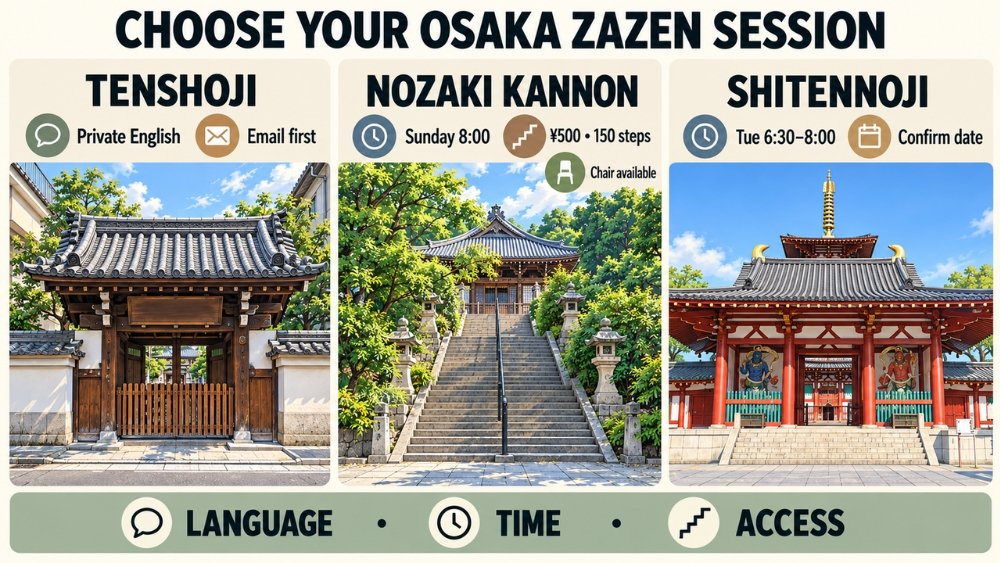
For a first session in English, Tenshoji Temple is the clearest option because it arranges private English guidance by email. Nozaki Kannon is the simplest low-cost public session if you can follow a Japanese-led class and climb the approach steps. Shitennoji is the most central, but its current zazen meeting is early, dates are not published in one stable English schedule, and several details need direct confirmation.
| Temple | Best fit | Published timing | Cost and booking | Important limitation |
|---|---|---|---|---|
| Tenshoji Temple | First-timers who want private English guidance | Date and time arranged with the temple | From ¥3,000 for one person; from ¥2,000 per person for a group; email required | Do not confuse it with nearby Shitennoji |
| Nozaki Kannon (Jigenji) | Budget-minded visitors comfortable in a Japanese public session | Sundays, zazen 8:00–9:00; talk and tea until shortly before 10:00 | ¥500 offering; no reservation | The station route includes a long stone staircase |
| Shitennoji | Visitors staying near Tennoji who can confirm before attending | About twice monthly, Tuesday 6:30–8:00 | Ask the temple about dates, fee and participation | No English support is promised on the official page |
Schedules and participation rules can change for temple ceremonies. Treat the table as a decision guide, then open the official page or contact the temple before building a non-refundable journey around a session.
Choose Tenshoji when English guidance matters
Tenshoji Temple’s English zazen page invites visitors to arrange a private English session for a mutually convenient date and time. The current English information lists a donation from ¥3,000 for an individual and ¥2,000 per person for a group, payable by cash or credit card. Email the temple with your name, contact address, preferred date and preferred time; wait for a reply before treating the session as confirmed.
This is the least ambiguous option for a visitor who wants to understand the instructions rather than copy the person beside them. It is also useful when a fixed Sunday morning will not work. Allow roughly 60–90 minutes unless your confirmation says otherwise, and arrive with enough time to remove your shoes, put away your phone and settle quietly.
Tenshoji is a small urban temple at 1-11-31 Katsuyama, Tennoji-ku. The temple lists approximate walks of seven minutes from Shitennoji-mae-Yuhigaoka Station, 12 minutes from JR Tennoji or Momodani, and 15 minutes from Osaka-Uehommachi. It is near Shitennoji’s East Gate but is a separate temple with a separate programme. Use the exact Google Maps pin rather than following only the word “Shitennoji.”
Before booking, mention any need for a chair, difficulty sitting on the floor, or other access concern. The public page describes the session and approach but is not a detailed accessibility guarantee.
Choose Nozaki Kannon for a regular public session
Nozaki Kannon’s official zazen page publishes the most straightforward walk-in routine in this guide. The session is held every Sunday: zazen runs from 8:00 to 9:00 a.m., followed by a talk and tea until shortly before 10:00. The offering is ¥500, and no reservation is required.
First-time participants should arrive about 10 minutes early. The temple says beginners receive around 20 minutes of instruction and then sit for about 25 minutes. It normally welcomes 20–30 people, permits participants to leave partway if necessary, and accepts people regardless of faith. Instruction follows Soto Zen practice.
The published information is in Japanese and does not promise an English interpreter. If you cannot follow simple Japanese directions, contact the temple before travelling or choose Tenshoji instead. “No reservation required” does not mean an English explanation will be available on demand.
The temple provides cushions and can provide a chair for someone who cannot cross their legs. That solves the sitting question, not the route question. From JR Nozaki Station’s east exit, the official route is about 600 metres and 12 minutes, then climbs a long stone staircase to the grounds. The precinct guide describes roughly 150 stone steps. If stairs are a barrier, ask the temple about the current practical access route before attending.
JR Nozaki is on the Gakkentoshi Line. JR means the Japan Railways network; this route is separate from Osaka Metro. From central Osaka, check your transfer and first-train timing the night before; an 8:00 a.m. start leaves little room for a missed connection. Open Nozaki Kannon on Google Maps and read the temple’s official access page before setting out.
Treat Shitennoji as a confirm-first option
Shitennoji’s current official FAQ says a public zazen meeting is held about twice a month on Tuesdays, from 6:30 to 8:00 a.m., at Gochikoin in the temple’s main residential compound. This corrects older information that sent visitors only to a remote branch venue.
The FAQ does not publish the exact dates, fee, reservation method, arrival deadline or English-language support. Those omissions matter at 6:30 in the morning. Call 06-6771-0066 during the temple’s published enquiry hours and ask about the next session before you commit to it. A useful Japanese question is: “Tsugi no sanzenkai wa itsu desu ka?”—“When is the next zazen meeting?”
Shitennoji lists a five-minute walk south from Shitennoji-mae-Yuhigaoka Station and a 12-minute walk north from Tennoji Station. The outer gates may be accessible early, but the zazen meeting is an organised activity inside Gochikoin; ordinary gate access does not prove that a session is running. Use the official access page and Google Maps pin. If you are new to Osaka’s rail system, our Osaka subway guide explains lines, gates and IC cards—rechargeable transit smart cards such as ICOCA, Suica and PASMO.
Dress for sitting, not for sightseeing photos
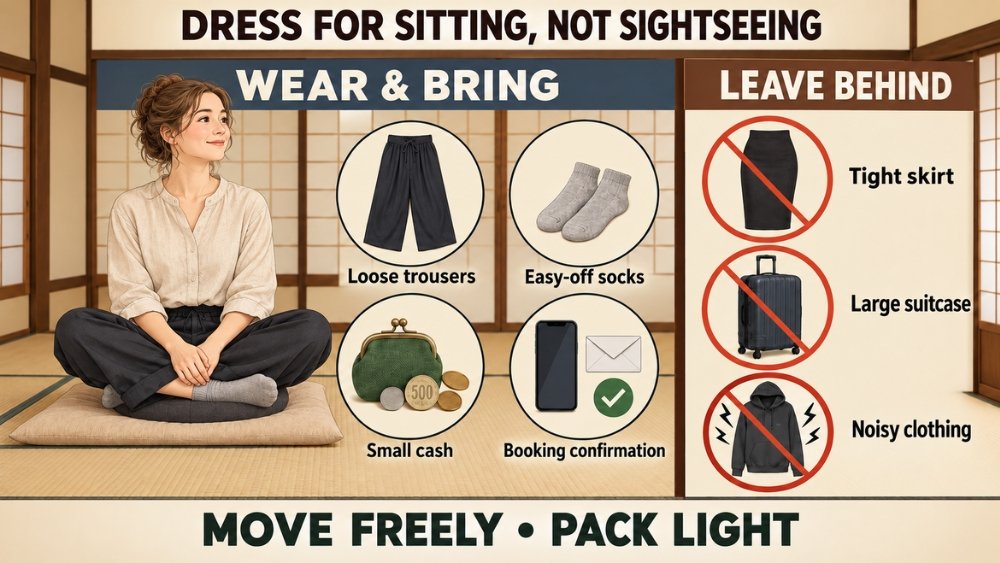
You do not need special robes. You do need clothes that let your hips and knees move without pulling or making noise.
- Wear loose trousers or another flexible lower layer. Nozaki Kannon specifically advises against short, tight skirts.
- Choose socks you are comfortable removing. A temple may ask you to sit barefoot or in socks, so follow the instruction in the room.
- Avoid stiff jeans, noisy waterproof fabric, dangling jewellery and strong fragrance.
- Bring a small bag rather than a large suitcase. None of the three published session pages promises visitor luggage storage; leave large luggage at your hotel or suitable station storage.
- Carry a few small notes and coins. Tenshoji lists card payment, but Nozaki Kannon’s ¥500 temple offering is easiest to handle in cash.
- Keep your booking reply or temple phone note available for a private or confirm-first session.
The Soto Zen guidance recommends avoiding zazen when you are drunk, uncomfortably full or severely exhausted. Eat lightly enough that you can sit without fighting your stomach, but do not turn the morning into a test of hunger. Water before or after the session is sensible; do not carry an open drink into the hall unless the temple permits it.
What happens once you enter the room
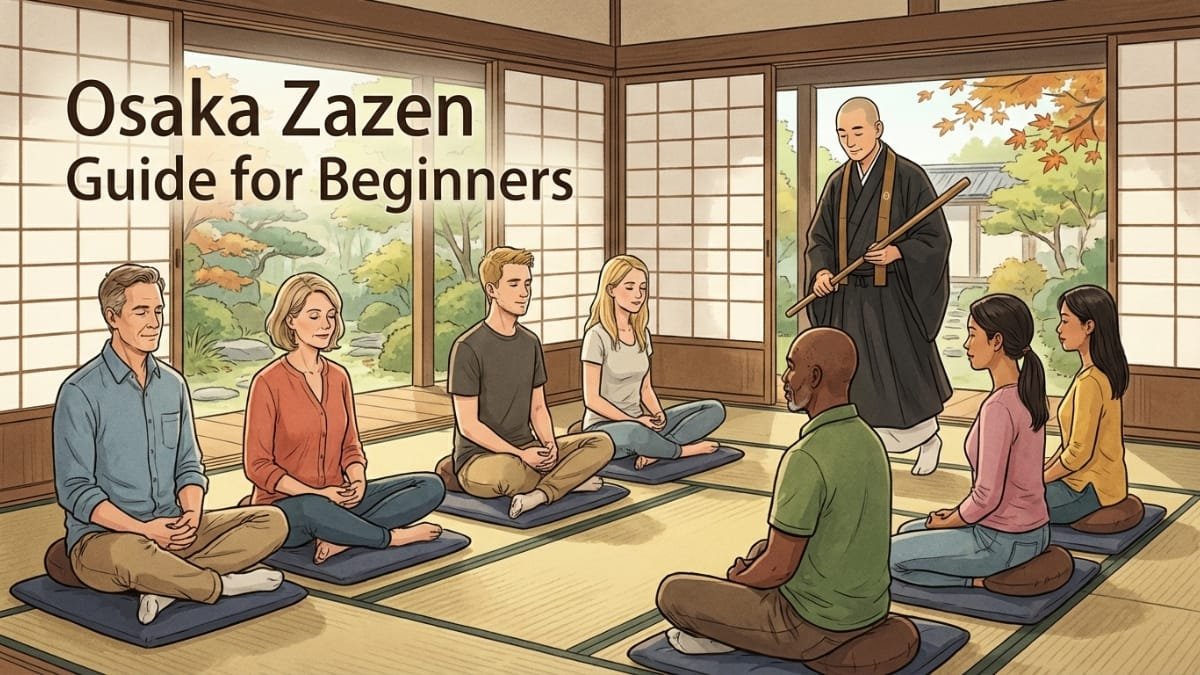
Zazen means seated Zen meditation. A zafu is the round cushion placed under the base of the spine; a zabuton is the larger flat mat under the knees. You are not expected to force a full lotus position. The instructor may offer half lotus, a simpler cross-legged position, kneeling support or a chair.
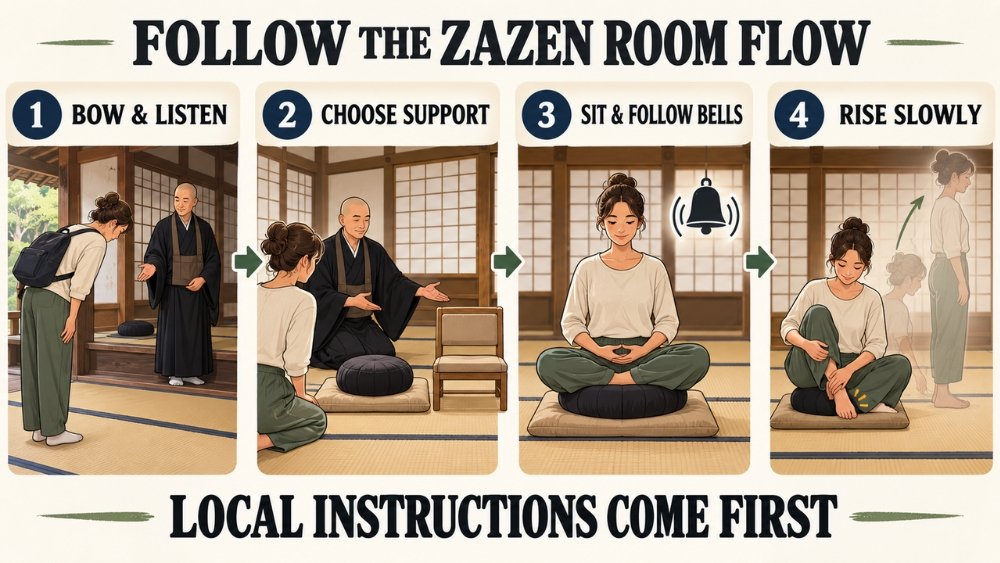
The exact sequence differs by temple and tradition, so the local instructor always takes priority. A typical beginner flow is:
- Enter quietly and copy the room’s bowing instructions. Put your phone completely away rather than leaving it on vibrate.
- Choose the supported posture you can hold. On a cushion, raise the pelvis and let the knees settle; on a chair, sit upright without collapsing into the backrest. Ask for help before the bell, not after pain becomes distracting.
- Set the hands and gaze as shown. Soto guidance commonly uses the cosmic mudra—left hand over right, thumb tips lightly touching—with the eyes softly open and angled down. Another temple may teach a different detail.
- Breathe naturally and return to posture. Zazen is not a contest to empty the mind. Notice distraction, release it and come back to upright sitting.
- Respond to bells and movement cues. Some sessions include kinhin, slow walking meditation. Do not begin moving just because you recognise a bell from an online video; follow the people leading the room.
- Unfold the legs and stand slowly. If a foot is numb, let circulation return before putting full weight on it.
Traditional accounts of Zen sometimes focus on the kyosaku, the flat encouragement stick. Do not assume it will be used, and do not ask another visitor for a demonstration. Current Soto guidance treats it as something received according to the hall’s method, generally by request. Your practical task is simply to follow the instructor.
A chair is a valid option, not a shortcut around every barrier
Chair zazen still uses a deliberate meditation posture. Choose a firm, stable chair without wheels or armrests. Sit far enough forward that your spine supports itself rather than leaning back. Keep the pelvis upright, shoulders relaxed and feet supported; a firm cushion on the seat or under the feet can help when the chair height does not fit.
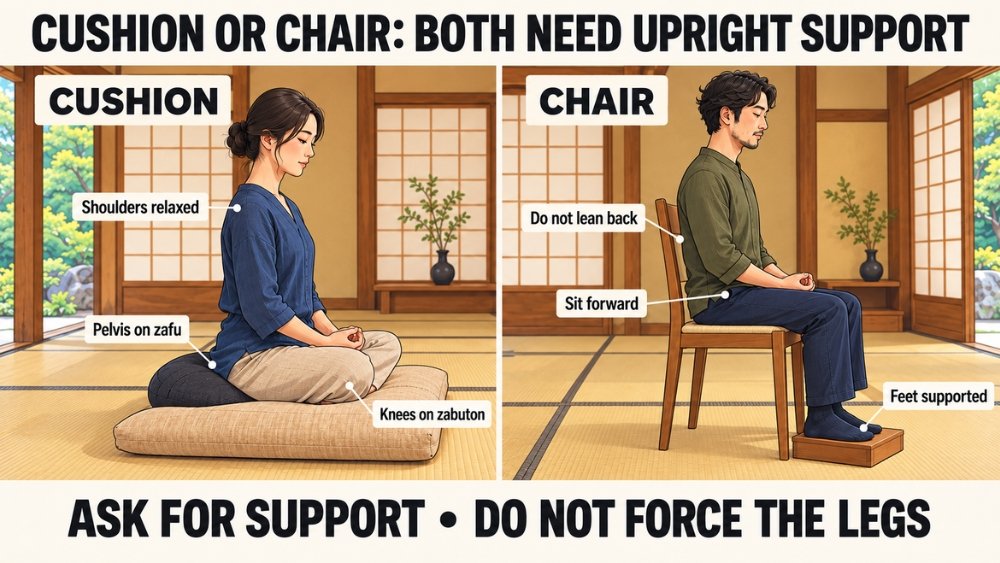
Tell the temple about a chair request in advance whenever booking is required. At a walk-in session, arrive early enough to ask without delaying the group. If pain, dizziness or loss of feeling becomes more than ordinary posture adjustment, stop forcing the position and quietly seek guidance. Zazen is not improved by turning preventable pain into a personal endurance test.
The distinction matters most at Nozaki Kannon: a chair can make the meditation itself possible, while the public-transport approach still includes many stone steps. Assess the whole visit—from station to hall and back—not only the final seated position.
Make one clear choice before you go
Choose Tenshoji if understanding the instructions in English is the deciding factor. Choose Nozaki Kannon if you want an inexpensive, established Sunday session and can manage Japanese-led guidance plus the hillside approach. Choose Shitennoji if its Tennoji location is ideal and you are willing to confirm the next date and participation details directly.
Whichever you choose, arrive early, wear clothes that allow movement, keep your phone silent and let the temple’s instructions override anything you read online. A first zazen session does not require perfect posture or a mystical experience. It requires a workable route, a supported seat and enough attention to follow the room.