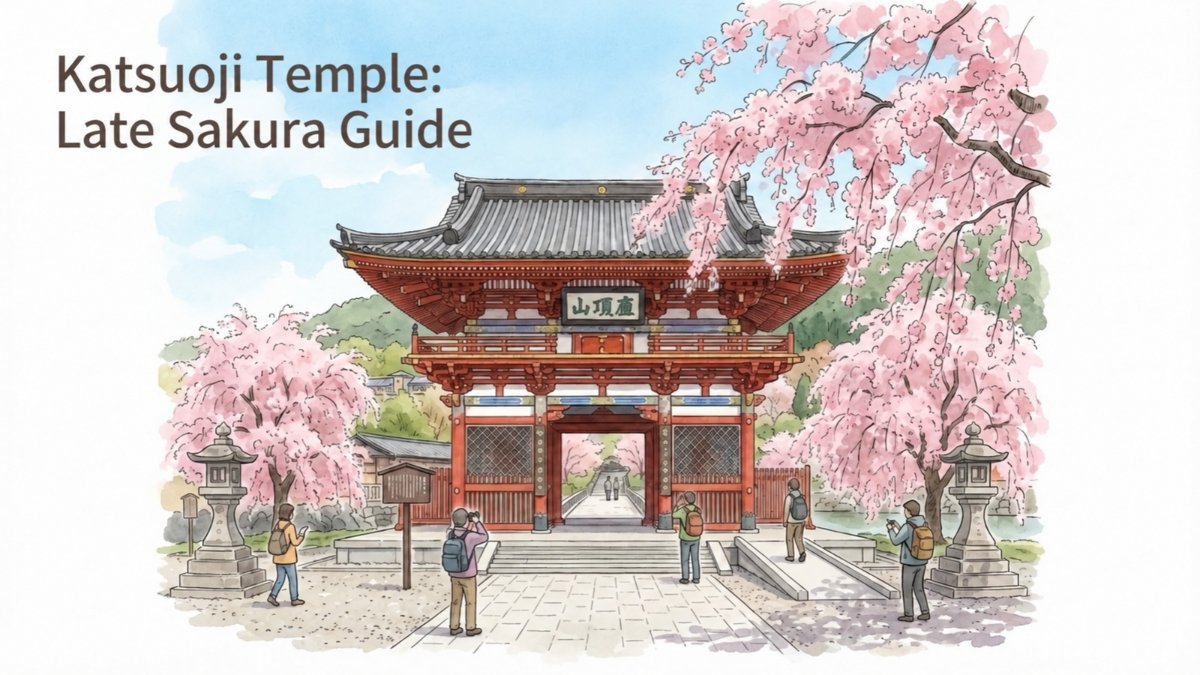
Season update — September 26, 2026: The 2026 cherry blossom season has ended. Katsuoji has not yet announced spring 2027 event details, so do not book a date around an old forecast or assume that a special evening opening will return. The temple’s long-term seasonal guidance, current access rules, hours and admission are set out below; recheck the dated notices before a future spring visit.
Katsuoji is a sensible choice when central Osaka’s peak bloom is finishing and you still want a mountain temple with cherry blossoms. Its own seasonal guide places the usual viewing period from early to late April, later than many lowland spots. The trade-off is logistics: the temple is beyond Osaka’s central rail network, the last part of the journey is by bus or taxi, and weekend drivers need a parking reservation.
If your priority is the broadest choice of easy city locations, start with our guide to Osaka cherry blossom spots. Choose Katsuoji when its later timing, hillside grounds and daruma culture are worth a dedicated half-day.
Separate the reliable pattern from the date you still need to check
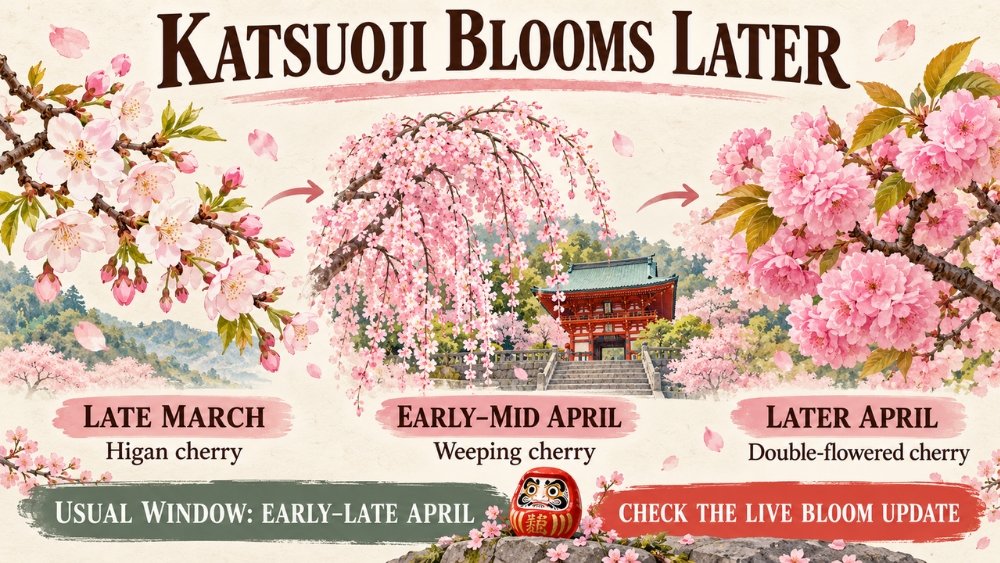
Cherry blossom dates move with the weather. Katsuoji’s official spring page gives a useful sequence rather than a promise for one exact weekend:
| What usually happens | Practical meaning |
|---|---|
| Higan cherry trees begin around late March | A few early trees do not mean the whole site is at peak bloom. |
| Weeping cherries follow in April | Early to mid-April can produce the classic combination of temple buildings and hanging blossom branches. |
| Double-flowered cherries bloom later | A later April visit can still work after simpler varieties have begun to fall. |
| Official general window: early to late April | Treat this as a planning range, then check current photos and notices close to your date. |
The mountain setting is the reason Katsuoji can bloom after central Osaka, but it is not insurance against an unusually warm spring, wind or heavy rain. Check the official spring page and the latest dated notice shortly before you travel. If the blossoms are the main reason for the journey, look again two or three days before departure rather than relying on a forecast saved weeks earlier.
Build the visit around the bus, not the photograph
The most straightforward public-transport route is:
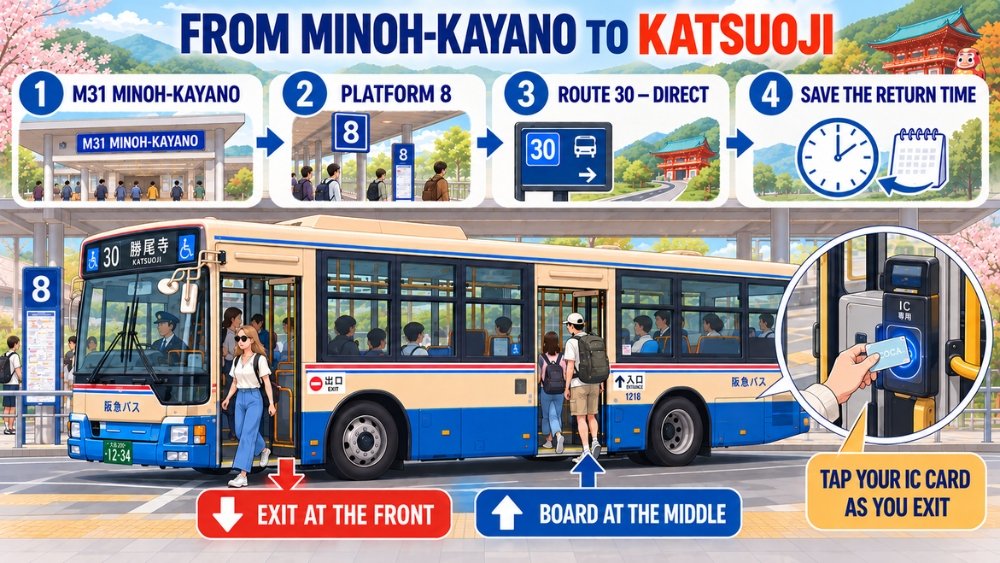
- Take a northbound Osaka Metro Midosuji Line/Kita-Osaka Kyuko service to Minoh-Kayano Station (M31). Check the train’s destination display; change trains if your service does not continue to Minoh-Kayano.
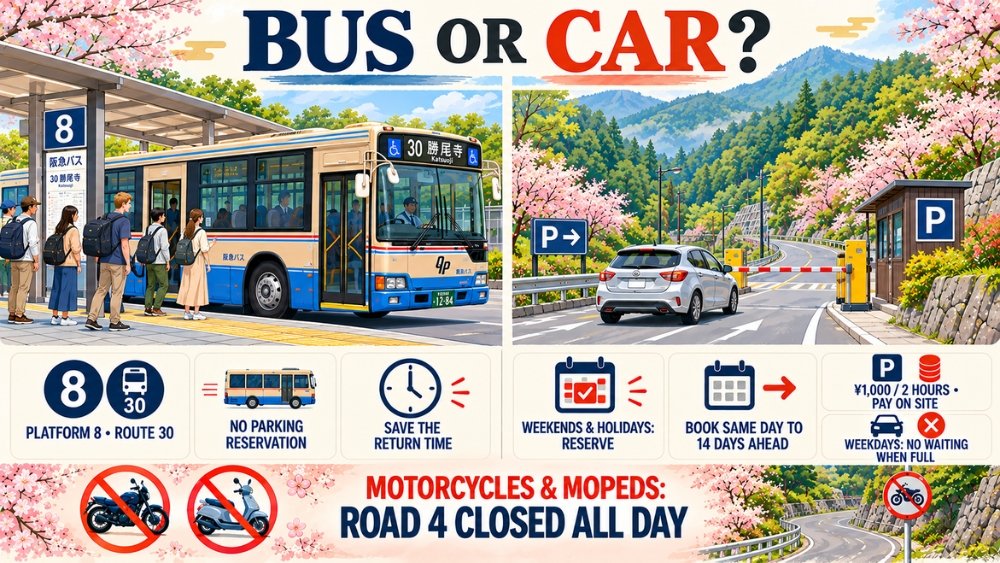
- Follow signs to the bus area and use platform 8.
- Board Hankyu Bus route 30 for Katsuoji. It is a direct service with no intermediate stops.
- Save the return timetable before entering the temple. Mobile reception, crowds and a low battery are poor reasons to miss the final bus.
Katsuoji’s current Japanese access page shows outbound departures from 9:00 through 14:50 at 10-minute intervals, plus 15:00, with additional direct buses operated every five to ten minutes when demand requires. Hankyu Bus separately publishes a smaller base timetable and labels extra follow-on buses without fixed times. That difference matters: frequent spring service can make the queue move faster, but it is not a guarantee that a bus will leave at every imagined minute. Check both the temple’s current access page and the Hankyu Bus platform and timetable page on the day.
For the return journey, the current 2026 route 30 timetable lists 17:05 as the last bus to Minoh-Kayano. Do not carry that time forward into 2027 without checking again. Photograph or screenshot the current return schedule at the stop, and aim for an earlier departure if you have a reserved train or dinner.
An IC card is a rechargeable transit card such as ICOCA, Suica or PASMO. Hankyu Bus accepts major interoperable IC cards. On a standard Hankyu Bus, board through the middle door, then leave through the front and tap or pay at the fare box near the driver. If you need a primer before the trip, see our ICOCA guide for Osaka. Carry some yen as backup and keep the card separate from other contactless cards when tapping.
A taxi takes about 15 minutes from Minoh-Kayano according to the temple. It can be useful for a small group or for one direction when the bus queue is long, but you should still plan the return instead of assuming a taxi will be waiting at closing time.
Hours, admission and the first decision at the gate
Current regular visiting hours are:
- Weekdays, Sundays and public holidays: 8:00–17:00, final admission 16:30
- Saturdays: 8:00–18:00, final admission 17:30
Admission is ¥500 for high-school students and adults, ¥400 for elementary and junior-high students, ¥100 for preschool children, and free for children aged two and under. Katsuoji offers a web admission ticket so you can bypass the ticket-office queue. Keep the ticket available on your phone and make sure the screen is bright enough to show it at the entrance.
The official English guide mentions extended hours on special light-up days. That does not mean spring illumination happens on a fixed schedule. Unless Katsuoji publishes a dated announcement for your visit, plan around normal closing time and daylight.
Let the grounds unfold in order
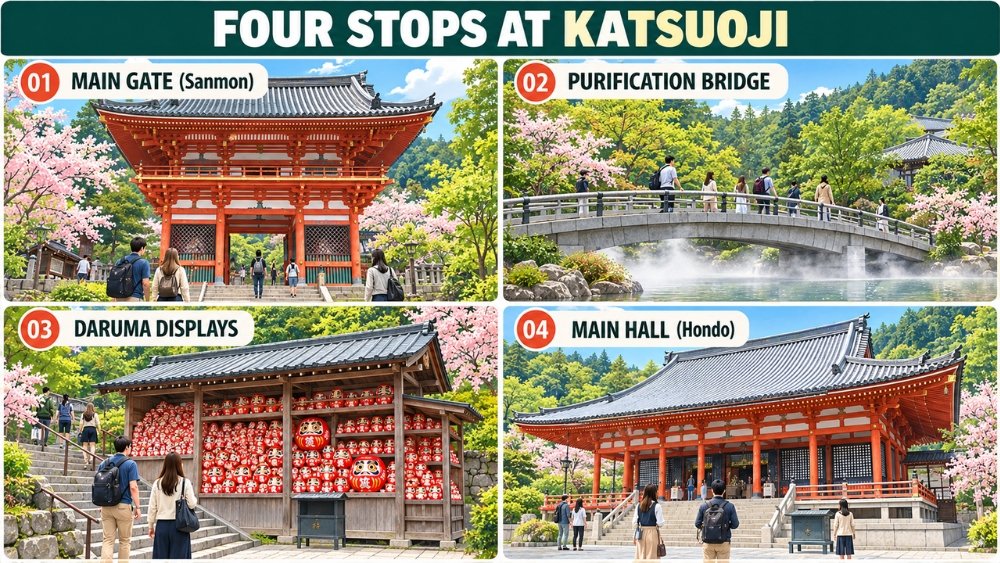
Katsuoji is not only a blossom backdrop. The official grounds map places the main gate and purification bridge near the entrance, followed by the climbing temple precincts, daruma displays, the main hall and the pagoda area. A practical visit is to keep moving upward, pause at the worship areas without blocking the route, then use the descent for the views you skipped on the way in.
Expect gray stone steps and paths, slopes, patches of moss and changing surfaces. Cherry branches and small red daruma appear against dark timber, white plaster and vermilion temple structures. The contrast is part of the place, but the grounds are a working Buddhist temple. Keep entrances and prayer spaces clear, and avoid turning a daruma shelf or stairway into a long portrait setup.
The temple is associated with kachi-daruma, or “winning daruma.” Its English guide explains the custom as a commitment to work toward a goal, not a figure that grants a wish by itself. A visitor receiving a Kachi-Daruma writes a goal and fills one eye; after achieving the goal, the other eye is completed and the daruma can be returned for dedication. The smaller daruma mikuji contain words of guidance and may be taken home or placed in an allowed area of the grounds.
Allow time to understand what you are seeing instead of treating every red figure as decoration. If you buy or receive a daruma, follow the temple’s instructions rather than copying an abbreviated ritual from social media.
Driving requires a decision before you leave Osaka
Private-car parking costs ¥1,000 for two hours. On Saturdays, Sundays, public holidays and designated peak dates, it is reservation-only; a vehicle without a reservation cannot park. The current system opens reservations from the same day through 14 days ahead. There is no separate reservation fee, and the parking charge is paid on site.
On ordinary weekdays, no reservation is required, but cars cannot wait at the entrance when the lot is full. That rule removes the tempting fallback of “we will queue nearby.” If the lot status is uncertain, use public transport.
Motorcycles and mopeds are not an alternative: the section of Osaka Prefectural Road 4 in front of Katsuoji prohibits them all day. The temple also has a priority parking area for visitors who need barrier-free access; tell the guard on arrival and state the need when making a reservation on a reservation-required day.
Plan for a mountain temple, not a flat city park
Wear shoes that can handle stone steps and damp surfaces. Spring temperatures can feel cooler than central Osaka, especially early in the morning, after rain or while waiting for the bus. A light layer and a compact rain cover are more useful than carrying a large bag through the grounds.
The bus and station have accessible features, and Katsuoji provides a priority parking area, but the historic grounds include slopes, steps and uneven paths. A low-floor bus icon confirms the vehicle type, not that every part of the temple will be step-free. If stairs or walking distance will determine whether the visit works, contact the temple with your specific needs before setting out.
Food and drink should not drive the schedule. Eat before the last transport leg or bring only what you can carry discreetly, and follow posted rules inside the precincts. Do not rely on finding luggage storage at the temple; leave suitcases at your hotel or a station locker before the trip.
A low-stress spring plan
For a future cherry blossom visit, choose a flexible date in Katsuoji’s usual early-to-late-April window, then confirm the bloom and any special opening on the official site. Travel to Minoh-Kayano early enough to absorb a bus queue, save the return timetable, and enter with either a web ticket or enough time for the admission line. Drivers should secure the required parking reservation before leaving the city.
Katsuoji works best as the purpose of the half-day, not as a hurried add-on after several central Osaka stops. The later blossoms may be what brings you there, but the visit is stronger when you leave room for the mountain setting, worship spaces and daruma tradition as well.
Useful links: Katsuoji official site · current access, hours and fees · Katsuoji on Google Maps