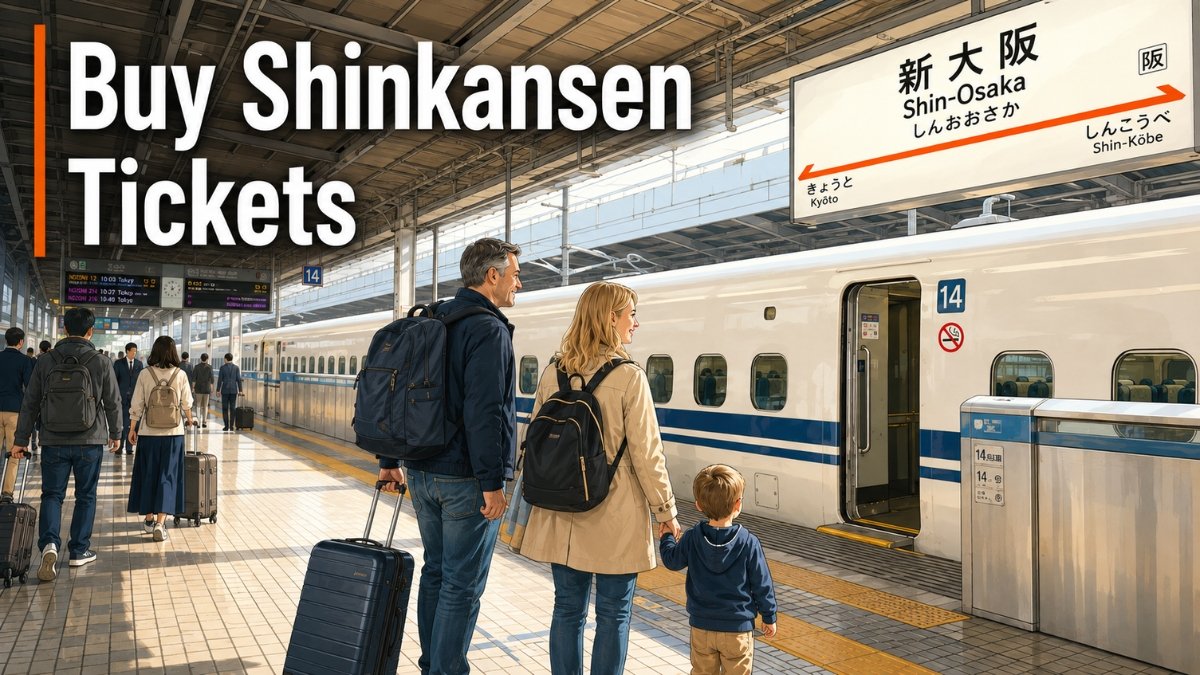
Buying a Shinkansen ticket in Osaka is straightforward once you separate two decisions: where to buy and what ticket you need.
First, go to Shin-Osaka Station, not Osaka Station in Umeda. Shin-Osaka is Osaka’s Shinkansen station. From there, you can buy at a staffed ticket office or an eligible ticket machine, or arrive with an online booking from Klook, SmartEX, or JR-West Online Train Reservation.
Quick answer: Use a station counter when your route is complicated or you want a person to check it. Use SmartEX for the official Tokaido–Sanyo–Kyushu booking flow. Use JR-West’s online service for supported westbound journeys and relevant pass products. Use Klook when its route inventory and checkout are the most convenient for you—but confirm whether your exact product uses a QR ticket or requires paper-ticket pickup.
Compare current Shinkansen routes on Klook after fixing your travel date, departure station, destination, and luggage needs.
Where to buy Shinkansen tickets in Osaka
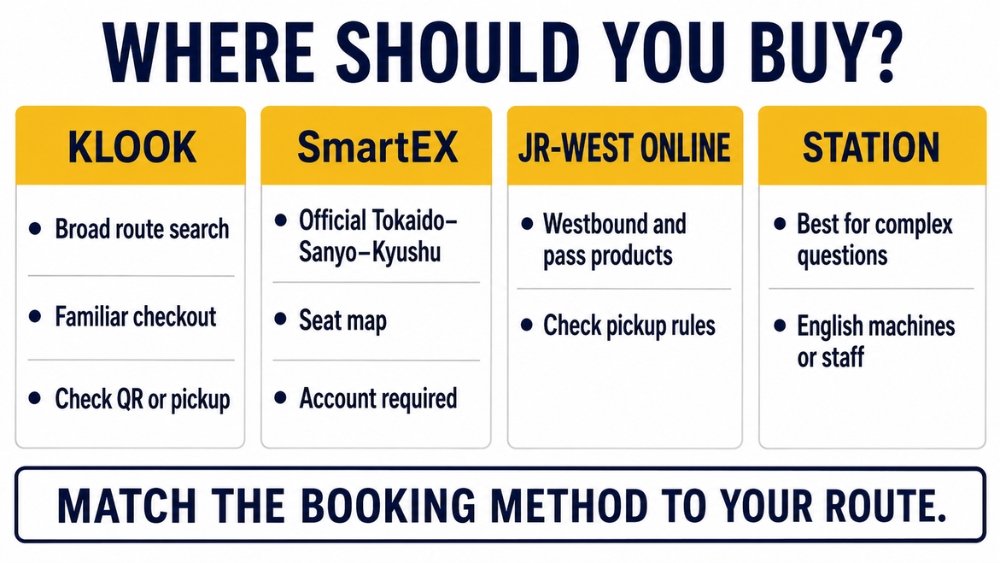
No single method is best for every traveler. The safest choice depends on your route, payment setup, need for staff help, and whether you want a QR ticket or a paper ticket.
| Buying method | Best for | Main strength | Check before paying |
|---|---|---|---|
| Klook | Travelers comparing supported routes in a familiar booking interface | Broad journey search and advance booking | Whether the specific product uses QR boarding or paper pickup |
| SmartEX | Tokaido, Sanyo, and Kyushu Shinkansen journeys covered by the service | Official booking, seat map, and QR boarding | Account registration, card compatibility, and product-change rules |
| JR-West Online Train Reservation | Supported westbound journeys and relevant JR-West products | Official route and product access | Pickup location, pickup deadline, and whether the payment card must be presented |
| Shin-Osaka ticket machine | Straightforward same-day or advance purchases | English menus and immediate paper tickets | That the machine supports the ticket and payment method you need |
| Shin-Osaka staffed counter | Complex itineraries, rail-pass questions, or travelers who want confirmation | Staff can build and explain the ticket combination | Allow extra time for a queue |
Booking and boarding conditions can change. Recheck the exact operator or seller page before purchase, especially for pickup, changes, refunds, supported cards, and QR use.
Osaka Station and Shin-Osaka are different stations
This is the mistake to avoid before anything else.
- Osaka Station is the large JR hub in Umeda for local and regional trains. The Tokaido and Sanyo Shinkansen do not stop there.
- Shin-Osaka Station is the Shinkansen station. It also connects with regular JR trains and the Osaka Metro Midosuji Line.
If you are staying around Umeda, travel from Osaka Station to Shin-Osaka on a regular JR train before your Shinkansen departure. Do not search the Osaka Station concourse for a Shinkansen platform.
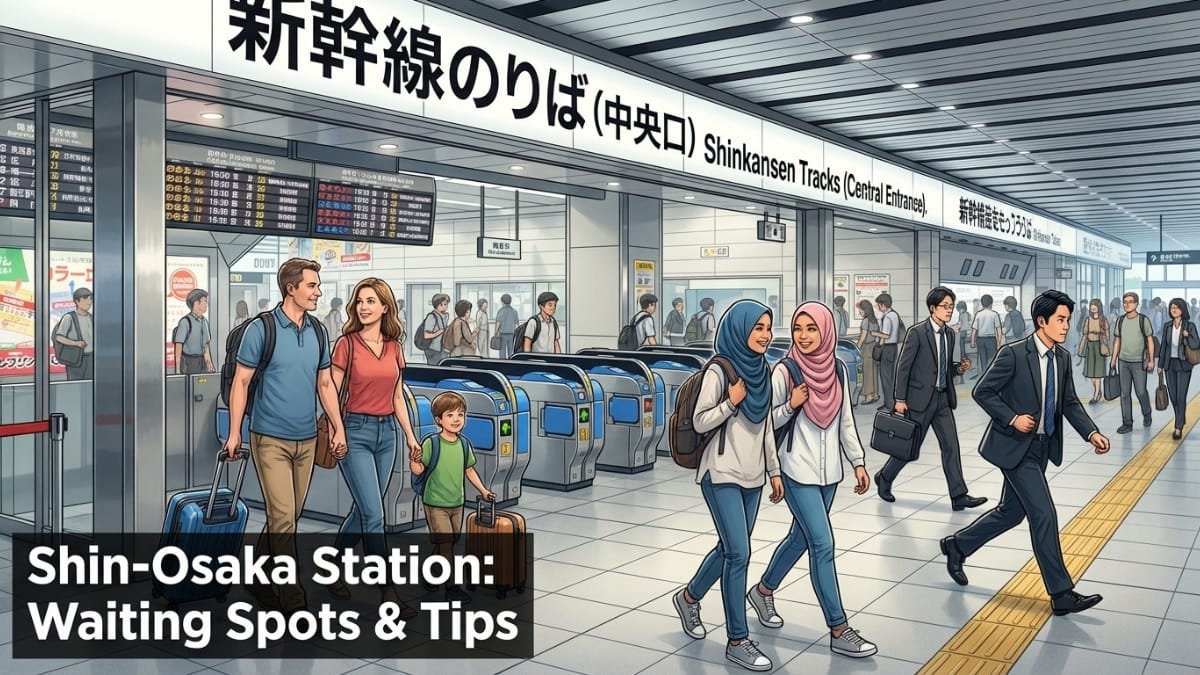
If you arrive early, the Shin-Osaka waiting guide explains the main concourse and practical places to spend the time before boarding.
Option 1: buy at Shin-Osaka Station
Buying at the station is the most reassuring option when the route is complicated, the online payment fails, or you want help with a connection.
Buy from a ticket machine
Eligible reserved-seat ticket machines have English-language menus. For a standard booking, prepare:
- departure station;
- destination;
- travel date;
- approximate departure time;
- preferred train;
- reserved or non-reserved seating;
- ordinary car or Green Car;
- number of adults and children;
- oversized-baggage requirement, if applicable.
Follow the screen through route, train, seat, and payment selection. Before confirming, check the date, origin, destination, train number, departure time, car, seat, and passenger count.
Machines vary by location and ticket type. If the screen does not offer the journey or product you need, cancel the transaction and use the staffed counter instead of guessing.
Buy from a staffed counter
A staffed counter is useful when you have:
- a multi-leg journey;
- a tight connection;
- a rail pass or discount product;
- children in the group;
- a large suitcase requiring a special seat;
- an accessibility request;
- uncertainty about which ticket pieces are required.
Write the route and preferred departure time on your phone before joining the queue. Ask for a later train if the remaining transfer time feels too short.
Option 2: book with SmartEX
SmartEX is the official online reservation service for the Tokaido, Sanyo, and Kyushu Shinkansen. It supports advance booking, seat selection through a seat map, and boarding by a registered IC card or the service’s QR ticket, subject to the product and account setup.
If you are new to Japan, an IC card is a rechargeable tap-to-pay transit card used for trains, subways, buses, and some everyday purchases. Common examples include ICOCA in the Osaka/Kansai area and Suica or PASMO in the Tokyo area.
SmartEX allows compatible IC cards such as ICOCA, Suica, and PASMO to be registered for Shinkansen boarding. Visitor-oriented IC cards such as Welcome Suica and PASMO PASSPORT can also be registered.
SmartEX is a strong choice when:
- your journey is within its supported network;
- you can complete account registration;
- your payment card works with the service;
- you want to manage the reservation directly;
- you understand the selected product’s change and refund conditions.
Registering an IC card with SmartEX lets you use that card to pass through the Shinkansen ticket gate, but the IC card balance does not pay for the SmartEX Shinkansen reservation. The Shinkansen ticket is purchased through SmartEX, and the registered IC card simply works as your boarding credential.
If you use a visitor-oriented IC card such as Welcome Suica or PASMO PASSPORT, check its validity period before travel. An expired card cannot be used for SmartEX IC card boarding. SmartEX also notes that some visitor cards purchased overseas may need to be used once at a PASMO or Suica-area ticket gate before they can be used to board the Shinkansen.
If you use a SmartEX QR ticket, scan it at a QR-marked Shinkansen gate and collect the printed seat-information slip. At a transfer gate from a local line, the exact sequence depends on whether you used an IC card or a paper local ticket; follow the official QR boarding instructions rather than improvising at the gate.
Option 3: use JR-West Online Train Reservation
JR-West Online Train Reservation is JR West’s English-language booking service. For travelers in Osaka, it is especially useful when heading west from Shin-Osaka on the Sanyo Shinkansen, for example to Okayama, Hiroshima, or Hakata. It also handles JR-West rail passes and some discounted products.
The main difference from SmartEX is that most regular bookings through this service require you to collect a physical ticket before boarding. At Shin-Osaka and many other JR-West stations, look for a reserved-seat ticket machine displaying the 5489 mark, or use a JR Ticket Office (Midori-no-madoguchi).
If you paid online by credit card, bring the same physical credit card you used for the reservation. A virtual card on its own cannot be used for ticket pickup. At a ticket machine, you will also need your reservation details and the four-digit identification number you created when booking. Some discounted tickets may additionally require your passport.
A simple first-time workflow is:
- Book your train online.
- Save the reservation confirmation and pickup details.
- Arrive at the station with a little extra time.
- Find a ticket machine with the 5489 mark.
- Choose “Receive reserved ticket” → “JR-WEST ONLINE TRAIN RESERVATION.”
- Insert the physical credit card used for payment and enter the requested reservation details.
- Collect all issued tickets before going through the Shinkansen gate.
If the machine cannot issue your particular ticket, go to the JR Ticket Office instead. Ticket pickup locations can vary by product, especially for special discounted tickets, so check the official receiving instructions before travel.
In short: booking online with JR-West does not usually mean that your phone becomes the Shinkansen ticket. Think of the website as the place where you reserve and pay, and the station machine as the place where you collect the tickets you will actually use.
Option 4: buy through Klook
Klook lists Shinkansen journeys across Japan and can be practical when you prefer its route search and checkout. For many listed journeys, a QR ticket may be available; other products require paper-ticket pickup. The product page and confirmation determine the correct method.
Check Shinkansen tickets on Klook only after confirming the station names, train date, seat type, and baggage requirement.
Before completing the booking, verify:
- station: Shin-Osaka is not Osaka Station;
- route: the origin and destination match your plan;
- date: Japan time and the correct travel day are shown;
- train: the selected service stops at your destination;
- seat: non-reserved, reserved, or Green Car;
- baggage: an oversized-baggage seat is selected when required;
- delivery: QR boarding or paper pickup;
- changes and refunds: the exact product conditions.
Never rely on a generic promise about QR boarding. Read the instructions attached to the exact route and product you purchased.
What a Shinkansen fare includes
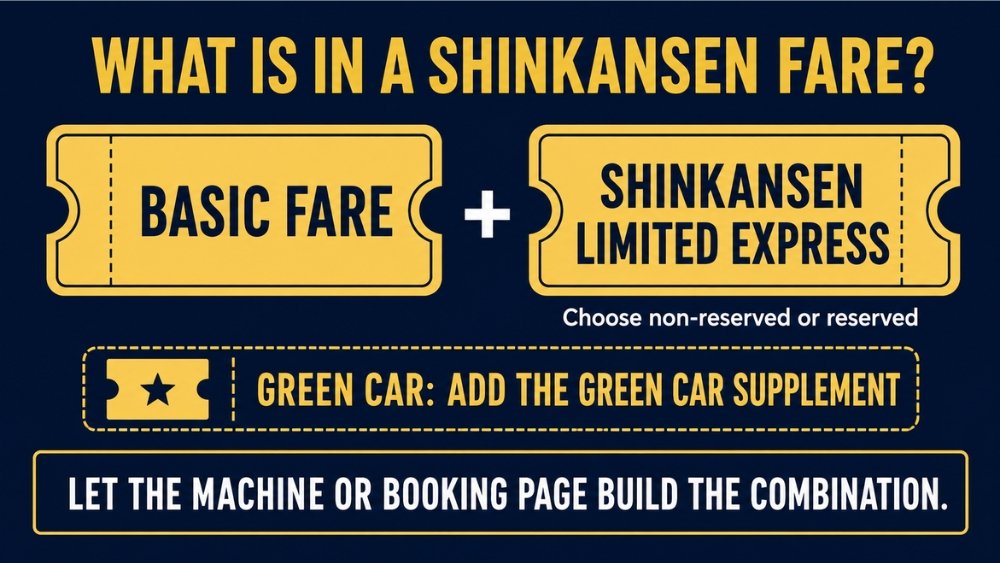
A Shinkansen journey normally combines:
- a basic fare for travel between the origin and destination; and
- a Shinkansen limited-express charge for using the high-speed train.
Within the limited-express choice, you select non-reserved or reserved seating when available. A Green Car journey also adds the applicable Green Car supplement.
The paper output may be one ticket or multiple tickets depending on how and where it was issued. Do not discard a ticket simply because another ticket shows the seat. Insert the required pieces together when the gate instructions tell you to do so.
Reserved, non-reserved, or Green Car?
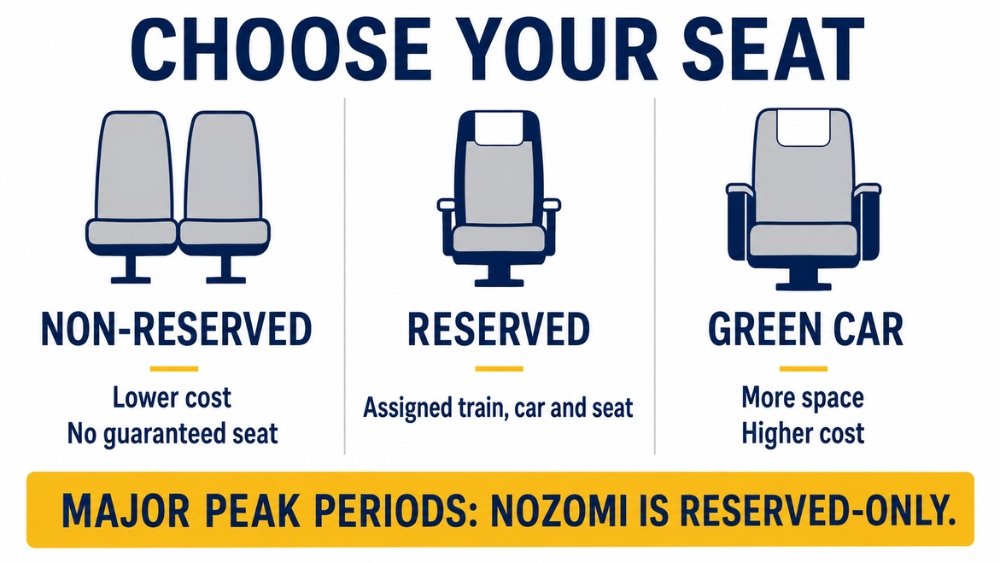
Non-reserved seat
A non-reserved ticket lets you use the designated non-reserved cars on an eligible service without an assigned seat. It offers flexibility, but a seat is not guaranteed. You may need to stand or wait for another train when cars are crowded.
Choose it when your schedule is flexible, the train permits non-reserved travel, and you are comfortable managing the queue for the correct car.
Reserved seat
A reserved ticket assigns a specific train, car, and seat. It is the safest default for first-time visitors, families, groups, busy travel dates, and anyone connecting to another service.
Choose it when certainty matters more than last-minute flexibility.
Green Car
The Green Car is the premium cabin. It generally offers more personal space and a quieter environment at a higher fare. It is not automatically faster; the train service and stopping pattern determine journey time.
Nozomi, Hikari, and Kodama: which train should you choose?
On the Tokaido Shinkansen between Shin-Osaka, Kyoto, Nagoya, and Tokyo:
- Nozomi has the fewest stops and is usually the fastest option;
- Hikari makes more stops than Nozomi;
- Kodama stops at every station and is normally the slowest of the three.
The fastest label is not the only factor. Check whether the train stops at your destination, whether your ticket or pass permits that service, and how much connection time remains.
During designated major peak periods, all Nozomi seats on the Tokaido and Sanyo Shinkansen are reserved-only. There are no non-reserved Nozomi cars during those periods. Check the current official peak-period notice before holiday travel.
Oversized baggage rules
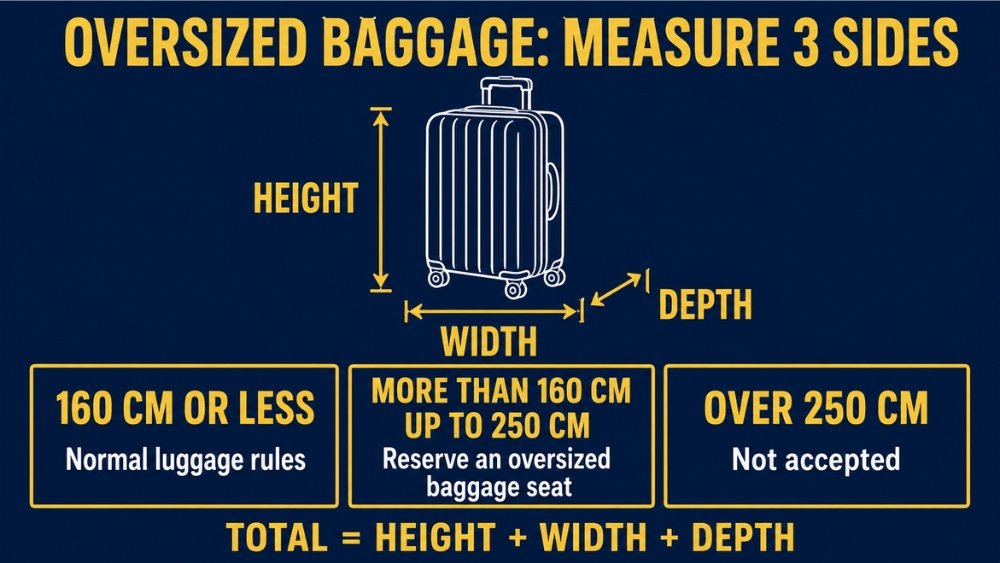
On the Tokaido, Sanyo, and Kyushu Shinkansen, baggage with combined external dimensions of more than 160 cm and up to 250 cm requires a seat with an oversized-baggage area. Add height, width, and depth, including wheels and handles.
Reserve the correct seat before boarding. Non-reserved cars do not provide the designated oversized-baggage area. Baggage with total dimensions over 250 cm is not accepted on these trains.
The rule is based on dimensions, not merely the word “large.” A normal suitcase may still fall below the threshold. Measure it before buying the ticket and read the official oversized-baggage instructions.
How to pass through the Shinkansen gate
Use the method attached to your ticket. Do not mix instructions from a different seller or product.
Paper tickets
At a Shinkansen gate, insert every paper ticket the gate requires together. Walk through and collect all returned tickets immediately. Keep them until you exit at the destination.
At a transfer gate between a local JR line and the Shinkansen, the gate may process the local ticket and Shinkansen tickets in one sequence. If unsure, use the staffed lane.
SmartEX QR ticket
Use a gate displaying the QR symbol. Scan the live QR code, pass through, and collect the seat-information slip. Keep the QR available until the journey is complete.
Registered IC card with SmartEX
Touch the registered IC card linked to the reservation. Collect the seat-information slip. The IC card is the credential for the booking; the stored-value balance does not replace the separately purchased Shinkansen reservation.
For local travel before or after the Shinkansen, an IC card is still useful. The ICOCA guide explains normal tap-in and tap-out use around Osaka.
Klook booking
Follow the confirmation for the exact product. If it provides a valid QR ticket, use the stated QR gate flow. If it requires pickup, collect the paper ticket before approaching the gate. Save the confirmation offline, but remember that a saved confirmation image is not a substitute for a live QR ticket when live display is required.
How early should you arrive at Shin-Osaka?
There is no single arrival buffer for every traveler. Build extra time when you need to:
- buy or collect tickets;
- find the Shinkansen concourse for the first time;
- transfer from Osaka Station or Osaka Metro;
- buy food;
- use a locker;
- reserve an oversized-baggage seat;
- travel with children or a group;
- solve a payment or pickup problem.
If the ticket is already ready and you know the station, the process is faster. If you must collect paper tickets or speak with staff, arrive substantially earlier than the minimum needed to reach the platform. Shin-Osaka can be busy, and a queue is not a reason for a train to wait.
Traveling directly from the airport on the same day adds another risk. Use the Kansai Airport to Osaka guide and avoid building a tight, non-refundable connection after an international arrival.
Common Shinkansen ticket mistakes in Osaka
Going to Osaka Station instead of Shin-Osaka
The Shinkansen departs from Shin-Osaka. Confirm the station name before leaving your hotel.
Booking the right city but the wrong station
Route search results may show several Osaka-area stations. Match the booking to the station printed in your itinerary.
Assuming every online ticket is phone-only
Some products use a QR ticket; others require paper pickup. Read the delivery instructions before payment.
Treating an IC card as the full Shinkansen ticket
An IC card can be linked to certain online reservations, but tapping a normal stored-value card alone does not create a Shinkansen reservation.
Ignoring oversized baggage until boarding
Measure before booking. The required space is tied to a specific reserved seat.
Choosing a tight connection
Shin-Osaka involves gates, corridors, escalators, and platform changes. Leave time for navigation and queues.
Discarding one of several paper tickets
A paper booking may produce separate fare and Shinkansen components. Keep every issued ticket until the journey is finished.
Final verdict: the easiest way to buy Shinkansen tickets in Osaka
Choose the Shin-Osaka staffed counter if your itinerary is complicated, your online payment fails, or you want a person to verify the ticket and connection.
Choose SmartEX if you want the official Tokaido–Sanyo–Kyushu online booking flow, can complete the account setup, and are comfortable following its QR or IC-card boarding instructions.
Choose JR-West Online Train Reservation for supported westbound journeys or relevant JR-West products when you have checked the pickup and payment-card requirements.
Choose Klook when its supported route, checkout, seat options, and stated QR-or-pickup method fit your trip.
Whichever method you choose, verify the date, station, train, seat, baggage rule, delivery method, and change conditions before paying. That final check prevents most expensive mistakes.