The best route from Kansai International Airport (KIX) to Osaka depends on your hotel—not simply the fastest train on a timetable.
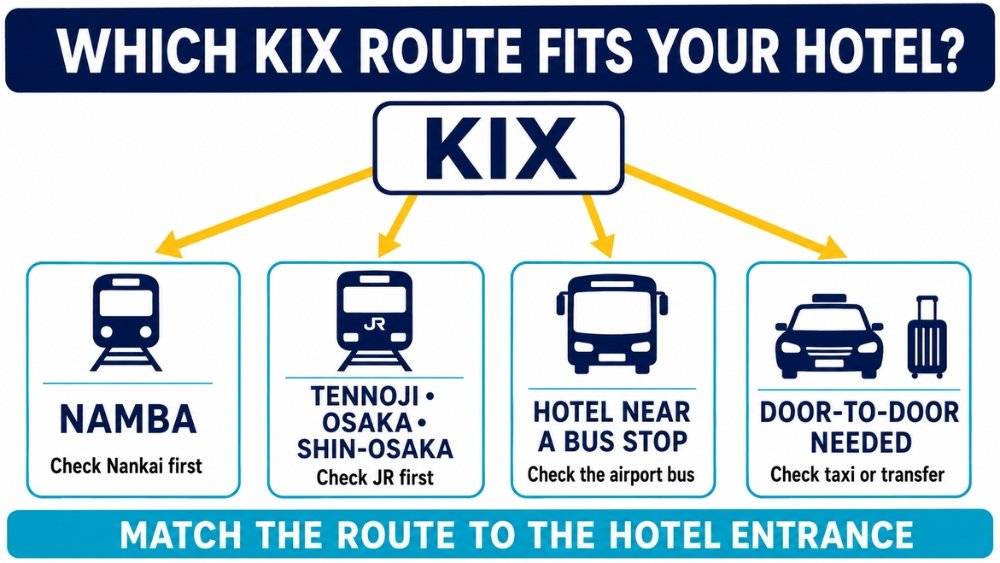
- Take Nankai Railway for Nankai Namba, Dotonbori, Shinsaibashi, and much of south-central Osaka.
- Take JR for Tennoji, Osaka Station/Umeda, and Shin-Osaka.
- Take an airport limousine bus when your hotel is close to its actual stop and you want luggage stored below the bus.
- Consider a taxi or pre-booked transfer for a late arrival, several large bags, young children, reduced mobility, or a hotel far from a useful station.
Before buying anything, confirm three details: your arrival terminal, your hotel’s exact nearest station or bus stop, and the last service that still works after immigration and baggage claim.
KIX to Osaka at a glance
| Osaka destination | Strong first choice | Why it works | Check before choosing |
|---|---|---|---|
| Namba / Dotonbori / Shinsaibashi | Nankai Railway | Direct trains to Nankai Namba | Your hotel may be closer to JR Namba, Osaka-Namba, or another subway station |
| Tennoji / Abeno | JR | Direct JR airport services | Limited-express and rapid-service ticket rules differ |
| Osaka Station / Umeda | JR or airport bus | Rail access to Osaka Station; buses serve specific Umeda stops | Umeda is a large district, so compare the final walk |
| Shin-Osaka | JR HARUKA | Direct limited-express service on relevant departures | Check the current timetable and your Shinkansen connection buffer |
| Universal City / USJ area | Airport bus when the timetable fits | Avoids a multi-train luggage transfer | The route may not match every flight arrival |
| Hotel far from a station | Taxi or private transfer | Door-to-door travel | Confirm the total price, pickup instructions, luggage capacity, and late-night terms |
Times, fares, routes, and product conditions can change. Use this table to choose the transport type, then confirm the exact departure on the operator’s first-party page.
First: identify your terminal
Terminal 1 is connected to Kansai Airport Station by a pedestrian bridge from the terminal’s second floor. Both JR and Nankai use the station, but they have separate ticket gates.
Terminal 2 is not connected directly to the railway station. The airport operates a free shuttle between Terminal 2 and Aeroplaza. The airport currently states a typical shuttle journey of 7–9 minutes, but you also need time to wait, load luggage, and walk to the station.
Do not plan a tight rail connection from Terminal 2. Check the airport’s Terminal 2 shuttle information before travel.
Nankai Railway: usually best for Namba
Nankai trains run from Kansai Airport Station to Nankai Namba Station. This is usually the cleanest first choice for hotels around central Namba, Dotonbori, Nipponbashi, and southern Shinsaibashi.
Nankai offers two different airport-train experiences.
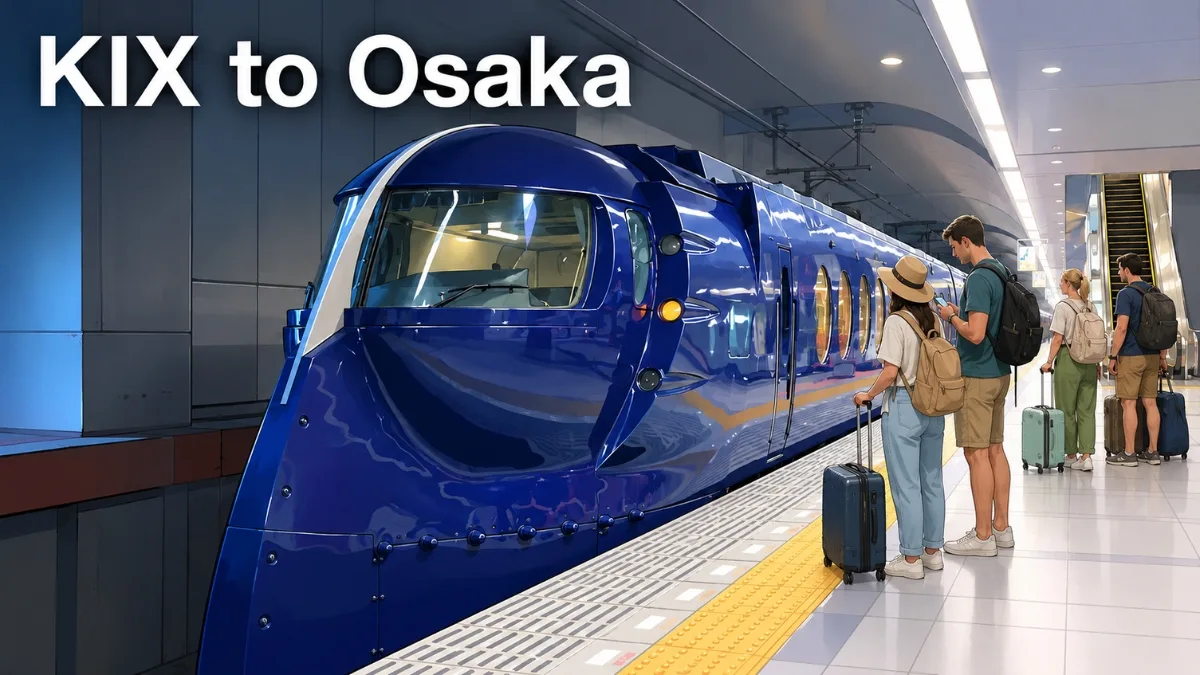
Rapi:t: reserved seat and predictable luggage space
The Limited Express Rapi:t provides reserved seating between Kansai Airport and Namba. Nankai currently advertises a minimum journey time of 34 minutes.
Choose Rapi:t when:
- you want a reserved seat after a long flight;
- you have a suitcase and prefer not to stand on a commuter-style train;
- Nankai Namba is genuinely convenient for your hotel;
- the next departure fits your arrival time.
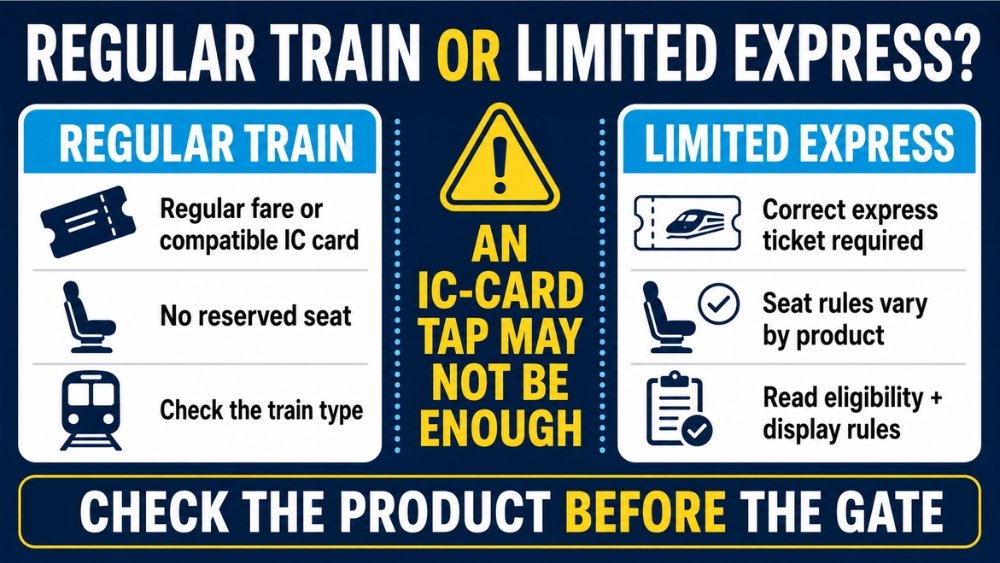
A basic IC-card tap alone is not the complete ticket for a limited-express reserved seat. Confirm the current product, eligibility, boarding method, and ticket display rules on the official Nankai Rapi:t page.
After checking those conditions, compare the current Nankai Rapi:t ticket on Klook.
Airport Express: regular train with no seat reservation
The Nankai Airport Express also runs to Nankai Namba, but it is a regular service without reserved seating. It can suit travelers who prioritize a simpler regular fare and do not mind the possibility of standing or sharing space with commuters.
Choose it when:
- you have manageable luggage;
- you do not need a reserved seat;
- you prefer to use a regular ticket or accepted IC cards (ICOCA, Suica, PASMO, etc.)
- you are comfortable checking the train type before boarding.
Do not confuse “Airport Express” with Rapi:t. The train, seat rules, and required ticket are different.
JR: best for Tennoji, Osaka Station, and Shin-Osaka
JR and Nankai leave from the same airport station building but use different gates. JR is normally the first network to check for hotels near Tennoji, Osaka Station/Umeda, or Shin-Osaka.
HARUKA: limited express for a direct, reserved-seat-friendly journey
The Kansai-Airport Express HARUKA serves Tennoji, Osaka, Shin-Osaka, and destinations beyond Osaka on applicable departures. The airport’s current access guide lists approximate journey times of 30 minutes to Tennoji and 50 minutes to Shin-Osaka; actual trips depend on the departure and operating conditions.
Choose HARUKA when:
- you are going to Tennoji, Osaka Station, or Shin-Osaka;
- a direct limited-express departure fits your schedule;
- you want to reduce transfers with luggage;
- you understand the ticket and seat conditions of the product you buy.
JR West sells several ticket types. Its discounted HARUKA products can have passport, Temporary Visitor, smartphone, purchase-channel, seat, and usage conditions. Do not assume the lowest price shown online applies to every traveler. Read the official HARUKA one-way ticket information before purchase.
Once the eligibility and destination match, compare the current JR HARUKA ticket on Klook.
Kansai-Airport Rapid Service: regular JR travel
The Kansai-Airport Rapid Service is a regular JR train useful for Tennoji and Osaka Station. It does not provide the same reserved limited-express experience as HARUKA and can be busy at commuting times.
It may be the better fit when:
- your destination is on the rapid-service route;
- you are comfortable without a reserved seat;
- you want to use a regular ticket or compatible IC card;
- the departure time works better than HARUKA.
The official JR West airport usage guide explains the separate purchase routes for regular tickets, limited-express tickets, ICOCA, and digital products.
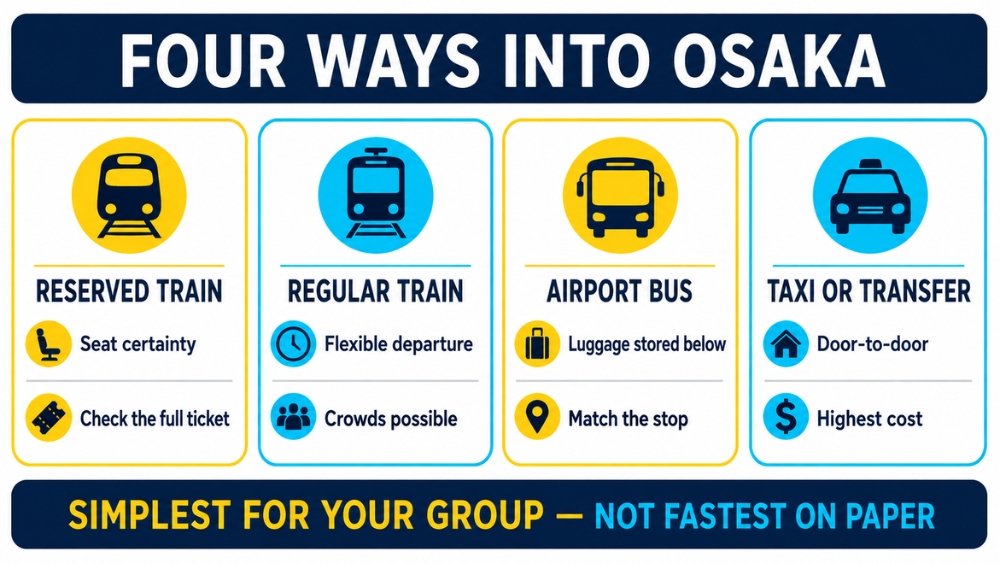
Airport limousine bus: best when the stop matches your hotel
An airport bus can be easier than rail when its stop is close to your hotel. Your main luggage is normally stored below the bus, so you avoid carrying it through a large station.
The current airport route list includes Osaka Station/Umeda, Namba (OCAT), Kintetsu Uehommachi/Shinsaibashi, Universal Studios Japan and other Osaka destinations. Routes and stop numbers differ between Terminal 1 and Terminal 2.
Choose the bus when:
- your hotel is a short, simple walk from the actual stop;
- luggage handling matters more than the fastest scheduled journey;
- the departure still operates after your flight arrives;
- road-delay risk does not threaten a fixed onward connection.
Do not choose a bus only because its destination says “Umeda” or “Namba.” Open the stop map and trace the final walk to your hotel. The airport’s official bus access page lists current destinations, terminal stops, and ticket locations.
If the route and stop fit, compare the current Kansai Airport limousine bus ticket on Klook.
Taxi or private transfer: best for door-to-door simplicity
A taxi or pre-booked transfer costs far more than public transport but can remove the hardest part of an arrival: moving tired travelers and several bags from a station to the hotel.
Consider door-to-door transport when:
- your flight arrives after useful train or bus services;
- several people can share the cost;
- your group has children, reduced mobility, or many large bags;
- the hotel is inconvenient from a station or bus stop;
- you want a named pickup process rather than deciding after landing.
For an airport taxi, check the current official information, approximate pricing, toll treatment, and counter instructions on the KIX taxi page.
For a private transfer, verify the vehicle size, included luggage, flight-delay policy, waiting time, pickup terminal, child-seat request, cancellation rule, and whether the displayed price covers the whole vehicle or each passenger.
Compare the current Kansai Airport private transfer options on Klook only after confirming those conditions.
Do not mix up regular fares and limited-express tickets
The most common ticket mistake is treating every airport train as an ordinary IC-card journey.
- A regular Nankai or JR service can generally use an eligible regular ticket or accepted compatible IC cards (ICOCA, Suica, PASMO, etc).
- Rapi:t is a limited express with reserved seating and requires the correct product for that journey.
- HARUKA is a limited express; the correct fare and seat entitlement depend on the ticket or pass used.
- A discounted visitor product may have eligibility and digital-use conditions that do not apply to a normal station ticket.
Read the exact product screen before payment. If you are uncertain at the airport, use the correct operator’s machine or staffed counter rather than entering a gate and trying to fix the ticket later.
Choose by the hotel entrance, not the district name
Large Osaka districts contain multiple operators and station buildings.
- Namba: Nankai Namba, Osaka-Namba, Osaka Metro Namba, and JR Namba are not one platform complex.
- Umeda: JR Osaka, Hankyu Osaka-Umeda, Hanshin Osaka-Umeda, and three Osaka Metro stations serve different parts of the district.
- Shin-Osaka: this is the Shinkansen station, not another name for Osaka Station.
Use the first-time Osaka area guide to choose the right base, then check the exact hotel entrance. If your route ends at Osaka Station, the Osaka Station navigation guide helps with the final station transfer.
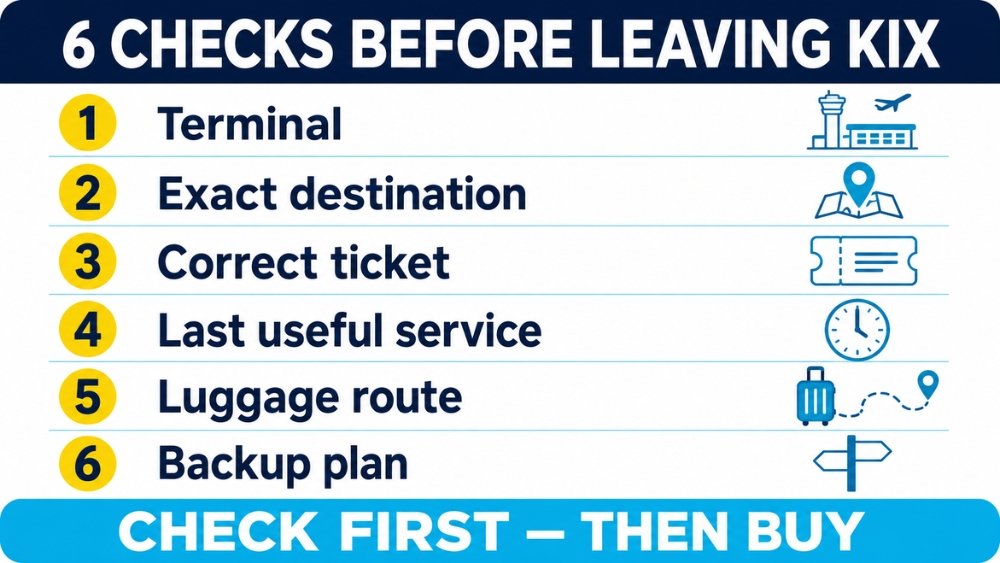
Six checks before leaving the airport
- Terminal: Are you at Terminal 1 or Terminal 2?
- Exact destination: Which operator, station, exit, or bus stop is closest to the hotel entrance?
- Ticket: Is this a regular fare, a limited-express ticket, a reserved seat, or a restricted visitor product?
- Last useful service: Does it still operate after immigration, bags, customs, and any terminal shuttle?
- Luggage: Can the group handle every transfer, stair, underground passage, and final walk?
- Backup: If the planned service is missed, which train, bus, taxi, or transfer remains realistic?
Final verdict
For Namba, check Nankai first. For Tennoji, Osaka Station/Umeda, or Shin-Osaka, check JR first. Use the airport limousine bus when its stop is genuinely convenient for your hotel. Choose a taxi or private transfer when luggage, arrival time, mobility, or group size makes door-to-door travel worth the higher cost.
After matching the route to the hotel entrance, use Klook to compare the relevant Rapi:t, HARUKA, limousine-bus, or private-transfer product and read its current conditions before paying.
Transport schedules, fares, stops, ticket rules, and sales channels can change. Recheck the airport, railway, bus, and booking-provider pages for your actual travel date.