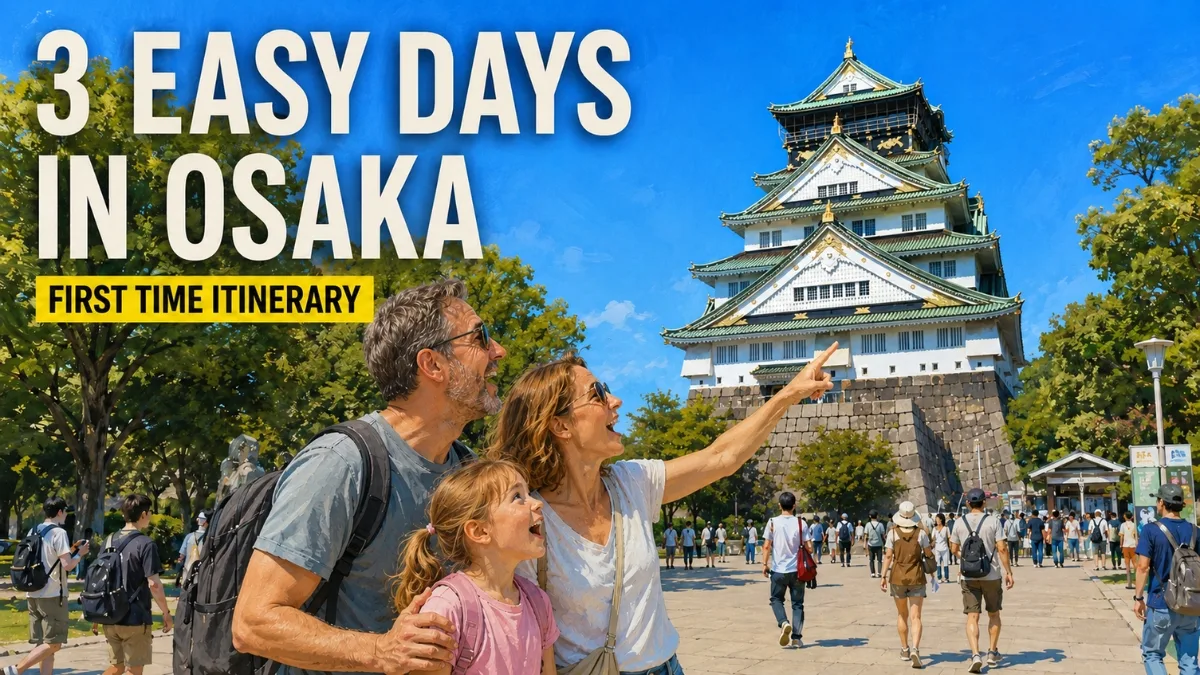
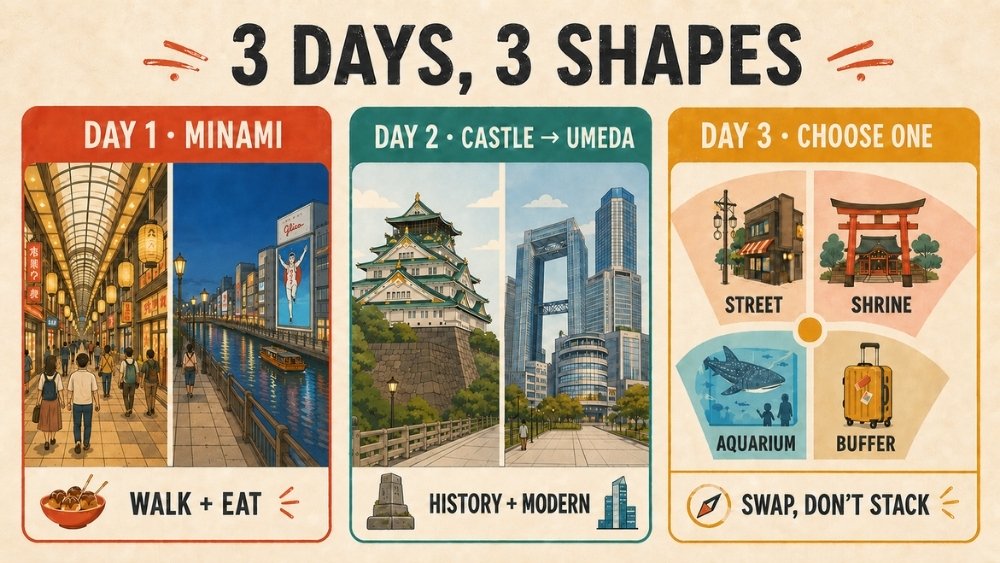
The easiest first Osaka trip is one compact area on Day 1, one major sight plus one modern district on Day 2, and one deliberate choice on Day 3. Use Minami—Namba, Kuromon, Dotonbori and Shinsaibashi—for your first day. Pair Osaka Castle with Umeda on the second. Then choose Shinsekai and Tennoji, Sumiyoshi Taisha, Osaka Aquarium Kaiyukan, or a buffer day. Do not try to stack all four Day 3 options.
This plan is designed for travelers staying in central Osaka and assumes three usable sightseeing days. It preserves the city’s different moods without repeatedly crossing it. If your arrival day begins after lunch or your departure day ends early, use the shorter alternatives below instead of compressing the full plan.
| Day | Main plan | Sensible time budget | What not to add |
|---|---|---|---|
| 1 | Namba and Minami | One easy day and evening | Osaka Castle or Umeda |
| 2 | Osaka Castle, then Umeda | Morning through evening | A separate southern district |
| 3 | One branch that fits your group | Half day to one full day | A second Day 3 branch |
Before Day 1: choose the base that removes your hardest journey
Namba is the easier base if you want to walk to Dotonbori, eat late in Minami, or arrive at Kansai Airport on a Nankai train. Umeda/Osaka Station is usually more practical for JR day trips, a Shinkansen connection through Shin-Osaka, and an early northbound departure. Our guide to Osaka’s best areas for tourists compares these bases in more detail.
Do not choose only by the neighborhood label. “Namba” covers several separate station facilities, while the Umeda area contains JR Osaka Station and multiple railway stations with Umeda in their names. Check the exact operator, station and hotel entrance before booking.
If Namba fits your evenings, compare current Namba hotel options on Klook after checking each property’s exact map pin. Klook lets you switch the displayed language and currency, which can make room terms and the final amount easier to compare. Recheck taxes, cancellation rules, bed configuration and walking distance to the station entrance you will actually use.
If Umeda fits your rail plans, compare current hotels near Umeda Station on Klook separately. Do not use the Namba results as a substitute: the two areas solve different trips. Confirm whether the property is closest to JR Osaka, Osaka Metro Umeda, Higashi-Umeda, Nishi-Umeda, Hankyu Osaka-Umeda or Hanshin Osaka-Umeda.
Shin-Osaka is useful for Shinkansen transfers, but it is not automatically the best sightseeing base. Staying there can save time for one long-distance train while adding a ride to Minami or other central districts every day.
For ordinary local rides, an IC card is a rechargeable card that you tap at the ticket gate. Our ICOCA guide explains the Kansai version, while JR-West’s official guide confirms that ICOCA can be used on participating railways, buses and shops. A limited express or Shinkansen may still need an additional ticket.
Day 1: understand Minami before seeing it at its busiest
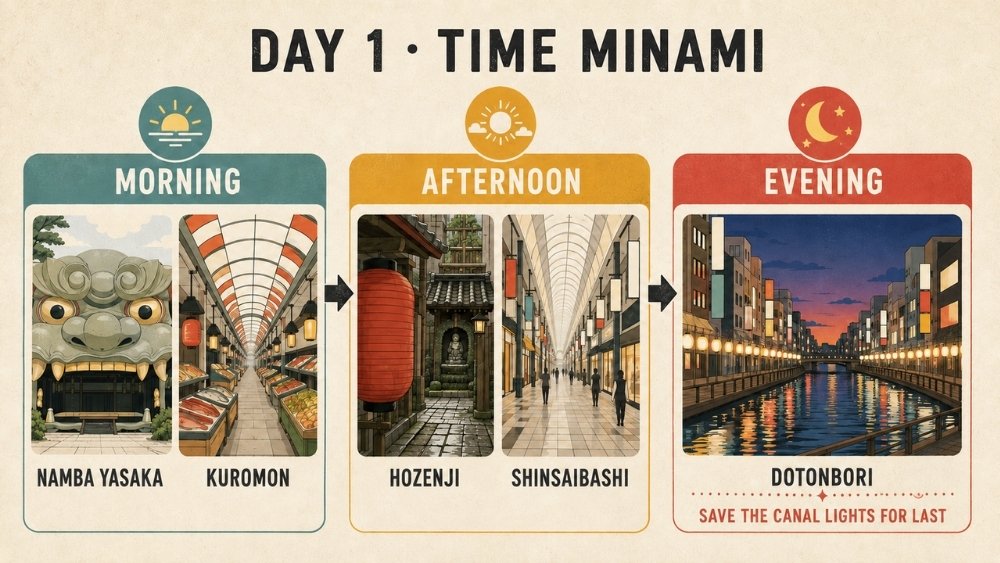
Day 1 is a time-aware route, not a race. Start south of the canal, use the market and shopping streets while businesses are open, and keep Dotonbori for late afternoon or evening when the lights become part of the experience.
Morning: Namba Yasaka Shrine, then Kuromon Market
Begin at Namba Yasaka Shrine. Its lion-head stage makes the stop visually memorable, but the grounds are compact. Save Namba Yasaka Shrine on Google Maps and allow roughly 30–45 minutes unless a ceremony or event changes access. This is a place of worship, so keep voices low, do not interrupt prayer, and follow photography signs.
Walk or ride toward Kuromon Ichiba Market, a covered food market east of central Namba. Open Kuromon Ichiba Market on Google Maps rather than following a pin for a single shop. The official information center currently lists 9:00–18:00, but individual businesses control their own hours and closing days. Treat the market as a browse and an optional early lunch, not a promise that every stall will be open.
Eat only what you genuinely want. If a seafood item or fruit looks expensive, check the displayed price and portion before ordering. Stand where the seller directs, keep the central walkway clear and use the shop’s waste bins; a covered market is still a working passage.
Afternoon: Hozenji and Shinsaibashi-suji
Move toward Hozenji Temple, a small temple known for the moss-covered Mizukake Fudo image. Save Hozenji Temple on Google Maps. “Mizukake” means splashing water; if the practice is available, watch what worshippers do and follow posted instructions rather than treating the statue as a photo prop.
Continue through Shinsaibashi-suji Shopping Street, the long covered arcade north of Dotonbori. Open Shinsaibashi-suji on Google Maps. Store hours differ, so use this as the flexible part of the afternoon: shop, take a café break, or turn back early if jet lag is winning.
Evening: Dotonbori without making it your only meal plan
Finish around Dotonbori and the canal. Save Dotonbori on Google Maps. The district’s own access page points visitors toward Namba Exit 14, but the best exit still depends on your line and mobility needs.
Dotonbori is valuable as a first look at Osaka’s night energy: canal views, dense signs, snack counters and heavy pedestrian flow. It is not necessary to spend hours in the most visible food queue. If a line blocks the evening, walk one or two streets away, choose a sit-down meal, or use our Minami area guide to understand how Namba, Dotonbori and Shinsaibashi fit together.
If you arrived late, skip the shrine and market. Take one calm hotel break, see Dotonbori after dark, eat, and stop. Moving missed Day 1 places onto Day 2 will break the northward flow.
Day 2: make one choice at Osaka Castle and one in Umeda
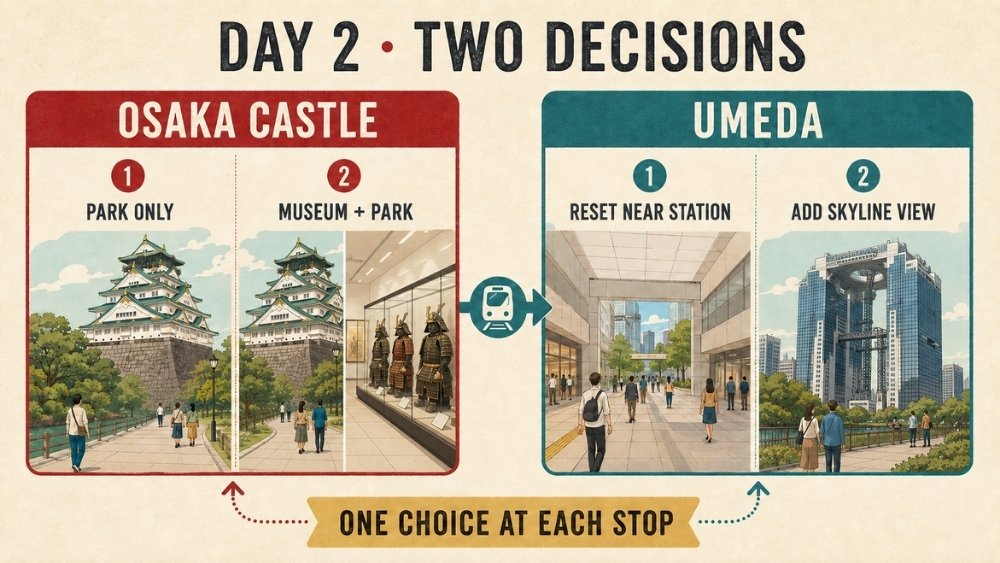
Day 2 has two halves. The first is historic and walking-heavy. The second is modern, station-connected and easy to shorten. Start early enough that Osaka Castle does not consume the hottest or busiest part of the day.
Morning: choose the grounds, the museum, or both
Osaka Castle Museum is a modern museum inside the reconstructed main tower, not a sequence of empty original castle rooms. Save Osaka Castle Museum on Google Maps. The official guide currently lists 9:00–18:00, with last admission at 17:30, and closure from December 28 through January 1. Recheck the official page because operations can change.
Choose your visit before entering the park:
- Grounds only: allow about 90 minutes for a gate, stone walls, moat views and an exterior look. This is the better choice if stairs, indoor crowds or museum exhibits are not a priority.
- Museum plus grounds: allow roughly 2.5–3 hours. The park is large, and the walk from a station is part of the visit.
- Heat, rain or limited mobility: choose the station and exit from the official maps before traveling. Morinomiya’s exit map and Tanimachi 4-chome’s exit map approach different sides of the grounds; the shortest-looking route is not always the easiest.
If you plan to enter the museum, compare the current Osaka Castle admission ticket on Klook with the official ticket terms. Confirm the date, included area, child category, cancellation rules and whether your chosen product is admission only or a guided tour.
During cherry-blossom periods, weekends and school holidays, add crowd time. In midsummer, carry water and move the outdoor portion earlier. Do not schedule a rigid lunch reservation on the opposite side of Osaka immediately after the castle.
Afternoon: reset around Osaka Station
Travel north to Umeda and use Osaka Station City as the first anchor. Save Osaka Station City on Google Maps. The challenge is scale, not a lack of signs. Follow the railway company, line, gate and building name; “meet at Umeda” is too vague for a group.
For an outdoor break beside the station area, use Grand Green Osaka and Umekita Park. Open Grand Green Osaka on Google Maps. The complex is connected to JR Osaka Station, but its shops, events and lawn conditions have their own operating information. Treat the park as a flexible reset, not a timed attraction.
Rain, heat or tired feet are good reasons to stay inside the station-connected commercial area for a café, shopping or an early dinner. Our Osaka Station area guide explains why exact building names matter in this district.
Evening: add one skyline view only if the group still wants it
Umeda Sky Building’s Kuchu Teien Observatory is west of the main station complex. Save Umeda Sky Building on Google Maps. The official access page provides separate walking routes from JR, Osaka Metro, Hankyu and Hanshin; do not assume every “Umeda” exit leads to the same side.
The observatory is optional. Choose it for an elevated city view, especially around late afternoon or evening. Skip it if the castle already used the group’s walking and queue tolerance. In rain, the building can remain open while the exposed rooftop section closes for safety, so check the live notice before committing.
If the viewpoint is part of your plan, compare current Umeda Sky Building observatory tickets on Klook. Confirm the admission date, last entry, rooftop conditions, cancellation terms and any bundled extras before paying.
Day 3: choose one Osaka, then protect the rest of the day
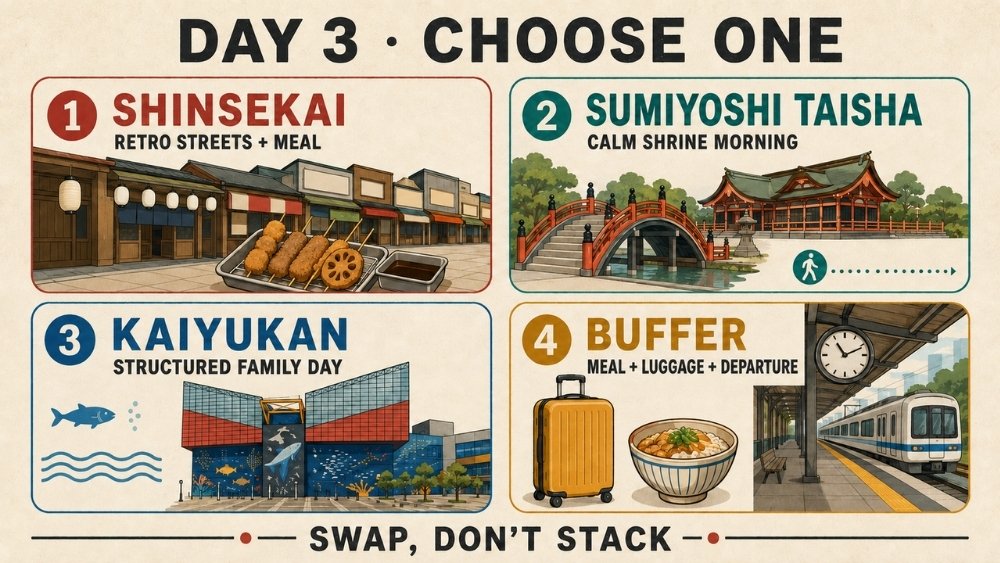
Day 3 is not a spare checklist. Choose one branch according to the group’s energy, weather and departure time. Swap, do not stack. A relaxed final lunch and unhurried luggage collection are legitimate parts of the itinerary.
| Choose this branch | Best fit | Realistic shape | Main caution |
|---|---|---|---|
| Shinsekai and Tennoji | Retro streets, casual food, southern Osaka | Half day | Better as a compact walk than an all-day district |
| Sumiyoshi Taisha | Culture, quiet, couples or older travelers | Calm morning plus free afternoon | The famous arched bridge is steep |
| Kaiyukan and Tempozan | Families, aquarium priority, poor outdoor weather | Structured half or full day | Tickets and travel consume flexibility |
| Buffer and revisit | Early departure, fatigue, shopping or packing | One meal and one familiar area | Resist adding a distant attraction |
Option A: Shinsekai and Tennoji for street-level contrast
Choose Shinsekai if you want a retro district and a casual meal after the polished Umeda day. Save Shinsekai on Google Maps, then use our Shinsekai walking guide to select Ebisucho, Dobutsuen-mae or Shin-Imamiya as the station that fits your direction.
Allow about 90 minutes for the neighborhood itself or two to three hours with one meal or paid extension. Continue toward the wider Tennoji area only if the group wants more time. Large luggage, a very early departure and a dislike of dense restaurant streets are reasons to choose another branch.
Option B: Sumiyoshi Taisha for a quieter morning
Sumiyoshi Taisha is a major Shinto shrine south of central Osaka. Save Sumiyoshi Taisha on Google Maps. From Namba, Nankai’s official access guide gives about ten minutes by local train to Sumiyoshitaisha Station, followed by the short walk shown on the station’s official page.
The steep vermilion Sorihashi bridge is famous, but crossing it is not mandatory. Travelers who use a wheelchair, stroller or walking aid should use the level approach through the grounds. Go in the morning, allow two to three hours including transport from Namba, keep voices low and follow signs around prayer and photography. Our detailed Sumiyoshi Taisha guide covers the route choices.
Option C: Kaiyukan and Tempozan for a structured attraction day
Choose Osaka Aquarium Kaiyukan when the aquarium itself is a priority, not merely as a rain filler. Save Kaiyukan on Google Maps. Hours and admission prices vary by date, so use the official calendar and ticket page rather than a fixed time copied into an itinerary.
Osakako Station Exit 1 is the official Osaka Metro approach for Kaiyukan and Tempozan Harbor Village. After the aquarium, Tempozan Marketplace next door gives the group indoor food and shopping choices. Open Tempozan Marketplace on Google Maps. Its businesses have separate hours; proximity does not guarantee that every shop remains open after the aquarium.
Before building the day around a timed visit, compare current Osaka Aquarium Kaiyukan tickets on Klook. Confirm the selected date and entry conditions, age category, cancellation rules and whether the ticket is aquarium-only or a combination product.
Option D: revisit, eat and leave with time in hand
Choose the buffer branch if you have a midday train or flight, if the first two days were physically tiring, or if everyone wants different things. Return to one familiar district, eat one meal, collect purchases and leave a generous margin for the station.
Do not use a 13:00 departure as permission for a distant “quick morning” attraction. Hotel checkout, luggage collection, platform finding and the walk inside Namba, Umeda or Shin-Osaka can consume more time than the train schedule suggests.
Rescue the itinerary when conditions change
If it is hot
Move Osaka Castle and shrine grounds earlier. Carry water, use indoor breaks in Umeda, and reduce the number of market or shopping stops. Do not replace one cancelled outdoor stop with two distant indoor attractions.
If it rains
Shinsaibashi-suji, station-connected Umeda buildings and Tempozan Marketplace provide cover, but transfers and the walk between facilities still include exposed sections. Kaiyukan is a reasonable Day 3 choice only if tickets and travel fit; it should not be forced into Day 1 or Day 2.
If someone has limited mobility
Measure entrances and exits, not only station-to-station time. Osaka Castle Park is large, the Umeda complex involves long internal walks, and Sumiyoshi Taisha’s famous bridge is steep. Use operator maps for elevators and choose one attraction fewer before the day begins.
If you are traveling with children
Use one adult headline sight per half day and protect meal times. Kaiyukan is the strongest structured Day 3 option; a short Shinsekai walk can work, but dense streets and restaurant queues are not a substitute for a child-focused activity.
If you have luggage
Leave large bags at the hotel or use a suitable staffed facility or locker after checking its size and closing time. Do not assume a locker will be available at the station you reach during a peak period. Build the final day around the place where you must retrieve the bag.
If food choices are limited
Do not make a famous queue your only plan. Confirm allergens, shared grills or frying oil, vegetarian or religious dietary needs, and last orders directly with the restaurant. Carry a small amount of cash because card and mobile-payment acceptance is not universal.
Is three days enough for a first visit to Osaka?
Yes—three full days are enough to understand central Osaka, see the main contrasts and eat without turning every hour into transit. They are not enough for central Osaka plus a major theme park, several museums and multiple day trips. Add days when Universal Studios Japan, Kyoto, Nara, Kobe or Himeji is a priority rather than pushing one of them into this plan.
The useful rule is simple: keep Day 1 south, Day 2 east-to-north, and Day 3 to one choice. If something takes longer than expected, remove the next stop instead of making the rest of the day faster. A good first Osaka itinerary leaves you knowing which district you want to return to—not merely which attractions you managed to photograph.