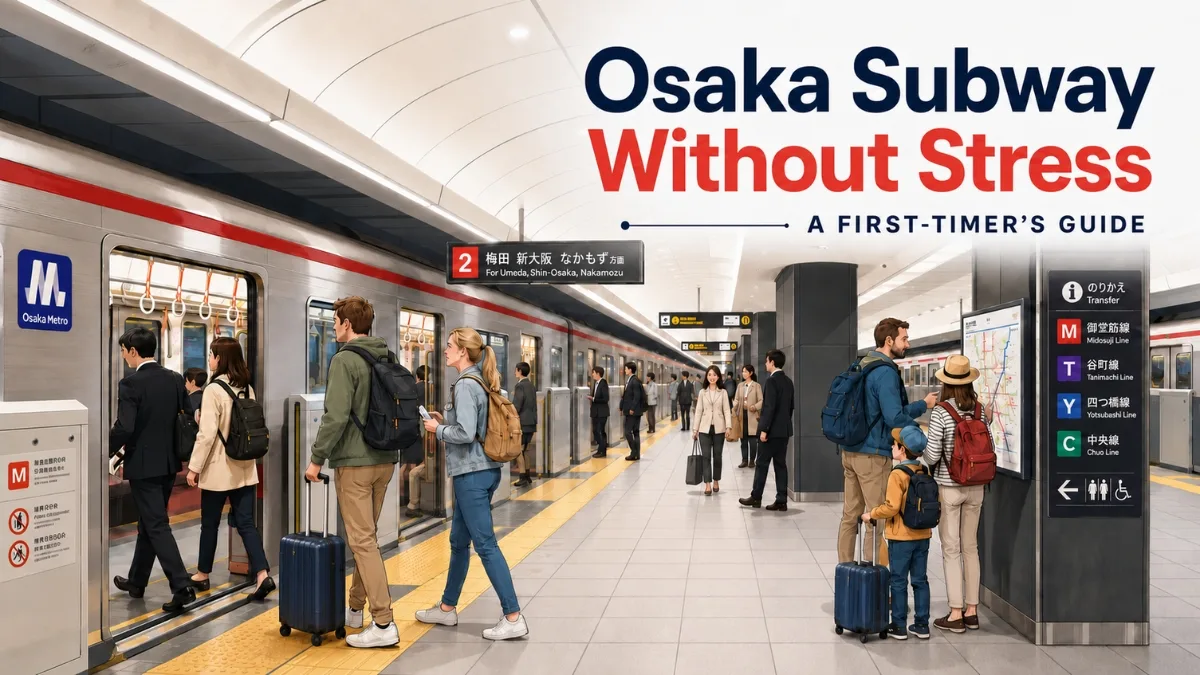
The easiest way to ride Osaka Metro is to decide four things before you pass the gate: the operator, how you will pay, the platform direction, and the exit you need at the other end. The train itself is usually the simple part. Busy station areas such as Namba and Umeda feel difficult because several railway companies, underground passages, and numbered exits share the same area.
For an ordinary ride, an IC card such as ICOCA, Suica, or PASMO is the most flexible choice: tap at the entry gate, take the train, and tap again when you leave. An eligible contactless bank card or device also works on Osaka Metro, while a paper ticket or one-day pass can make sense in specific situations. Whichever method you choose, use the same one from entry to exit.
You do not need to memorize Osaka’s subway map. You need a short route note that survives a crowded concourse.
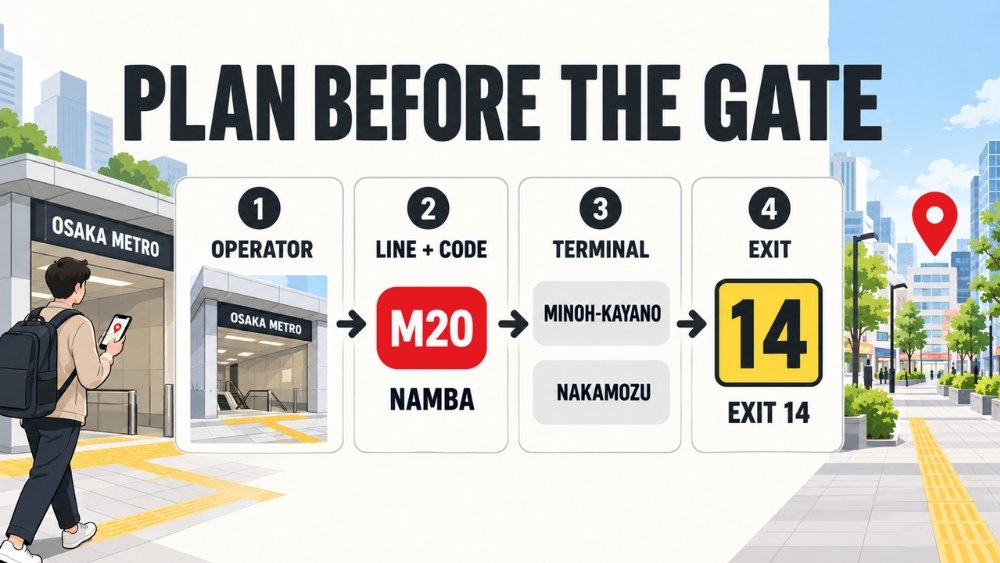
Save four facts before you enter
Open your route app while you still have room to stop. Write down or screenshot these details:
| What to save | Example | Why it matters |
|---|---|---|
| Operator | Osaka Metro | JR, Osaka Metro, Nankai, Kintetsu, Hankyu, and Hanshin can have stations in the same district but use different gates |
| Line and station code | Midosuji Line, Namba M20 | The letter identifies the line and the number confirms the station even when names are hard to read quickly |
| Platform direction | For Minoh-kayano or for Nakamozu | Osaka Metro signs normally identify a train by its terminal, not simply “northbound” or “southbound” |
| Destination exit | Exit 14, or the elevator route shown on the station map | The correct station with the wrong exit can create a long underground or street-level detour |
The operator is the first check. A route that says Osaka Metro Namba M20 does not mean JR Namba or Nankai Namba. Look for the Osaka Metro symbol and the line’s letter-color combination before following the crowd.
Use the official Osaka Metro route and fare search when you want to confirm the operator, fare, or transfer. The official route map is useful for seeing station codes, but the individual station page is better for exits and elevators.
Choose one way to pay
There is no single best payment method for every visitor. The least stressful choice is the one that matches your itinerary and that you understand before reaching the reader or ticket slot.
| Payment method | Good choice when | What to know |
|---|---|---|
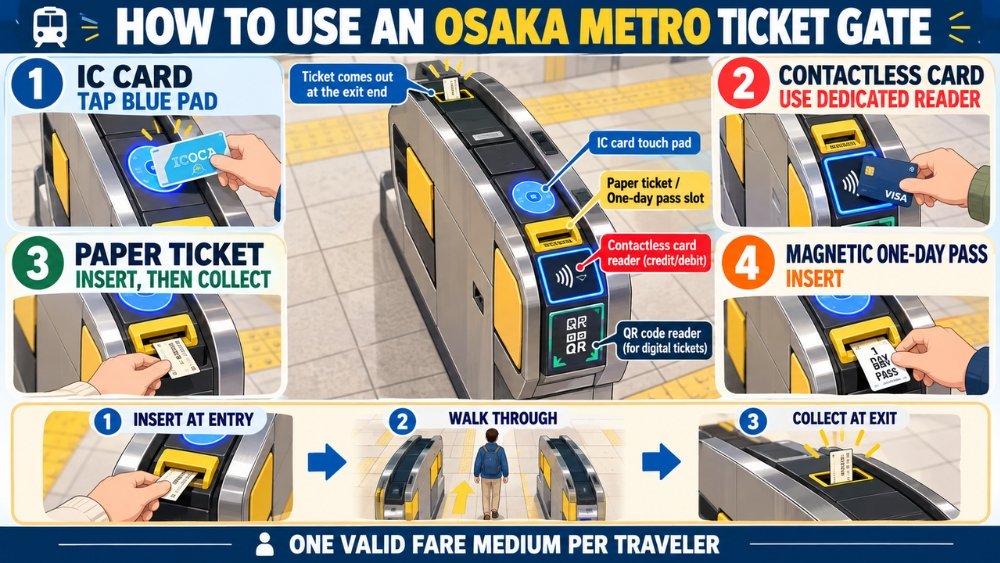
| IC card such as ICOCA, Suica, or PASMO | You will use Osaka Metro plus JR, private railways, buses, or shops | Tap the blue-lit IC reader for about one second. One card pays for one person, and the same card must record entry and exit |
| Contactless bank card or device | You are an adult making ordinary rides on Osaka Metro and prefer not to buy a transit card | Use the dedicated contactless reader. Osaka Metro charges the regular adult fare; a child is still charged the adult fare, and acceptance does not extend to every railway in Osaka |
| Paper ticket | You are taking one or two simple rides or need a child fare without an IC card | Buy the correct fare, insert the ticket at entry, collect it, and insert it again at the exit |
| Enjoy Eco Card | You will make enough covered Metro or city-bus trips in one day to beat pay-as-you-go fares | Adult price is ¥820 on weekdays and ¥620 on Saturdays, Sundays, and holidays; child price is ¥310. It excludes Yumeshima Station and several other services |
Osaka Metro’s regular adult fares currently run from ¥190 to ¥390, depending on the fare zone, with an additional fare for travel to or from Yumeshima. A day pass is not automatically cheaper. Three short rides can cost less than a weekday pass, while a day with repeated cross-city trips may favor the pass. Check your actual route rather than buying by instinct.
An IC card is not an unlimited pass. It stores money and deducts the fare. If the balance is too low at the exit, use a fare-adjustment or recharge machine inside the gates, then try again. Do not present two IC cards together or switch cards between entry and exit. Our ICOCA guide for Osaka explains buying, recharging, and end-of-trip options in more detail.
Osaka Metro accepts Visa, Mastercard, JCB, American Express, Diners Club, Discover, and UnionPay contactless cards and eligible linked devices. No advance registration is required. The reader for a bank card is separate from the ordinary IC-card pad, so look for the contactless-payment marking rather than tapping every blue surface you see. The operator’s contactless-payment page shows the current reader and supported cards.
The Enjoy Eco Card covers Osaka Metro except Yumeshima and most Osaka City Bus routes, but it does not turn Hankyu, Hanshin, JR, Kintetsu, Nankai, or Kita-Osaka Kyuko into free rides. A train can continue onto another operator without making everyone leave the carriage; that seamless ride does not erase the pass boundary.
From the gate to the correct train
Pass through without holding up the lane
Prepare the card or ticket before you reach the gate. For an IC card, touch the illuminated reader for about one second. For a paper ticket, insert it into the yellow ticket slot and collect it at the far end. Contactless bank cards and linked phones or watches use the dedicated reader marked for contactless payment.
If the gate closes or shows an error, step out of the flow and read the display. A low balance, an unmatched entry record, or the wrong reader is usually fixable. Repeatedly trying different cards can make the situation harder to explain; use the adjustment machine or show the card and message to station staff.
Read the terminal name, not a compass direction
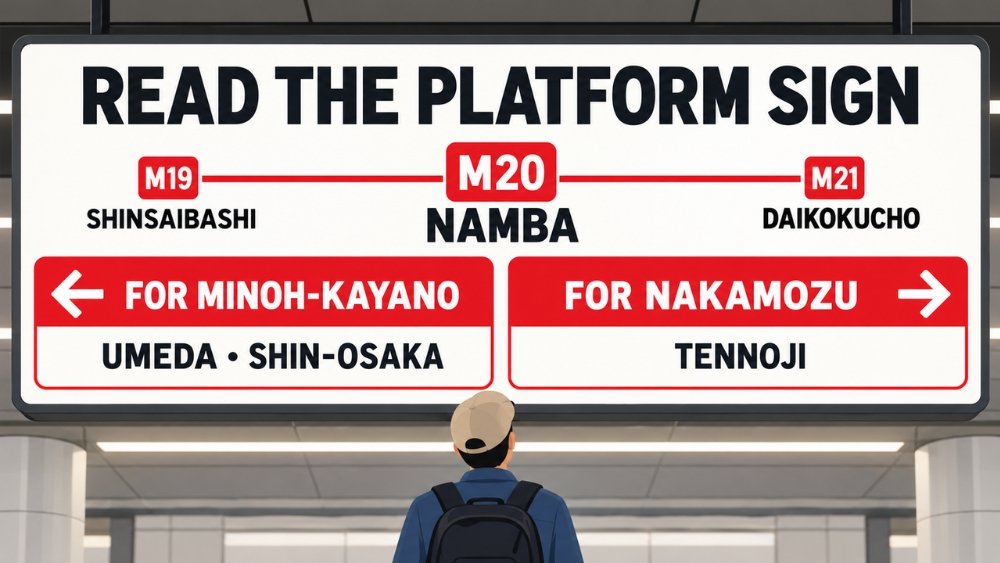
On the platform, match all three elements: the line color and letter, your present station code, and the terminal shown for that platform. At Namba on the red Midosuji Line, for example, M20 confirms the station. Trains toward Umeda and Shin-Osaka are shown as for Minoh-kayano, while trains toward Tennoji are shown as for Nakamozu.
The terminal may lie well beyond your stop. That is normal. You are not deciding to ride to the end of the line; you are using the terminal name to choose the correct side.
Next-station signs provide a second check. From Namba M20, Shinsaibashi M19 is on the Minoh-kayano side and Daikokucho M21 is on the Nakamozu side. Station numbers increasing or decreasing give you a quick confirmation after departure.
Board, watch the codes, and recover calmly
Let passengers leave before you board. Keep luggage beside you rather than across the doorway, and move farther into the car when it is crowded. The display and announcements identify upcoming stations in English on major routes; the station code is useful when similar place names blur together.
If you miss your stop, leave at the next station and follow signs for the opposite direction. Do not assume the return train is directly across the platform: layouts differ by station. If you board the wrong line or cannot find the other platform without exiting, ask staff before passing through a gate.
Treat every transfer as one of three types
The word “transfer” can hide very different amounts of walking.
Inside the same paid area: Follow the next line’s color, letter, and terminal direction. Hommachi and Namba are examples where Osaka Metro lines connect within the station system, although the walk can still take several minutes.
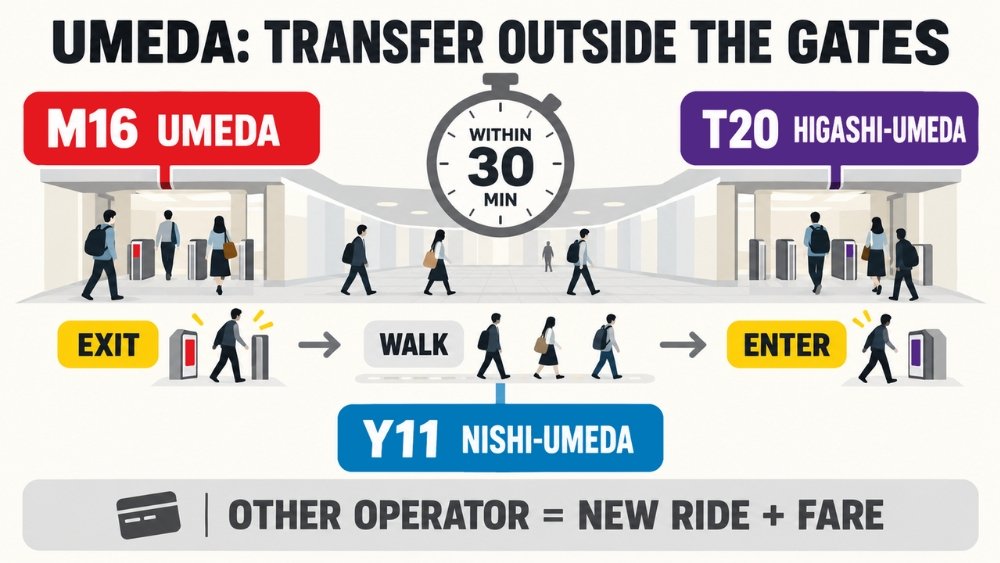
Between the three Osaka Metro stations in Umeda: Umeda M16, Higashi-Umeda T20, and Nishi-Umeda Y11 are connected by underground passages, but the transfer requires leaving one gate and entering another. For an ordinary fare, complete the transfer within 30 minutes. After 30 minutes, after entering another company’s railway, or after canceling the new gate entry, Osaka Metro treats the next ride as a new fare. The time limit does not apply in the same way to a commuter pass or the Enjoy Eco Card. The official Umeda transfer rules explain the current conditions.
Between different railway operators: A walk from Osaka Metro to JR, Hankyu, Hanshin, Nankai, or Kintetsu may look like one connected station on a map, but it is usually a new ride through a different operator’s gate. Confirm that your ticket or pass covers that operator. Osaka Station and Osaka Metro Umeda are part of the same transport district, not the same set of platforms; our Osaka Station navigation guide explains the wider complex.
Make the exit part of the route
Do not wait until the train arrives to choose an exit. Open the destination pin, note the numbered exit or landmark, and compare it with the station’s official exit map. At a large station, “leave by any exit and correct above ground” can mean crossing wide roads or retracing a long underground passage.
The official Namba M20 station page lists transfers, station maps, exits, and facilities. The official Umeda M16 page does the same for Umeda. Use the matching station code rather than a generic district search, especially where several stations share a name.
If you use a wheelchair, stroller, or heavy suitcase, choose the step-free route before choosing the shortest exit. Osaka Metro provides at least one wheelchair-accessible route from street level to the platform at each Metro and New Tram station, but that route may lead to a different gate or street corner from the exit nearest your destination. The individual station page shows barrier-free routes and elevators; when the route is unclear, ask staff before leaving the paid area.
Know the few line patterns that save effort
The Midosuji Line is the most useful backbone for many visitors. It links Shin-Osaka M13, Umeda M16, Shinsaibashi M19, Namba M20, and Tennoji M23 without a transfer. Its line color is red and its station letter is M.
Other lines become useful according to the exact destination rather than a visitor hierarchy. The purple Tanimachi Line, blue Yotsubashi Line, green Chuo Line, pink Sennichimae Line, brown Sakaisuji Line, lime-green Nagahori Tsurumi-ryokuchi Line, and orange Imazatosuji Line all have their own letter and numbered stations. Let the route search choose the line; then use its color and code to navigate.
This is safer than memorizing attractions by line. Osaka Castle, for example, can be approached from different stations depending on the gate or side of the park you want. The useful question is not “Which line goes to Osaka Castle?” but “Which station and exit put me near today’s entrance?”
Reduce friction at busy times
Weekday commuting periods can leave less space to pause at gates and doors. If your first ride is flexible, a midday practice trip is easier than starting with a suitcase during the morning peak. On a crowded train, keep bags close, let people exit first, keep calls and loud conversation to a minimum, and avoid stopping immediately beyond the gate.
Families should give each person their own valid fare medium. One IC card or contactless bank card cannot pay several people through the gate. For a child who needs a child fare, use an appropriate child IC card or ticket rather than an adult contactless bank card, which Osaka Metro charges at the adult rate.
For an airport or Shinkansen day, fewer transfers usually beat a route that is only a few minutes faster on paper. A direct Midosuji Line ride to Shin-Osaka can be easier with luggage than a technically quicker journey involving several platforms. Check the elevator route and leave enough time for the station walk, not only the train ride.
Make your first ride deliberately easy
Choose a familiar payment method, take a direct route if possible, and save the station code, terminal direction, and exit before going underground. Once you see how Osaka Metro repeats line colors, letters, numbers, and terminal names, the system stops feeling like one enormous station and starts behaving like a sequence of small checks.
That is the useful habit to keep: operator, payment, direction, exit. Get those four right, and most Osaka subway journeys become routine.