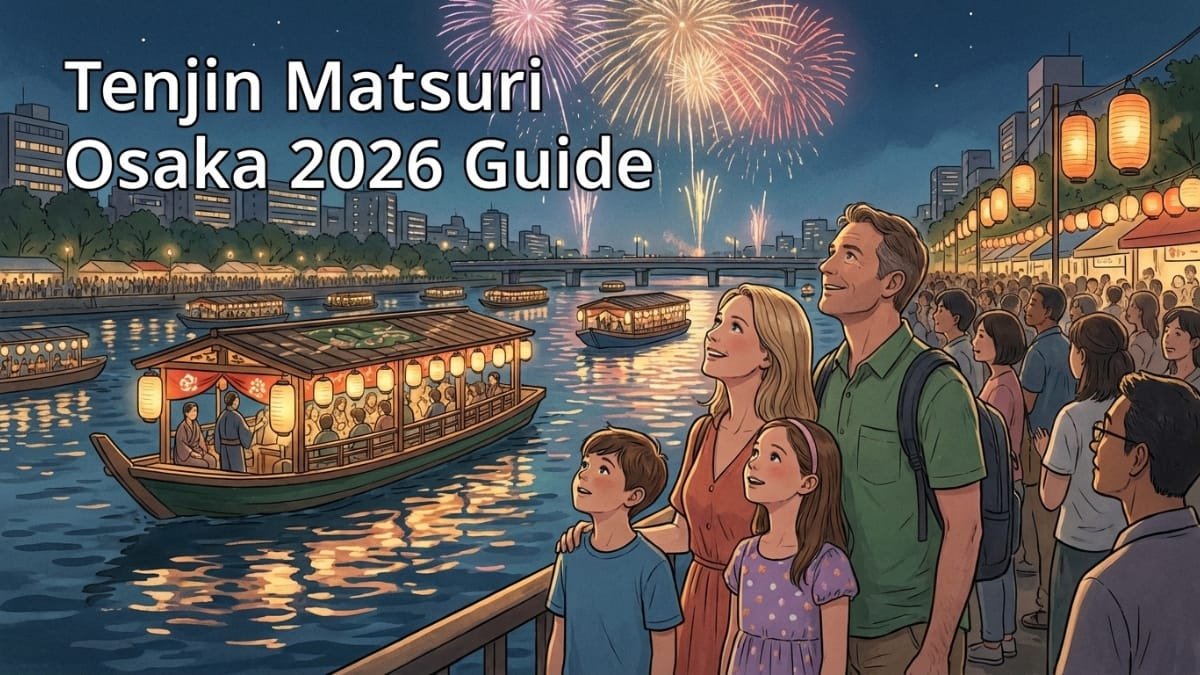
Planning Tenjin Matsuri in Osaka for 2027? Start with one important distinction: the festival is not a single fireworks show in one place. It begins at Osaka Tenmangu, moves through central Osaka as a land procession, and reaches its most famous scene on the Okawa River, where illuminated boats travel beneath fireworks.
The established headline days are July 24 and 25, which fall on a Saturday and Sunday in 2027. However, as of September 29, 2026, Osaka Tenmangu has not published the 2027 timetable, procession route, fireworks operation, traffic controls, viewing areas, or reserved-seat sales. Use this guide to make the decisions that are possible now, then confirm the event-specific details after the official 2027 guide appears.
For a first visit, make two decisions early: choose July 24 or 25, then choose the shrine area or the river area as your main focus. Trying to improvise both choices inside the evening crowd is the easiest way to miss the part you came to see.
What is known for 2027—and what is not yet announced
The festival’s long-established structure gives you a useful planning framework, but it is not a substitute for the 2027 operating notice.
| Planning point | What you can use now | What still needs the 2027 announcement |
|---|---|---|
| Dates | July 24 is the yomiya, or festival-eve day; July 25 is the honmiya, or main day | Confirmation of the complete 2027 program and any changes |
| Main experience | July 24 centers more on shrine rituals; July 25 traditionally carries the land procession, boat procession, and dedication fireworks | Exact start times, routes, river operation, and fireworks conditions |
| Viewing | Osaka Tenmangu and the Okawa River remain the two main planning centers | Usable riverbanks, restricted areas, one-way crowd routes, and bridge rules |
| Tickets | The shrine festival itself does not require a general admission ticket | Whether reserved viewing is offered, plus its locations, prices, and sale date |
| Transport | Rail is the practical default; the shrine is served by Minami-morimachi and Osaka-Tenmangu stations | Temporary exits, diversions, traffic controls, and the best station for each river area |
Do not book a non-refundable viewing product from an old page or build a minute-by-minute plan around the 2026 timetable. The right 2027 strategy is to reserve the dates, choose the kind of experience you want, and leave the final route and timing flexible until Osaka Tenmangu releases current information.
Choose the day before you choose the view
The two days offer different experiences. July 24 is the yomiya, the opening or festival-eve day. July 25 is the honmiya, the main day.
| Your priority | Better fit | What the day centers on | Main trade-off |
|---|---|---|---|
| Shrine rituals and a more focused cultural visit | July 24 | Osaka Tenmangu, the Hokonagashi ritual, and shrine-centered events | Fewer of the famous river-night scenes |
| The full procession and fireworks spectacle | July 25 | Rikutogyo land procession, Funatogyo boat procession, and Hono Hanabi fireworks | The heaviest heat, congestion, and exit pressure |
| Lower physical and sensory demand | July 24, especially earlier | A shorter visit built around the shrine | It is still a major festival, not a quiet normal day |
| The classic lantern boats and fireworks image | July 25 evening | The Okawa River | You need a current viewing and return plan before arrival |

If July 25 is your only option but you do not enjoy dense crowds, go for the daytime shrine or procession atmosphere and leave before the riverside peak. The festival does not become meaningful only after the fireworks begin.
Why Tenjin Matsuri is more than a fireworks night
Tenjin Matsuri is the annual festival of Osaka Tenmangu Shrine. The shrine dates the festival’s origin to 951, more than 1,000 years ago, and identifies it as one of Japan’s three major festivals alongside Kyoto’s Gion Matsuri and Tokyo’s Kanda Matsuri.
The vocabulary explains how the day unfolds:
- Rikutogyo means the land procession. Festival participants and sacred elements move through city streets before reaching the river.
- Funatogyo is the boat procession on the Okawa River. The procession is not a sightseeing cruise; it is part of the shrine festival’s religious movement.
- Hono Hanabi are dedication fireworks. They accompany the river procession rather than forming a separate picnic-style fireworks event.
The shrine describes July 25 as a festival of fire and water: lantern and torch light reflects on the river while the fireworks appear above the boats. Its current sponsorship information describes the traditional scale as roughly 100 boats and about 3,000 fireworks. Treat those figures as the scale of the established festival, not a guarantee of the next edition’s exact operation.
Pick one center: shrine or river
Osaka Tenmangu and the Okawa River are connected by the festival, but they are not one compact viewing spot. Your best station and arrival time depend on which side matters more to you.
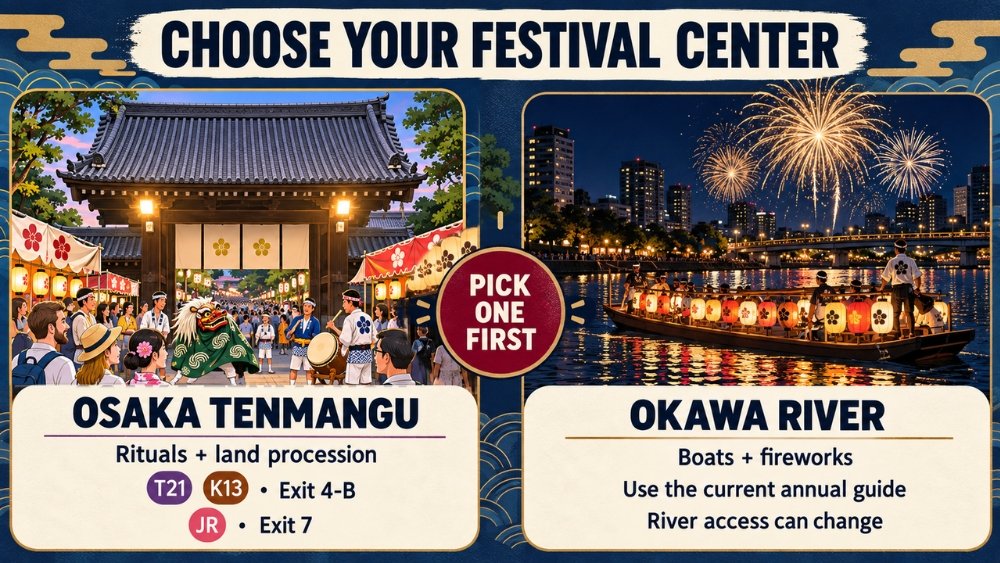
Choose Osaka Tenmangu for the shrine and procession context
Use one of these rail approaches:
- Minami-morimachi Station on the Osaka Metro Tanimachi Line (T21, shown in purple) or Sakaisuji Line (K13, shown in brown). The current station map marks Exit 4-B for Tenmangu.
- Osaka-Tenmangu Station on the JR Tozai Line. JR means Japan Railways; this is a separate operator from Osaka Metro even though the stations connect underground. The shrine’s access directions use Exit 7.
From either exit, the shrine is only a short walk, but the normal route may be managed differently during the festival. Follow temporary signs and staff instructions instead of forcing the usual shortest path.
Useful links:
- Osaka Tenmangu official access information
- Osaka Tenmangu on Google Maps
- Minami-morimachi Station on Google Maps
- Osaka-Tenmangu Station on Google Maps
Choose the Okawa River for boats and fireworks
Do not treat “the river” as one pin. The usable banks, bridges, procession direction, restricted sections, official seating, and nearest practical stations can change by edition. A place that looks close on a map may have no view, one-way crowd control, or a long detour.
Wait for the current official digital guide and traffic notice before choosing a precise riverside position. Then save the map offline or take screenshots. Mobile service can slow when a very large crowd gathers.
The key planning rule is simple: use Minami-morimachi or Osaka-Tenmangu when the shrine is your center; choose your riverside access from the current annual guide when the boats or fireworks are your center. Do not assume the shrine’s nearest station is automatically the best station for every river view.
Use the 2026 timetable as a planning model—not the 2027 schedule
The completed 2026 program shows the sequence and the long gap between the first shrine rite and the night climax. It is useful for understanding how July 25 can unfold, but none of these times should be treated as the announced 2027 timetable.
| 2026 reference time | Event | What it meant for visitors |
|---|---|---|
| 1:30 p.m. | Honmiya main rite | The main-day religious program began at the shrine |
| 3:30 p.m. | Rikutogyo departed | The land procession moved away from Osaka Tenmangu |
| 5:30 p.m. | Boats began departing | Activity shifted toward the river |
| 6:00 p.m. | Funatogyo | The boat procession was underway |
| 7:30–8:50 p.m. | Hono Hanabi | Fireworks accompanied the river procession |
| Around 9:00 p.m. onward | Return procession | Movement continued after the fireworks, with the return ceremony scheduled for 10:00 p.m. |
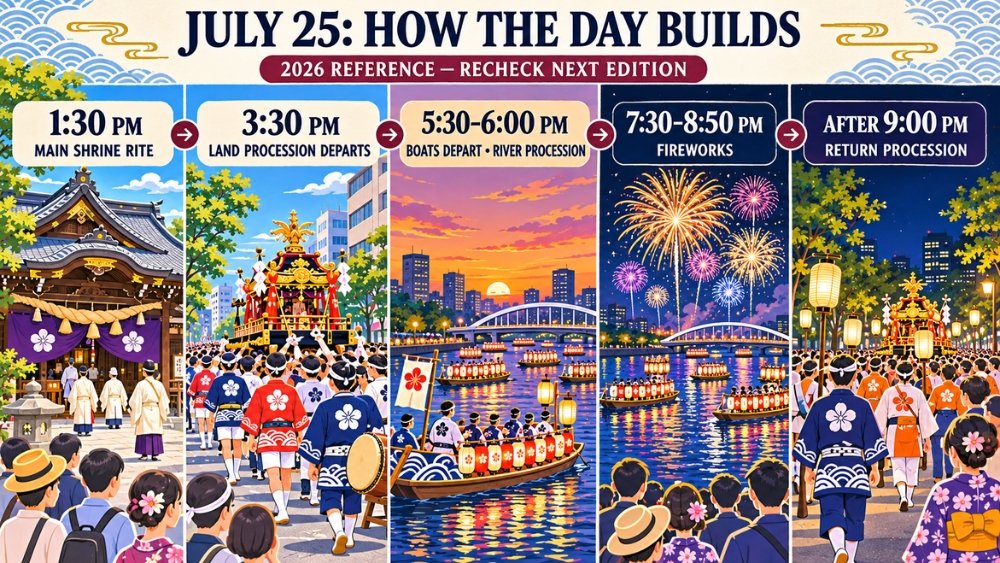
This is why a “show up at 7:20 p.m.” plan is fragile. By then, popular approaches may already be slow or controlled. If the river is your priority, arrive early enough to understand the space in daylight, use facilities, and settle before the evening surge. If the land procession is your priority, build the day around its departure and route instead of waiting beside the river.
Before your trip, replace this reference table with the official 2027 schedule from Osaka Tenmangu’s Tenjin Matsuri page and its current-year announcements.
Fireworks viewing: free space and reserved seats are different plans
There is no general admission ticket for the festival, and worship at the shrine is free. Public areas do not become one guaranteed free viewing zone, however. Sightlines, access controls, bridge rules, and crowd direction can limit what you can see.
Official reserved viewing has been sold in recent editions. In 2026, Osaka Tenmangu announced special viewing seats through an official ticket partner. No 2027 sale has been announced as of September 29, 2026. Locations, inclusions, prices, and sales dates may differ, so do not buy from an old page or assume a previous seating map still applies.
Choose one of two strategies:
- Reserved plan: wait for the next official sales notice, check exactly what the seat overlooks, and follow its entry time and access instructions.
- Public-space plan: wait for the 2027 map, accept a less controlled view, arrive earlier, stay flexible, and follow staff directions if an area closes or becomes one-way.
Do not block a bridge, roadway, building entrance, or emergency route to improve your angle. The festival continues on the water and streets; a clear exit path matters more than one photograph.
Build the exit plan before the evening
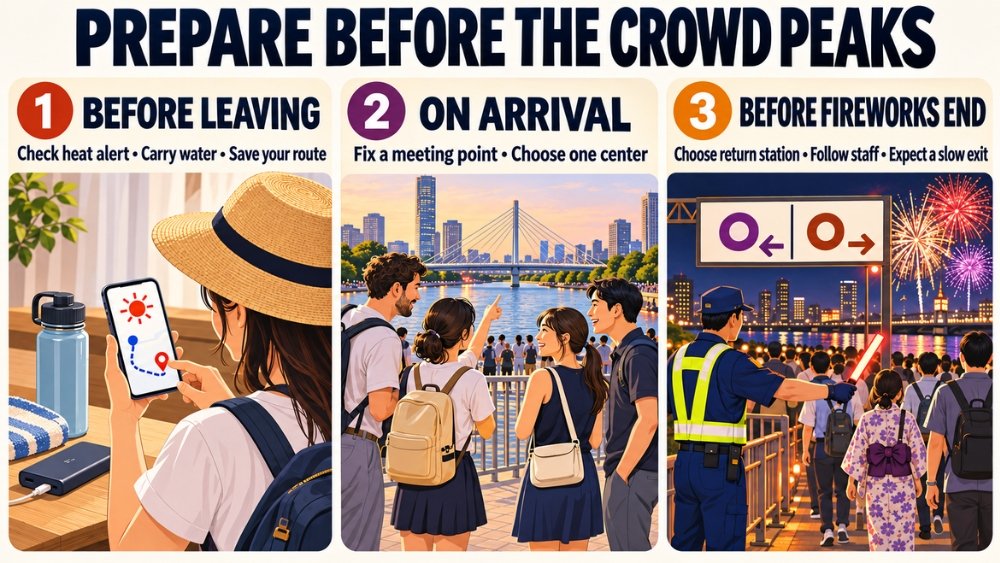
The return journey deserves the same attention as the view. The 2026 shrine safety notice imposed traffic controls, provided no shrine parking or bicycle parking, and instructed visitors to follow police, fire, and security staff. Treat that as evidence of the operating constraints, not as the 2027 traffic plan. Rail should be your default assumption until the new notice is released.
Before joining the crowd:
- Decide which station you will try first and which station is your backup.
- Give your group one exact meeting point outside the densest viewing area. “At the station” is too vague when entrances are busy.
- Screenshot the route to your hotel, including the last useful train connection.
- Charge your phone and carry a small power bank if you rely on it for navigation.
- Load enough value onto an IC card before the busiest period. An IC card such as ICOCA, Suica, or PASMO is a rechargeable transit card that you tap at compatible gates. See how to use ICOCA in Osaka if this is new to you.
- Leave large luggage at your hotel or a confirmed storage facility. A suitcase is difficult to control in a dense, slow-moving crowd, and station lockers may already be full.
Leaving a few minutes before the climax may reduce what you see but will not necessarily produce an empty station. Leaving later can also be reasonable if you have the energy and can wait in a safe, open place. What matters is choosing deliberately instead of being pulled toward the nearest entrance with everyone else.
For a broader explanation of the city’s operators and IC cards, read how to get around Osaka without stress.
Heat changes the plan
Late July in Osaka can remain hot and humid into the evening. The fireworks starting after sunset does not remove the hours of heat exposure that come before them. Check the Ministry of the Environment’s English heat-illness information and alert page on the day.
A practical heat plan is more than carrying one bottle:
- Eat and drink before the crowded period, then carry water you can reach without unpacking your bag.
- Replace salt as well as fluid if you are sweating heavily; a sports drink or appropriate oral rehydration product can help.
- Use a hat, light breathable clothing, sunscreen, and a fan or cooling towel during daylight.
- Schedule an indoor or shaded rest before moving to the river.
- Reduce the plan for children, older travelers, pregnant travelers, and anyone with a medical condition or poor heat tolerance.
Headache, dizziness, nausea, unusual fatigue, confusion, or inability to drink are reasons to stop, cool down, and seek help—not signals to push through until the fireworks. If someone is confused, unresponsive, or unable to drink safely, contact event staff or emergency services immediately.
Accessibility, children, and sensory load
Minami-morimachi and Osaka-Tenmangu stations have elevators and accessible facilities in their normal station layouts. That does not make every festival route step-free or comfortable. Temporary barriers, one-way controls, dense riverbanks, long standing periods, sound, and heat can all change the practical experience.
If you use a wheelchair or stroller, or travel with someone who needs frequent rest:
- inspect the current Osaka Metro or JR station layout, not only a map pin;
- ask the organizer about the current viewing area and accessible route once the annual plan is released;
- choose one center instead of attempting shrine, procession, river, and fireworks in one continuous route;
- consider July 24 or the earlier part of July 25 rather than the evening peak;
- identify toilets, indoor cooling space, and an early-exit option before entering the crowd.
Young children may enjoy the lanterns and drums but struggle with the wait, noise, and slow exit. Ear protection, identification/contact details, and a fixed family meeting point are sensible. Keep children close; do not rely on being able to move quickly across the crowd.
Check these five things before you leave
- The official 2027 schedule: confirm that you are reading the new edition, not an archived 2026 page.
- The official 2027 map and traffic notice: use them to choose your center, arrival station, and return station.
- Weather and heat alerts: fireworks or parts of the program can change in bad weather, while severe heat can make a long plan unsafe.
- Reserved-seat details, if you bought a ticket: confirm the entrance, admission time, what the seat overlooks, and what you must show.
- Your group’s exit plan: save the hotel route, set the meeting point, and agree what to do if you become separated.
If your Osaka dates are still flexible, compare Tenjin Matsuri with other events in the Osaka seasonal festival calendar. Tenjin Matsuri offers an unusually rich combination of shrine ritual, city procession, river spectacle, and fireworks, but it asks more of the visitor than a normal evening event.
The most satisfying first visit is not the one that covers every ritual and every viewpoint. It is the one that chooses a day, chooses a center, respects the heat, and reaches the river or shrine with enough time and energy to understand what is happening.