Night cherry blossoms in Osaka are not one interchangeable experience. Osaka Castle’s Nishinomaru Garden is a dated, paid event when it is announced. The Japan Mint is a short annual passage that may require a timed reservation. Kema Sakuranomiya Park is an always-open riverside park, but it is not a guaranteed illumination event. Expo ’70 Commemorative Park and Katsuoji only work as night plans when special evening hours are officially confirmed.
That distinction matters more than any ranking. A beautiful place can still be the wrong choice if you arrive after last entry, expect lights that are not operating or discover that the booking window has closed.
Season status — October 13, 2026: the 2026 programs have ended, and the 2027 dates, prices, reservation methods and illumination hours reviewed for this guide have not yet been announced. Use the place comparisons below now; use the linked official pages to confirm the event itself before committing an evening.
Start with how structured your evening can be
| Place | What the night is like | Planning commitment | Best fit | What must be confirmed |
|---|---|---|---|---|
| Osaka Castle Nishinomaru Garden | Formal illumination with the castle tower beyond the blossoms | Medium | A classic first Osaka night | Event dates, seasonal fee, last entry and which gate is open |
| Japan Mint Cherry Blossom Passage | One-way annual walk among many cherry varieties | High | A distinctive, often later blossom window | Dates, advance reservation, time slot, entry gate and current rules |
| Kema Sakuranomiya Park | Flexible walk beside the Okawa River | Low | A spontaneous sunset-to-evening stroll | Current bloom, weather and whether your chosen segment feels suitably lit after dark |
| Expo ’70 Commemorative Park | Large seasonal park event when night opening is announced | Medium to high | A planned half-day that continues into evening | Illumination dates, extended hours, admission and return transport |
| Katsuoji | Mountain temple visit only after a special evening opening is announced | High | A destination evening, not an after-dinner add-on | Special opening, ticketing, last entry and the final bus or other return plan |
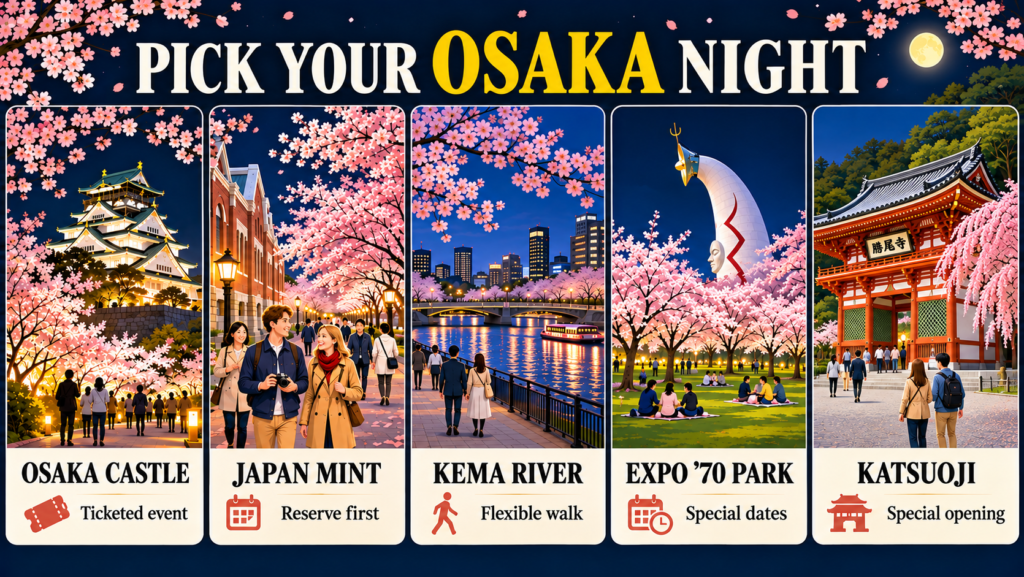
If you want the strongest first-time image and can accept a fixed event, wait for Osaka Castle’s announcement. If your priority is freedom, use Kema Sakuranomiya around sunset and keep the walk short. If the Japan Mint is the reason for the evening, secure its required entry arrangement before planning dinner, transport or another blossom stop.
Osaka Castle: commit only after the night event is announced
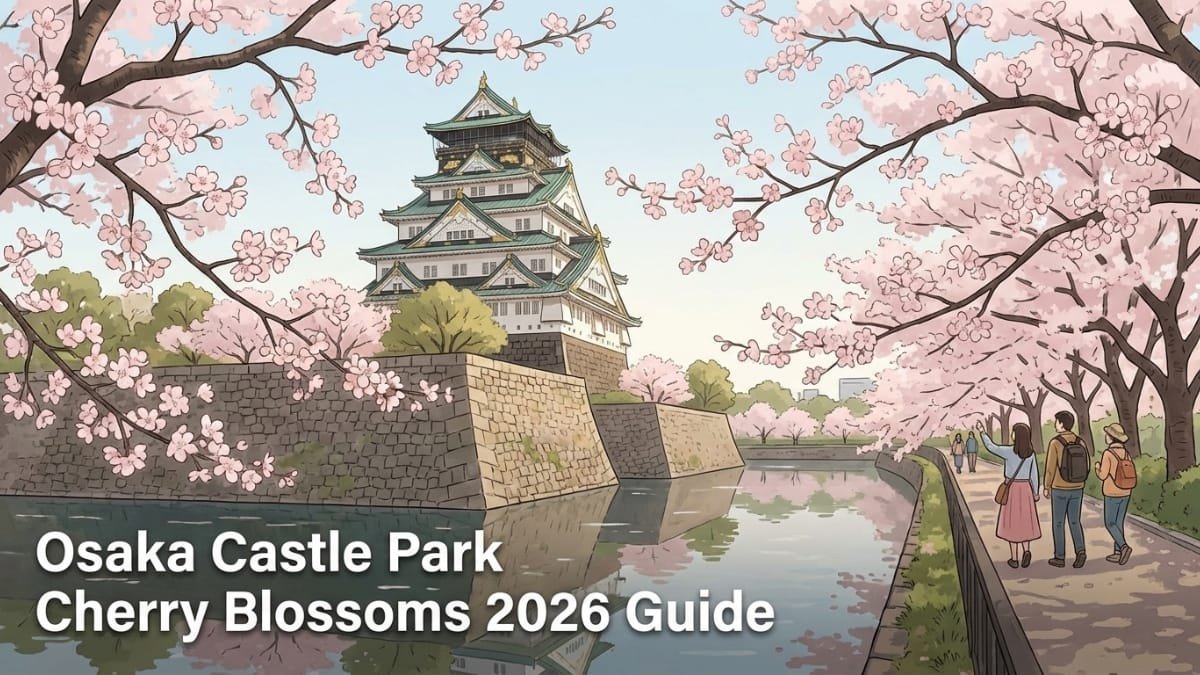
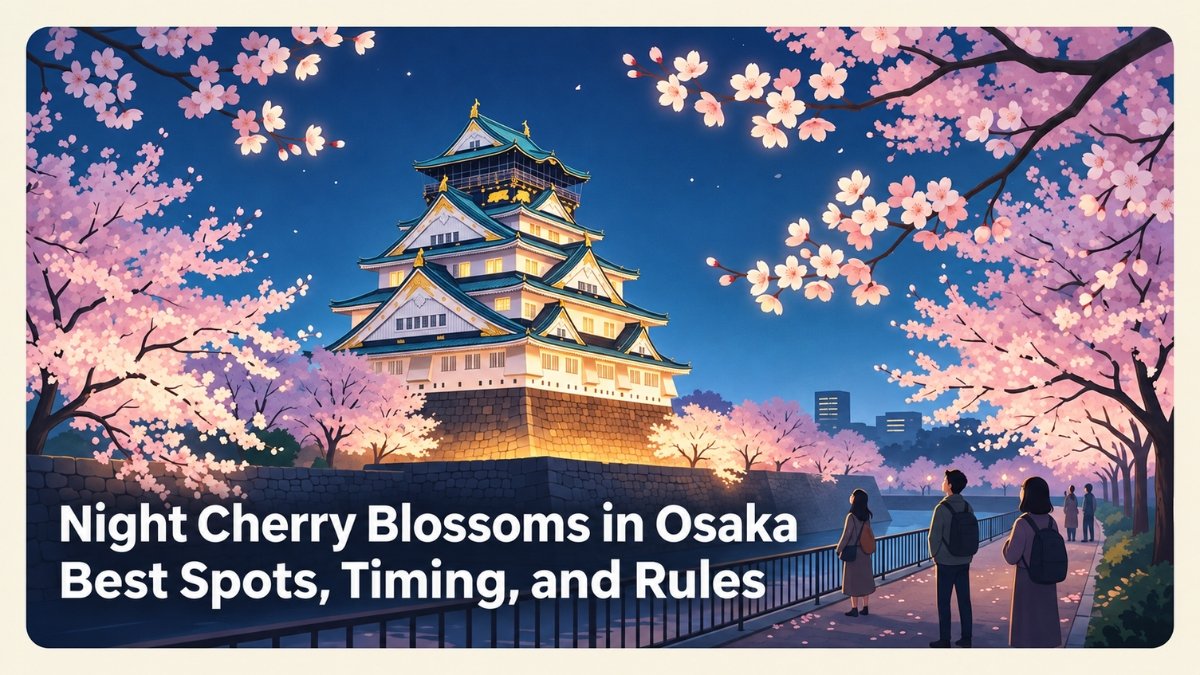
Nishinomaru Garden sits west of Osaka Castle’s main tower and creates the most deliberate castle-and-sakura composition in this guide. It is different from the surrounding public park: the garden is a controlled area with its own admission and operating conditions.
The official Osaka Castle Spring Festival archive shows how the 2026 version worked. It opened Nishinomaru until 9:00 p.m., set final admission at 8:30 p.m. and charged a special ¥350 admission for high-school-age visitors and older. Those figures are useful evidence of the event format, but they are not 2027 operating information.
For a future visit, open the Osaka Castle Park official site and look for the new spring program. Confirm four items on the same page: event period, illumination time, final admission and seasonal price. Then save Nishinomaru Garden on Google Maps rather than navigating only to the broad “Osaka Castle Park” pin.
Do not arrive with an old 9:00 p.m. closing time in mind. On an ordinary day, Nishinomaru’s schedule can be much earlier than a special night event. Our separate Osaka Castle Park cherry blossom guide explains the garden, free park areas and useful entry stations in more detail.
Japan Mint: reserve first, then build the evening
The Japan Mint’s Cherry Blossom Passage is not a public park route. It is a short annual opening of Mint grounds, traditionally arranged as a one-way walk. The trees include many varieties beyond the city’s dominant Somei Yoshino, which is why the passage can create a later blossom opportunity rather than simply repeating the main city peak.
The official 2026 English notice required an advance, first-come reservation and did not admit visitors without one. Guests entered at a designated time, showed a 2D code, passed a baggage inspection and followed the route from the south entrance near Temmabashi to the north exit near Sakuranomiyabashi. The event was free, but “free” did not mean “walk in whenever you like.”
The same notice prohibited eating, drinking, smoking, parasols, selfie sticks and tripods inside the Mint. These are 2026 rules, not a promise that every detail will be identical next time. Treat them as a warning to read the new notice from top to bottom, not just its date headline.
When the next program appears on the Japan Mint Cherry Blossom Passage page, make the reservation before committing to a restaurant or a second attraction. Save the confirmation code offline, note the correct entrance—not merely the Mint’s general map pin—and allow time for the walk from Temmabashi or Osakajokitazume. Because the passage is one-way, your exit will not return you to the point where you entered.
Kema Sakuranomiya: flexible does not mean formally illuminated
Kema Sakuranomiya Park follows both banks of the Okawa River between the Kema area and Tenmabashi. Osaka City lists it as always open, with cherry trees, toilets and no park shop or restaurant. That makes it the easiest option to shorten, extend or abandon when the weather changes.
It also creates the most common misunderstanding in this guide. Always open does not mean that the whole riverside is staged as a night illumination. City lights, bridges and nearby buildings may brighten parts of the route, but you should not promise yourself a continuous tunnel of floodlit trees.
The better plan is to arrive before sunset, use a familiar station such as JR Sakuranomiya or Osakajokitazume, and assess the path, crowd level and available light while you can still see the surroundings clearly. Walk one useful segment rather than treating the park’s full length as a nighttime target. The official Osaka City park page gives permanent facility information; Google Maps helps you save the station and turnaround point you actually intend to use.
This is the strongest backup when a ticketed event is sold out or has not yet been announced. It is not the right backup when heavy rain, strong wind or poor visibility is the reason the formal event no longer works.
Do not leave until four checks are green
For a formal night event, one event listing should answer all four of these questions:
- Is this year shown? A page headed 2026 is an archive after the season, even if it still ranks highly in search.
- Can you enter? Confirm whether admission is walk-up, ticketed or reservation-only, and whether every visitor needs a code.
- When is the real cutoff? “Open until 9:00 p.m.” and “last admission 8:30 p.m.” are different facts. Transport disruptions do not normally extend the gate.
- Can you get back comfortably? Check the final useful train, monorail or bus and leave a buffer for queues and the walk out.

Screenshots help when mobile reception is weak, but take them only after checking the page date. Save the official notice, reservation code, exact entrance and return route together. If any one of the four checks is unresolved, treat the plan as provisional.
One season offers two different bloom windows
Central Osaka’s broad Somei Yoshino wave and the Japan Mint’s mixed, often later-flowering collection should not be treated as one fixed week. Weather can move the main bloom earlier or later, and rain or wind can shorten the most photogenic phase. Different cherry varieties then open on their own schedules.
Use that sequence strategically:
- For Osaka Castle, Kema Sakuranomiya and a possible Expo ’70 illumination, start with the current city and venue reports for the main blossom wave.
- For the Japan Mint, wait for the Mint’s own annual dates. Its event period is chosen around its collection and cannot be inferred from the Castle’s trees.
- For Katsuoji, the official spring guide places its usual mountain blossom season from early to late April, but that describes a broad seasonal tendency—not a night-opening calendar.

If your dates are fixed, choose the place you would still enjoy with imperfect blossoms. A castle setting, river walk or temple visit can carry the evening when the flowers are slightly early or past peak. Our wider Osaka cherry blossom spots guide helps you compare daytime and later-season alternatives.
Central night or destination trip?
Osaka Castle, the Mint and the southern half of Kema Sakuranomiya can fit naturally into a central Osaka day. Expo ’70 Park and Katsuoji require a different mindset.
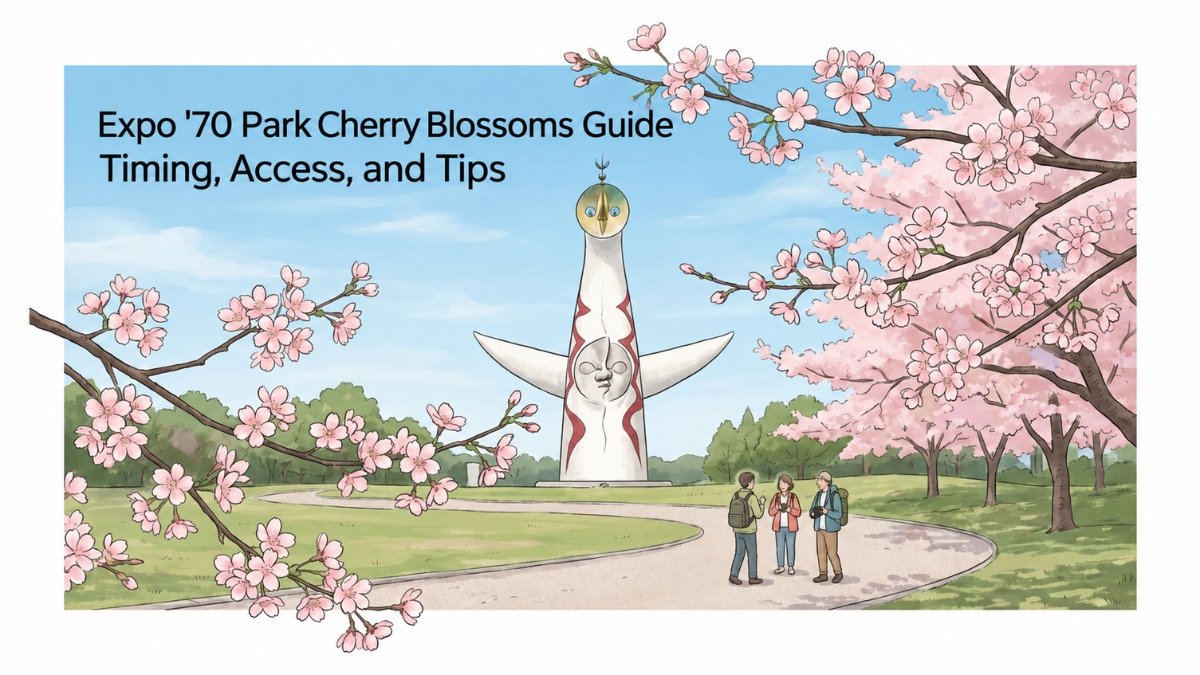
Expo ’70 Commemorative Park is a 260-hectare destination in Suita, normally reached by Osaka Monorail. Its regular park hours and admission do not guarantee a night visit. The 2026 spring event ended, and the current official event list reviewed on October 13 did not publish a 2027 cherry-blossom night program. Build a normal daytime park plan first; add illumination only after the park announces extended hours. See the official park site, save the exact destination, and use our Expo ’70 Park cherry blossom guide for the full station-to-gate plan.
Katsuoji is a mountain temple in Minoh. Its current normal schedule closes at 5:00 p.m. on weekdays, Sundays and holidays, and at 6:00 p.m. on Saturdays, with entry ending 30 minutes earlier. Therefore it is not a dependable night-sakura option unless the temple announces a special evening opening. The official spring page describes blossoms from early to late April, while the current hours and access page controls whether a night visit is possible. If a special opening is announced, check the temple location, outbound transport and the last practical return before buying or reserving anything.

The Japanese Garden in Daisen Park is a worthwhile daytime garden, but it is not included here as a night-sakura recommendation. No reliable recurring night-cherry-blossom program was established in the current official information reviewed for this update.
Three evening plans that survive changes
The classic event night
Reserve the evening for Nishinomaru only after the new Osaka Castle program is live. Eat before entering or plan dinner after leaving; do not place a rigid reservation immediately against the final-admission cutoff. If the event is not running, use the free park before dark and finish somewhere with normal evening operations instead of searching for an unannounced gate.
The flexible river night
Reach Sakuranomiya before sunset, walk a comfortable section of Kema Sakuranomiya and turn back or exit at the station that suits your onward route. This plan tolerates a late start better than a ticketed event. It does not require you to cover the whole riverbank.
The Mint night
Treat the reserved Mint slot as the anchor. Approach the correct south entrance, complete the one-way passage and let the north exit determine what comes next. A short riverside extension may be possible if conditions are good, but do not promise a second formal blossom event on the same night.
For any version, define a backup before dinner. “Kema Sakuranomiya if the event is sold out” is a real alternative. “We will decide after reaching the closed gate” is not.
After dark, comfort and rules become part of the view
Spring evenings beside the river or on open lawns can feel colder than central shopping streets. Carry a light layer and choose shoes that remain secure on damp paving. A compact phone grip is usually more useful than equipment that may be prohibited or cumbersome in a crowd.
Keep paths and gate areas clear. Never move barriers for a photograph, aim bright lights at other visitors or block a one-way passage. At the Mint, follow that year’s published restrictions exactly. At temples, remember that the grounds remain a place of worship even during a special opening.
In a public riverside park, stay on paths you can see, keep children close to the landward side and avoid turning a quiet or poorly lit stretch into a photography challenge. Save the station you plan to use at the end, not just the attraction at the start.
The best Osaka night blossom plan is the one whose operating model matches you. Choose Nishinomaru for a confirmed, classic event; the Japan Mint for a reserved seasonal passage; Kema Sakuranomiya for flexibility; or Expo ’70 and Katsuoji only when their own special evening announcements justify the extra journey. Then check the year, the gate, the cutoff and the way home one final time.