Expo ’70 Commemorative Park gives you a very different cherry blossom day from central Osaka. Instead of fitting one riverbank or castle garden into a city itinerary, you travel to a 260-hectare park in Suita and choose among broad avenues, mixed-variety planting and a formal Japanese landscape. The reward is space and variety; the trade-off is that a vague “go to the park” plan can turn into a long, tiring walk.
The 2026 SAKURA EXPO and its night program have ended. Spring 2027 dates, extended hours, illumination details and food-stall plans had not been announced as of October 9, 2026. This guide separates the park information you can use now from the seasonal details you should verify later.
For most first visits, use Bampaku-kinen-koen Station, enter through the Central Gate, and make one blossom zone your priority. Allow about two hours for a focused walk or half a day if you also want the Japanese Garden or the inside of the Tower of the Sun.
This is a park day, not a central Osaka add-on
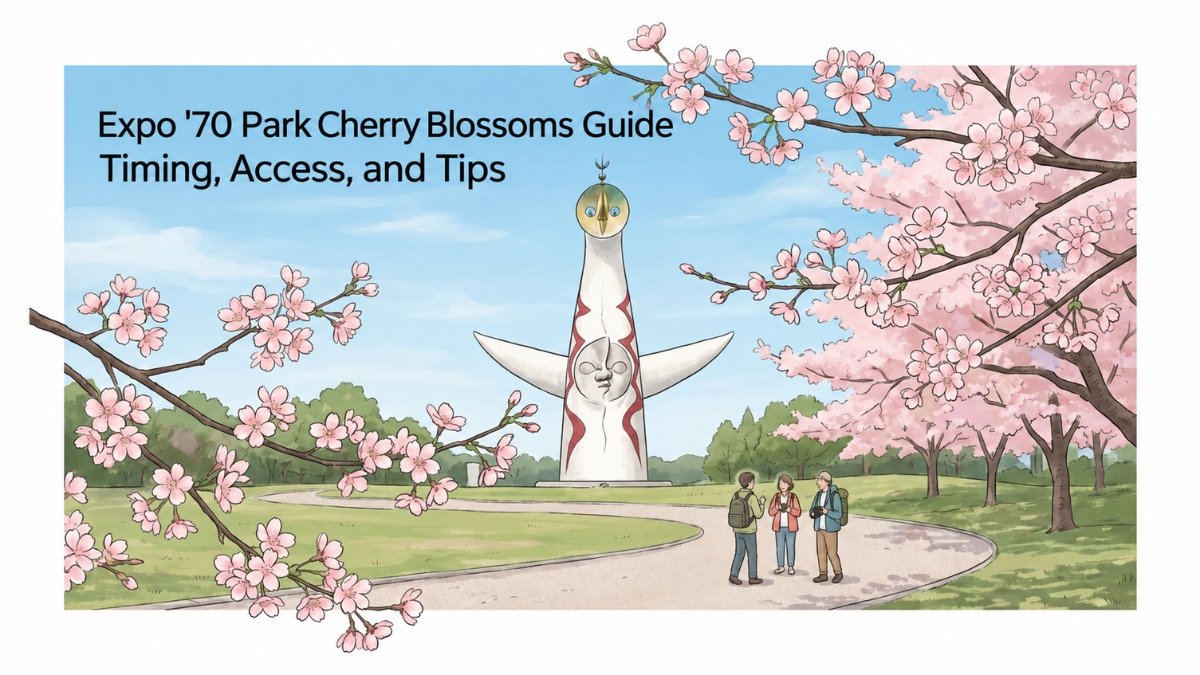
Expo ’70 Commemorative Park occupies the former site of the 1970 Japan World Exposition. The Tower of the Sun remains its visual anchor, but the grounds now combine the Natural and Cultural Gardens, the Japanese Garden, museums, sports facilities and large lawns.
That scale changes the planning. A visitor who wants the famous avenue-and-tower scene does not need to cross the entire park. A visitor chasing several cherry varieties should accept more walking. A family or anyone managing fatigue may get more from one compact zone and a café stop than from a complete circuit.
Choose your goal before you enter:
- Classic first visit: Tower of the Sun exterior, Higashioji avenue and nearby lawns.
- Wider blossom search: Higashioji plus Sakura no Nagare, using the current bloom update to decide whether the extra walk is worthwhile.
- Slower landscape visit: Japanese Garden, with one nearby blossom area rather than a full-park loop.
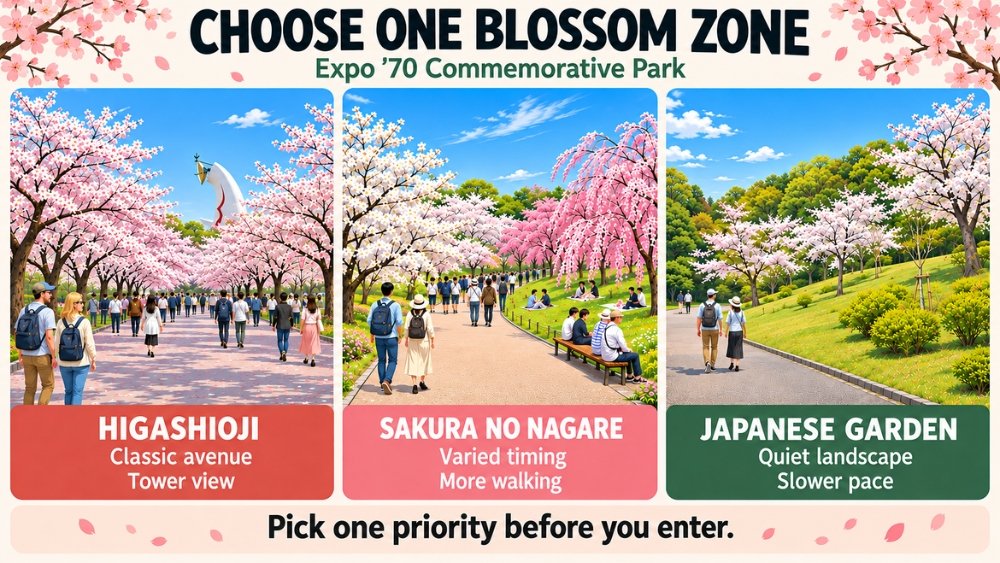
Choose one blossom zone before entering
Higashioji: the recognizable avenue
Higashioji is the strongest default when you want the broad cherry-lined approach associated with the spring event and a chance to compose the blossoms with the Tower of the Sun. It is easy to connect with the Central Gate and the tower area, so it suits a first visit and a shorter stay. It can also feel busy around the main bloom period.
Sakura no Nagare: useful when varieties overlap
Sakura no Nagare appears repeatedly in the park’s official bloom records for different cherry varieties. That makes it useful when your dates fall before or after the main Somei Yoshino peak. It is not a guarantee of flowers on any particular day: use the current park update to see which variety and area are actually being reported.
Japanese Garden: a quieter change of pace
The Japanese Garden was created for Expo ’70 and is best enjoyed for its water, stone, bridges and carefully composed planting. You can see cherry blossoms here, including Kanzan cherries (botan-zakura), when they bloom, but the garden scenery is the main attraction. If you want to see lots of cherry blossoms, prioritize Higashioji or Sakura no Nagare and add the garden for a quieter change of pace. Entry is included in the common Natural and Cultural Gardens/Japanese Garden admission, but the walking time still deserves a place in your plan.
Three clocks matter more than one forecast date
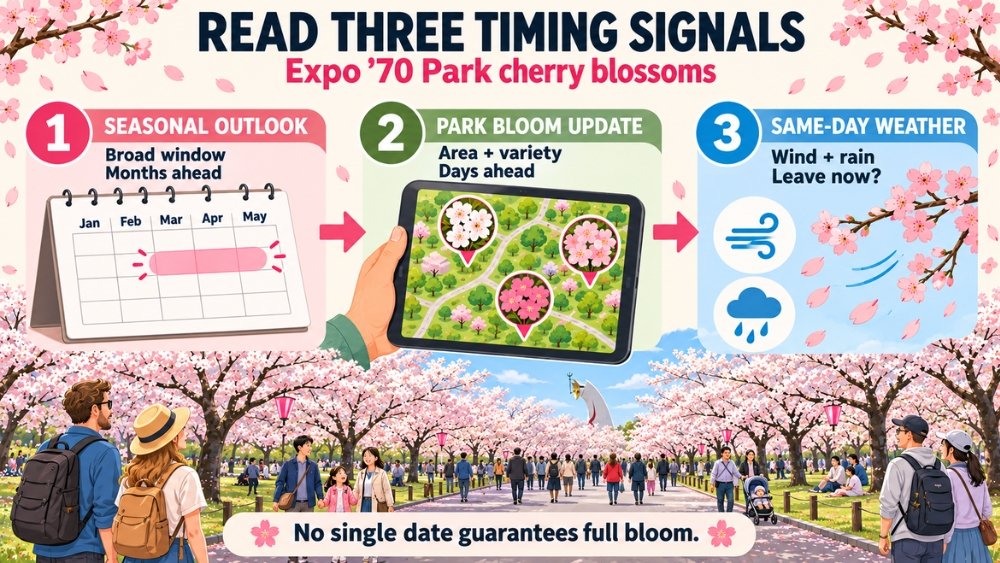
Cherry blossom forecasts are useful, but they answer only the broad question: when might the city’s main Somei Yoshino trees open and reach full bloom? They do not tell you whether one avenue at Expo ’70 Park looks ready, whether a later variety is still attractive or what wind and rain did overnight.
Use three layers of information:
- Seasonal outlook: use it to protect a broad Osaka travel window, not to promise one perfect day.
- The park’s bloom update: shortly before visiting, read the official cherry blossom page for named varieties, observation dates and areas.
- Same-day weather: wind and sustained rain affect comfort and can remove petals quickly, even when a forecast still says “full bloom.”
The park’s 2026 records illustrate why this matters. Early records covered Higan and Kanhi cherries; Somei Yoshino was then documented at Higashioji and Sakura no Nagare, as well as within the Japanese Garden, an optional stop for garden scenery; later Satozakura remained at East Plaza after the main wave. That sequence is evidence that the park can offer more than one bloom phase—not a calendar to copy into 2027.
If your Osaka dates are fixed, compare this outing with the city alternatives in our Osaka cherry blossom spots guide. Expo ’70 Park is strongest when you want a spacious half-day; it is less efficient when you have only a short gap between central Osaka plans.
The low-friction route is rail plus monorail
From Namba, Umeda or Shin-Osaka, a practical route is the Osaka Metro Midosuji Line/Kita-Osaka Kyuko through service to Senri-Chuo, followed by Osaka Monorail to Bampaku-kinen-koen. Other starting points may make Yamada or Minami-Ibaraki the easier monorail interchange, so use a live journey planner rather than memorizing one universal route.
An IC card—such as ICOCA, Suica or PASMO—lets you tap through the participating rail gates without buying a separate ticket for each segment. Keep enough stored value for both operators and follow the platform signs for Bampaku-kinen-koen.
Once you arrive at Bampaku-kinen-koen Station on the Osaka Monorail, exit through the ticket gates and turn left. Follow the signs for Expo ’70 Commemorative Park, continue along the right side of the slope, then turn left at NIFREL. Pass through the Natural and Cultural Gardens arch, cross the footbridge, and continue toward the Tower of the Sun Museum to reach the Central Gate.
The official Osaka Monorail walking guide shows the route step by step. The operator estimates about a five-minute walk from the station, but crowds and photo stops can make it longer.
Koen-higashiguchi Station serves the east side of the grounds. It can make sense for an East Plaza destination or a deliberately one-way park plan, but Bampaku-kinen-koen is the clearer default for the Tower, Higashioji and a first visit.

Build the visit around your available time
For a focused two-hour visit, arrive through the Central Gate, see the Tower of the Sun exterior, walk Higashioji and use the latest bloom update to choose one nearby extension. Leave time to return to the gate; the final walk out is easy to underestimate when the lawns are busy.
For a half-day visit, add Sakura no Nagare for more blossoms or the Japanese Garden for a change of landscape, then schedule food or a rest before returning. Add the Tower of the Sun interior only with a booking that fits the route. The inside visit is a separate paid attraction, and the park advises reserving by the previous day for certainty; same-day tickets are sold only when capacity remains.
Trying to combine every blossom area, the Japanese Garden, the tower interior and a museum is a full-day project. If cherry blossoms are the priority, let them remain the priority.
Know the normal hours and admission first
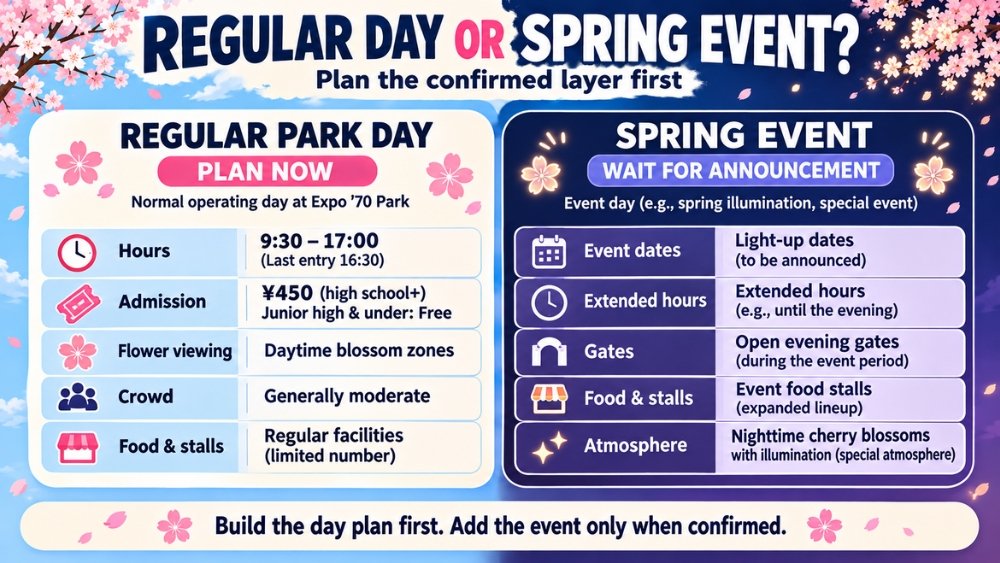
The park’s normal opening hours are 9:30 a.m. to 5:00 p.m., with last admission at 4:30 p.m. It normally closes on Wednesdays, or the next weekday when Wednesday is a holiday or substitute holiday. The current schedule lists no regular closure from April 1 through May 2, but events and weather can still change access. Check the official hours page close to your visit.
As of October 2026, common admission to the Natural and Cultural Gardens and Japanese Garden is ¥450 for high-school-age visitors and older; children through junior high school are free. The Tower of the Sun, EXPO’70 Pavilion and some other facilities have separate fees. Paying the general park fee does not reserve the tower interior.
The park accepts cash and supported cashless methods at designated admission and parking terminals. If you want to use a transit IC card at the gate, look for the compatible terminal rather than assuming every counter has the same setup.
Plan a normal park day before planning a night event
The regular park day—daytime admission, normal closing time and the permanent gardens—is the dependable base plan. Spring-only features are a second layer.
In 2026, the seasonal program included extended hours, illuminated blossoms and temporary food vendors. None of those details should be carried forward automatically. Wait for the new official announcement before building a 2027 evening around a light-up, late entry, a particular gate or a vendor lineup.
This distinction is especially important for travelers coming from central Osaka. Arriving after the normal last-admission time because an old article shows a 9:00 p.m. close can ruin the whole trip. Until the new program is confirmed, plan to enter during regular hours and treat any later opening as a bonus.
Food, picnics and practical comfort
The park has permanent cafés, light-meal counters, shops and a convenience store, while the Japanese Garden has its own rest facility. Opening days and hours differ by outlet. Seasonal stalls add choice when announced, but they should not be your only meal plan.
For a picnic, carry only what you are comfortable taking through a large park and follow any temporary restrictions around crowded blossom areas. Barbecue facilities are separate, time-limited and reservation-based; a normal picnic lawn is not permission to light a grill.
Wear shoes with grip after rain. The park specifically warns that riverside areas, fallen leaves and moss can become slippery. A light layer also helps: the open lawns and evening conditions can feel cooler than dense streets in central Osaka.
Families and visitors managing mobility should decide the route before entering. The park lists five nursing rooms and lends strollers and wheelchairs free of charge on a first-come basis, without advance reservations. Quantities are limited, and equipment normally returns to the gate where it was borrowed. Large distances remain the main accessibility issue even when individual paths are step-free.
Driving is possible, but rail is easier at peak bloom
Expo ’70 Park has several parking areas. As of October 2026, an ordinary car costs ¥410 for up to two hours on a weekday and ¥620 on a weekend or holiday; the maximum for more than four and up to 24 hours is ¥1,100 on a weekday and ¥1,600 on a weekend or holiday. Parking discounts from EXPOCITY do not apply to the park’s own lots.
Those prices do not solve the larger spring problem: approach roads, entrances and payment queues are busiest when blossoms and seasonal events draw the most visitors. Rail is the lower-risk default. If driving is necessary, check the current official parking information before departure and save the exact lot rather than using the park name as a single map pin.
Save these links before leaving Osaka
Keep the official Expo ’70 Park site, the park map and English guides, the current blossom update and Expo ’70 Park on Google Maps together on your phone. Then make four final checks: today’s bloom area, normal or event hours, wind and rain, and whether the Tower of the Sun booking is part of the day.
If you want the easiest central-Osaka castle setting instead, use our Osaka Castle Park cherry blossom guide. Choose Expo ’70 Park when the larger landscape, changing varieties and a slower half-day are the point—not when you are trying to squeeze one more landmark into a crowded itinerary.