
Kyoto accommodation can become difficult to find or unusually expensive during peak travel periods. Cherry blossom season, Gion Matsuri, autumn foliage and long holiday weekends can leave travelers with a frustrating choice: pay far more than expected, accept a hotel in an inconvenient part of Kyoto, or change the trip completely.
There is another option: stay in Osaka and visit Kyoto by train.
For many travelers, this is not only realistic — it can make a better-balanced trip. Osaka gives you more hotel districts to search, accommodation at many price levels, larger family-oriented and apartment-style options, excellent food, shopping and nightlife after you return, and three useful railway approaches to Kyoto.
The important point is that there is no single “Osaka to Kyoto” route. Your best train depends on where you stay in Osaka and where you want to start sightseeing in Kyoto.
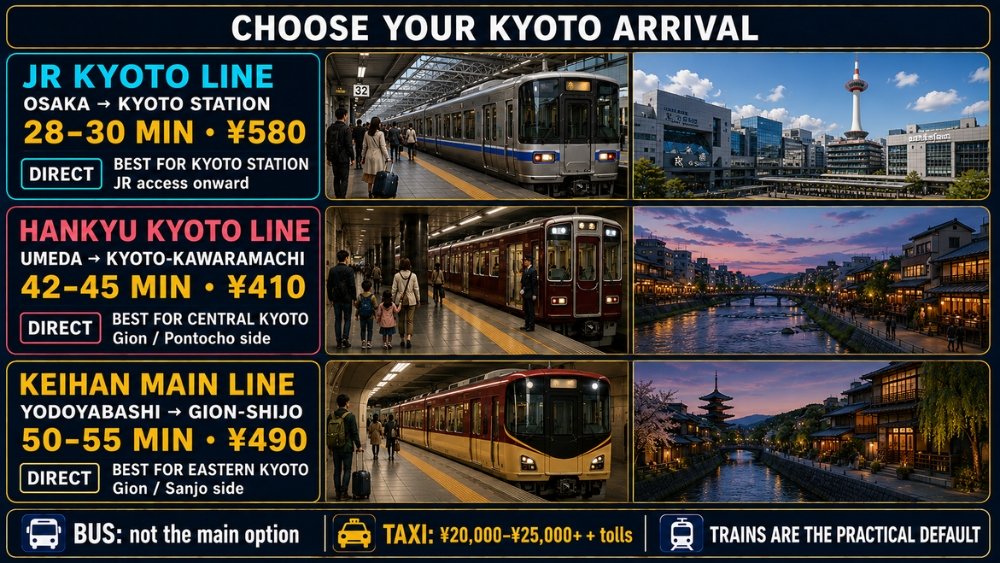
As of August 2026, a JR Special Rapid can take you from Osaka Station to Kyoto Station in about 28–30 minutes for ¥580, Hankyu can take you from Osaka-Umeda to Kyoto-Kawaramachi in about 42–45 minutes for ¥410, and Keihan is a strong direct option from Yodoyabashi to Gion-Shijo at about 50–55 minutes for ¥490.
That makes Osaka a practical Kyoto base — but only if you choose it with the commute in mind.
Important: Fares and typical journey times in this guide were checked against current operator information on August 26, 2026. Exact departure times, stopping patterns and last trains vary by date. Special schedules can also operate during major events, so recheck the official operator timetable for your travel day.
The short answer: when staying in Osaka works well
Staying in Osaka is especially sensible when:
- the Kyoto hotel you want is sold out;
- remaining Kyoto rooms are much more expensive than comparable Osaka hotels;
- you plan to spend two or three days in Kyoto rather than your entire trip there;
- you also want Osaka food, shopping or nightlife;
- you can stay close to Osaka Station, Osaka-Umeda, Shin-Osaka or Yodoyabashi;
- your Kyoto sightseeing can begin around normal morning hours rather than before sunrise.
It is less attractive when you want to be in Kyoto extremely early every morning, when you expect to stay in Kyoto until the last train every night, or when most of your itinerary is concentrated in places that require another long local journey after reaching Kyoto.
The railway ride itself may be only 30–55 minutes. Door to door, however, you should usually budget more. Walking through a large station, waiting for a connection and getting from your Kyoto arrival station to the first sight can easily add another 15–30 minutes.
JR, Hankyu or Keihan? Choose by your Kyoto destination
Here is the practical comparison for most visitors.
| Route | Typical Osaka departure | Useful Kyoto arrival | Typical direct ride | Adult one-way fare | Transfer normally needed? | Best use |
|---|---|---|---|---|---|---|
| JR Kyoto Line | Osaka Station / Shin-Osaka | Kyoto Station | about 28–30 min from Osaka; about 24 min from Shin-Osaka on a fast current service | ¥580 | No | Kyoto Station, onward JR connections, first-time simplicity |
| Hankyu Kyoto Line | Osaka-Umeda | Kyoto-Kawaramachi | about 42–45 min on many limited/semi-limited expresses | ¥410 | No | Shijo, Kawaramachi, Nishiki, Pontocho, Gion side of central Kyoto |
| Keihan Main Line | Yodoyabashi | Gion-Shijo | about 50–55 min on typical fast through services | ¥490 | No | Gion, Higashiyama, Sanjo, Shichijo; useful line for Fushimi Inari |
| Bus | No comparable central shuttle to recommend | — | — | — | — | Not a practical default for this commute |
| Taxi | Door to door | Door to door | roughly 60–90+ min depending on traffic | roughly ¥20,000–¥25,000+ as a planning estimate, plus tolls | No | Large luggage, groups, exceptional late-night situations |
A terminology note for first-time visitors: on Hankyu and Keihan, a limited express is a faster train that skips more local stops. Standard limited express cars can normally be used with the ordinary fare; a separate charge applies only if you choose a specific paid reserved-seat product such as PRiVACE or Premium Car. This is different from many JR trains branded “Limited Express,” which often require an additional limited-express ticket.
JR: best when Kyoto Station is genuinely useful to you
For most first-time visitors, JR is the easiest route to understand. JR means Japan Railways; in this region, conventional JR services are operated by JR West.
From Osaka Station, the JR Kyoto Line’s Special Rapid trains can reach Kyoto Station in roughly 28–30 minutes on current schedules. From Shin-Osaka, the same conventional rail corridor can be even quicker; a current Special Rapid example covers Shin-Osaka to Kyoto in about 24 minutes. The current adult ordinary fare from either Osaka or Shin-Osaka to Kyoto is ¥580.
You do not need to reserve a standard seat on an ordinary Special Rapid. Some selected trains include a paid reserved-seat section, but the normal cars remain the straightforward option for most tourists.
The normal cars are unreserved and can be crowded at commuter times and on peak-season weekends. Families and travelers with suitcases should avoid blocking doors, board with enough time to move inside, and consider a later train rather than forcing luggage into a full car. A hotel physically at Osaka Station or Shin-Osaka makes this route much easier than a property that merely advertises the wider “Umeda” area.
JR works particularly well if:
- your hotel is at Osaka Station, Umeda or Shin-Osaka;
- you want to arrive at Kyoto Station;
- you are continuing to places served by JR;
- you want to change at Kyoto to the JR Nara Line for Inari Station, beside Fushimi Inari Taisha;
- you are going toward Saga-Arashiyama using JR after changing in Kyoto.
The main weakness is location. Kyoto Station is an excellent transport hub, but it is not next to Gion, Nishiki Market or the heart of Shijo-Kawaramachi. If those are your first stops, the fastest train to Kyoto Station may still produce a slower total journey.
Use JR West’s route and timetable search for your date. Save JR Osaka Station and Kyoto Station in Google Maps before the first morning.
Do you need the Shinkansen from Shin-Osaka? Usually not. The Shinkansen (Japan’s bullet train) covers the station-to-station section in roughly 14 minutes, but it uses separate Shinkansen gates and requires a basic fare plus a limited-express ticket. The conventional JR Kyoto Line is already direct, costs ¥580 and is normally the simpler daily commute. A route app showing the bullet train first does not mean it is the best overall journey.
Hankyu: often the smartest choice for downtown Kyoto
Hankyu is a private railway, meaning it is not part of JR. From Osaka-Umeda, frequent Kyoto Line services run directly to Kyoto-Kawaramachi.
Current limited and semi-limited express examples take roughly 42–45 minutes, and the adult one-way fare is ¥410.
Kyoto-Kawaramachi is one of the most useful arrival points for visitors who want central Kyoto. You step out around the Shijo-Kawaramachi area, with Nishiki Market, Pontocho and the Kamo River close by; Gion is across the river.
Hankyu therefore pairs exceptionally well with an Umeda hotel.
It is also useful for Arashiyama. Instead of going all the way to Kyoto-Kawaramachi, you can change at Katsura for the Hankyu Arashiyama Line. That can be more logical than traveling via Kyoto Station depending on your starting hotel and itinerary.
Most ordinary Hankyu limited express services do not require a seat reservation. On eligible trains, Hankyu also operates PRiVACE, a paid reserved-seat car. This can be attractive during crowded periods if you value a guaranteed seat.
For a family, the main inconvenience is often the walk across the Osaka-Umeda complex rather than the ride. Stay near Hankyu or learn the indoor route in advance. With substantial luggage, ordinary cars are workable outside the busiest periods; PRiVACE can reduce seat uncertainty, but a reservation does not remove the need to handle the bags yourself.
Check the official Osaka-Umeda station timetable and the current PRiVACE conditions. In Kyoto, save Kyoto-Kawaramachi Station rather than only searching for “Kyoto Station.” They are different arrival areas.
Keihan: particularly good for Gion and eastern Kyoto
Keihan is another private railway, and it follows a different corridor into Kyoto. Its Osaka terminal at Yodoyabashi is especially useful if you stay in the Yodoyabashi or Kitahama area.
The key arrival for many visitors is Gion-Shijo Station. The adult one-way fare from Yodoyabashi to Gion-Shijo is ¥490. Typical fast through journeys are around 50–55 minutes; exact times depend on the service.
The ride is longer than JR to Kyoto Station, but that comparison can be misleading. If your first destination is Gion or Higashiyama, Keihan can save you the local transfer you would need after arriving at Kyoto Station.
Keihan is also useful for:
- Shichijo, convenient for the eastern side of the Kyoto Station area and nearby sights;
- Sanjo, north of Gion-Shijo;
- Fushimi-Inari Station, on the same line as Yodoyabashi.
One detail matters at Fushimi Inari: the fastest limited express trains do not stop at Fushimi-Inari Station, so you normally change to a service that does. Do not simply board the fastest-looking train and assume it stops everywhere.
Keihan also offers a Premium Car with reserved seating on limited express services. It requires an additional Premium Car ticket on top of the normal passenger fare. For families or travelers tired after a long day, the guaranteed seat and luggage space can be worth considering.
Yodoyabashi is the Osaka end of the line, which can make boarding calmer than joining later, although no seat is guaranteed in an ordinary car. Travelers with a stroller or large case should remember that changing from a fast train to a stopping service for Fushimi-Inari adds a platform transfer.
The current Gion-Shijo fare table lists Yodoyabashi at ¥490. Use Keihan’s English ticket guide and Premium Car guide if you want a reserved seat. Save Yodoyabashi Station and Gion-Shijo Station in Google Maps.
At the station, follow the railway company — not only “Kyoto”
JR Osaka Station and Hankyu Osaka-Umeda Station are in the same district but have different gates. At Shin-Osaka, follow JR Lines for the ¥580 conventional train, not the Shinkansen gates. At Yodoyabashi, follow signs for Keihan Railway, not only the red Osaka Metro Midosuji Line. A ticket gate is the barrier where you insert a paper ticket or tap an IC card before entering the paid platform area.
Platform numbers can change with service patterns, so use the live departure board rather than memorizing one number from a guide.
What about a bus between Osaka and Kyoto?
For an ordinary sightseeing commute, I would not choose a bus over the train.
Current highway-bus route lists from major operators include services that pass through Osaka and Kyoto as part of longer intercity routes, plus suburban routes using “Kyoto” in the name. They do not present a frequent central-Osaka-to-central-Kyoto shuttle that competes cleanly with JR, Hankyu or Keihan for this purpose. For example, the current Keihan Bus Direct Express Q Kyoto page serves Kyoto Station and suburban stops rather than a useful central Osaka hotel district.
That matters because a bus comparison can look attractive on paper while being useless in practice. Longer-distance coaches may have limited departures, reservation rules or restrictions designed for passengers traveling beyond the Osaka–Kyoto section.
For a hotel commute, the railways are faster to understand, more frequent and better integrated with the areas where visitors usually stay.
Is a taxi realistic?
Technically, yes. Economically, usually no.
The Osaka Taxi Association’s current fare table gives a representative standard-car tariff of ¥600 for the first 1.2 km and ¥100 for each additional 231 m, with time-distance charges when traffic is slow. It also notes that expressway tolls are extra and that actual fares vary by company, route and congestion.
Using that tariff as a planning basis, a central Osaka-to-central Kyoto taxi is a low-to-mid ¥20,000s trip, not a normal alternative to a ¥410–¥580 train. Treat roughly ¥20,000–¥25,000+ plus tolls as an order-of-magnitude estimate rather than a quoted fare.
A taxi can still make sense when:
- three or four people are splitting the cost;
- you have several large suitcases;
- a child or elderly traveler makes multiple transfers difficult;
- you miss the final useful train;
- you need true door-to-door transport for a special reason.
If you start the taxi in Kyoto, Kyoto-area taxi tariffs apply rather than Osaka’s fare table, so get a live quote from the operator or app rather than assuming the same amount in both directions.
Where should you stay in Osaka for Kyoto day trips?
Your Osaka neighborhood is more important than shaving five minutes from a train schedule.
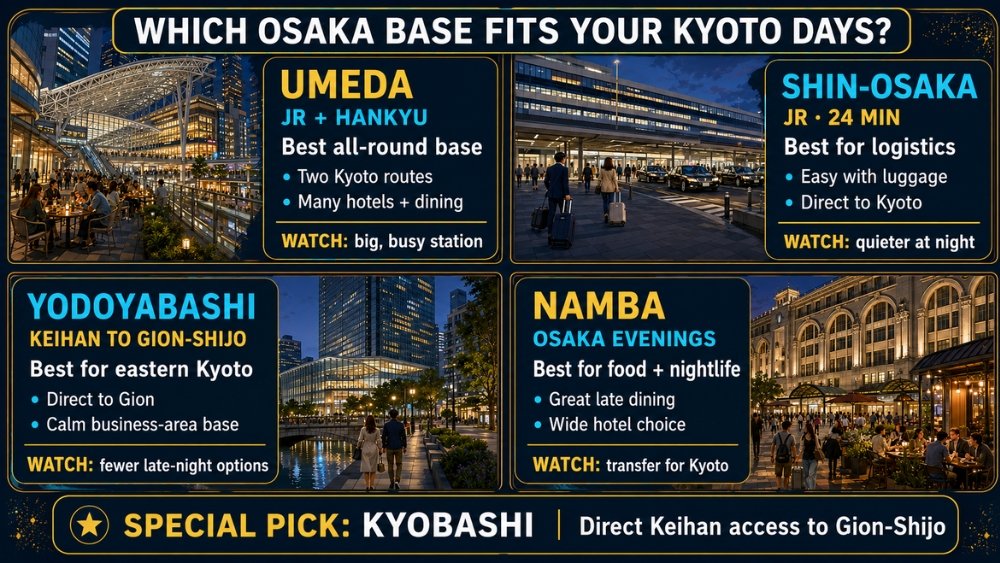
For a wider city-level comparison, Osaka Map’s guide to the best Osaka areas for first-time visitors explains how Umeda, Namba, Shin-Osaka and other bases change the rest of the trip.
Umeda / Osaka Station: the best all-round base
For most travelers, Umeda is the safest recommendation.
JR Osaka Station gives you the fastest conventional rail access to Kyoto Station, while Hankyu Osaka-Umeda gives you a direct route to Kyoto-Kawaramachi. That flexibility is extremely useful if your Kyoto plans change from day to day.
Umeda also works well after you return. You have major department stores, restaurants, bars and shopping around the station, so the evening does not end simply because you left Kyoto.
The downside is complexity. Osaka/Umeda is a huge group of connected stations and underground passages. The first morning, allow extra time to find the correct railway and platform.
Osaka Map’s Shin-Osaka vs Osaka Station guide is useful if the two names are still confusing.
Shin-Osaka: best for pure transport efficiency and luggage
Shin-Osaka is not the most atmospheric place to stay, but it is extremely practical.
It is on the JR Kyoto Line and is Osaka’s Shinkansen station. If you are arriving from Tokyo, Hiroshima or another city with luggage, staying here can eliminate an extra hotel transfer. Current conventional JR services can reach Kyoto very quickly without needing to use the more expensive Shinkansen for this short journey.
Choose Shin-Osaka if your priority is logistics, not nightlife.
Yodoyabashi: underrated for Gion and Higashiyama
Yodoyabashi is a business district rather than an obvious tourist base, which is exactly why it can work so well.
The Keihan Main Line starts here, giving you a direct ride toward Gion-Shijo, Sanjo and other eastern Kyoto stations. Osaka Metro’s Midosuji Line also connects Yodoyabashi directly with Umeda and Namba, so you are not isolated from Osaka’s busier evening areas.
The trade-off is simple: the neighborhood itself becomes quieter at night than Namba or Umeda.
Kyobashi: a specialist Keihan base
Kyobashi is not the usual first recommendation for an international visitor, but it has one compelling reason to appear here: Keihan trains run directly from Kyobashi to Gion-Shijo in about 40 minutes, and the current adult fare is ¥480.
It is also on the JR Osaka Loop Line, so Osaka Station and other city districts remain accessible. The station area has plenty of everyday restaurants and shops, although it is less polished and less immediately legible than Umeda. Choose it when eastern Kyoto is the clear priority and a station-adjacent hotel solves a room or family-layout problem.
Namba: choose it for Osaka, not for the fastest Kyoto commute
Namba can still be an excellent choice if you want Dotonbori, food, bars and shopping after your Kyoto day.
But Namba does not have a direct JR/Hankyu/Keihan route that makes it the obvious Kyoto-commuter base. In most cases, you first take the Osaka Metro or another local train to Umeda, Yodoyabashi or another interchange.
That extra transfer is not disastrous. It is simply a trade-off. If Kyoto is the reason for almost every day of your stay, choose Umeda, Shin-Osaka or Yodoyabashi instead. If you want a genuine Osaka evening after Kyoto, Namba may be worth the extra commute.
Use Osaka Map’s Namba hotel-area guide to check which “Namba” station a property actually means, and the Osaka nightlife area guide if late food and entertainment are part of the decision.
Osaka hotels that make sense for this specific trip
These hotels were selected for location and trip design, not fame. Rates can change dramatically by date, so no hotel below is guaranteed to be cheap during cherry blossom season, Gion Matsuri or autumn foliage.
| Hotel | Area | Best for | Kyoto route advantage | Main drawback |
|---|---|---|---|---|
| Hotel Granvia Osaka | Osaka Station | First-timers, luggage, maximum JR convenience | Directly connected to JR Osaka Station | Usually not a budget-first choice; station area is very busy |
| Hotel Hankyu RESPIRE Osaka | Umeda | Couples, families, travelers wanting JR + Hankyu flexibility | About 3 min from JR Osaka and 5 min from Hankyu Osaka-Umeda | Large hotel in a very large station district |
| VIA INN SHIN-OSAKA SHOMENGUCHI | Shin-Osaka | Solo travelers, couples, value-focused stays | 3 min from JR Shin-Osaka; direct conventional JR to Kyoto | Less nightlife than central Osaka |
| karaksa hotel grande Shin-Osaka Tower | Shin-Osaka | Families, groups, luggage-heavy trips | 5 min from Shin-Osaka; connecting rooms available | More practical than atmospheric |
| Prince Smart Inn Osaka Yodoyabashi | Yodoyabashi | Solo travelers, couples, simple stays | 1 min from Yodoyabashi; ideal for Keihan | Limited-service concept; quiet neighborhood at night |
| Hotel Keihan Kyobashi Grande | Kyobashi | Families, direct eastern-Kyoto access | Directly above Kyobashi Station; Keihan to Gion-Shijo | Kyobashi is less intuitive than Umeda for a first visit |
| Fraser Residence Nankai Osaka | Namba | Families, longer stays, Osaka nightlife | Near Midosuji Line for the transfer to Umeda or Yodoyabashi | No direct Osaka–Kyoto train from Namba |
Once you know which Osaka railway base fits your Kyoto plans, compare current Osaka hotel availability and full-stay prices. Then verify room occupancy, bed layout and exact station access on the hotel’s official website before paying.
Hotel Granvia Osaka — best for stepping straight onto JR
Hotel Granvia Osaka is directly connected to JR Osaka Station. That is almost ideal for this strategy: you can leave your room, enter the station complex and board the JR Kyoto Line without a separate subway ride. The official room list includes single, twin, double, triple and family configurations; confirm the actual bed count rather than assuming every room accepts a child as an additional guest.
Best for: first-time Japan visitors, couples, travelers with suitcases, travelers prioritizing Kyoto Station.
Trade-off: convenience is the selling point, so it may cost more than a property several stops away; the station is also busy and multi-level.
Links: Official website · Google Maps
Check rates on Klook: Hotel Granvia Osaka
Hotel Hankyu RESPIRE Osaka — best for switching between JR and Hankyu
Hotel Hankyu RESPIRE Osaka is about a three-minute walk from JR Osaka Station’s Bridge Exit and about five minutes from Hankyu Osaka-Umeda Station, according to the hotel’s access page.
That gives you something Hotel Granvia cannot offer quite as neatly: easy access to two different Kyoto arrival strategies. Use JR when Kyoto Station makes sense; use Hankyu when you want Shijo/Kawaramachi.
The hotel also has room types that can accommodate families, including rooms for up to four guests.
Best for: couples, families, travelers with changing Kyoto plans.
Trade-off: Umeda is convenient but enormous; allow time for the walk between JR and Hankyu, especially with children.
Links: Official website · Google Maps
Check rates on Klook: Hotel Hankyu RESPIRE Osaka
VIA INN SHIN-OSAKA SHOMENGUCHI — best simple base near the trains
VIA INN SHIN-OSAKA SHOMENGUCHI is about one minute from Osaka Metro’s Shin-Osaka entrance and about three minutes from JR Shin-Osaka Station. This is a strong practical choice for a solo traveler or couple who cares more about transport than about a glamorous hotel district.
Best for: solo travelers, couples, practical multi-city trips.
Trade-off: when you return from Kyoto, you are in a transport hub rather than one of Osaka’s best nightlife districts; check the selected room’s floor area if opening a large suitcase matters.
Links: Official website · Google Maps
Check rates on Klook: VIA INN SHIN-OSAKA SHOMENGUCHI
karaksa hotel grande Shin-Osaka Tower — strongest family option near Shin-Osaka
karaksa hotel grande Shin-Osaka Tower is about five minutes on foot from Shin-Osaka Station. The hotel’s current room information includes many triple and quadruple layouts plus connecting-room combinations for up to six guests. Two connected rooms also solve a practical family problem: more beds, more floor area and two bathrooms.
That combination — family-friendly room layouts plus easy railway access — makes it one of the most practical Osaka bases for a Kyoto-heavy itinerary.
Best for: families, groups, travelers with multiple suitcases.
Trade-off: the five-minute route is not station-direct, and the neighborhood is optimized for transport rather than classic Osaka nightlife.
Links: Official website · Google Maps
Check rates on Klook: karaksa hotel grande Shin-Osaka Tower
Prince Smart Inn Osaka Yodoyabashi — best value-focused Keihan pairing
Prince Smart Inn Osaka Yodoyabashi is about one minute from Yodoyabashi Station. For travelers who expect to spend time around Gion or Higashiyama, this pairing is unusually efficient: walk to Keihan, ride directly toward Gion-Shijo and avoid crossing Osaka before the intercity trip.
The hotel has a streamlined, limited-service concept. That can help when price matters, but compare the full stay rather than assuming a brand label guarantees the lowest rate during Kyoto’s peak dates.
Best for: solo travelers, couples, budget-conscious travelers, travelers prioritizing Keihan.
Trade-off: the neighborhood is calm and businesslike at night, and the hotel is more functional than full-service.
Links: Official website · Google Maps
Check rates on Klook: Prince Smart Inn Osaka Yodoyabashi
Hotel Keihan Kyobashi Grande — best specialist base for Keihan
Hotel Keihan Kyobashi Grande is directly above Kyobashi Station, where JR, Osaka Metro and Keihan meet. That removes the weakest part of many commutes — the first local ride — and puts you on the direct Keihan corridor to Gion-Shijo.
The hotel’s family room is 36 square metres and can sleep up to four with the specified additional bedding. That makes the property unusually relevant when a family cannot find a suitable Kyoto room, not merely when Kyoto prices are high.
Best for: families, eastern-Kyoto days, travelers who want direct station access.
Trade-off: Kyobashi is efficient and lively, but it is less visually polished and less intuitive for a first-time visitor than Umeda.
Links: Official website · Google Maps
Check rates on Klook: Hotel Keihan Kyobashi Grande
Fraser Residence Nankai Osaka — best when the room must work like a home
Fraser Residence Nankai Osaka is near Nankai Namba and Osaka Metro Namba. Its serviced-apartment layouts include kitchens and in-room washer/dryers; official one- and two-bedroom options add separate living space, which can be valuable for families and longer stays.
This is an intentional Osaka-evenings-first choice. You can return to Namba’s restaurants and nightlife, and Nankai is convenient for Kansai International Airport. The price is an extra Midosuji Line ride to Umeda or Yodoyabashi before every Kyoto train.
Best for: families, longer stays, laundry-heavy trips, food and nightlife.
Trade-off: no direct Osaka–Kyoto railway starts in Namba, so every Kyoto day includes a local ride and transfer.
Links: Official website · Google Maps
Check rates on Klook: Fraser Residence Nankai Osaka
How much commuting time will Osaka really add?
Do not compare only the advertised train time.
A realistic morning from an Umeda hotel might look like this:
- 5–10 minutes from your room to the correct station gate;
- several minutes to find the platform and wait for the next fast service;
- 28–45 minutes on the intercity train, depending on JR or Hankyu;
- another 5–30 minutes from the arrival station to your first Kyoto destination.
That can make a nominal 28-minute JR ride a 50–70 minute door-to-door trip. A 50-minute Keihan ride may produce a similar total if it leaves you much closer to Gion than JR would. Across the full day, a realistic Osaka base often adds about 1.5–2.5 hours of round-trip movement compared with sleeping close to the same Kyoto sights. The actual number depends more on hotel placement and Kyoto’s local leg than on the intercity train alone.
This is why Osaka works best when you choose a hotel and railway as one package.
The fares are low enough that the commute can still be financially attractive. At current adult fares, a round trip is approximately:
- JR Osaka–Kyoto: ¥1,160 per adult;
- Hankyu Osaka-Umeda–Kyoto-Kawaramachi: ¥820 per adult;
- Keihan Yodoyabashi–Gion-Shijo: ¥980 per adult.
If a Kyoto hotel costs ¥15,000 more per night than an Osaka hotel, the train fare is not the deciding factor. If the price difference is only ¥1,000–¥2,000, staying in Kyoto may be worth it simply to remove the commute.
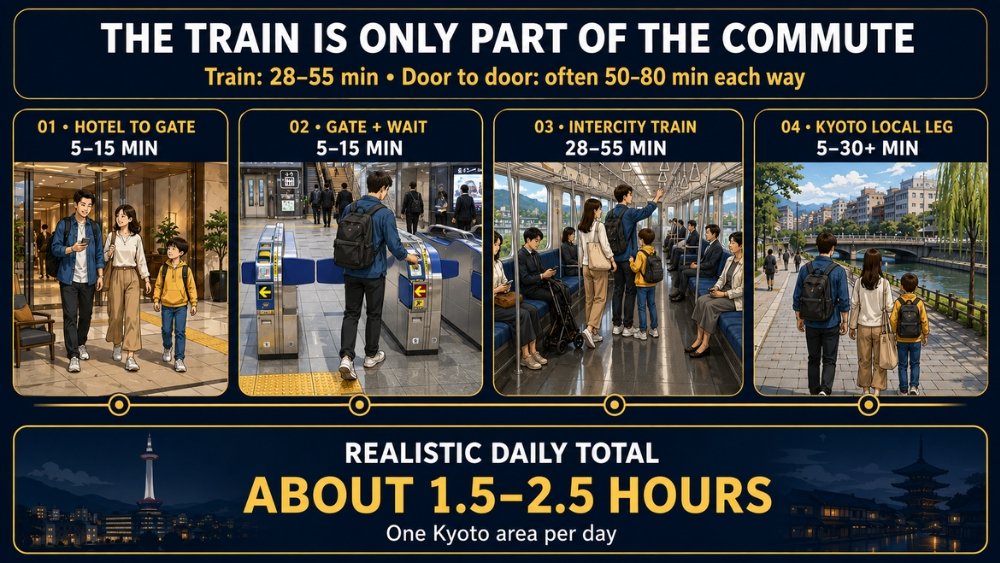
Osaka works better when Kyoto days stay geographically focused. Osaka Map’s Kyoto entry in its day-trip guide explains why trying to cross the whole city in one day creates more stress than the Osaka–Kyoto ride itself.
What time should you leave Osaka?
For an ordinary Kyoto sightseeing day, you do not need to leave Osaka at dawn.
If you want to be in a central Kyoto neighborhood around 8:00–9:00 a.m., leaving an Umeda, Shin-Osaka or Yodoyabashi hotel roughly 60–90 minutes before your target arrival time is a sensible planning range. That includes station access and the last leg after the intercity train.
Peak seasons change the calculation. Trains, platforms and buses inside Kyoto can be much more crowded. Build extra buffer rather than planning a connection down to the minute.
If your goal is to photograph Gion before sunrise or reach a famous temple at the very start of the day, a Kyoto hotel is better. An Osaka base can technically work, but you lose much of the advantage of being out before the crowds.
What if you stay in Kyoto until late?
A late dinner, evening illumination or festival is completely compatible with sleeping in Osaka — within reason.
Current JR and Hankyu schedules still show useful Kyoto-to-Osaka services around 11:00 p.m. on representative dates. For example, current Hankyu timetable results include a Kyoto-Kawaramachi departure at about 23:00 reaching Osaka-Umeda in about 44 minutes, while current JR schedules also show Kyoto-to-Osaka services around that time.
Do not turn those examples into a universal “last train.” Day of week, destination, stopping pattern and special-event schedules can change the final workable connection.
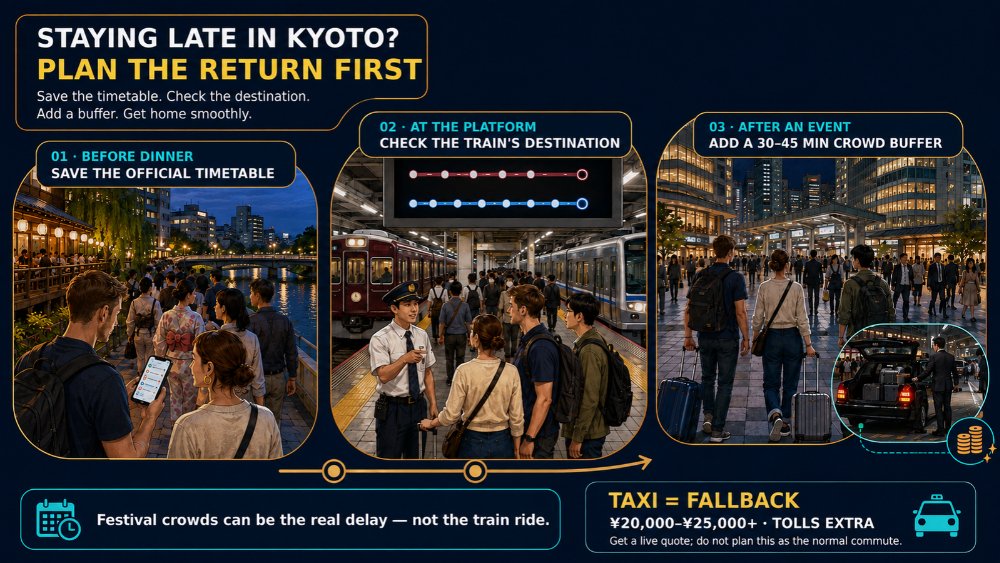
The safer approach is:
- decide your return station before the evening starts;
- save the official timetable on your phone;
- allow 30–45 minutes more than usual when a festival or illumination is ending;
- remember that late services may stop more often and take longer;
- use a taxi only as an expensive fallback.
Check the actual destination displayed on the train. Late-night departures can terminate at an intermediate station even when another train on the board continues to Osaka. Useful official return pages include the Hankyu Kyoto-Kawaramachi timetable, Keihan’s Gion-Shijo station information and JR West’s route and timetable search.
If this is your first night at the Osaka hotel and you have not checked in yet, do not assume you can arrive at any hour without notice. Check the hotel’s arrival policy, complete check-in before going to Kyoto when practical, or tell the hotel if you expect to arrive late.
During major events, the problem may not be the train itself. It may be the time needed to walk through a crowd and enter the station.
IC cards, tickets and reserved seats: what first-time visitors need to know
An IC card is a rechargeable contactless transit card. Common examples include ICOCA, Suica and PASMO. You tap it at the ticket gate when entering and exiting, and the fare is deducted automatically.
JR, Hankyu and Keihan accept the major nationwide interoperable IC cards on these conventional railway journeys. For a simple Osaka–Kyoto day trip, an IC card usually removes the need to buy a paper ticket for every ride.
A few points still matter:
- Keep enough balance on the card before entering.
- One IC card is used for one passenger; you cannot tap one card through for the whole family.
- School-age children generally need their own child fare. Child fares are usually half the adult basic fare, while the rules for younger children depend on age, group composition and whether a separate seat is used. Check the operator’s current child-ticket rule rather than assuming every child rides free.
- Ordinary JR Special Rapid, Hankyu limited express and Keihan limited express seating is generally used without a reservation, except for specifically designated paid reserved-seat cars or services.
- If you choose Hankyu PRiVACE or Keihan Premium Car, buy the required seat ticket in addition to your normal fare.
- You do not need to use the Shinkansen just because you are staying at Shin-Osaka. Conventional JR trains are already fast and much cheaper for Kyoto.
Is this practical with children?
Yes, particularly from Umeda or Shin-Osaka, but the answer depends on your family’s tolerance for long days.
For young children, the hardest part is not the Osaka–Kyoto train. It is combining that train with a full Kyoto sightseeing day, crowded local transport, lots of walking and then another commute home.
A family-friendly strategy is to:
- stay very close to the departure station;
- plan one main Kyoto area per day rather than crossing the city repeatedly;
- avoid the busiest commuter periods when possible;
- consider a reserved-seat car on eligible trains if a guaranteed seat materially improves the day;
- return to Osaka before everyone is exhausted.
For families, the extra cost of a hotel beside the station can be more valuable than choosing the cheapest room several subway stops away.
What about large luggage?
If Osaka is your base, the best solution is usually not to carry large luggage to Kyoto at all. Leave it at the hotel and make Kyoto a day trip.
If you are changing hotels between Osaka and Kyoto, avoid treating a crowded peak-season commuter train like a luggage shuttle. Travel outside the busiest times if possible, use elevators rather than blocking escalators, and keep bags close to you.
Shin-Osaka becomes especially attractive if you are arriving or departing by Shinkansen because you can minimize the number of times you move large suitcases through the city.
Hotel policies for luggage storage before check-in or after check-out vary, so confirm with the hotel if that service is important to your travel day.
If you decide to split the stay, hotel-to-hotel luggage delivery can remove the hardest part of the move. Yamato Transport’s official luggage-delivery guide explains the service, but delivery time, acceptance deadline and eligible destination vary. Do not assume same-day delivery; keep medication, documents and one night’s essentials with you.
Would a split stay be better?
A split stay is often the strongest compromise when the trip contains both unusually early Kyoto plans and several Osaka nights.
For example, spend one or two nights in Kyoto for a dawn visit, an evening illumination or a festival night, then move to Osaka for the rest of the trip. The disadvantage is the hotel change itself: packing, checkout, luggage handling and a new check-in can consume much of a half-day if badly planned.
Choose the split only when those Kyoto-only hours have real value. Moving hotels simply to save one morning commute rarely improves the trip.
The hidden advantage: you still get an Osaka trip
The strongest argument for this plan is not transport. It is what happens after the transport.
If you return from Kyoto at 7:00 or 8:00 p.m., the day does not have to be over.
In Umeda, you can eat, shop or have a drink around Osaka Station. In Namba, you can walk into one of Japan’s busiest food and nightlife districts. Even from Yodoyabashi, the Midosuji Line puts both Umeda and Namba within easy reach.
That gives the trip a useful rhythm:
Kyoto in the morning and afternoon; Osaka at night.
For some travelers, that is more enjoyable than paying a peak-season premium for a Kyoto room and spending every evening in the same city.
When I would still choose Kyoto
Osaka is not automatically better.
Stay in Kyoto if:
- you want to walk through Gion before the day-trippers arrive;
- you have several dawn or early-morning temple visits planned;
- you want to return to your room for a midday break;
- you are attending late events on multiple nights;
- your Kyoto hotel is only slightly more expensive than a comparable Osaka hotel;
- moving children or older family members through major stations twice a day will make the trip less enjoyable.
The commute is easy by Japanese intercity standards, but it is still a commute.
A practical rule for choosing
If Kyoto accommodation is sold out or dramatically overpriced, search Osaka before you change your itinerary.
Start with Umeda if you want the most flexible option. Choose Shin-Osaka if luggage and onward rail travel matter most. Choose Yodoyabashi if Gion and eastern Kyoto dominate your plans. Choose Namba only when enjoying Osaka at night is worth the extra transfer.
Then match the railway to your actual first stop in Kyoto:
- JR → Kyoto Station
- Hankyu → Kyoto-Kawaramachi
- Keihan → Gion-Shijo and the east side
Do that, and staying in Osaka stops feeling like a backup plan. It becomes a deliberate way to experience both cities on the same trip.