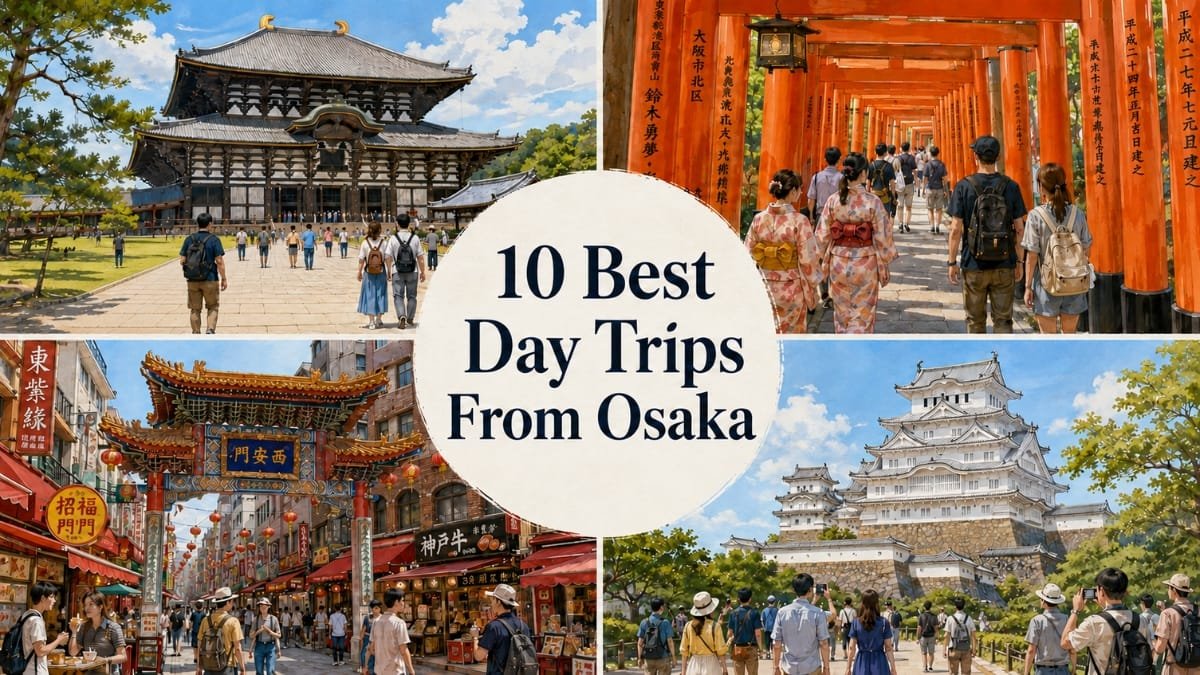
The best day trip from Osaka is the one that matches your available time, departure station, and tolerance for transfers.
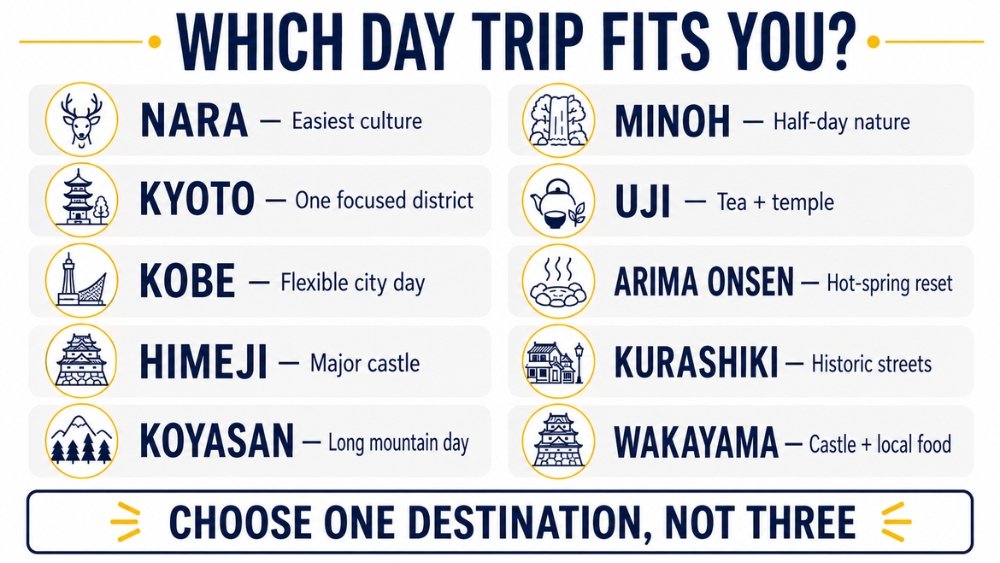
- Choose Nara for the easiest first cultural day trip.
- Choose Kyoto for one carefully selected temple district.
- Choose Kobe for a flexible city day with food, views, or a waterfront walk.
- Choose Himeji for one major landmark and a straightforward rail journey.
- Choose Koyasan for a long, focused mountain and temple day.
- Choose Minoh for a low-pressure half-day nature walk.
- Choose Uji for tea, Byodoin, and a compact historic centre.
- Choose Arima Onsen for hot-spring time rather than a long sightseeing checklist.
- Choose Kurashiki for historic canal streets and an art stop.
- Choose Wakayama for a castle, local food, and a less crowded city day.
If you prefer a fixed meeting point and planned transport, compare the current day tours from Osaka on Klook after choosing the destination—not before.
Osaka day trips at a glance
| Destination | Best for | Practical trip length | Useful Osaka departure area | Main trade-off |
|---|---|---|---|---|
| Nara | First cultural day trip | Standard day | Namba | Crowds and deer require attention |
| Kyoto | Temples and historic streets | Full focused day | Umeda, Osaka, Kyobashi, or Yodoyabashi | Trying to cover too many districts wastes time |
| Kobe | Food, city views, and waterfront | Half or standard day | Umeda or Namba | Easy to overbuild the itinerary |
| Himeji | Castle and one major landmark | Standard day | Osaka or Shin-Osaka | Castle stairs and queues can slow the visit |
| Koyasan | Mountain temples and a spiritual setting | Long day | Namba | Multiple transport stages and a long return journey |
| Minoh | Nature close to Osaka | Half day | Umeda | Outdoor conditions and walking surface matter |
| Uji | Tea and a compact temple visit | Standard day | Kyobashi, Kitahama, or Yodoyabashi | Smaller in scope than central Kyoto |
| Arima Onsen | Hot springs and a slow day | Standard day | Umeda or Namba via Kobe | Bath rules, closures, and transfers need checking |
| Kurashiki | Canal streets and art | Long day | Shin-Osaka | Higher transport cost and a longer rail commitment |
| Wakayama | Castle and local food | Standard day | Namba | Attractions are more spread out than in Uji or Nara |
“Practical trip length” is an editorial planning category, not a fixed timetable. Train patterns, connection times, walking pace, weather, and temporary closures can change the real journey.
Start from the right Osaka station
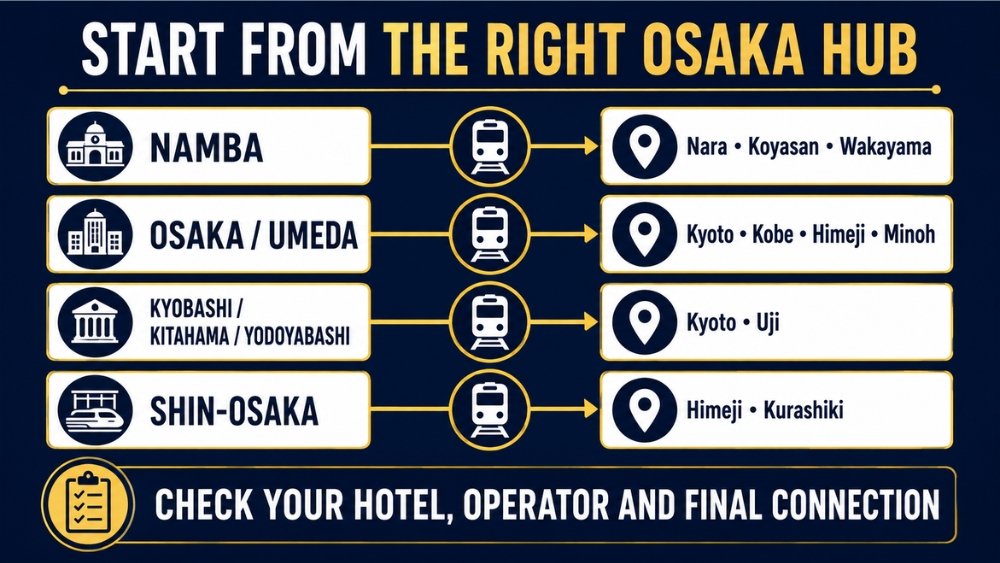
Your hotel may be in Osaka, but the most convenient departure point depends on the destination.
- Namba is especially useful for Nara on Kintetsu and for Koyasan or Wakayama on Nankai.
- Osaka-Umeda or JR Osaka Station is useful for Kyoto, Kobe, Himeji, and Minoh.
- Kyobashi, Kitahama, or Yodoyabashi can simplify a Keihan trip toward Kyoto and Uji.
- Shin-Osaka is the practical starting point when using the Sanyo Shinkansen toward Himeji or Okayama for Kurashiki.
Do not choose a route only because the first train looks fast. Count the walk to the station, transfers, reserved-seat requirements, local connection, and the journey back to your accommodation.
If your trip starts around Umeda, the Osaka Station navigation guide can help you identify the correct operator and concourse before departure. For a Shinkansen day trip, use the Osaka Shinkansen ticket guide to compare ticket counters, machines, and online options.
1. Nara: the easiest cultural day trip from Osaka
Nara is the safest first choice when you want major cultural sights without committing to a complicated route. From Osaka-Namba, Kintetsu trains take you directly toward Kintetsu-Nara, which is convenient for Nara Park and Todai-ji.
A simple day can include:
- Nara Park;
- Todai-ji and the Great Buddha Hall;
- a walk toward Kasuga Taisha or Naramachi;
- an early return before you are tired.
The official Todai-ji visitor information publishes current opening times, admission, and temporary notices. Recheck it on your travel date.
The deer are wild animals, not props. Keep food secured until you intend to use it, follow current local signs, and do not approach a mother and fawn. Nara is compact enough to be easy, but the park, temple grounds, and shopping streets still involve substantial walking.
Best for: first-time visitors, families comfortable with walking, and travelers based near Namba.
Skip it when: the main goal is a quiet indoor day or you dislike crowded animal areas.
2. Kyoto: best when you choose one district
Kyoto can be an excellent day trip from Osaka, but only if you reduce the plan. Treating Kyoto Station, Arashiyama, Kinkakuji, Kiyomizu-dera, Fushimi Inari, and Gion as one walkable zone creates unnecessary transfers.
Choose one core area:
- Higashiyama and Gion for temple streets and an evening atmosphere;
- Arashiyama for a western-Kyoto day with riverside scenery;
- Fushimi and Uji direction for a southern route;
- central Kyoto for a museum, market, or palace-focused day.
Hankyu can be useful from Osaka-Umeda, Keihan from Yodoyabashi, Kitahama, or Kyobashi, and JR from Osaka Station. The right operator depends on the district you chose, not merely the word “Kyoto.”
Best for: travelers with one priority district and an early start.
Skip it when: your plan still contains four distant headline sights.
3. Kobe: best for a flexible city day
Kobe works because you can build a compact day around one or two themes: Kitano and the Nunobiki area, the waterfront, shopping and cafes, or an evening city view.
Hanshin and Hankyu connect Osaka with Kobe from different Osaka hubs. Check which terminal is closer to your hotel and which Kobe station is closest to your first stop.
For a view-focused day, Kobe Nunobiki Herb Gardens is reached by ropeway from the Shin-Kobe side. The facility’s official operating page lists seasonal hours and planned maintenance closures, and warns that strong wind or thunderstorms can suspend service.
Avoid combining a long lunch, Kitano, the herb gardens, the waterfront, shopping, and a distant night view unless you are willing to rush. Kobe is best when its flexibility reduces pressure.
Best for: food, cafes, couples, mixed-interest groups, and travelers who want a later start.
Skip it when: one monumental historic sight is your priority.
4. Himeji: best for one major landmark
Himeji is the clearest choice for travelers whose day revolves around a castle. From Osaka, a JR rapid service is the economical straightforward option; from Shin-Osaka, the Sanyo Shinkansen can reduce the main rail time at a higher cost.
The castle visit involves gates, slopes, narrow interior stairs, and queues that vary by date. Leave more time than the exterior photos suggest. If mobility or heat is a concern, decide in advance whether the full keep interior is essential.
A sensible plan is Himeji Castle plus Koko-en or a relaxed meal near the station. Adding Kobe later can work for an energetic traveler, but it turns a simple landmark day into a multi-city schedule.
Best for: castle enthusiasts and travelers comfortable with stairs.
Skip it when: you need a step-free attraction day or want many unrelated stops.
5. Koyasan: best for a long, focused mountain day
Koyasan is the most demanding option on this list. The route normally uses Nankai from Namba toward Gokurakubashi, followed by the cable car and local transport into the mountain area. Nankai’s official Koyasan guide and Limited Express Koya page explain the route and reserved-seat service.
Do not describe the journey as one train ride. A delayed start can compress the time available for Kongobuji, the Danjo Garan area, or Okunoin. Choose two core sites rather than treating the mountain as a checklist.
The official Kongobuji site provides current temple information. Recheck transport notices, cable connections, bus schedules, temple hours, and the final practical return route before leaving Osaka.
Best for: travelers who value the setting and are comfortable with a long day.
Skip it when: you want a spontaneous late start or minimal transfers.
6. Minoh: best half-day nature escape
Minoh is the simplest outdoor alternative to another city. From Osaka-Umeda, take Hankyu toward Ishibashi-handai-mae and change for the Minoh Line. The official Minoh Station page and transfer-station page show the current station arrangement.
The classic plan is the walking route from Minoh Station toward the waterfall area, allowing time for stops and the return walk. Surface conditions, seasonal crowding, construction, heat, rain, and trail restrictions can change the experience.
Minoh suits a half day because the journey is close to Osaka and the activity is focused. It is not a guaranteed wilderness experience; it is an accessible nature walk connected to the city.
Best for: light hiking, autumn scenery, and a lower-cost half day.
Skip it when: heavy rain, extreme heat, or walking limitations make the route unsuitable.
7. Uji: best for tea and a compact historic centre
Uji is a strong alternative to central Kyoto when you want a smaller area with a clear theme. Keihan’s Uji Line branches at Chushojima, and the operator’s station information shows the route to Uji Station.
A focused day can combine Byodoin, the river, tea shops, and one additional temple or museum stop. The official Byodoin visitor guide publishes current garden and museum hours and explains that Phoenix Hall interior visits have separate capacity and reception conditions.
Uji is not “all of Kyoto without the crowds.” It is a different destination with a smaller scale. That narrower scope is the advantage when you do not want to cross a large city.
Best for: tea, temple architecture, riverside walking, and a calm standard day.
Skip it when: your priority is Kyoto’s famous western or eastern districts.
8. Arima Onsen: best for a hot-spring reset
Arima Onsen works when bathing and slowing down are the purpose of the trip. Rail access normally requires transfers through the Kobe side; Kobe Electric Railway’s official Arima access page identifies Arima Onsen Station as the final stop on the Arima Line.
Choose the bath facility before departing. Check day-use admission, operating hours, maintenance closures, towel policy, tattoo rules, age restrictions, and whether the facility has reached capacity. Do not assume every inn accepts day visitors.
Build the day around one bath, lunch, and a short town walk. Adding central Kobe is possible, but only if bathing hours and return connections still work.
Best for: couples, repeat visitors, and travelers who want recovery time.
Skip it when: you are uncomfortable with shared-bath rules or need a guaranteed private bath without booking.
9. Kurashiki: best for historic canal streets and art
Kurashiki is one of the longest rail commitments here. A practical fast route uses the Sanyo Shinkansen from Shin-Osaka to Okayama, then a local train to Kurashiki. JR West’s route search should be checked for the exact date and connection.
The central appeal is a slow walk through the historic canal area, with an optional visit to the Ohara Museum of Art. The museum’s official visitor page lists seasonal hours and regular closure information.
Kurashiki deserves a full, unhurried visit. Do not pair it with Himeji simply because both lie west of Osaka unless you have deliberately accepted a fast-paced multi-stop day.
Best for: photography, architecture, art, and travelers willing to pay for a longer rail day.
Skip it when: you want the cheapest or shortest day trip.
10. Wakayama: best for a castle and local-food day
Wakayama is a useful change of direction from the better-known Kyoto–Kobe corridor. Nankai connects Namba with Wakayamashi, and the Limited Express Southern page explains the current reserved and unreserved car arrangement.
A practical itinerary can combine Wakayama Castle, a local meal, and one additional city stop. The attractions are more spread out than the core sights in Uji or Nara, so local buses or careful walking plans matter.
Nankai also publishes a Wakayama transport ticket page covering current rail-and-bus options. Treat any fare or product as changeable and verify it on the booking date.
Best for: repeat visitors, castle interest, ramen, and a less obvious city day.
Skip it when: you want a compact destination that works entirely on foot.
How much time do you really have?
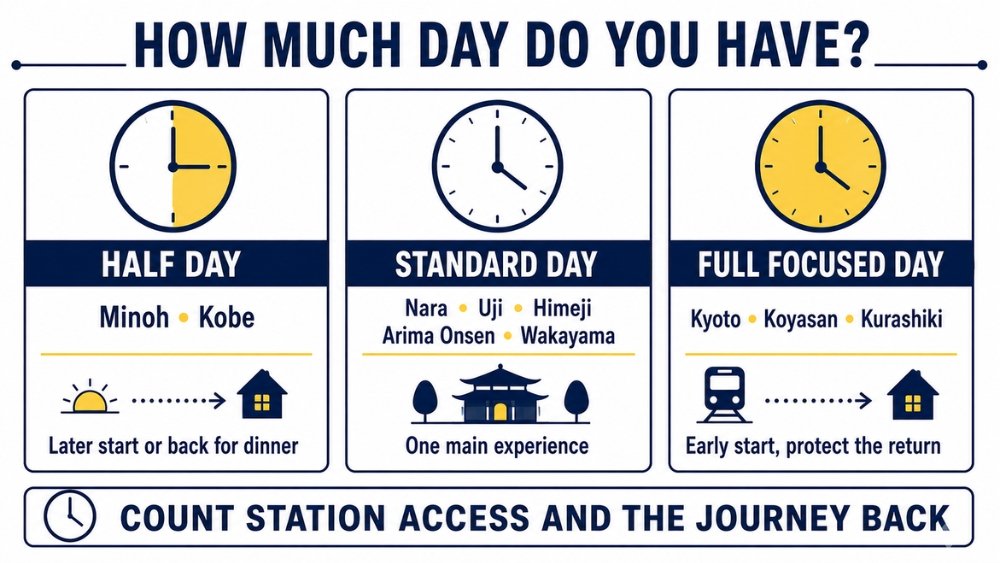
Use your usable sightseeing window, not the number of hours between waking and sleeping.
Half day
Choose Minoh or a focused Kobe visit. These work when you want a later start or need to return to Osaka for dinner.
Standard day
Choose Nara, Uji, Himeji, Arima Onsen, or Wakayama. Each rewards an early-enough start without requiring the longest possible day.
Full focused day
Choose one Kyoto district, Koyasan, or Kurashiki. These destinations punish late starts, excessive stops, or careless return planning.
Guided tour or independent day trip?
Independent travel is best when the rail route is simple, you want control over pace, and you are comfortable changing plans. Nara, Kobe, Minoh, Uji, Himeji, and Wakayama are usually easy to structure independently after checking current transport.
A guided tour can be useful when it combines distant stops, provides a fixed meeting point, or reduces the planning burden for Koyasan, Kyoto-and-Nara combinations, Himeji-and-Kobe combinations, or Arima Onsen.
Before booking, check:
- the exact Osaka meeting point and return point;
- whether transport, entry, meals, or bath admission are included;
- how much independent time is provided at each stop;
- walking, stairs, and accessibility conditions;
- minimum age and child-seat rules;
- language and group size;
- cancellation, late-arrival, and weather policies.
Compare the current Osaka day-trip products on Klook only after the itinerary and inclusions match your priorities.
The selected product page controls the current price, availability, meeting point, inclusions, and cancellation terms. Recheck the live page before payment.
Rail pass, IC card, or separate ticket?
Do not buy a rail pass before choosing the destination and operator.
- An IC card is convenient for many ordinary rail and bus trips, but it does not automatically cover every reserved seat, limited express, Shinkansen, cable car, or tour.
- A destination-specific ticket can be useful only when its covered route matches your real itinerary.
- A Shinkansen ticket may include several fare components and should be checked carefully before boarding.
The ICOCA guide explains basic use and limitations. Calculate the actual journeys you plan to take, then compare the live ticket conditions.
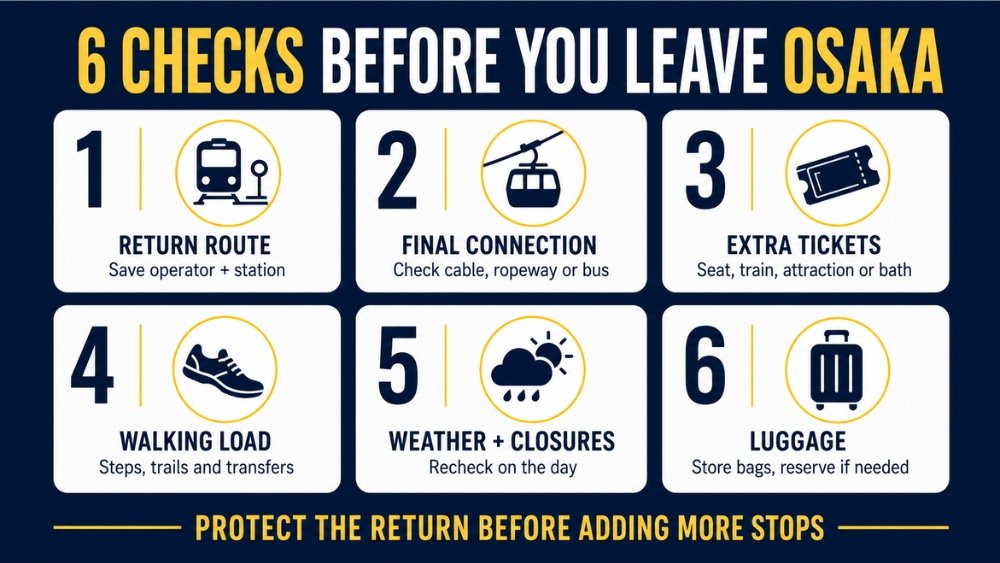
Six checks before leaving Osaka
- Confirm the return route. Save the operator, station name, and final useful departure.
- Check the final connection. Mountain, cable, ropeway, and local-bus legs may finish before the main railway.
- Identify separate tickets. Reserved seats, Shinkansen services, attractions, and baths may require additional payment.
- Match the walking load. Castle stairs, temple grounds, trails, and station transfers add up.
- Recheck weather and closures. Outdoor routes and ropeways can change on the day.
- Manage luggage. Leave large bags in Osaka when possible and reserve any required seat or baggage space.
Common mistakes to avoid
Combining destinations because they look close on a map
Kyoto and Nara, or Himeji and Kobe, can be combined—but the result is a different, faster trip. Choose the combination deliberately rather than treating the second city as free.
Choosing the wrong Osaka departure hub
Crossing Osaka before and after a day trip can erase the benefit of a faster train. Start from the operator that fits both your hotel and destination.
Planning around an old fare or timetable
Use official operator and facility pages shortly before travel. Screenshots, old promotions, and cached route results are not reliable booking tools.
Ignoring the final local connection
The main train may run later than the cable car, ropeway, or bus you need. Work backward from the final connection.
Carrying large luggage
Day trips become harder when every transfer includes a suitcase. Use accommodation storage or a suitable locker and take only what the day requires.
Treating a tour name as a complete itinerary
Read the meeting point, included admissions, walking conditions, and time at each stop. A long list of place names may mean short visits.
Final verdict: which Osaka day trip should you choose?
Choose Nara for the easiest first day trip, Kyoto for one focused historic district, Kobe for a flexible city day, Himeji for a major castle, Koyasan for a long mountain experience, Minoh for a half-day nature walk, Uji for tea and Byodoin, Arima Onsen for bathing, Kurashiki for historic streets and art, or Wakayama for a castle-and-food day.
Choose Klook if a current guided itinerary matches your destination, Osaka meeting point, included transport, walking conditions, and cancellation needs better than independent travel.
Whichever destination you choose, build the day around one main experience, verify current first-party information, and protect the journey back to Osaka.