
Namba and Tennoji are both practical south-Osaka bases, but they solve different problems. Choose Namba if you want Dotonbori, Shinsaibashi, late dining and shopping close enough to reach on foot. Choose Tennoji if you prefer a calmer station district, easier access to parks and large malls, and direct JR trains toward Kansai Airport and Nara.
The useful question is not “Which area is better?” It is “Which area removes the most awkward journey from my own itinerary?” Your arrival train, first evening and first full-day trip usually reveal the answer.
| Your priority | Better base | Why |
|---|---|---|
| Walk back after dinner in Namba or Dotonbori | Namba | You avoid a late train for the trip you are most likely to repeat |
| Direct Nankai train from Kansai Airport | Namba | Nankai services terminate at Nankai Namba |
| Direct JR train from Kansai Airport | Tennoji | The Kansai Airport Rapid serves Tennoji |
| Nara by JR | Tennoji | JR Yamatoji services run from Tennoji toward Nara |
| Nara by Kintetsu | Namba | Kintetsu’s Nara route leaves from Osaka-Namba, not Osaka-Abenobashi |
| A more open, family-friendly daytime setting | Tennoji | Tenshiba, Tennoji Park and large shopping complexes are nearby |
| Nightlife and dense restaurant choice | Namba | The Minami entertainment district is on your doorstep |

Decide from your arrival, not from the map center
On a map, Namba and Tennoji look close enough that the choice can seem unimportant. In practice, Osaka’s named stations are large and the last walk with luggage can matter more than a few minutes on the train.
Arriving at Kansai International Airport
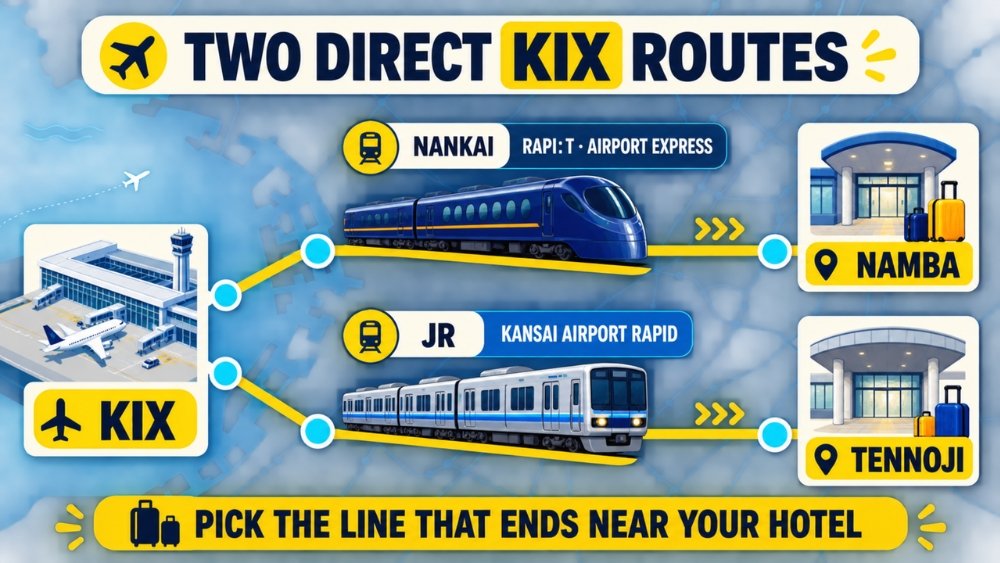
For Namba, the simplest direct option is the Nankai Airport Express or limited-express Rapi:t to Nankai Namba Station. The Airport Express uses an ordinary ticket; Rapi:t requires a limited-express ticket in addition to the basic fare. Check the current timetable before choosing, especially for a late arrival.
For Tennoji, use a JR Kansai Airport Rapid that stops at Tennoji. Confirm the destination and stopping pattern on the departure board because JR services can divide, couple or use different destinations. If you are still comparing all airport options, see our Kansai Airport to Osaka guide.
Neither airport route is automatically superior. A direct train followed by a ten-minute luggage walk may be less convenient than one transfer followed by a two-minute walk. Before booking, put the exact hotel entrance into a map and test the route from the correct operator’s station.
Arriving by Shinkansen
Both areas are on the Osaka Metro Midosuji Line from Shin-Osaka, so either can work after a Shinkansen journey. Namba comes first when traveling south; Tennoji is farther along the same line. If repeated Shinkansen trips are central to your plan, compare both with the practical distinctions in our Shin-Osaka vs Osaka Station guide.
An IC card—a rechargeable tap-to-pay transit card such as ICOCA, Suica or PASMO—reduces ticket-machine friction when you move among JR, Osaka Metro and participating private railways. It does not remove the need to check the operator and station name. Our ICOCA guide explains the first-use basics.
Namba is the stronger evening base
Namba works best when the center of gravity of your trip is Dotonbori, Shinsaibashi, Kuromon Market, Hozenji and the wider Minami district. The advantage is not only sightseeing. It is the ability to finish dinner, shopping or a bar visit without planning one more train.
That convenience has a trade-off. Streets around the busiest exits can be crowded, loud and visually confusing. Hotel listings that say “Namba” may sit near different stations or on the quieter outer edge of the district. A five-minute difference on a booking map can become a much larger difference at street level when you use the wrong exit.
Namba is usually the better fit if:
- you expect to eat in the Namba–Dotonbori area on several evenings;
- shopping in Shinsaibashi or Namba is a major goal;
- you want the Nankai train to or from Kansai Airport;
- you prefer energy and variety over a quiet station environment;
- your hotel is genuinely close to the station used by your arrival train.
Travelers who sleep lightly should inspect recent room reviews for street noise, not just the hotel’s star rating. A room on a higher floor or away from the main nightlife lanes can make Namba much easier. For a deeper neighborhood comparison, use our first-time Osaka area guide and nightlife-area guide.
Tennoji is the easier daytime base
Tennoji feels more open around the station, especially on the park side. Tenshiba’s lawn, Tennoji Park, the zoo area, Abeno Harukas and large department-store and mall complexes give families and slower-paced travelers several options without entering the densest part of Minami.
Tennoji is not quiet everywhere. The station is a major interchange, and roads, underground passages and shopping buildings can still be busy. The difference is that the district offers more space and more daytime-oriented facilities than central Namba. Hotel rates can also be attractive, although price varies by date and room type.
Tennoji is usually the better fit if:
- your first or last major journey uses JR toward Kansai Airport;
- you plan to visit Nara using JR;
- parks, family time or large indoor shopping complexes matter more than nightlife;
- you want a south-Osaka base but do not need to walk home from Dotonbori;
- your hotel is near JR Tennoji or Osaka Metro Tennoji rather than merely advertised as “Tennoji area.”
The Midosuji Line connects Tennoji directly with Namba, Umeda and Shin-Osaka. That makes an evening in Namba easy, but it does not make the two bases identical: after the final activity, you still have a train ride and a station walk back to Tennoji.
The station-name trap matters more in Namba
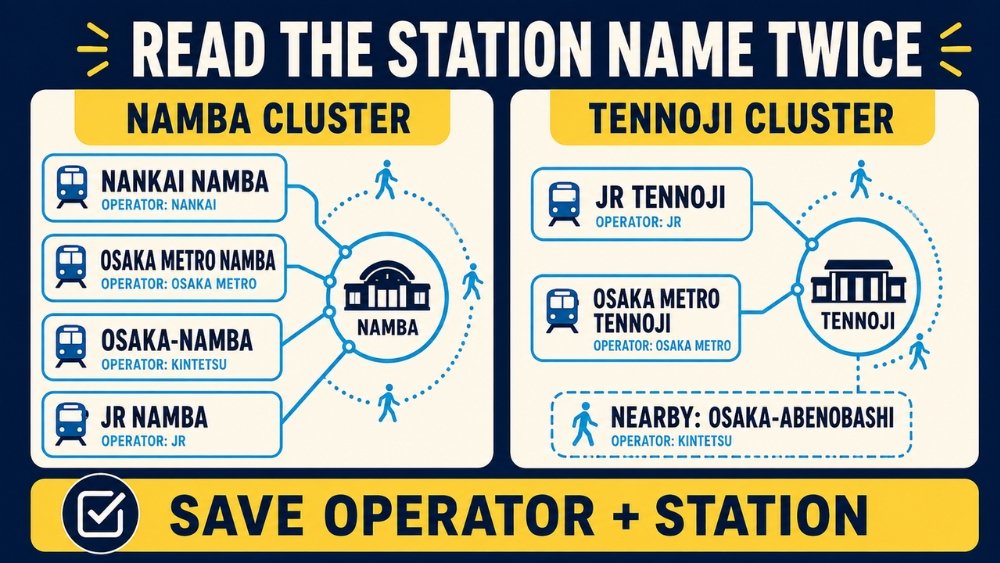
“Namba Station” is not one single set of platforms. The cluster includes:
- Nankai Namba for Nankai trains, including Kansai Airport services;
- Osaka Metro Namba for the Midosuji, Sennichimae and Yotsubashi lines;
- Osaka-Namba for Kintetsu and Hanshin services;
- JR Namba, west of the busiest central Namba streets.
These stations connect through streets or underground passages, but they are not interchangeable when you have luggage or a timed train. Save both the operator and station name in your phone—for example, “Nankai Namba,” not only “Namba.” The official Osaka Metro Namba station page is useful for checking exits and elevators.
Tennoji’s core is simpler: JR Tennoji and Osaka Metro Tennoji are adjacent. Osaka-Abenobashi, the Kintetsu terminal, is nearby but has a different name and serves Kintetsu’s southern network toward destinations such as Yoshino.
This corrects a common route misunderstanding: Osaka-Abenobashi is not the main Kintetsu departure point for central Nara. The official Kintetsu route map shows the Nara line from Osaka-Namba to Kintetsu-Nara, while Osaka-Abenobashi sits on the route toward Yoshino. From Tennoji, the straightforward Nara option is JR; from Namba, Kintetsu is the direct private-rail option.
Test the exact hotel, not the neighborhood label
Before paying for a room, perform three checks:
- Arrival test: Map the route from your actual arrival station platform to the hotel entrance with luggage. Note elevators, large roads and underground passages.
- Late-evening test: Map the journey from your likely dinner area at 10:00 p.m. If it involves a train you will repeat on three nights, the cheaper hotel may not feel cheaper.
- First-morning test: Map the longest or most time-sensitive trip in your itinerary. Removing one awkward transfer on that day can be more valuable than being closer to attractions you visit only once.
Families using strollers and travelers with mobility needs should check the correct elevator exit on the official station page rather than assuming the nearest numbered exit is step-free. Osaka Metro provides station maps for both Namba and Tennoji. In large stations, an accessible route may be longer but easier than the shortest route shown by a general map app.
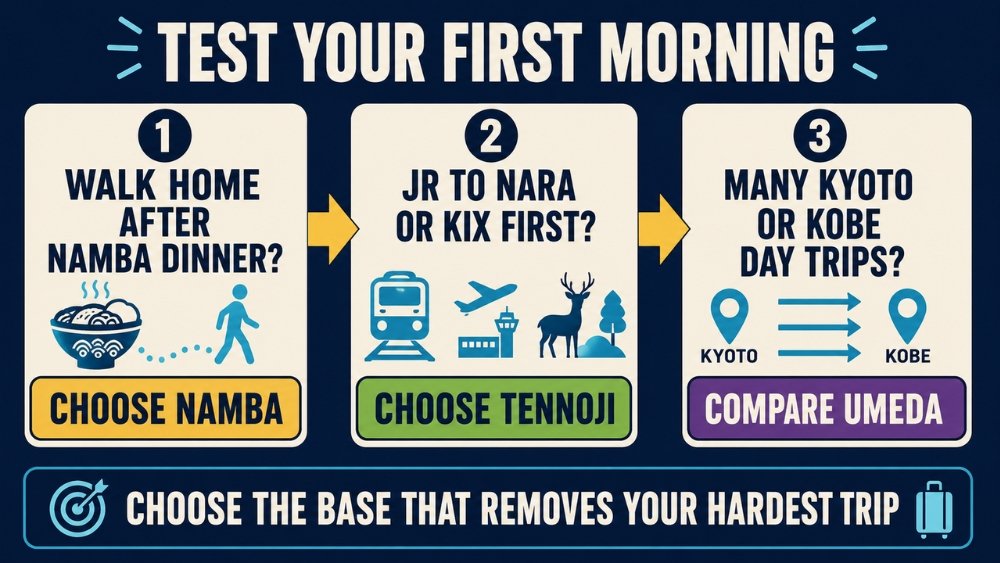
Three realistic trip patterns
Food and nightlife trip: choose Namba
If your days are flexible but your evenings repeatedly end around Dotonbori, Hozenji and Shinsaibashi, Namba removes the journey you would otherwise make when tired. Tennoji remains easy to visit for a park morning or Abeno shopping afternoon.
Nara, parks and an airport departure: choose Tennoji
If you want a calmer base, plan to use JR for Nara, and expect to return to Kansai Airport by JR, Tennoji aligns several important journeys. You can still take the Midosuji Line to Namba for dinner. Check live departure information on the day because rail schedules and service patterns can change.
Repeated Kyoto and Kobe day trips: compare Umeda
If most of your itinerary points north or west, neither Namba nor Tennoji may be the best answer. Osaka/Umeda can reduce repeated cross-city travel for Kyoto and Kobe. Do not force a south-side base simply because its hotel price looks better before transport is added.
The practical choice
Choose Namba when the trip you most want to simplify is your evening: food, shopping, entertainment and the walk back to the hotel. Choose Tennoji when the trip you most want to simplify is your first morning or departure: JR toward Nara or Kansai Airport, plus a more open daytime neighborhood.
Whichever you choose, verify three exact names before booking: the hotel entrance, the operator, and the station. That small check prevents more inconvenience than trying to identify a universal winner.