
An Osaka layover can become a memorable meal or a quick city walk—but only after you prove that you have enough usable time. A six-hour connection does not mean six hours in Osaka. Arrival formalities, baggage, airport-to-city transport, the return journey, terminal transfers, and your airline’s check-in or boarding deadline all reduce the time you can safely spend outside the airport.
This guide gives conservative plans for 4-, 6-, and 8-hour connections at Kansai International Airport (KIX) and Osaka Itami Airport (Itami, ITM). Treat the suggested itineraries as decision frameworks, not guarantees. Flight status, immigration queues, weather, rail disruptions, and airline requirements can change the answer on the day.
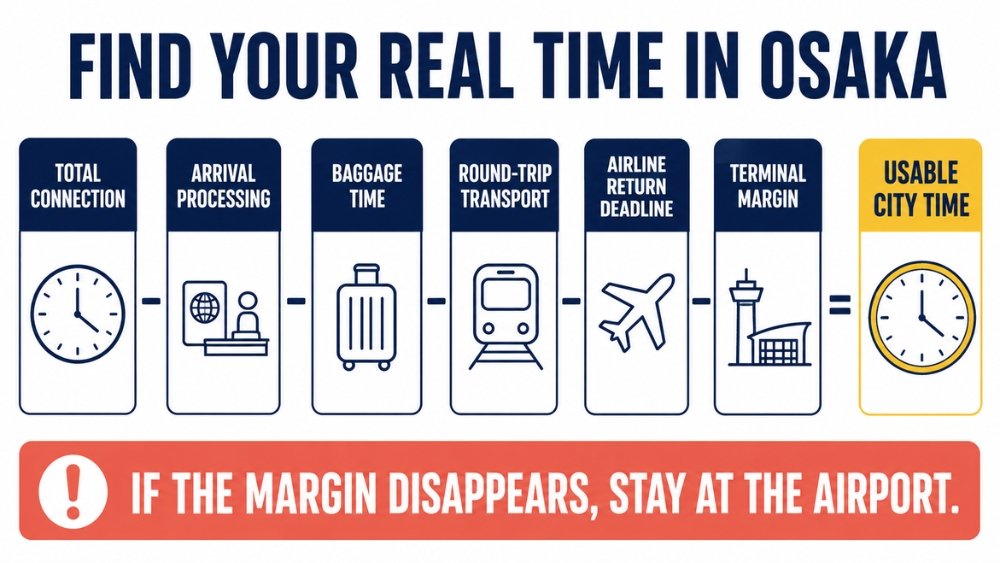
Short answer: With 4 hours, stay at the airport. With 6 hours, one compact district may work if every time check passes. With 8 hours, one district plus one nearby extra is realistic—but a multi-stop sightseeing sprint is still a poor bet.
First, calculate your real time in Osaka
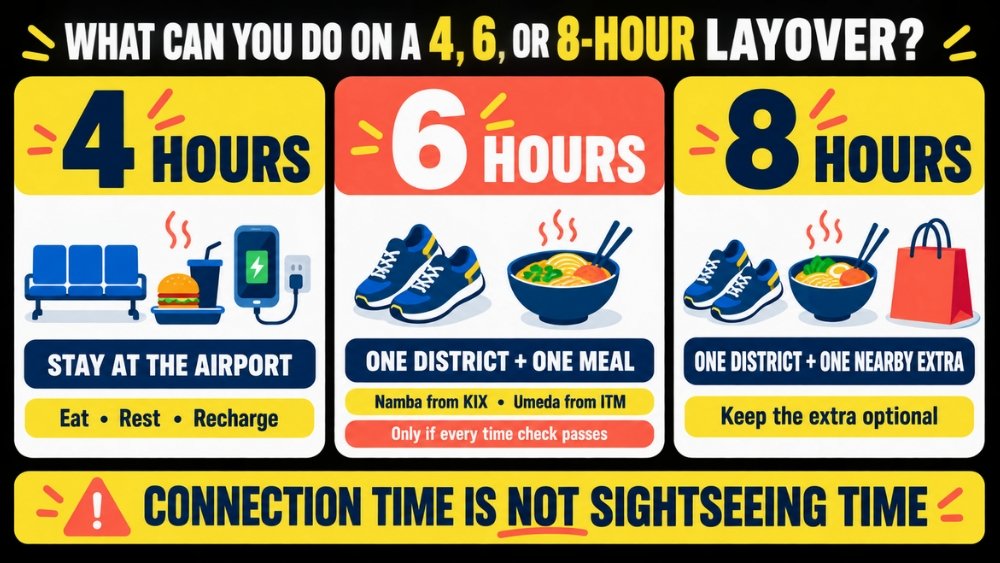
Use this equation before choosing any route:
Usable city time = total connection − arrival processing − baggage time − round-trip airport transport − airline return deadline − terminal-transfer margin
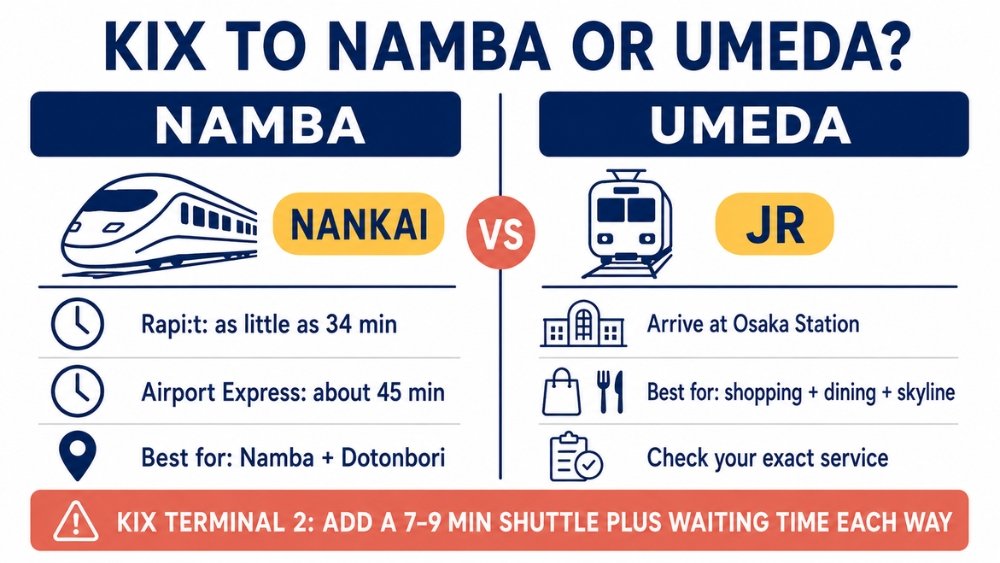
Do not estimate only the train ride. Include the walk to the station, waiting for the next service, finding the correct platform, and getting from the city station to your destination. At KIX Terminal 2, the official free shuttle between Terminal 2 and Terminal 1/Aeroplaza takes about 7–9 minutes; waiting and walking add more time.
Your airline’s deadline matters more than any generic rule. Check whether you must collect and recheck bags, change terminals, clear immigration, or obtain a new boarding pass. If separate tickets are involved, confirm who is responsible if the first flight is late. If you cannot answer those questions, stay airside or remain at the airport.
Five questions that decide the trip
- Are you permitted to enter Japan? Entry requirements depend on nationality and circumstances. Verify them before travel.
- Are your bags checked through? Collecting, storing, and rechecking baggage can consume the margin that made the city trip look possible.
- Which airport and terminal are you using? KIX is far from central Osaka; ITM is much closer. KIX Terminal 2 also requires a landside shuttle for rail access.
- What is your airline’s return deadline? Use the airline’s instructions for check-in, security, immigration, and boarding—not a universal number from a travel article.
- What is your backup? Know the next practical train or bus and the point at which you will abandon sightseeing and return.
KIX or Itami: the airport changes everything
Kansai International Airport and Osaka Itami Airport are not interchangeable.
| Airport | Best city target for a short layover | Why | Main caution |
|---|---|---|---|
| KIX(Kansai International Airport) | Namba | Nankai trains arrive in the heart of south Osaka; the fastest Rapi:t services take as little as 34 minutes | Immigration, long airport distance, and a possible Terminal 2 shuttle |
| KIX(Kansai International Airport) | Umeda/Osaka Station | JR services are useful when north Osaka is the goal | Allow more total route time and verify the exact service you can board |
| ITM(Osaka Itami Airport) | Umeda | Official airport buses list an approximate 30-minute journey to Osaka Station/Umeda | Road traffic can change the timing |
From KIX, Namba is usually the cleanest short-layover target. The Nankai Limited Express Rapi:t is all-reserved and reaches Namba in as little as 34 minutes. The Airport Express takes about 45 minutes and does not require a limited-express ticket. Check the live timetable before committing.
If advance booking suits your schedule, compare the selected-date rules for the Klook Nankai Limited Express Rapi:t ticket.
For Umeda, JR’s airport services are the more natural rail direction. Verify the current stop pattern and ticket conditions on JR West before buying. A Klook JR Haruka airport train ticket can be a convenient option when its selected route and validity match your plan.
For a fuller airport-transfer comparison, see Kansai International Airport to Osaka.
4-hour Osaka layover: stay at the airport
A four-hour connection is not a practical Osaka city visit from KIX. Even a smooth arrival leaves too little margin after two airport transfers and the return process. A delay, missed train, terminal mistake, or long queue can erase the plan.
Use the time to:
- eat without rushing;
- shower, rest, or use a lounge if available to you;
- charge devices and download onward-travel information;
- confirm your departure terminal and gate process;
- reorganize baggage;
- take a short walk around the accessible airport facilities.
ITM is closer to the city, but a four-hour connection is still too tight for most international visitors. The bus ride may be listed at about 30 minutes to Umeda, yet road traffic and airport procedures remain variable. Staying at the airport is the sensible default.
6-hour Osaka layover: one district and one meal
A six-hour connection can support a short city visit only when the time calculation leaves a meaningful buffer after all airport obligations. Pick one district. Do not build an itinerary around crossing Osaka.
From KIX: choose Namba
Namba keeps the route simple and concentrates food, covered shopping streets, canalside scenery, and railway access in one area.
Conservative sequence
- Clear the required arrival procedures and confirm that baggage is handled.
- Check the live Nankai service and the latest acceptable return train.
- Travel directly to Namba.
- Walk through one compact area, such as Namba and Dotonbori.
- Eat one meal near the return route.
- Turn back before your planned cutoff, even if you feel you could squeeze in one more stop.
Do not add Osaka Castle, Umeda, Shinsekai, or a ticketed attraction to this version. The extra transfer and navigation time offer little reward compared with the risk.
For a focused food choice near the route, use Where to Eat in Namba or the Osaka Food Street Guide.
From ITM(Osaka Itami Airport): choose Umeda
Umeda can work for a domestic connection with bags already handled and a generous return margin. The official airport-bus estimate is about 30 minutes, but traffic can make the journey longer.
Keep the visit close to the bus stop or Osaka Station. Choose one meal, a department-store food floor, or one indoor viewpoint. Osaka Station is large, so save your return stop and boarding point on your phone. The guide to navigating Osaka Station can reduce avoidable wandering.
8-hour Osaka layover: one district plus one nearby extra
Eight hours creates more breathing room, but it does not justify a citywide checklist. The best plan is still one district, with one nearby extra that can be dropped immediately if the schedule slips.
Low-friction KIX plan: Namba, Dotonbori, and one nearby extra
Start in Namba. Walk to Dotonbori, eat, and then choose one of the following if your return margin remains intact:
- Shinsaibashi for shopping;
- Kuromon Market during suitable daytime hours;
- Hozenji Yokocho for a compact atmospheric walk;
- Namba Parks for an easy-to-reach urban garden and shopping break.
Avoid making Osaka Castle the default add-on. It is worthwhile on a normal stay, but the transfer, station navigation, and large grounds make it inefficient for a risk-sensitive layover.
Alternative KIX plan: Umeda only
Choose Umeda if Osaka Station is your preferred rail destination and you want shopping, dining, or a skyline view in north Osaka. Keep the whole visit in the station area. If time, weather, and ticket availability align, the Umeda Sky Building guide explains the free 39th-floor area and the paid observatory. Skip it if queues or navigation begin to consume your margin.
Luggage, cash, and phone preparation
Store bags before going into the city
KIX lists temporary baggage-storage counters in Terminal 1 and coin lockers in Terminal 1, Terminal 2, and Aeroplaza. Availability, opening hours, size limits, and fees can change. Check the official airport page on the day and keep the storage receipt accessible.
If collecting checked baggage is required, include collection, storage, retrieval, and recheck time in the original calculation. Do not treat those as small errands.
Carry a working payment method
Airport and rail ticket machines commonly accept several payment methods, but compatibility is never guaranteed. Carry some yen and a backup card. If you plan to use an IC card, make sure it is ready before the outbound trip.
Save the return plan offline
Before leaving the airport, save:
- the airport and terminal name;
- the city station and exact return operator;
- your planned return service plus one earlier backup;
- screenshots of ticket instructions;
- the airline’s deadline and boarding details;
- the airport’s live transport-status page.
Do not rely on finding the information again with a weak battery or unstable connection.
Six checks before you leave the airport
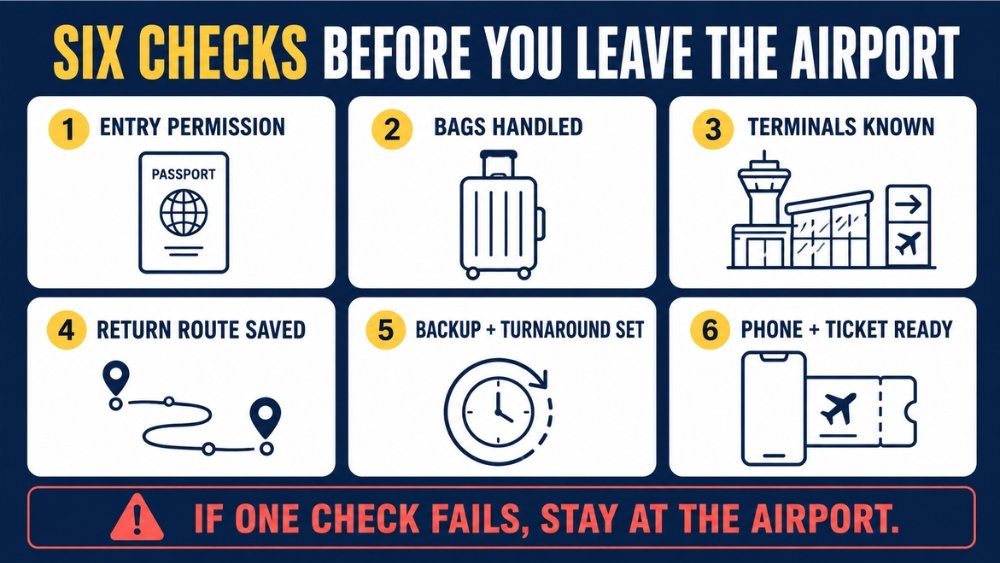
- Entry permission is confirmed.
- Bags are checked through or storage/recheck time is included.
- Arrival and departure terminals are known.
- The outbound and return routes are saved.
- A disruption fallback and turnaround time are set.
- Your phone, ticket, payment method, and battery are ready.
If any one of these is unresolved, stay at the airport. Missing a flight costs far more than missing a bowl of ramen.
Final verdict: which Osaka layover plan should you choose?
Choose the plan that still works after subtracting every airport task and preserving your airline’s required return margin:
- 4 hours: stay at KIX or ITM.
- 6 hours: consider one district and one meal only if every timing check passes—usually Namba from KIX or Umeda from ITM.
- 8 hours: keep one district as the core plan and add only one nearby, disposable extra.
For a KIX-to-Namba layover, the natural advance-booking choice is the Klook Nankai Limited Express Rapi:t ticket; for an eligible JR route toward Osaka Station, compare the Klook JR Haruka airport train ticket.
Recheck the official airport, railway, and airline pages immediately before travel. If the live conditions are worse than the plan assumed, the correct Osaka layover itinerary is the one that stays at the airport.