The 2026 Vermeer exhibition at Nakanoshima Museum of Art, Osaka ended on September 27, 2026. If an older search result still tells you to wait for its ticket release, do not use that advice: the exhibition is over, and the museum has already announced a substantial 2027 program.
For a future visit, begin with the exhibition, not with a generic museum ticket. The fourth- and fifth-floor galleries can hold different shows at the same time, and admission prices, advance-sale periods, timed-entry rules and photography policies are set separately. Choose the show you want, open its current official page, and only then decide whether to buy ahead or try for a same-day ticket.
Information checked October 8, 2026: the 2027 dates below have been announced by the museum, but later ticket details and exceptional closure dates may still be added. The museum also says that further exhibitions may be announced. Use the official upcoming-exhibitions page as the live source.
Useful links: official museum website · upcoming exhibitions · official ticket site · hours and admission · access · Google Maps
Start with the exhibition, not the building
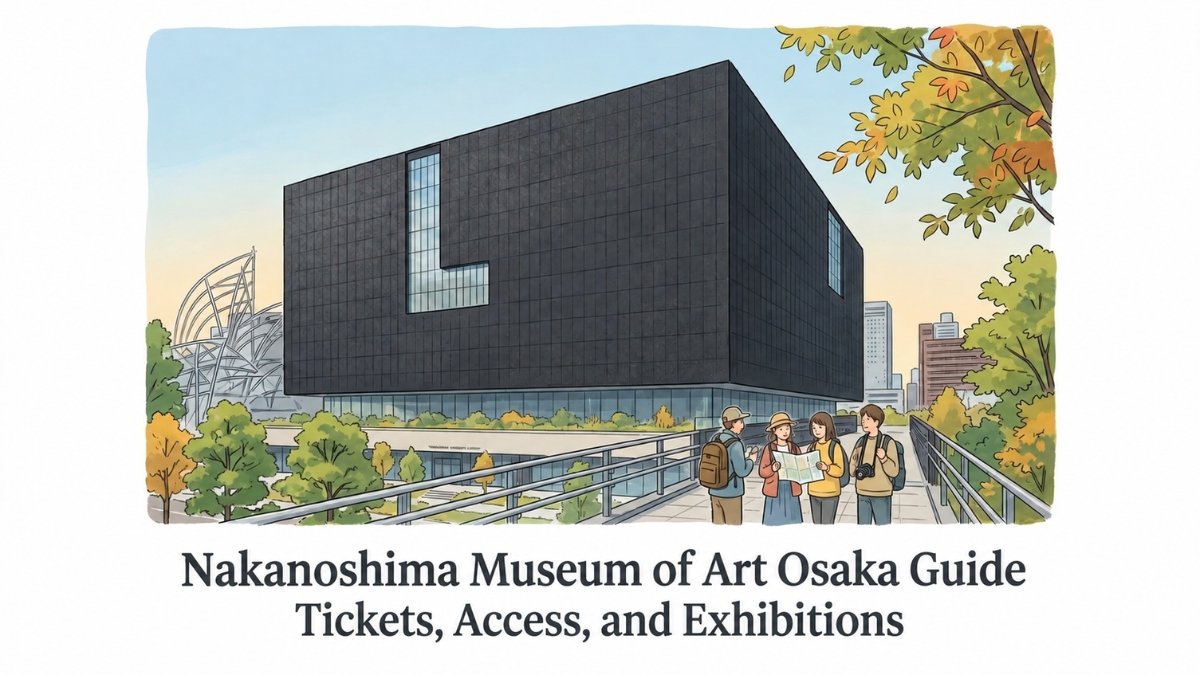
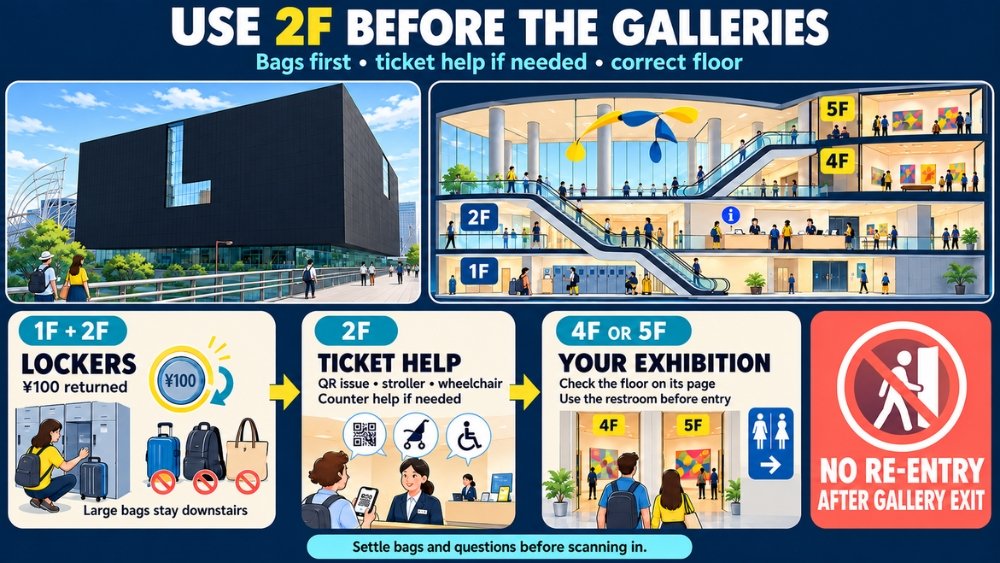
Nakanoshima Museum of Art opened in 2022 as a museum of modern art and design in central Osaka. Its black-cube exterior is easy to recognize, but the visitor experience is not organized around one permanent-admission ticket. The main exhibition galleries are on the fourth and fifth floors, while the ticket counter is on the second floor.
That layout matters when two shows overlap. A fourth-floor exhibition and a fifth-floor exhibition may have separate prices and separate entry conditions. Treat them as two visits unless an individual exhibition page explicitly offers a combination ticket. A free program may also be running in the second-floor multipurpose space without giving access to either paid gallery.
The building is still worth entering carefully rather than rushing straight to an escalator. The first and second floors contain public facilities, shops and visitor services; the gallery ticket is what controls entry to the exhibition upstairs.
The confirmed 2027 exhibition calendar
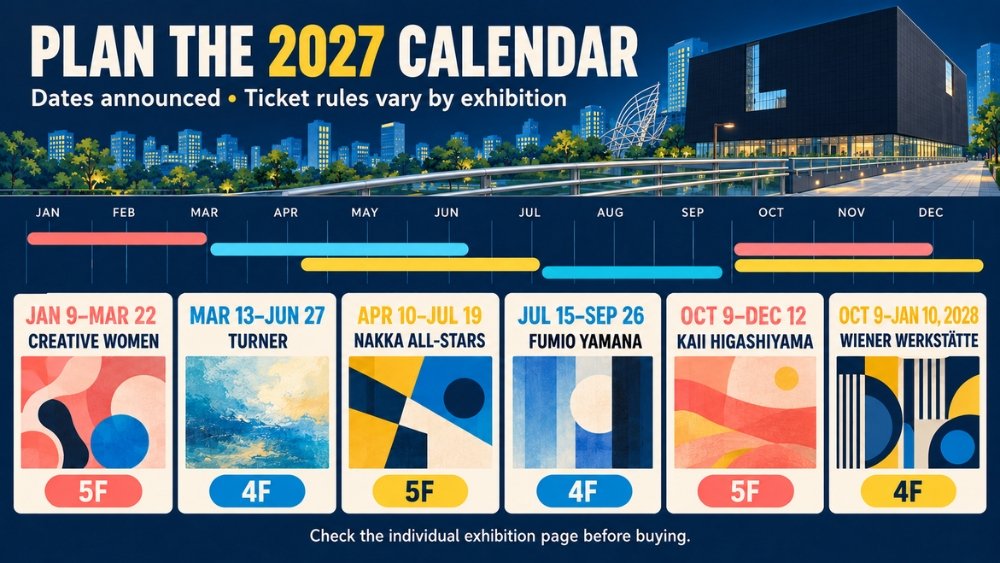
The museum’s August 2026 press announcement confirms the following program. Titles are translated or romanized for English readers; the official page may display a Japanese title until its full English information is published.
| Dates | Exhibition | Floor | What to know now |
|---|---|---|---|
| January 9–March 22, 2027 | Creative Women in Japan: Paving the Way for 100 Years | 5F | The individual page is already live with prices and sales information. |
| March 13–June 27, 2027 | Tate: Turner — Sublime Painting, Dialogue with Contemporary Art | 4F | More than 80 Tate-owned oil paintings and watercolors are announced; wait for the show page before assuming a ticket format. |
| April 10–July 19, 2027 | Nakanoshima Museum of Art All-Stars | 5F | A fifth-anniversary selection from the museum’s collection; it overlaps the Turner exhibition on another floor. |
| July 15–September 26, 2027 | Fumio Yamana: Design That Captures and Never Lets Go | 4F | A major design retrospective; detailed ticket information was not yet published when checked. |
| October 9–December 12, 2027 | Kaii Higashiyama: 120th Anniversary Exhibition | 5F | A large survey of the Japanese painter; current announcement gives dates and floor, not final visitor rules. |
| October 9, 2027–January 10, 2028 | Wiener Werkstätte | 4F | Runs alongside the Higashiyama exhibition for part of the season, so choose one or budget time and admission for both. |
The same fiscal-year announcement also lists Takehisa Yumeji: An Artist Who Shaped His Era for January 29–April 9, 2028 on the fourth floor.
One smaller program is already useful for early-2027 planning: Osaka Directory 15: Mayuko Inui is scheduled for January 23–February 21, 2027 in the second-floor multipurpose space, with free admission. It can be an add-on, but it is not a substitute ticket for the fifth-floor exhibition.
For a concrete price example, the current page for Creative Women in Japan lists adult admission at ¥1,900 on the day or ¥1,700 for advance/group admission; university and high-school students are ¥1,200 or ¥1,000, and junior-high-school age and younger are free. Those prices belong to that exhibition. They do not establish the price of Turner, the All-Stars show or any later exhibition.
How Nakanoshima Museum tickets work
The museum’s general FAQ describes a flexible framework rather than one rule for every show. An exhibition may prioritize date-specific entry, use a ticket without a specified time, sell through the museum’s own site, or appoint an outside ticket agency. Walk-up admission is possible only when the exhibition offers same-day tickets and capacity remains.
Use this order:
- Open the exhibition’s own page and confirm the dates, gallery floor and closure days.
- Check whether entry is timed, date-specific or open-date, and whether advance admission is cheaper.
- Follow the purchase link from that page. Do not assume the museum’s general ticket button is the only authorized seller.
- Read the change and refund conditions before paying, especially if your train or flight schedule is uncertain.
- Keep the ticket URL and order number available on your phone. If the ticket uses a QR code, open it before you reach the gate; a printed QR code can be used when the ticket terms allow it.
The museum does not take reservations by telephone. On its own ticket site, online payment is by credit card. The on-site machines take cash and major credit cards, while the second-floor counter also accepts several Japanese electronic-payment methods, including transport IC cards and PayPay. An IC card is a rechargeable tap-to-pay card such as ICOCA or Suica. Payment choices at outside ticket agencies can differ.
Do not build a fixed-day itinerary around an assumed walk-up ticket. The completed 2026 Vermeer show eventually used an exceptional lottery-based system and sold no tickets at the museum on the day. That was a show-specific rule, not the museum’s permanent system, but it proves why the individual exhibition page outranks old general advice.
If you need a disability discount, the museum directs eligible visitors and one accompanying caregiver to buy at the second-floor counter and show the relevant certificate or supported digital ID. Check the chosen exhibition’s price notes before arrival; some ticket categories and exhibitions have additional conditions.

Choose the station that fits your route
The museum is at 4-3-1 Nakanoshima, Kita-ku, Osaka. The shortest published walk is not always the simplest journey from your hotel, so choose by the railway you are already using.
| Starting point | Official walking estimate | When it makes sense |
|---|---|---|
| Keihan Watanabebashi Station, Exit 2 | About 5 minutes southwest | The shortest walk; best when the Keihan Nakanoshima Line fits your route |
| Osaka Metro Higobashi Station, Exit 4 | About 10 minutes west | The practical Metro choice from the Yotsubashi Line |
| JR Fukushima or JR Shin-Fukushima | About 10 minutes south | Useful from the Osaka Loop Line or JR Tozai Line; follow the live station map for the correct exit |
| Hanshin Fukushima Station | About 10 minutes south | Useful when arriving on the Hanshin network |
| Osaka Station | About 20 minutes southwest | A reasonable city walk in good weather, but not the low-friction choice with luggage or a tight entry time |
From JR Osaka Station, city bus 53 or 75 is another official option. Get off at Taminobashi, then walk south for about two minutes. The museum notes that Watanabebashi is the nearest stop for the return journey to JR Osaka Station, so do not assume the outbound and return stop names are identical.
If you walk from Osaka Station, identify the gate and street side before starting. Our Osaka Station area guide explains why “Osaka” and “Umeda” cover several operators and connected buildings rather than one small station entrance.
Save both the museum pin and your chosen station exit. In rain or summer heat, the five-minute difference between Watanabebashi and a longer approach can matter more than a theoretically easier train transfer.

Use the second floor before going to the galleries
The simplest inside sequence is bags first, ticket help second, gallery third.
Coin lockers are on the first and second floors. They require a ¥100 coin, which is returned when you collect your belongings. Wheeled luggage, backpacks and large bags cannot enter the galleries. If an item does not fit, the ticket counter can hold it on exhibition days from 9:30 a.m. to 5:30 p.m. Lockers cannot be used overnight.
The second-floor counter is also the place to ask about a QR-code problem or to borrow a wheelchair or stroller. Loans are free but limited, so availability is not guaranteed. The family rest area, nursing room and accessible facilities are also on this level; the nursing-room key is collected at the counter.
From the second floor, the internal circulation leads to the fourth- and fifth-floor galleries. Check the floor printed on your exhibition information instead of following the largest crowd. Once you leave a gallery, the museum says re-entry is not allowed, so use the restroom and settle bags before scanning in.
The galleries are normally open 10:00 a.m.–5:00 p.m., with entry ending 30 minutes before closing. Monday is the general closure day, moving to the next weekday when Monday is a public holiday, but each exhibition can set exceptions. A 4:30 p.m. entry leaves very little time for a large show even when the gate still accepts the ticket.
Photography, drinks and gallery comfort
Photography rules depend on the exhibition and sometimes on the individual work. Look for the signs inside the gallery rather than treating one permitted photo as permission for the whole show. Flash is prohibited in the galleries, and tripods, monopods, gimbals and selfie sticks cannot be used anywhere in the museum. Photography and video are also prohibited on escalators.
Food and ordinary drinks are not allowed inside the museum. Hydration or medicine is permitted in public spaces outside the galleries, but the museum limits carried drinks to water or sugar-free tea in a closable container and asks visitors to keep the drink in a bag. The galleries are maintained at approximately 20–23°C to protect the art, so a light layer can be useful even in summer.
The first-floor cafe and shops keep their own hours. At the October 2026 check, the museum shop was listed for 10:00 a.m.–6:00 p.m., HAY OSAKA for 11:00 a.m.–6:00 p.m., and Musée KARATO for 11:00 a.m.–9:00 p.m., with occasional closures. These public businesses generally do not require exhibition admission, although a temporary shop inside a paid show can be different. Reopen the official shops and restaurants page for the day you plan to go.
Allow enough time without overloading the day
For one substantial exhibition, a practical planning block is about two to three hours door to door at the museum: arrival and bag storage, ticket or QR preparation, 90 minutes or more in the galleries, and a short pause afterward. This is a planning estimate, not an official viewing limit. A focused visitor may finish sooner; a major retrospective, audio guide or crowded gallery can take longer.
Two overlapping exhibitions can fill most of a day once you add separate admission, a break and time on two gallery floors. Do not put a timed attraction across Osaka immediately afterward. If you want a lighter plan, choose one paid show, use the public atrium or cafe, and leave time for an unhurried Nakanoshima walk.
The durable planning rule is simple: choose the exhibition, verify its ticket, pick one station, and clear your bags before going upstairs. That sequence works for the 2027 program and will remain useful after its individual titles change.