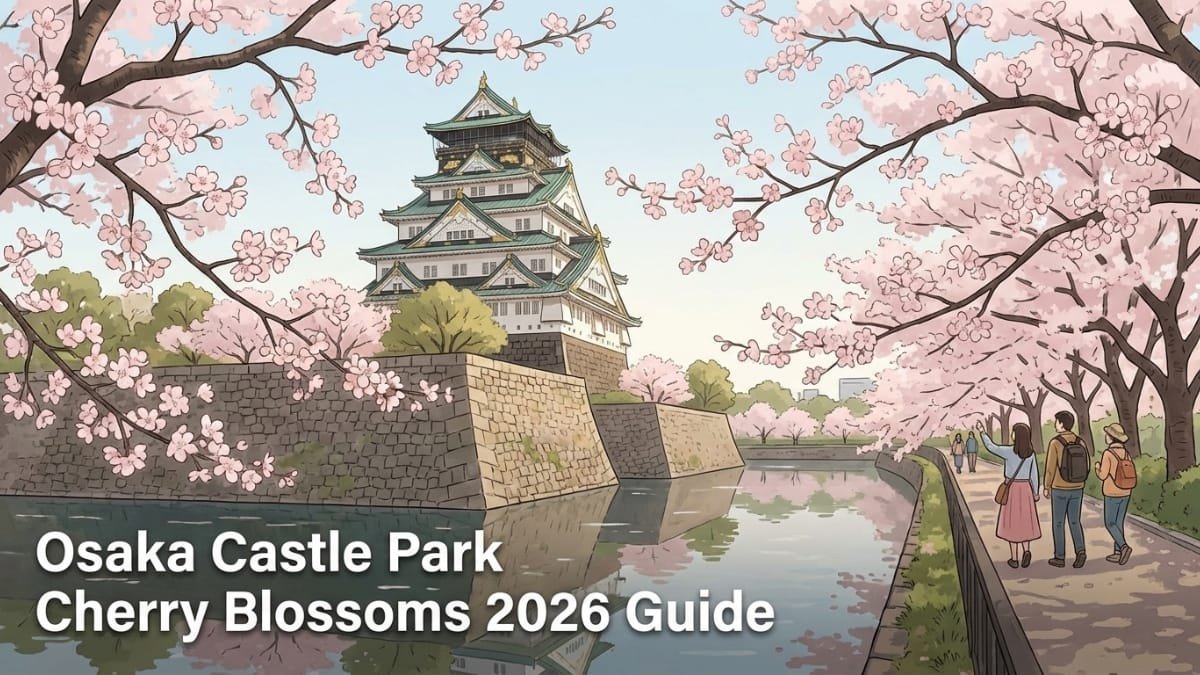
Osaka Castle Park is an easy place to add cherry blossoms to a first Osaka trip, but it is not a five-minute photo stop. The grounds are large, the best entrance depends on what you want to see first, and the famous castle-and-sakura view is inside paid Nishinomaru Garden rather than on every path.
The 2026 cherry blossom season and its special night program have ended. Details for spring 2027 have not yet been announced. Use this guide for the parts that stay useful every year, then check the official Osaka Castle Park website and its current spring announcement before fixing an evening visit, food-stall plan or event budget.
Quick answer
For the classic castle framed by cherry trees, enter from Tanimachi 4-chome Station, walk through the Otemon side and make Nishinomaru Garden your main stop. For a flexible free walk, use the wider park paths and moat viewpoints. Arrive early on a weekday if you can, and allow for roughly 18–21 minutes of walking from the surrounding stations to the central castle area—not counting the time you spend inside the park.
First, choose the experience you actually want
The park covers 105.6 hectares. Treating it as one small cherry blossom spot is the easiest way to waste energy.
Choose Nishinomaru Garden when the castle-and-blossom composition is your priority. The garden lies west of the main tower, contains about 300 cherry trees and normally has its own admission fee and operating hours. Seasonal night viewing, when held, also uses a separate schedule and last-entry time.
Choose the free park when you want flexibility, a moat-side walk, picnic space or an easy exit if the weather changes. You can see plenty of blossoms without entering Nishinomaru, although the angles are different and the main tower may be distant or hidden behind stone walls and trees.

When do the cherry blossoms bloom?
Late March to early April is the usual planning window for the main Somei Yoshino blossoms in central Osaka, but it is not a promise. Warm weather can bring flowering forward; cold days can slow it; rain and strong wind can shorten the best-looking period.
Do not book around a date copied from an older article. Check the current official park update shortly before your visit. A forecast tells you when the city may reach first bloom or full bloom; it does not guarantee that every tree, lawn and photo angle will look the same.
The wider park also contains different varieties, so a visit just outside the headline peak can still be worthwhile. If cherry blossoms are the main reason for your trip, keep one Osaka day flexible until the short-range forecast becomes useful.
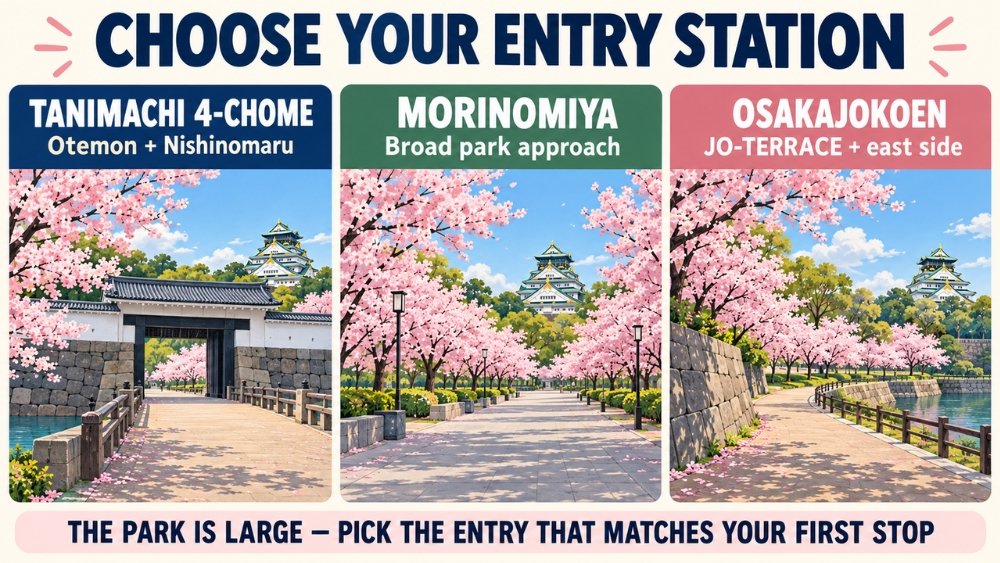
Which station should you use?
The official English park map gives approximate walks to the castle area of 18 minutes from Osakajokoen, Morinomiya, Osaka Business Park and Tanimachi 4-chome; 19 minutes from Temmabashi; and 21 minutes from Osakajokitazume. Your actual time will be longer when paths are busy or you stop for photos.
Tanimachi 4-chome: best for Otemon and Nishinomaru
Use Tanimachi 4-chome Station when your first priority is Nishinomaru Garden or the historic approach through the Otemon side. This is the clearest default for a first visit built around the classic west-side view.
Morinomiya: best for a broad park walk
Morinomiya Station works well when you want to enter from the southeast, see more of the park and walk gradually toward the castle. It is practical, but not the shortest-feeling choice if Nishinomaru is your only goal.
Osakajokoen: best for the east side and JO-TERRACE
Osakajokoen Station gives a straightforward approach through the east-side facilities and JO-TERRACE OSAKA. Choose it when you want food or a rest stop near that entrance, or when the JR Osaka Loop Line fits the rest of your day.
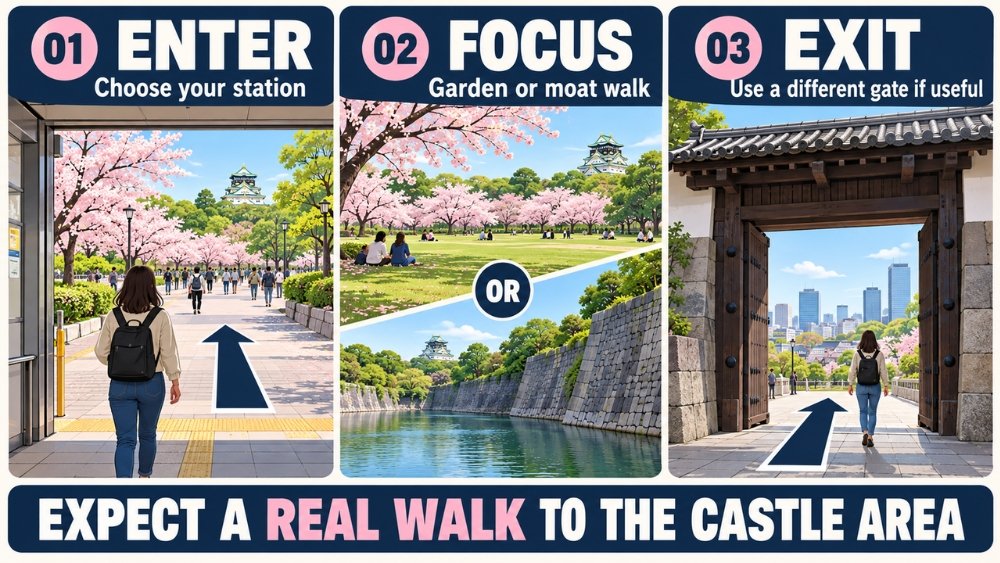
Do not force yourself to leave from the station where you arrived. A one-way walk between two sides of the park can be more efficient than backtracking.
A simple first-visit route
For a classic visit, start at Tanimachi 4-chome, approach through Otemon, enter Nishinomaru Garden if it is open and worthwhile that day, then continue toward the inner castle area. After viewing the main tower area, leave toward Osakajokoen or Morinomiya if that direction suits your next stop.
This is a planning sequence, not a promise that every path or gate will stay open. Use the current official map on the day, especially when a seasonal event changes queues or circulation.
Allow at least 90 minutes for a focused park-and-garden visit. Two to three hours is more comfortable if you want photographs, food, the main tower or a slower walk. Osaka Castle Main Tower is a separate paid attraction with its own ticket and hours; seeing the exterior from the park does not require a tower ticket.
Free park, paid garden and seasonal fees
Entry to Osaka Castle Park itself is free. Nishinomaru Garden is a separate paid facility. Its normal adult admission has historically been ¥200, while special evening programs can use different prices and hours. Because spring 2027 details are not yet published, confirm the current garden page before stating a price in your day budget.
The same rule applies to night viewing: do not assume that the previous year’s dates, closing time or last-entry time will repeat. A night program is an event, not the park’s permanent operating pattern.
Daytime or night viewing?
Choose early daytime for easier navigation, clearer moat and stone-wall views and a better chance of finding space before weekend crowds build. Before 9:00 a.m. is a useful target for the free outdoor areas, but confirm the opening time of any paid facility you plan to enter.
Choose night viewing only after the official seasonal program is announced. Check the exact dates, garden entry window, last admission, lighting area and fee. Arriving at the general park after dark does not automatically give you access to the official illuminated garden.
Food stalls, picnics and barbecue
Temporary stalls and spring programs can change from year to year. Treat them as event features, not permanent services. JO-TERRACE OSAKA and other fixed facilities are more dependable for a meal, while a convenience-store picnic gives you flexibility if lawns are open and not restricted.
Do not bring an open flame or set up a barbecue wherever you find space. Use only an officially designated seasonal barbecue area when one is announced, and follow its reservation and equipment rules. Take your rubbish with you or use the collection points specified for the event.
Accessibility and reducing the walking load
The park welcomes wheelchairs and strollers, but the historic terrain includes slopes, bridges and long distances. Review the official barrier-free map before choosing an entrance. It identifies accessible toilets, nursing rooms and route cautions.
The Road Train and Electric Car can reduce some internal walking, but routes, stops and operating conditions can change. Check the day’s service rather than treating them as guaranteed connections. A companion should also confirm whether the remaining route from the stop to the desired garden or facility is manageable.
Driving and parking
Parking exists, but peak-bloom weekends are a poor time to depend on it. Traffic, queues and the distance from the parked car can cancel out the apparent convenience. Rail is the lower-risk default for most visitors.
If driving is necessary, open the official parking and congestion information shortly before departure. Do not plan on arriving at midday and finding a space without delay.
Common mistakes to avoid
- Using “Osaka Castle” as one map pin. Save your entrance station, first viewing area and intended exit separately.
- Assuming every blossom view includes the main tower. Walls, trees and distance block it from many paths.
- Confusing the free park with Nishinomaru Garden. The garden has separate access, hours and fees.
- Reusing the 2026 night schedule. Wait for the new official announcement.
- Underestimating the walk. The station-to-castle estimate is only the approach, not your whole visit.
- Arriving with large luggage. Leave suitcases at your hotel or station before entering the park.
Before you leave
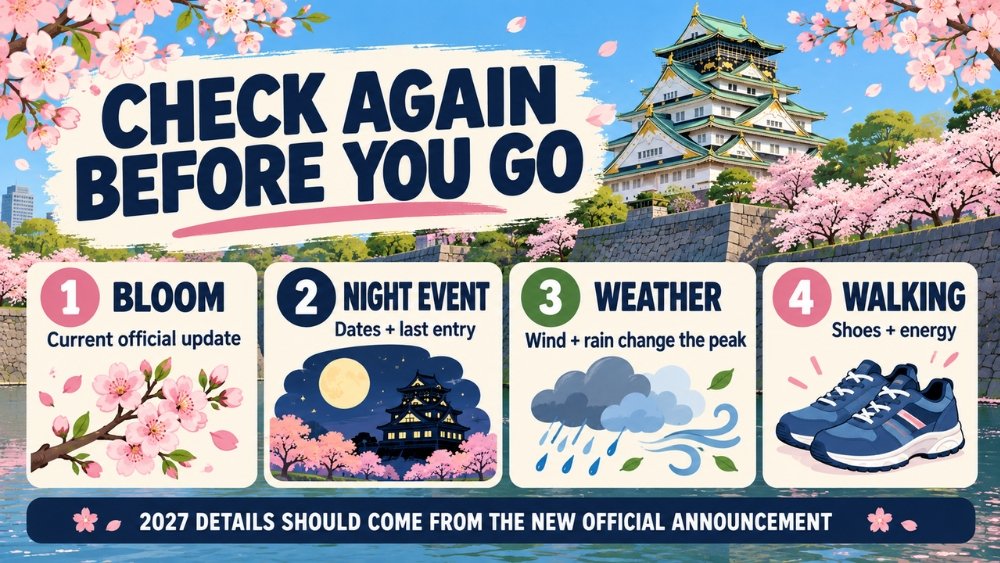
Check four things again: the current bloom update, any newly announced night-event dates and last entry, the day’s wind and rain, and the walking load for your group. Save the official Osaka Castle Park site, the park on Google Maps and the official PDF map offline if mobile reception or battery life becomes a problem.
The simplest successful plan is still the best: choose one entrance, give one viewing area priority and avoid backtracking. Osaka Castle Park is rewarding because blossoms, moats, stone walls and the main tower can fit into one visit—not because every part must be covered.