
The Osaka Mint cherry blossom viewing is not a park visit. It is a short annual opening of the Mint grounds, usually managed as a reserved, one-way passage from the South Gate to the North Gate. You cannot safely plan it from last year’s dates, and reaching the Mint without the required reservation may leave you outside the gate.
Season status — October 14, 2026: the 2026 event has ended. The Japan Mint has not yet announced the 2027 dates, reservation method or entry rules. The Mint’s FAQ says the period is generally decided and announced around mid-March after the blossom outlook is considered. Use this guide to prepare the route; use the official Cherry Blossom Passage page for the new year’s decision.
The event is a one-way passage, not a park visit
The event is called Sakura no Torinuke, or the Cherry Blossom Passage. For roughly one week in early to mid-April, visitors follow about 560 metres of Mint grounds beside the Old Yodo River. The public opening began in 1883.
“Torinuke” describes the movement: enter from the south, pass through and leave from the north. There is no normal loop back to the entrance. That affects the station you choose, where you meet other people and where you arrange a meal afterward.
It also explains why this event feels different from Osaka Castle or Kema Sakuranomiya Park. The main attraction is the Mint’s collection of many cherry varieties, especially later-flowering double blossoms, rather than lawns for picnics or an unrestricted river walk.
Plan from the announcement, not from last year’s dates
Do not copy the previous year’s calendar into a new itinerary. The Japan Mint chooses the viewing period around the expected flowering of its collection, and the reservation conditions can change with the new notice.
The 2026 edition illustrates the process. It ran from April 9 to 15, required a free advance reservation and did not admit people without a booking. Reservations opened on March 18 at 9:00 a.m. Japan time and were first come, first served. Those details are now an archive, not a 2027 schedule.
For the next edition:
- Check the official passage page around mid-March.
- Open the notice for the correct year, not an older page that still appears in search.
- Reserve through the link supplied by the Mint if booking is required.
- Save the confirmation and read the current entrance, prohibited-item and cancellation rules.
- Recheck the official page on the day, especially in poor weather.

The event is free when announced as such, but free does not mean walk-in. A required reservation is the real admission condition.
Choose the entrance before you choose the rest of the day
The approach and exit are on different sides of the grounds. Start by saving the South Gate, not merely a broad “Japan Mint” map pin.
| Stage | Useful rail access | What to remember |
|---|---|---|
| Approach | Osaka Metro Tanimachi Line, Temmabashi Station — north ticket gate, Exit 2 | About a 15-minute walk to the South Gate |
| Approach | Keihan Main Line, Temmabashi Station — east ticket gate, Exit 14 | About a 15-minute walk to the South Gate |
| Approach | JR Tozai Line, Osakajokitazume Station — Exit 3 | About a 15-minute walk to the South Gate |
| Passage | South Gate to North Gate | About 560 metres, one way |
| After exit | Osaka-Tenmangu, Minamimorimachi, Sakuranomiya or Kyobashi | Each is roughly a 15-minute walk from the exit area; choose by your next destination |
Save Temmabashi Station, Osakajokitazume Station and the Japan Mint before leaving Wi-Fi. Use the official event map when it appears because temporary queueing and entry instructions outrank a general navigation pin.
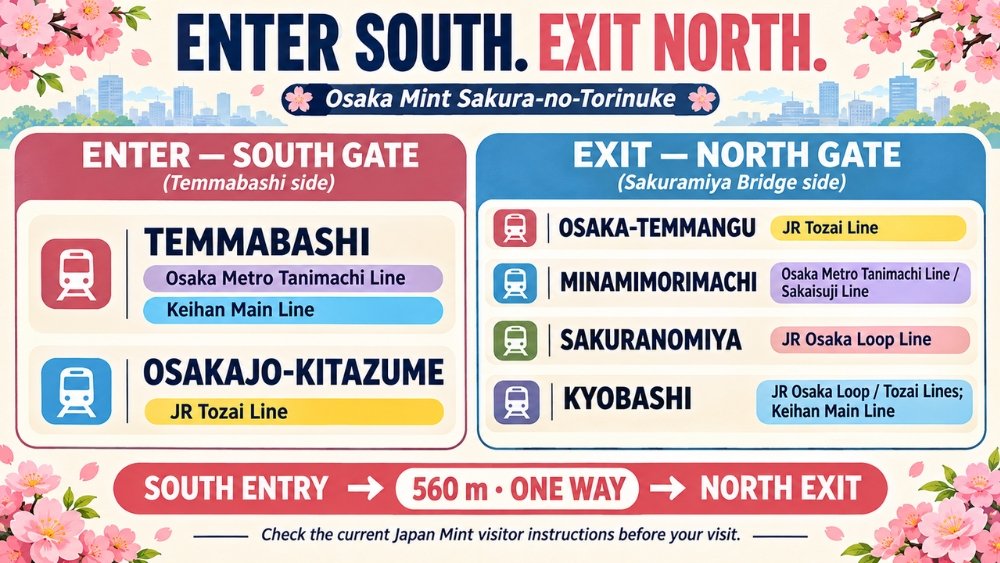
Do not schedule a companion to wait at the South Gate after you enter; the route carries you away from it. If your next stop is south of the Mint, allow for the northward passage and the journey back.
Your reservation code is the real ticket
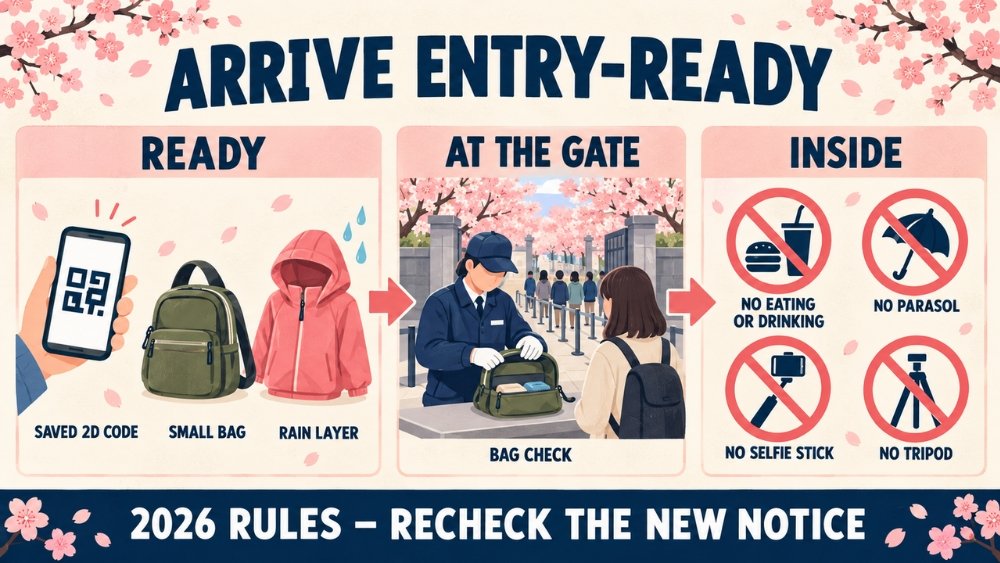
In 2026, the reservation confirmation contained a 2D code. Visitors could show it on a phone or bring a printout, and staff checked it at entry. The exact system may change, but the practical lesson is stable: make the confirmation available without depending on a slow connection at the gate.
Save the complete confirmation offline, keep a screenshot only after confirming it is the final code, and carry a printed copy if a dead battery would be difficult to recover from. Check whether one booking covers a group or whether every visitor needs an individual entry record; follow the current form rather than assuming last year’s arrangement.
The 2026 notice allowed a small amount of lateness caused by transport disruption, except around the opening and closing periods. That was a specific accommodation, not permission to arrive whenever convenient. Aim for the assigned time and use the new notice as the authority.
Pack for a moving queue, not a picnic
The simplest setup is a charged phone, a small bag, comfortable shoes and a light rain layer that leaves your hands free. The approach walk, possible queue, passage and walk to the next station add up; this is not only a 560-metre outing.
In 2026, visitors passed a baggage inspection. Eating, drinking and smoking were prohibited inside the Mint, as were parasols, selfie sticks and tripods. Pets could not enter except assistance dogs. These are strong reasons to travel light, but they remain previous-edition rules until the next notice confirms them.
Toilets have been provided around the entrance and exit areas, but it is still sensible to use station facilities before joining a long queue. In bad weather, check the event status rather than assuming the passage will continue. The Mint’s notice says cancellation may be announced at short notice on its website and by email.
The blossoms are the reason to choose the Mint
Osaka’s best-known central cherry trees are often Somei Yoshino. The Mint is valuable because its collection includes many satozakura, the cultivated, often double-flowered varieties that can bloom later and look fuller at close range.
The 2026 passage displayed 331 trees representing 140 varieties, and selected Gyoikō as its Flower of the Year. Those figures show the character of the collection, not a permanent promise: tree condition and the displayed count can change. The annual notice and the Mint’s variety information are the right sources for the edition you will attend.
Do not interpret the event date as a guarantee that every tree will be at peak bloom. Different varieties open at different times, and temperature, rain and wind change the result. Choose the Mint for variety, history and the controlled passage—not for certainty that one particular photograph can be recreated.
Food is outside—and temporary stalls are not a plan
Food stalls have appeared along the surrounding riverside in some seasons, but they are not part of the reserved Mint passage and should not be the only dinner plan. Vendor numbers, locations, hours and even their presence can change. Inside the Mint, follow the current rule; in 2026, eating and drinking were prohibited.
For a dependable meal, eat before joining the entry route or choose a permanent restaurant after leaving. Keihan City Mall is directly connected to Temmabashi Station and has multiple restaurant floors, making it a practical pre-entry option. Check the restaurant’s own hours and leave enough time to walk to the South Gate.
The public paths beside the Okawa River are separate from the Mint grounds. A riverside walk can be an optional extension, but it does not turn the controlled passage into a picnic area or guarantee a festival market.

Accessibility and total walking
Count the entire journey, not just the tree-lined section. A typical plan includes about 15 minutes from a station to the South Gate, time for entry and security, the 560-metre one-way passage, and about 15 minutes from the North Gate area to a useful station. Queues and photography make the elapsed time longer.
As a planning estimate, allow 60 to 90 minutes from the approach station to the onward station, then add extra buffer for a busy day. That is not an official duration or an entry-time guarantee.
The 2026 notice allowed electric wheelchairs. The Mint FAQ also says a limited number of wheelchairs may be available and recommends bringing your own when possible. Visitors who need help can ask staff, although an escort may not be immediate when the event is crowded. Confirm the new year’s accessibility arrangements before reserving, and avoid building a tight connection after the exit.
If you cannot get a reservation
Do not travel to the entrance hoping for an exception when the current notice says reservations are required. Switch to a place that operates as public space.
Kema Sakuranomiya Park follows the river outside the Mint and does not use the same controlled passage. It offers a flexible walk, but it is a different experience: it does not provide access to the Mint’s collection, and bloom, lighting, stalls and crowd conditions are not guaranteed. The broader Osaka cherry blossom spots guide can help you compare other alternatives.
The most useful next step is simple: save the Japan Mint’s official passage page, check it around mid-March, and reserve only from the notice for the year you will actually visit.