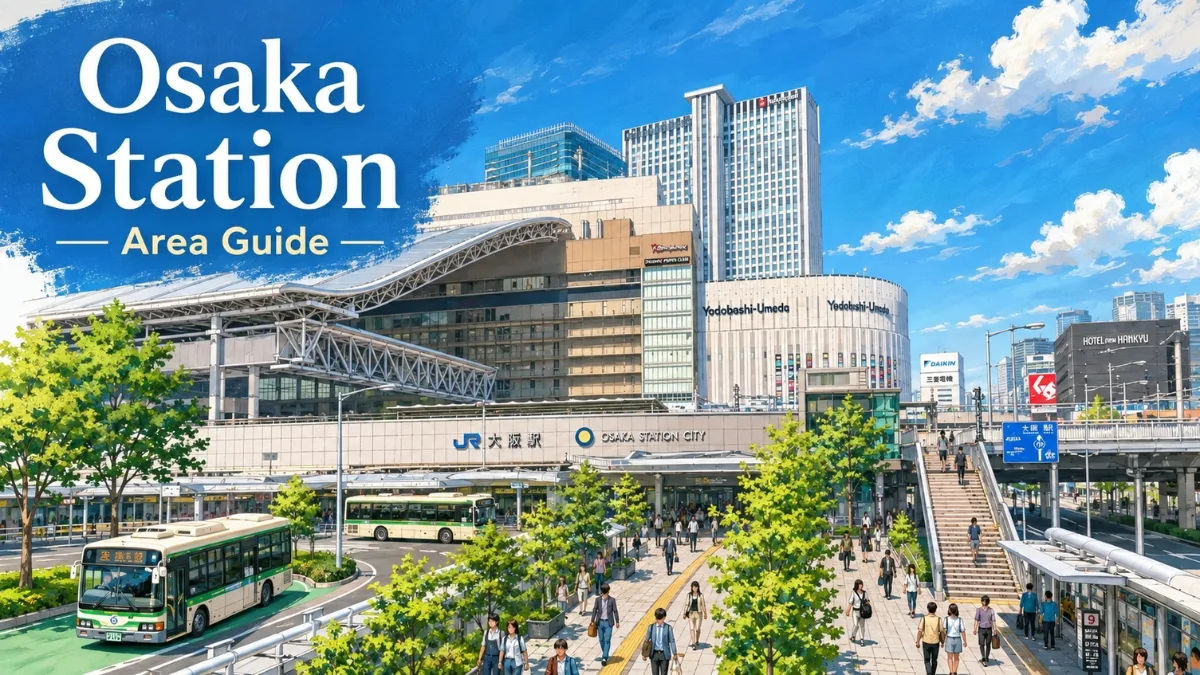
The Osaka Station area is one of the easiest bases for a first Osaka trip after you stop treating it as one station. JR Osaka Station sits at the center, while several separate Umeda stations, department stores, malls, hotels and pedestrian passages spread around it. The district is excellent for regional trains, bad-weather convenience and low-effort dining, but a hotel or restaurant can still be a 10- to 15-minute indoor walk from the platform you use.
You do not need to memorize the entire district. Use one repeatable sequence: identify the railway operator, choose the correct gate, aim for a named building, and confirm the floor before following the final exit. That turns “Umeda” from a maze into a set of useful anchors.
First decode the station names
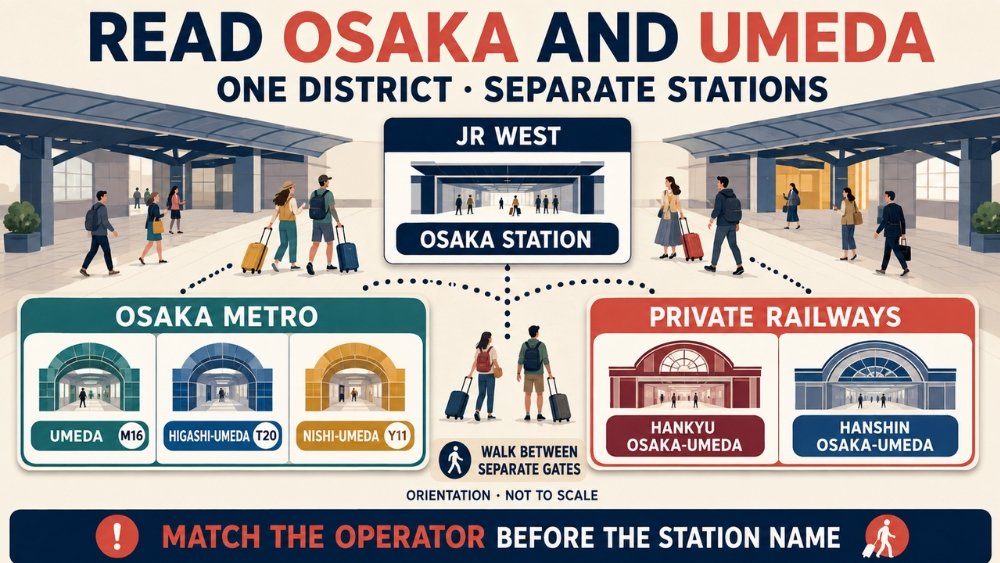
“Osaka” and “Umeda” refer to the same broad city-center district, not one shared paid station. The platforms belong to different operators, and transfers often involve leaving one ticket-gate area and walking through a public concourse.
| Station name | Operator and line | Most useful when you are going toward |
|---|---|---|
| Osaka Station | JR West — Japan Railways services | Shin-Osaka, Kyoto, Kobe, the Osaka Loop Line and JR regional trips |
| Umeda Station | Osaka Metro Midosuji Line (M16) | Shin-Osaka, Namba, Shinsaibashi and Tennoji on Osaka’s main north–south subway line |
| Higashi-Umeda Station | Osaka Metro Tanimachi Line (T20) | Tanimachi districts and the eastern side of central Umeda |
| Nishi-Umeda Station | Osaka Metro Yotsubashi Line (Y11) | Hommachi, Namba’s western subway side and the southwest side of Umeda |
| Osaka-Umeda Station | Hankyu Railway | Kyoto and Kobe corridors on Hankyu services |
| Osaka-Umeda Station | Hanshin Electric Railway | Kobe and destinations along the Hanshin network |
Kitashinchi Station on the JR Tozai Line is another nearby station south of the main JR Osaka buildings. It is part of the walking district, but it is not a platform inside Osaka Station.
The official JR West Osaka Station map and official Umeda district map show why the names matter. Osaka Metro also lists Umeda, Higashi-Umeda and Nishi-Umeda as separate stations with walking transfers among them. Save the operator with the station name—for example, “Hankyu Osaka-Umeda,” not only “Umeda.”
Use four building anchors around JR Osaka Station
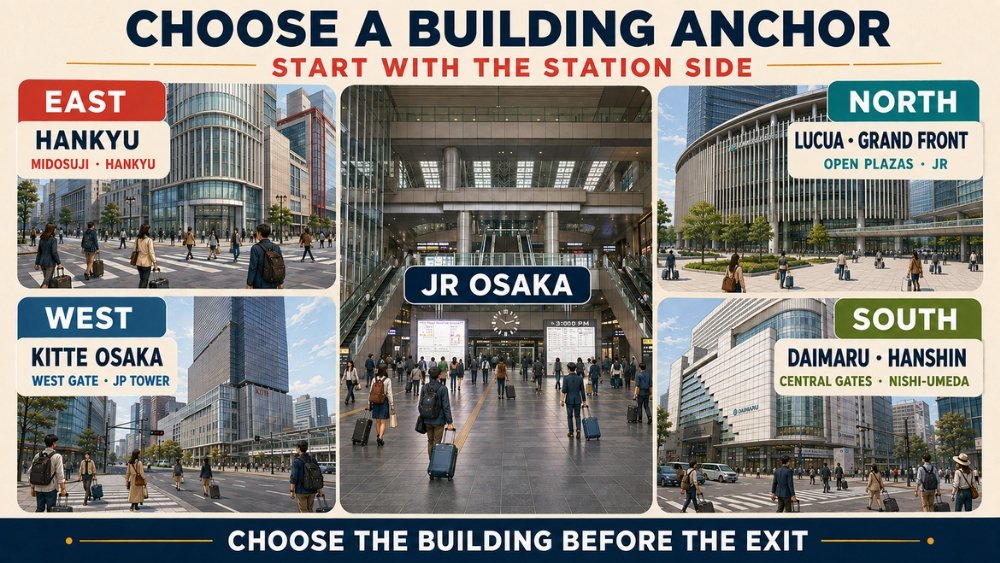
Directions such as “north of Osaka Station” become much easier when a real building gives you something visible to follow. These four sides are orientation zones, not exact boundaries.
East: Hankyu and the Midosuji side
The east side is useful for Osaka Metro’s Midosuji Line, Hankyu Osaka-Umeda Station and the dense commercial streets beyond them. The Hankyu Umeda Main Store is a practical above-ground landmark; open it in Google Maps.
From JR Osaka, Midosuji Gate or Midosuji North Gate usually gives this side the clearest start. Do not follow the word “Umeda” alone: check whether the next sign says Osaka Metro, Hankyu or Hanshin. The three systems have separate gates.
This is the busiest-feeling side of the district. It works well when most local journeys use the Midosuji Line or when a Kyoto trip begins on Hankyu, but a hotel advertised simply as “Umeda” may still sit across several indoor passages.
North: LUCUA, Grand Front and Grand Green
The north side feels more open because large atriums, pedestrian decks and newer plazas interrupt the enclosed retail corridors. LUCUA Osaka is directly linked to JR Osaka Station; save its exact map pin. Beyond it, Grand Front Osaka provides a recognizable pair of large commercial buildings; open Grand Front Osaka in Google Maps.
Farther north and west, Grand Green Osaka combines shops and restaurants with a substantial urban park. Save Grand Green Osaka in Google Maps if you want an outdoor reset point rather than another indoor mall.
Bridge Gate is useful for upper-level pedestrian connections. Midosuji North Gate works for the northeastern side, while Umekita Underground Gate serves the newer underground platforms and developments to the northwest. Those gates are not interchangeable shortcuts, so match the gate to the exact building before leaving the platform.
West: West Gate, KITTE Osaka and JP Tower
The west side has changed substantially with the West Gate and JP Tower Osaka development. KITTE Osaka is the easiest visitor-facing anchor inside JP Tower; open KITTE Osaka in Google Maps.
This side is especially practical when you arrive on a service using Osaka Station’s underground platforms, including some limited-express and Osaka Higashi Line trains. JR West’s station map shows an inside-gate passage between Umekita Underground Gate and West Gate. Do not assume that passage connects every JR gate: it has a specific role within the station.
KITTE’s basement and upper restaurant floors also make the west side a useful first-night destination. You can choose food after checking in without learning the older Umeda underground maze immediately.
South: Daimaru, Hanshin and the central gate area
The South Gate Building contains Daimaru Umeda and Hotel Granvia Osaka. It is a strong anchor for Central Gate, South Central Gate and Sakurabashi Gate routes. Hanshin Osaka-Umeda Station and Nishi-Umeda are also reached through the wider southern and southwestern passage network.
The Hanshin Umeda Main Store is a useful landmark for the southern Metro and Hanshin side; open it in Google Maps. If your destination is south of the station, going up to daylight may be clearer than following a long chain of basement signs.
Navigate in four decisions, then use the final exit
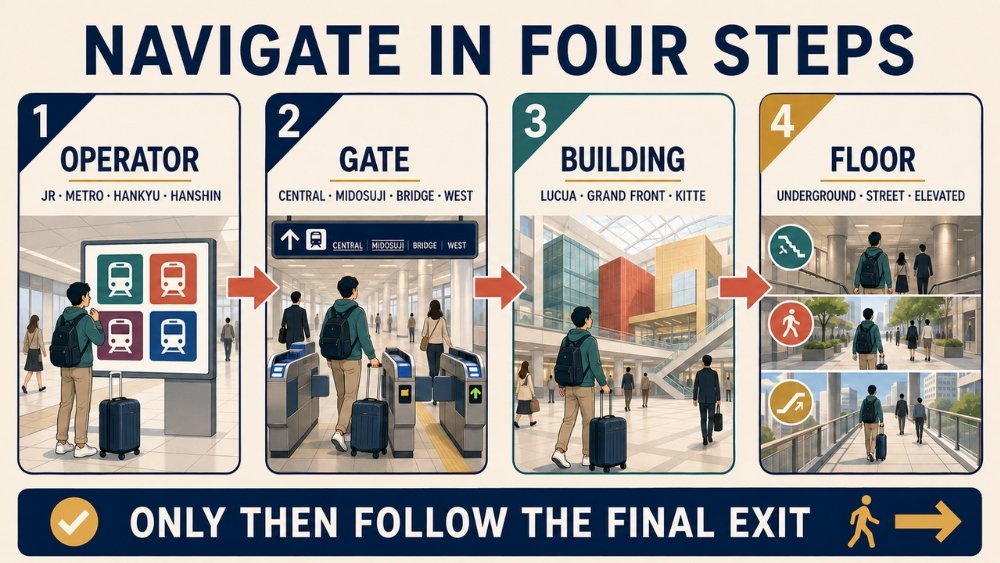
Osaka Station becomes harder when you start with a numbered exit before knowing which system and level you are in. Use this order instead.
- Railway operator: JR, Osaka Metro, Hankyu or Hanshin.
- Named gate: for example, JR Central Gate, Midosuji Gate, Bridge Gate, West Gate or Umekita Underground Gate.
- Building anchor: LUCUA, Grand Front, KITTE, Hankyu or Hanshin department store, or your hotel.
- Floor: underground, street level or an elevated pedestrian deck.
Only then follow the final numbered exit or hotel entrance. A screenshot should include all four pieces, not just a map pin in the middle of the district.
If you lose the route, stop at a large concourse or plaza and re-anchor. Continuing through a familiar-looking underground corridor can turn one wrong junction into several. Our dedicated guide to navigating Osaka Station without stress covers the gate-by-gate habits in more detail.
Osaka Metro has one rule worth knowing before you pause for shopping mid-transfer. Transfers among Umeda, Higashi-Umeda and Nishi-Umeda must normally be completed within 30 minutes under Osaka Metro’s outside-gate transfer rules. After that, the operator says the trip may be treated as a new ride; ticket and pass exceptions apply. This rule does not turn JR, Hankyu or Hanshin into part of the same Metro transfer.
Travelers using a wheelchair, stroller or large suitcase should check a barrier-free route on the official Osaka Metro Umeda page and the JR station map. The nearest-looking stairs are not necessarily beside the elevator, and a slightly longer route may be much easier.
Think in three levels: underground, street and elevated
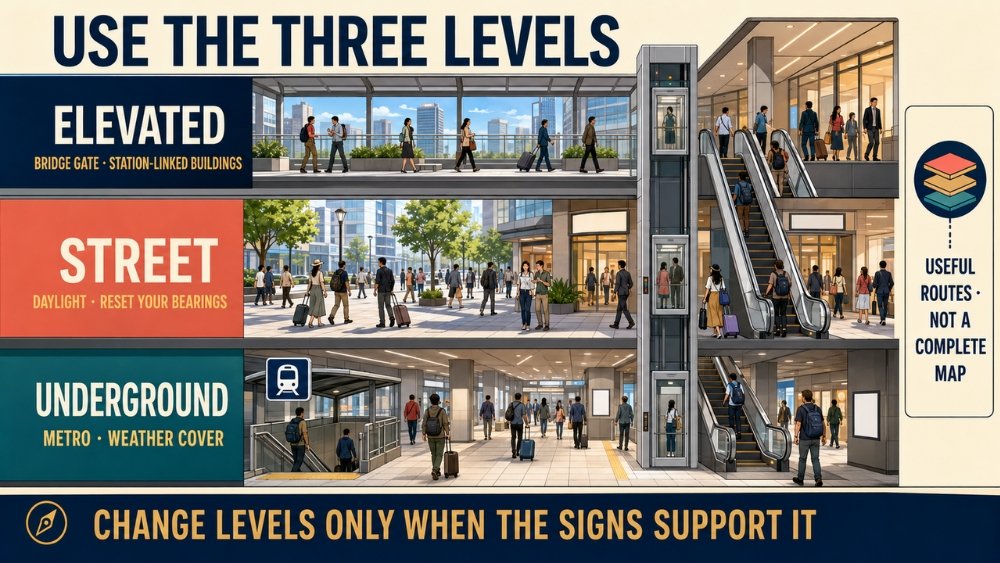
Umeda feels confusing because two routes to the same building may use different heights. Each level has a useful role.
Underground is valuable in rain, summer heat and cold weather. It connects Metro concourses, department-store basements and many commercial passages. It is not automatically the shortest route. Similar corridors, closing doors and floor changes can make a simple outdoor walk easier after business hours.
Street level gives you daylight, road crossings and visible building facades. Use it when you need to reset your sense of direction or when a basement sign chain becomes unclear. Waiting at a safe place above ground is also easier than telling another traveler that you are “near an escalator underground.”
Elevated decks and bridges connect parts of Osaka Station City and several north- and west-side buildings. Bridge Gate is on the third-floor north–south bridge, above the main platforms. These routes are useful when your destination is already on an upper level, but they may add lifts or escalators when you ultimately need a basement railway.
Do not try to learn all three networks at once. Choose the level that matches the next building, and change levels only when the signs support that choice.
Pick a building before you pick a meal
“Let’s eat somewhere in Umeda” is too broad when everyone is tired. Choose a building first, then compare the current restaurants inside it.
| What you need | A practical anchor | Why it works |
|---|---|---|
| Many familiar choices close to JR | LUCUA Osaka · Google Maps | Dining floors and the B2 food hall keep several price points in one station-linked complex |
| A west-side first-night meal | KITTE Osaka gourmet guide · Google Maps | Basement casual food plus upper restaurant floors; useful after a West Gate arrival |
| Department-store takeaway | Hanshin Umeda Main Store · Google Maps | A depachika—a department-store basement food hall—can solve a low-energy dinner or snack stop |
| A north-side indoor break | Grand Front Osaka · Google Maps | Information, seating areas, restaurants and lockers are concentrated in a recognizable building pair |
| Fresh air between trains or plans | Grand Green Osaka · Google Maps | The park and open space provide a change from the station’s enclosed flow |
Restaurant hours and last orders vary by floor and shop, so use the linked facility directory on the day. A depachika is best for buying prepared food, sweets or gifts; do not assume every counter has seating. For a group with different diets, a large building is often easier than searching narrow streets one restaurant at a time.
If you have only one or two hours, resist the urge to cross the whole district. Choose one building on the same side as your next train or hotel, eat or browse there, and return to the named gate with time to spare. Lockers exist around the station, but availability is not guaranteed during busy periods; hotel storage or a prearranged luggage service can be more reliable for a time-sensitive plan.
Choose a hotel by station side, not by the word “Umeda”
The following hotels are location examples, not a universal ranking. Each one makes a different part of the station district easier. Check the exact room, bed setup, taxes, breakfast terms and cancellation policy before paying.
Hotel Granvia Osaka: central and south-side JR access
Hotel Granvia Osaka is directly connected to JR Osaka Station in the South Gate Building. Its official directions identify Central Gate and Sakurabashi Gate as the shortest stair/escalator routes, Bridge Gate for a barrier-free route, and West Gate for travelers arriving on Haruka, Kuroshio or Osaka Higashi Line services. Open Hotel Granvia Osaka in Google Maps.
Klook lets you switch the displayed language and currency, which can make room comparisons easier in a familiar format. Still match the exact room name and cancellation terms with the hotel’s official information before paying. Check current rooms and prices for Hotel Granvia Osaka on Klook.
Hotel Hankyu RESPIRE Osaka: north-side JR and Hankyu access
Hotel Hankyu RESPIRE Osaka is above the Yodobashi Umeda Tower complex on the north side. The hotel lists about three minutes from JR Osaka’s Bridge Gate, about six minutes from Umekita Underground Gate and about five minutes from Hankyu Osaka-Umeda or Osaka Metro Umeda. It is a practical fit when north-side buildings and Hankyu journeys matter more than Nishi-Umeda. Open Hotel Hankyu RESPIRE Osaka in Google Maps.
Check current rooms and prices for Hotel Hankyu RESPIRE Osaka on Klook.
THE OSAKA STATION HOTEL: West Gate and KITTE access
THE OSAKA STATION HOTEL, Autograph Collection is inside JP Tower Osaka with direct access from JR Osaka Station’s West Gate. Its official page also describes the inside-gate route from the underground platforms toward West Gate, which can be useful for Haruka arrivals. The trade-off is that this west-side advantage does not make Hankyu or Higashi-Umeda equally close. Open THE OSAKA STATION HOTEL in Google Maps.
Check current rooms and prices for THE OSAKA STATION HOTEL on Klook.
For any Umeda hotel, map the luggage route from the platform you will actually use. “Five minutes from Osaka Station” can describe a different gate and level from your arrival. Travelers with mobility needs should ask the hotel for the current step-free entrance rather than relying only on a map app.
The transport advantage is real, but itinerary-specific
Osaka Station is a strong base when several days begin on JR trains toward Kyoto, Kobe or other regional destinations. Hankyu and Hanshin add private-railway alternatives from their separate Osaka-Umeda terminals. The advantage is choice and repeated access, not a promise that every attraction is one direct train away.
Shin-Osaka is one JR stop away on the JR Kyoto Line, and Osaka Metro’s Midosuji Line also connects Umeda with Shin-Osaka. However, the Shinkansen—the high-speed bullet train—does not depart from Osaka Station. If an early reserved train cannot be missed, compare the real hotel-door-to-platform journey in our Shin-Osaka versus Osaka Station guide.
JR Haruka services from Kansai International Airport use Osaka Station’s underground platforms. That direct service can make Umeda convenient, but your journey continues from the platform to the correct gate and hotel entrance. Compare Haruka with airport buses, Nankai and other options in our Kansai Airport to Osaka guide.
Nara does not automatically make Umeda the best base. It is reachable by JR, but travelers who want the direct Kintetsu route from Osaka-Namba—and several evenings around Dotonbori—may save more effort by staying in Namba. Our Namba or Umeda comparison tests that decision against the whole itinerary.
Who will like this area, and who may not
The Osaka Station area is a strong fit when:
- two or more mornings begin on regional trains;
- you want many food and shopping choices inside connected buildings;
- weather-protected routes are valuable;
- different people in your group need JR, Metro, Hankyu or Hanshin;
- you prefer a predictable commercial base to a nightlife district.
Another area may suit you better when late-night street energy matters more than morning rail access, when you want an intimate neighborhood outside the hotel, or when the lowest room price is the main decision. Namba is stronger for repeated Minami evenings; Nakazakicho and Tenma offer more street-level texture but less all-in-one transport convenience. Compare wider options in our guide to Osaka neighborhoods for tourists.
The area is workable for families and travelers with reduced mobility, but “connected indoors” does not always mean level or short. Check elevators, stroller width, luggage storage and the exact hotel entrance before arrival. Avoid the weekday commuter peak when you can, especially on the first journey with large bags.
Make the district smaller on day one
On your first day, save four things in your phone: the exact operator and station, the gate nearest your hotel, one reliable food building and the hotel entrance. Walk the hotel-to-station route once without a time-critical train if your schedule allows. That small rehearsal is more useful than trying to master every Umeda passage.
Treat Osaka Station as a base, not a destination you need to conquer. Use one side and one level at a time. Once those anchors become familiar, the district does what it is supposed to do: shorten regional mornings, protect low-energy evenings and give you dependable choices without sending you across Osaka.
After you choose the correct station side, compare the exact room, final price and cancellation terms.
Compare current Umeda hotel prices and availability on Klook.