
Namba and Umeda are both excellent places to stay in Osaka, but they make different parts of a trip easier. Choose Namba when you want Dotonbori, Shinsaibashi, late dining and the Nankai train to Kansai Airport close at hand. Choose Umeda when repeated trips toward Kyoto or Kobe, JR connections and large indoor shopping complexes matter more.
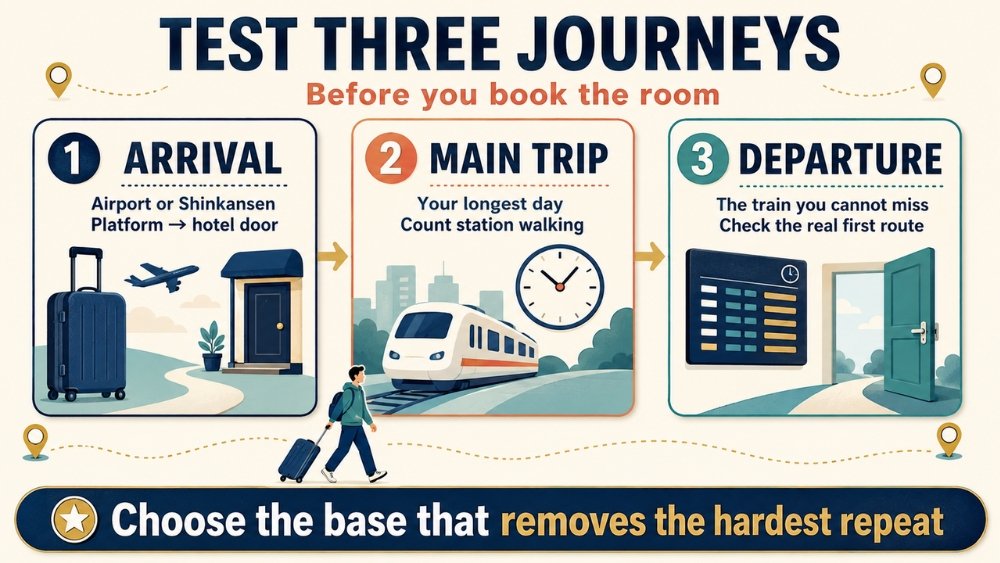
Do not decide from the neighborhood name alone. Test the exact hotel against three journeys: your arrival with luggage, your most important day trip and your final departure. A hotel on the right side of a large station can be more useful than a better-rated property across the district.
| Your trip priority | Better starting point | The reason that matters |
|---|---|---|
| Several evenings around Dotonbori and Shinsaibashi | Namba | You can finish many nights on foot instead of taking one more train |
| Kansai Airport by Nankai | Namba | Nankai services arrive at Nankai Namba |
| Kansai Airport by JR Haruka | Umeda | Haruka serves Osaka Station as well as Tennoji and Shin-Osaka |
| Repeated Kyoto or Kobe day trips | Umeda | JR, Hankyu and Hanshin options are concentrated in the Osaka–Umeda station district |
| Nara by Kintetsu | Namba | Direct services leave from Osaka-Namba for Kintetsu-Nara |
| Shopping and dining mainly inside connected buildings | Umeda | Department stores, malls and station buildings give you many weather-protected choices |
| A loose short stay built around food and nightlife | Namba | Minami’s best-known evening districts are close together |
| An early Shinkansen from Shin-Osaka | Neither automatically | Check the first Midosuji Line train or stay at Shin-Osaka when the departure cannot be missed |

First understand what the two area names mean
Namba is Osaka’s southern downtown hub in the wider Minami district. Dotonbori, Hozenji, Shinsaibashi, Kuromon Market and Den Den Town sit within or near the broader walking area. The streets are energetic, commercial and busy well into the evening.
Umeda is the commercial district around JR Osaka Station in northern central Osaka. Visitors use “Osaka” and “Umeda” for the same general area, but the station names belong to different operators. The district is filled with department stores, malls, restaurants, offices and underground passages.
The Osaka Metro Midosuji Line connects Namba and Umeda directly, so neither choice cuts you off from the other. The difference appears at the beginning and end of each day: Namba favors an evening that ends on foot, while Umeda favors a morning that starts on a regional train.
Namba is the stronger base when Osaka evenings shape the trip
Namba places the dense restaurant and entertainment side of Osaka outside your hotel. If your likely evenings include Dotonbori, Hozenji Yokocho, Shinsaibashi or Amerikamura, walking back can remove a repeated late journey. That is especially valuable on a two- or three-night stay, when there is little time to recover from an inefficient hotel location.
Namba is usually the better fit when:
- you expect to eat or drink around Minami on several nights;
- Dotonbori and Shinsaibashi are core parts of the trip rather than one short visit;
- you want direct Nankai access to or from Kansai International Airport;
- you plan a Nara day trip on Kintetsu from Osaka-Namba;
- you prefer street-level energy and variety to a more ordered business district.
The trade-off is friction at street level. Central Namba can be crowded, noisy and visually intense. A listing described as “Namba” may sit beside Nankai Namba, Osaka Metro Namba, Osaka-Namba or JR Namba, and those platforms are not in one compact hall. A cheap room west of JR Namba may be inconvenient for a traveler arriving on Nankai; a hotel beside Nankai Namba may be less convenient for someone using the airport bus terminal at OCAT.
Light sleepers should check recent room-specific comments about outside noise and ask whether a quieter room orientation is available. Families with strollers, travelers with mobility needs and anyone carrying large luggage should use the official Osaka Metro Namba station page to identify an elevator route. The closest numbered exit is not always the easiest exit.
For a hotel-by-hotel breakdown of the station’s different sides, use our guide to staying near Namba Station. Save the Namba station area on Google Maps only as an orientation pin; save the exact operator’s station separately before traveling.
Umeda is the stronger base when regional travel shapes the trip
Umeda works best when Osaka is a base for several journeys beyond the city. JR Osaka Station and the nearby Hankyu and Hanshin terminals provide multiple ways to travel toward Kyoto, Kobe and other parts of Kansai. The gain is not that every destination is direct. It is that you can start many regional trips without first crossing central Osaka from Namba.
Umeda is usually the better fit when:
- two or more days begin with trains toward Kyoto, Kobe or Himeji;
- your arrival or departure uses JR Osaka Station or the direct Haruka airport service;
- large department stores, food halls and indoor dining are a major part of the trip;
- different travelers in the group need different rail operators;
- you prefer a polished commercial district to the densest part of Minami.
Umeda is not automatically calmer or simpler. The streets around the station are busy, and the underground network is large enough to confuse a first-time visitor. “Near Umeda” may mean close to one railway and a long indoor walk from another. Before booking, identify whether the property sits nearest JR Osaka, Hankyu Osaka-Umeda, Hanshin Osaka-Umeda, Osaka Metro Umeda, Higashi-Umeda or Nishi-Umeda.
The area can be particularly useful during heavy rain, summer heat or cold weather because many shops and restaurants sit inside connected station buildings and underground malls. That protection comes with floor changes and long passages, so an understandable outdoor route may still be easier with luggage.
Use our Osaka Station area guide for the district’s main landmarks and Osaka Station navigation guide before arrival. The official Osaka Metro Umeda station page shows transfers and exits. Save Osaka Station on Google Maps as the JR anchor, then save your hotel’s exact entrance.
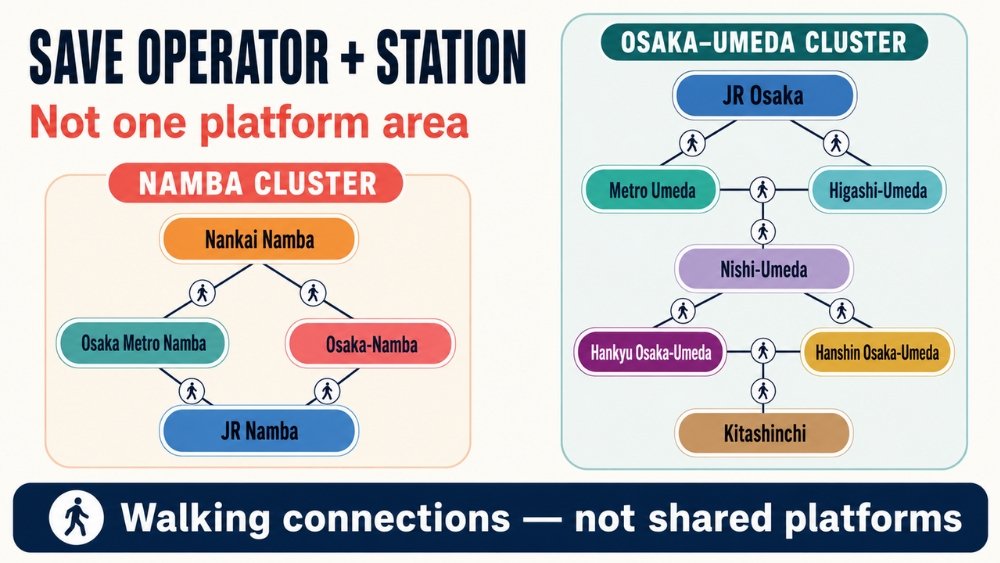
Read the station name twice before booking
Namba and Umeda both hide multiple station identities behind one neighborhood label.
The Namba station cluster
- Nankai Namba Station: Nankai services, including trains to Kansai Airport.
- Osaka Metro Namba Station: Midosuji, Sennichimae and Yotsubashi lines.
- Osaka-Namba Station: Kintetsu and Hanshin services, including the direct Kintetsu route toward Nara.
- JR Namba Station: JR Yamatoji Line platforms on the western side near OCAT.
The Osaka–Umeda station cluster
- JR Osaka Station: JR regional and city services, plus Haruka airport trains.
- Osaka Metro Umeda Station: Midosuji Line.
- Higashi-Umeda Station: Osaka Metro Tanimachi Line.
- Nishi-Umeda Station: Osaka Metro Yotsubashi Line.
- Hankyu Osaka-Umeda Station: Hankyu services toward Kyoto and Kobe corridors.
- Hanshin Osaka-Umeda Station: Hanshin services toward Kobe.
- Kitashinchi Station: JR Tozai Line, south of the main Osaka Station buildings.
These stations are connected by streets, signs, malls and underground passages, but “connected” does not mean “same platform area.” A transfer that feels easy without bags may feel very different after a long flight. Save the operator, line and station together—for example, “Nankai Namba,” not only “Namba.”
Compare the journeys that can change the answer
From Kansai International Airport
Namba has the most intuitive airport arrival when the hotel is close to Nankai Namba. Nankai’s limited-express Rapi:t reaches Nankai Namba in as little as 34 minutes and requires a limited-express ticket in addition to the basic fare. The Airport Express takes about 45 minutes and uses a normal ticket. Check the current Nankai timetable and ticket distinction before departure.
Umeda also has a direct rail option. JR’s Haruka serves Osaka Station from Kansai Airport. It is useful when your hotel is genuinely close to the correct Osaka Station side, but the underground arrival platform and the final walk still need to be checked. The current JR West Haruka page lists Osaka among the supported stations.
The better airport base is therefore not decided by the word “direct.” Compare the platform-to-hotel route, the ticket you plan to use, your arrival time and your luggage. Our Kansai Airport to Osaka guide covers the wider set of options.
For Kyoto and Kobe day trips
Umeda usually wins when several days point north or west. JR Osaka Station is already in the regional rail network, while Hankyu and Hanshin add alternatives from nearby terminals. This can remove the Namba-to-Umeda journey at both ends of the day.
One Kyoto or Kobe day trip does not force you to stay in Umeda. The Midosuji Line gives Namba a direct subway ride to Umeda, and some Kobe journeys are also possible on Hanshin from Osaka-Namba. Count repeated journeys, not isolated ones. If the trip includes four Osaka evenings and one Kyoto day, Namba may still save more total effort.
For Nara
Namba is the more natural choice for the direct Kintetsu route. The official Kintetsu itinerary shows Osaka-Namba to Kintetsu-Nara in about 40 minutes. This is an important correction to the idea that Umeda is automatically better for every day trip outside Osaka.
Umeda remains workable for Nara, but it normally adds a city transfer or uses a different route. If Nara is your only day trip and Minami is your evening focus, that combination points strongly toward Namba. For broader planning, compare the choices in our Osaka day-trip guide.
For Shin-Osaka and the Shinkansen
Both Namba and Umeda connect directly to Shin-Osaka on the Osaka Metro Midosuji Line. Umeda is closer, but neither neighborhood contains the Shinkansen platforms. When an early reserved train cannot be missed, test the first realistic door-to-platform journey and consider a final night at Shin-Osaka. Our Shin-Osaka vs Osaka Station guide explains why the two stations serve different purposes.
Food, shopping and atmosphere are different, not one-sided
Namba is stronger for spontaneous evening choice. Small restaurants, casual chains, bars, arcades and entertainment streets are close together, and many travelers can walk among Dotonbori, Hozenji and Shinsaibashi. The area feels lively because visitors, commuters and nightlife overlap. That same energy can become noise and crowd fatigue.
Umeda is stronger for structured indoor choice. Department stores, station buildings and malls gather restaurants, cafés, shops and services across many floors. It is easier to build a weather-protected day, but closing times and last orders vary by facility. The district becomes less intuitive when you say “let’s find something nearby” without choosing a building first.
Neither area is uniformly expensive. Hotel prices change with dates, events, room size and cancellation terms. Namba includes budget properties and premium station-linked hotels; Umeda includes business hotels, large station hotels and luxury choices. Compare the final total and the exact room category rather than assuming one neighborhood always costs less.
Four hotels that make the location difference concrete
These are location examples, not a universal ranking. Each property illustrates a useful station relationship. Check the current room type, bed layout, taxes, cancellation terms and official property notices before paying.
Namba: Swissôtel Nankai Osaka for the Nankai terminal
Swissôtel Nankai Osaka is the clearest example of choosing Namba for Nankai access. Its official directions list a two-minute walk from the third-floor north ticket gate at Nankai Namba and longer walks from the other Namba stations. It is useful for a traveler prioritizing a simple Kansai Airport arrival, but it is not equally close to JR Namba. Open Swissôtel Nankai Osaka in Google Maps.
Klook lets you switch the displayed language and currency, which can make it easier to compare a room in a familiar format. Still match the exact room and cancellation policy with the hotel’s official information before paying. Check current rooms and prices for Swissôtel Nankai Osaka on Klook.
Namba: Hotel Royal Classic Osaka for direct Metro access
Hotel Royal Classic Osaka is directly connected to Osaka Metro Namba via Exit Walkway 12. The hotel lists about four minutes from Nankai Namba and about ten minutes from JR Namba via Namba Walk. It suits a visitor who wants central Namba and easy Metro access without assuming every Namba platform is downstairs. Open Hotel Royal Classic Osaka in Google Maps.
Check current rooms and prices for Hotel Royal Classic Osaka on Klook.
Umeda: Hotel Granvia Osaka for JR Osaka Station
Hotel Granvia Osaka is directly connected to JR Osaka Station. It is the most straightforward of these examples for travelers whose important journeys use JR, although the best internal route still depends on the arrival gate. The trade-off is that a station-connected address can carry a premium on busy dates. Open Hotel Granvia Osaka in Google Maps.
Check current rooms and prices for Hotel Granvia Osaka on Klook.
Umeda: Hotel Hankyu RESPIRE Osaka for the north side
Hotel Hankyu RESPIRE Osaka sits on the north side of the station district. Its official access page lists about three minutes from JR Osaka Station’s Bridge Exit and about five minutes from Hankyu Osaka-Umeda and Osaka Metro Umeda. It fits travelers who want JR and Hankyu access near the north-side commercial buildings; it is less convenient when every important journey begins south of the station. Open Hotel Hankyu RESPIRE Osaka in Google Maps.
Check current rooms and prices for Hotel Hankyu RESPIRE Osaka on Klook.
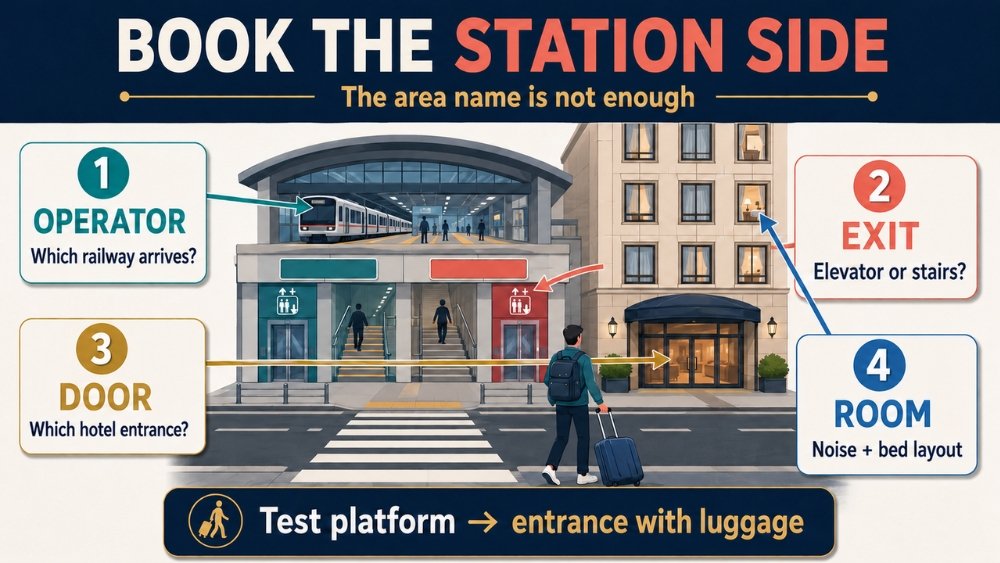
Run four checks on the exact room before paying
- Arrival check: Start at the platform used by your airport or Shinkansen connection. Map the elevator-friendly route to the hotel entrance with luggage.
- Evening check: Start at the place where two or three nights are likely to end. A repeated 25-minute return matters more than a one-time sightseeing journey.
- Main-trip check: Map the longest or most time-sensitive day trip. Include the walk inside the station, not only the train time shown by a route app.
- Sleep check: Read recent room-specific comments for outside noise, lifts, room size and climate control. A lively neighborhood and a restful room can coexist, but the room’s position matters.
Travelers with limited mobility should verify elevators on official station maps and contact the hotel when the step-free entrance is unclear. Families should check the booked bed layout rather than relying on a room label such as “twin” or “family.” If you plan to forward luggage, confirm the hotel’s current acceptance and storage rules directly.
The decision in real itineraries
Choose Namba for a short Osaka-focused trip with several Minami evenings, a Kintetsu day trip to Nara and a Nankai airport journey. The time saved is mostly after dinner and at the airport end of the stay.
Choose Umeda when two or more mornings begin toward Kyoto, Kobe or Himeji, or when JR Osaka Station is central to both arrival and departure. The time saved is mostly before and after regional trains.
If the itinerary is evenly divided, compare actual rooms rather than forcing an area winner. A quiet, larger room two minutes from the correct station may beat the neighborhood that wins a generic comparison. Travelers who want a calmer alternative should also compare the other bases in our Osaka neighborhood guide.
After deciding the area, compare the exact map location, room and final price—not just the hotel name.
Compare current Namba hotel prices and availability on Klook.
Compare current Umeda hotel prices and availability on Klook.