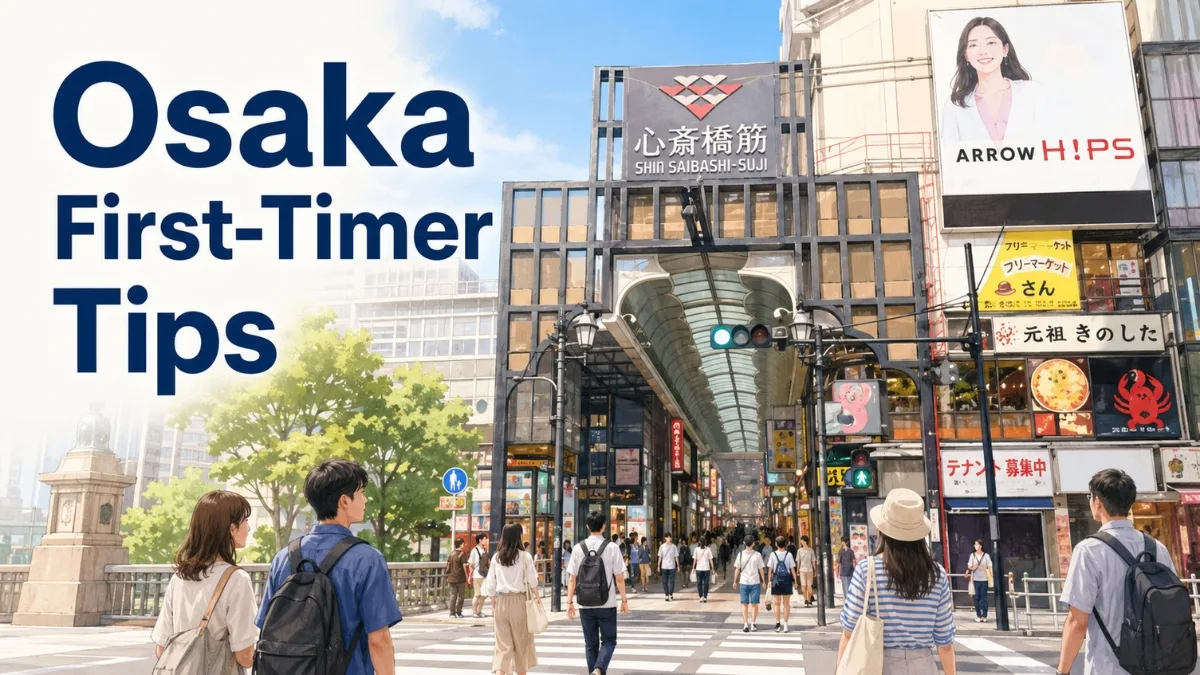
Osaka rarely feels difficult because of one big mistake. The friction comes from small assumptions: treating Umeda as one station, thinking an IC card covers every train, following the nearest exit without checking the level, or sitting down before noticing a meal-ticket machine by the door.
These 12 details are the parts a route app may not explain. Learn them before arrival and you can make faster decisions without turning the trip into a rulebook.
The map leaves out how Osaka really works
1. Osaka has several centers, not one downtown
Osaka works through several major hubs. They are connected, but they solve different travel problems.
| Hub | Best used for | What first-timers miss |
|---|---|---|
| Umeda / Osaka Station | JR connections, northern Osaka, large department stores, and regional trips | “Osaka” and “Umeda” appear on different stations and operators in the same district |
| Namba | Minami, Dotonbori, Shinsaibashi, nightlife, and Nankai airport trains | Namba is a group of stations, not one shared ticket-gate area |
| Tennoji | Southern and eastern Osaka, JR and Kintetsu connections, and a calmer return than central Namba | The JR, Osaka Metro, Kintetsu, and Hankai connections still require the correct route through the hub |
The Osaka Metro Midosuji Line links Umeda (M16), Namba (M20), and Tennoji (M23) in that north-to-south order. Its official line color is red. That makes the line a useful mental spine, but it does not make the three districts interchangeable.

If you are still choosing a hotel, start with the journey you will repeat most often—not with the district that looks most central on a small map. The Osaka first-trip planning guide gives that decision more room.
2. An area name is not a complete station name
“Meet me at Umeda” is not enough. In the Umeda area, Osaka Metro lists Umeda on the Midosuji Line, Higashi-Umeda on the Tanimachi Line, and Nishi-Umeda on the Yotsubashi Line, alongside JR, Hankyu, and Hanshin connections. JR Osaka Station is part of the same wider district, but it is not inside the Osaka Metro paid area.
Namba has the same problem in another form. Osaka Metro Namba connects with JR, Nankai, Kintetsu, and Hanshin, but the platforms and gates belong to separate operators. A hotel that says “near Namba Station” may be close to one operator and inconvenient for another.
When you save a place, include the full label:
- operator: JR West, Osaka Metro, Nankai, Kintetsu, Hankyu, or Hanshin;
- line: Midosuji Line, Osaka Loop Line, Nankai Line, or the line you will actually ride;
- station and code: for example, Umeda M16;
- gate or exit: use a named gate or numbered exit when the official map provides one.
JR means Japan Railways; in Osaka, local JR services are operated by JR West. It is a different system from Osaka Metro and the private railways.
3. “Five minutes from the station” may hide the hardest five minutes
A hotel or restaurant can be geographically close to a station and still require a long indoor walk, a change of floor, or a detour to the only useful lift. Large stations also have paid areas, public concourses, malls, and underground passages that a street map compresses into one pin.
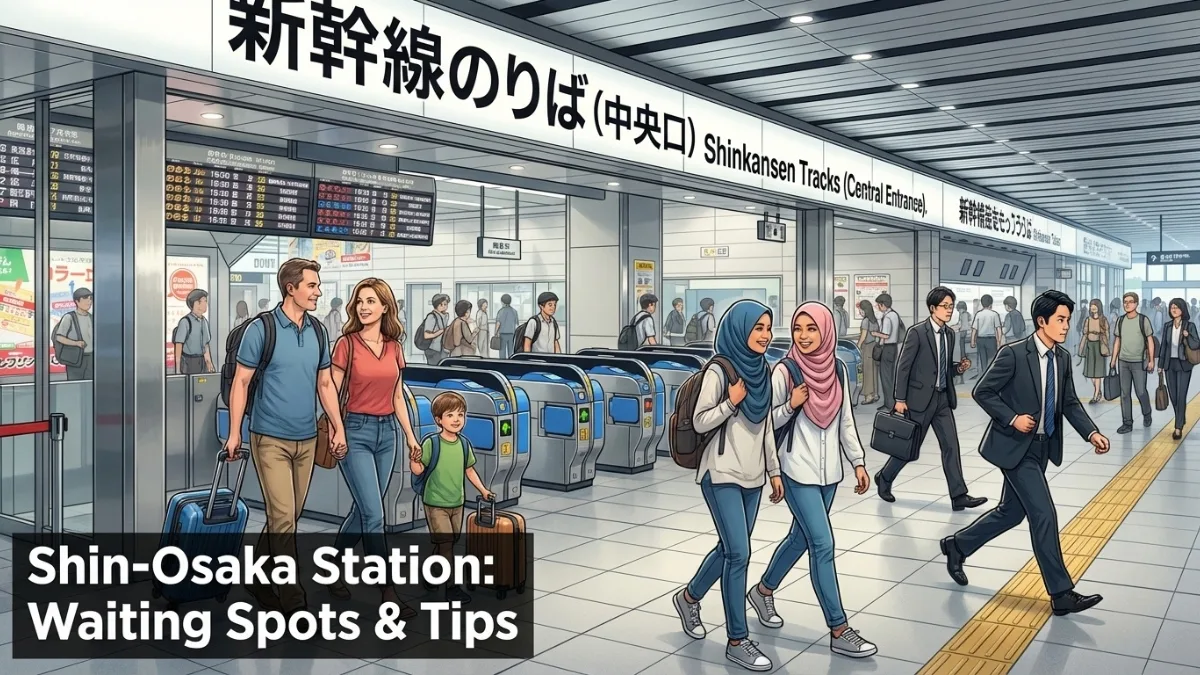
Check the walking route from the correct gate—not from the station’s center point. If you use a wheelchair, stroller, walking aid, or large suitcase, open the official station map and find the elevator route before travel. Osaka Metro’s station pages for Umeda, Namba, and Tennoji include station diagrams and step-free route information.
This is also why walking works best within one district, while trains are usually better between major districts. Do not turn a straight-looking map line into a tiring cross-city walk without checking the actual street and weather.
A fare card does not solve every transport decision
4. Save the route as a sequence, not a destination
A useful route note should survive a weak signal and a confusing concourse. Write it in the order you will need it:
- operator;
- line and direction;
- destination station and code;
- gate or exit;
- final landmark and level.
For example, Osaka Metro’s official Umeda exit information links Exit 3A with JR Osaka Station’s Midosuji North Gate and Osaka Station City. That is more actionable than a note that says only “go to Osaka Station.”

At the station, let the overhead signs replace your phone for the final turn. If a sign and the app disagree, first confirm the operator logo, station code, gate name, and floor. The detailed guide to navigating Osaka Station explains how to recover when the wider Umeda complex stops matching the map on your screen.
5. ICOCA pays a fare; it does not decide what ticket you need
ICOCA is a rechargeable IC card—an electronic stored-value card similar to Suica or PASMO. For ordinary journeys in compatible areas, touch it to the reader when entering and again when leaving. The fare is calculated automatically. JR West’s current ICOCA guide also says the card can be used at participating shops displaying the IC or ICOCA mark.
That convenience has a boundary. ICOCA by itself is not a seat reservation, a sightseeing pass, or proof that every long-distance journey is covered. A limited-express supplement, reserved seat, Shinkansen booking, or a trip beyond an IC-card area may need a separate product. Check the exact train before boarding.

The low-stress rule is simple: use ICOCA for ordinary local movement, then verify any train with a name, reserved seat, or premium service. The Osaka ICOCA guide covers purchase, top-up, shopping, and common mistakes.
6. Luggage and step-free access can change the best route
The fastest route on a phone may assume stairs, a short transfer, and no suitcase. Your best route may be a different one.
Before an arrival, departure, or hotel change, check:
- whether the hotel will hold luggage, and under what time or same-day conditions;
- the elevator route at the station you will actually use;
- whether a transfer requires leaving one operator and entering another;
- a backup if the nearest coin locker is full;
- enough time to find a platform without stopping in the passenger flow.
Do not build a fixed train or attraction reservation around the hope that a locker will be available beside the ideal gate. A confirmed hotel service or staffed storage option is safer when missing the next departure would matter.
The meal starts before you taste anything
7. Read the ordering system before you sit down
Osaka is excellent for casual food, but there is no single restaurant procedure. You may order from a meal-ticket machine near the entrance, speak at a counter, use a tablet at the table, or wait for a server. The useful skill is noticing the system before joining the wrong line.
At a meal-ticket machine, look for a language button, choose eat-in or takeaway, select the dish, pay, and take every ticket and any change. What happens next varies. Matsuya’s official self-service flow sends the order automatically and asks diners to watch for their number, collect the meal at the counter, and return the tray after eating. Another restaurant may ask you to hand the ticket to staff.

If the machine has no clear language option, photograph the menu away from the queue, translate it, and ask one focused question. Do not hold the entrance while trying to decode every topping.
8. Payment may happen before the meal, at the table, or at a register
Never assume the card logos on the door describe every machine inside. A restaurant may accept cards at a staffed register while its meal-ticket machine accepts a narrower set of methods. Another may give you a small bill holder to take to the register after eating.
Carry some Japanese yen even if you normally pay by card or phone. It is useful for small venues, older machines, shrine or temple purchases, and cash-only top-ups. JR West’s current recharge instructions say physical ICOCA recharges at its ticket machines, recharge machines, and fare-adjustment machines use cash; mobile ICOCA products follow different rules.
Keep a second payment method separate from the first. That is more useful than carrying an unnecessarily large amount of cash in one wallet.
9. Osaka food culture is larger than a viral checklist
Takoyaki, okonomiyaki, kushikatsu, udon, boxed sushi, pork buns, and small counter meals do not all belong to one street or one dining format. Dotonbori can be a good first look at Osaka’s energy, but it is not a complete food plan and it does not need to host every meal.
Choose food by the area you are already exploring. Keep one priority dish and two nearby alternatives: one seated option and one low-friction option. That makes a long queue, a sold-out item, a sudden rain shower, or simple fatigue much easier to absorb. The Osaka food-street guide compares the kinds of eating experiences found in different districts.
Also avoid turning one shop’s custom into a nationwide rule. Whether you can eat while standing outside, need to return a tray, share a sauce container, or photograph the kitchen depends on the place. Read the signs and follow the venue’s actual setup.
Time and passenger flow matter more than one extra pin
10. Most etiquette is about keeping shared space usable
You do not need to memorize a long list of Japan-only rules. Start with movement:
- wait beside the train door and let passengers leave first;
- follow floor markings for the queue;
- step away from ticket gates and machines before checking your phone;
- keep luggage out of aisles, doors, and tactile paving;
- keep calls and loud conversation to a minimum on public transport;
- follow current signs and staff directions on escalators and crowded platforms.
Osaka Metro’s current visitor manners page makes the same priorities explicit: keep luggage out of the way, reduce calls and loud conversation, and do not stop near gates or ticket machines.
The goal is not to imitate everyone perfectly. It is to avoid becoming the obstacle that other people have to route around.
11. The same place becomes a different decision at another hour—or in another season
Dotonbori in the morning is easier for orientation and walking. After dark, the illuminated signs and canal create the famous atmosphere, but the central bridge and main strip can require more patience. You can see the landmark area, then move into nearby streets or another district instead of spending the whole evening in one compressed crowd. The guide to exploring Dotonbori beyond the crowds gives a practical route.
Weather can change the same route just as much. In summer, an exposed ten-minute walk, a platform wait, and a restaurant queue all draw from the same energy reserve. Japan’s Ministry of the Environment publishes English heat-risk and WBGT information; check it on hot days, drink before you feel depleted, and put an indoor reset in the same area rather than across the city.
For rain, save an indoor alternative before leaving the hotel and keep the outdoor priority close to it. The Osaka rainy-day itinerary example shows how to regroup without zigzagging.
12. A day trip uses Osaka time; it is not a bonus day
Kyoto, Nara, and Kobe can all be reached from Osaka, but the train ride is only one part of the day. Count the hotel-to-station walk, the correct operator and gate, waiting, the destination’s local transport, and the return to your room. A route that looks short on a regional map can still consume the best daylight and most of your walking energy.
If Osaka is one of the reasons for the trip, protect at least one substantial Osaka day from excursions. On a shorter stay, choose the day trip that adds something your Osaka plan does not already provide. Then place it beside the hotel base that makes its departure easiest.
The useful question is not “Can I reach it?” It is “What part of Osaka am I willing to exchange for it?” That one decision prevents the city from becoming only the place where you sleep.
Osaka becomes much simpler when you read the cues the map leaves out: the operator before the station name, the gate before the street, the payment system before the meal, and the real energy cost before adding another destination. Save those details once, then leave enough room for the city to surprise you.