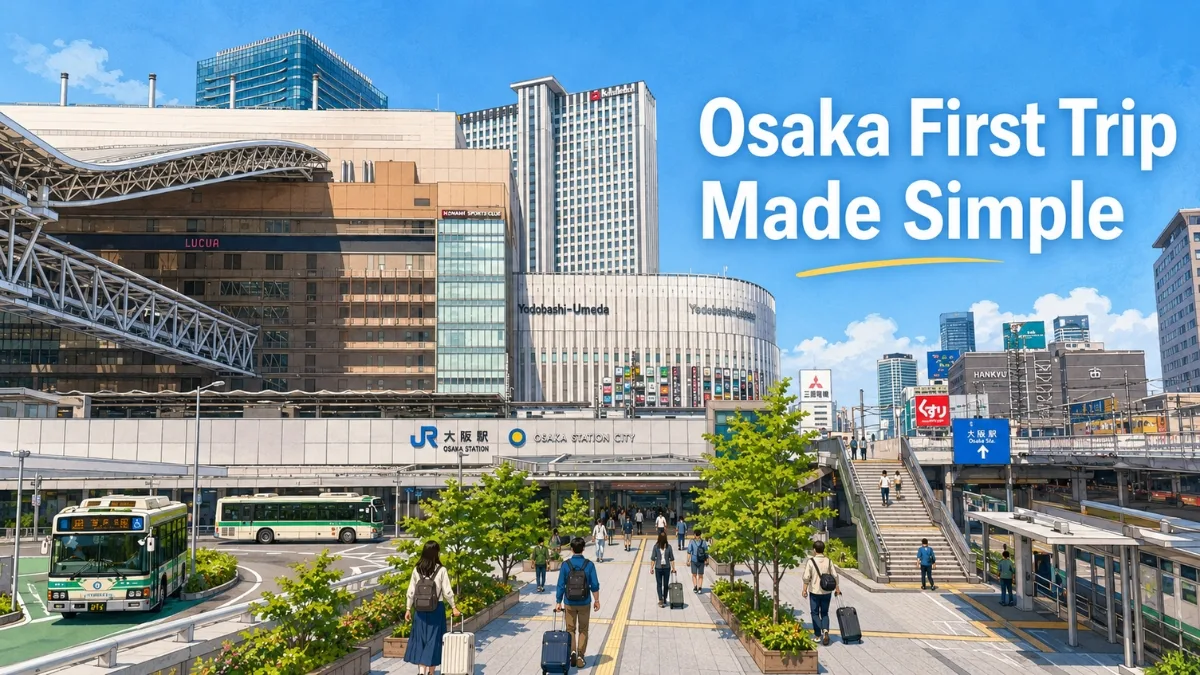
Planning a first Osaka trip becomes much easier when you make the decisions in the right order. Start with the time you can actually use, choose a base that removes your hardest journey, lock any date-specific bookings, and then group the rest of the trip by area. You do not need to schedule every hour.
For many first visits, three usable sightseeing days is a comfortable baseline. Two days can still work if you accept clear trade-offs. If you want Osaka to be your base for Kyoto, Nara, Kobe, or another day trip, four to five nights usually gives the city itself enough room.
This guide is about building that workable shape. If you want a ready-made route after the planning decisions are settled, use our three-day Osaka itinerary as a separate next step.
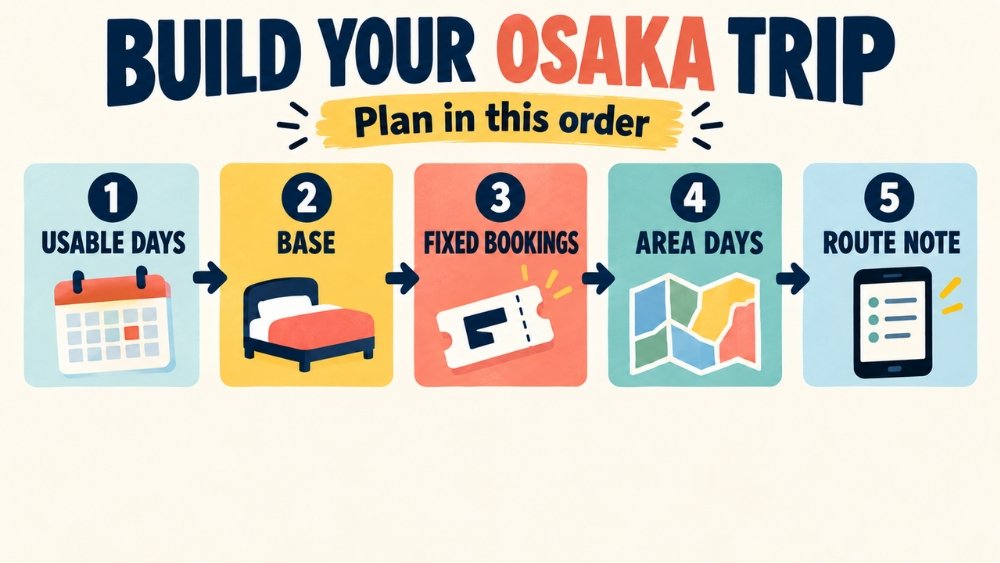
Make these five decisions in order
- Count usable time. Separate full sightseeing days from arrival and departure days.
- Choose the base. Match the hotel to your airport route, evenings, and repeated day trips.
- Lock fixed commitments. Add theme-park days, reserved activities, flights, and long-distance trains first.
- Give each day one main area. Add a nearby optional stop, not another cross-city mission.
- Save a route note. Record the operator, station, line, exit or gate, and your return plan.
Do those five things before collecting restaurants and minor attractions. Otherwise, the attractive details can hide a trip that requires too many transfers, too much walking, or an impossible arrival day.
Count usable days, not hotel nights
A hotel booking from Monday to Thursday does not automatically provide three sightseeing days. A late international arrival may leave only enough time to reach the hotel and eat nearby. An early departure can remove the final morning. Jet lag, immigration, baggage collection, and the last transfer to the hotel also affect the first day.
Use this simple test:
| Time in Osaka | A realistic first-trip shape |
|---|---|
| Two usable days | Choose two strong area blocks. Minami is the natural first choice for many visitors; use the other day for Osaka Castle and Umeda, or for southern Osaka if that matters more to you. |
| Three usable days | Give Minami one day, use another for a landmark plus Kita, and keep the third for one deliberate choice such as Tennoji, Sumiyoshi, the bay area, or a slower local day. |
| Four to five nights | Preserve at least two or three Osaka-focused days, then add a day trip or a full-day attraction without pushing the city into leftover evenings. |
A Universal Studios Japan visit normally needs its own day. The park’s official information explains that an Area Timed Entry Ticket or Standby Entry Ticket may be needed for a designated area, depending on conditions and capacity. An Express Pass is separate from the Studio Pass and can include attraction-specific times. If USJ is a priority, place that day on the calendar before building ordinary sightseeing days around it.
The same logic applies to a reserved restaurant, performance, workshop, or timed train. A fixed booking controls the day; flexible sightseeing should fit around it.
Choose a base from the trip’s hardest repeated journey
The cheapest room is not always the lower-effort choice. Compare the hotel entrance with the station you will actually use, especially when you have luggage, children, reduced mobility, or an early departure.
| Base | Strongest fit | Check before booking |
|---|---|---|
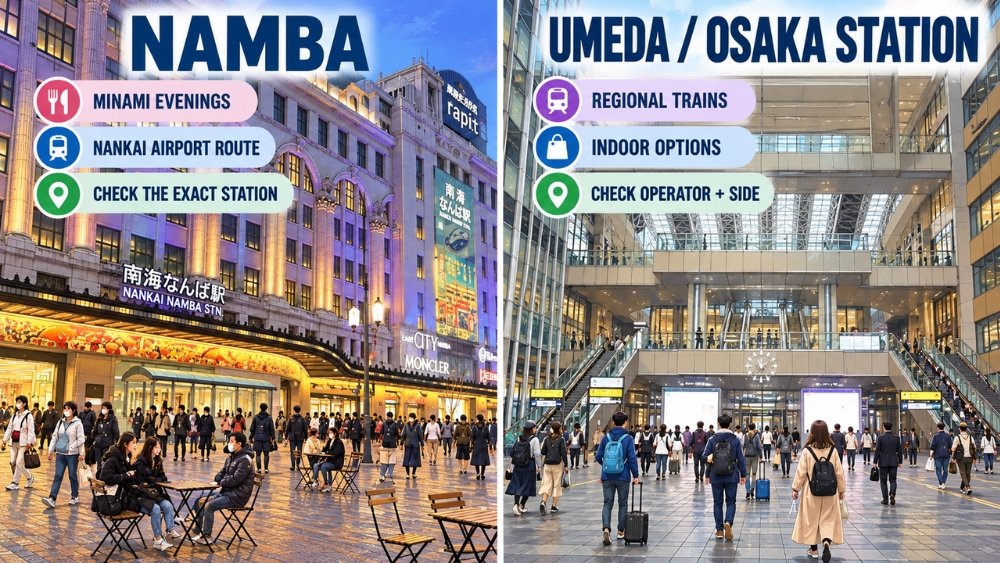
| Namba | Minami evenings, food and shopping around Namba and Dotonbori, direct Nankai access from Kansai Airport, and Kintetsu journeys toward Nara | “Namba” includes separate Nankai, Osaka Metro, JR, Kintetsu, and Hanshin station areas. Trace the correct platform-to-hotel walk. |
| Umeda / Osaka Station | Repeated journeys toward Kyoto or Kobe, JR connections, department stores, weather-protected options, and a transport-first base | JR Osaka and the surrounding Umeda stations belong to different operators. The final walk can cross several levels and passages. |
| Tennoji | A southern base with JR and Osaka Metro access, a useful airport route, and easier access to the wider Tennoji and Abeno area | Check whether the property is closest to JR Tennoji, Osaka Metro, or Osaka-Abenobashi; the name alone does not identify the entrance. |
| Shin-Osaka | An early, late, or repeated Shinkansen journey that genuinely controls the trip | It is not another name for Osaka Station and is not automatically the easiest sightseeing base. Count the daily ride into central Osaka. |
For Kansai International Airport, the best route depends on the hotel, not on one advertised fastest train. Nankai’s Limited Express Rapi:t runs to Nankai Namba in as little as 34 minutes and requires the appropriate limited-express ticket. JR airport services are useful for Tennoji, Osaka Station, and Shin-Osaka on applicable departures. Our Kansai Airport to Osaka guide compares the ticket and luggage differences.
Open the exact station pins before paying: Nankai Namba, JR Osaka Station, Tennoji Station, and Shin-Osaka Station. Then compare the final walking route with the hotel’s own access page.
If you are still deciding between the two most common first-trip bases, read Namba or Umeda: Which Area Fits You?.
Once you’ve chosen the area that best suits your plans, compare current Osaka hotel prices and availability across your preferred booking sites below. Use the same dates and number of guests, and check the exact property, room category, cancellation policy, taxes, and final payable amount before booking.
Compare Prices & Book
Lock fixed days, then group the rest by area
Once flights, accommodation, and any date-specific bookings are visible on one calendar, divide flexible sightseeing into compact areas. Osaka is simple to cross by rail, but repeatedly moving north, south, and east turns station time into the main event.
Useful first-trip clusters include:
- Minami: Namba, Dotonbori, Hozenji, Shinsaibashi, and Amerikamura. These places can form one walkable day or a long afternoon and evening. Use our Minami area guide to understand how the names fit together.
- Kita: Umeda and Osaka Station, with Nakanoshima as a possible extension when the day’s pace and destination fit. The Osaka Station area guide explains the station district before you arrive.
- Central and east: Osaka Castle and the surrounding park. Decide whether you want the museum, the grounds, or both before adding another district.
- South: Tennoji and Shinsekai can share a day, but choose the actual stops rather than treating the whole south side as one attraction.
A useful day has three layers:
- One anchor that would make the day worthwhile by itself.
- One nearby option that can be removed without regret.
- One easy ending near dinner, the hotel, or the station used to return.
That structure handles queues, weather, low energy, and discoveries better than a chain of six mandatory stops. If the anchor takes longer than expected, remove the optional stop; do not make every later activity faster.
Use a three-day shape without turning it into a race
For a first visit with three usable days, the following shape preserves Osaka’s contrasts without forcing one exact attraction list.
| Day | Main area | What the day needs | What to avoid adding |
|---|---|---|---|
| 1 | Minami | One daytime walk, a meal plan, and an evening atmosphere you can shorten if arrival fatigue appears | Osaka Castle or Umeda simply because they look close on a small map |
| 2 | One landmark, then Kita | A clear choice at the landmark and an easier afternoon or evening around Umeda | A separate southern district after dinner |
| 3 | One deliberate branch | Tennoji and Shinsekai, Sumiyoshi, the bay area, USJ, or a slower local interest | Two branches competing for the same day |
This is a planning frame, not a command. A traveler focused on shrines, architecture, food, anime shopping, nightlife, or accessibility should make different choices inside it. The important part is that each day has a geographical center and an exit plan.

Save one daily route note before leaving the hotel
Osaka’s trains are manageable, but several companies can serve places with similar names. JR means Japan Railways; Osaka Metro is the city subway operator; Nankai, Hankyu, Hanshin, Kintetsu, and Keihan are separate private railways. Saving only “Namba” or “Umeda” leaves out the information that controls the route.
For each day, save:
| Save this | Useful example |
|---|---|
| Operator, station, and line | Osaka Metro, Namba M20, Midosuji Line |
| Final exit, gate, or landmark | Exit 14, or a named JR gate and building |
| Train direction | The terminal name shown for the correct platform direction |
| Fixed time | Last entry, reserved time, or train departure |
| Luggage or step-free route | Elevator entrance, hotel storage confirmation, or staffed baggage option |
| Return trigger | The time to leave, the last useful train, and a simpler backup route |
The official Osaka Metro route map and individual station pages are better for line codes, exits, and barrier-free routes than a city map alone. Osaka Metro states that at least one wheelchair-accessible route from ground level to platform has been completed at all 133 Metro and New Tram stations. That does not mean every entrance is step-free. Its station accessibility page also notes that elevator routes, wide gates, and some platform gaps still need attention.
An IC card such as ICOCA, Suica, or PASMO is a rechargeable transit card that you tap at a compatible ticket gate. It removes the need to buy a basic ticket for each ordinary ride. JR West’s ICOCA guide lists participating transport and shops. A limited express, Shinkansen, or reserved-seat service may still need another ticket, so the IC card is not a universal reservation.
Do not buy a day pass automatically. First list the journeys that fall inside the pass’s valid area and compare them with ordinary fares. Osaka Metro’s Enjoy Eco Card is valid for unlimited rides on the stated Osaka Metro and Osaka City Bus network for the printed day, but travel outside its valid sector costs extra.
For the actual gate-to-platform sequence, see How to Ride Osaka Subway Without Stress. If the day starts or ends around Umeda, save our Osaka Station navigation guide separately.

Plan food and recovery, not a restaurant marathon
Food deserves space in an Osaka itinerary, but a full list of famous restaurants can make the day less flexible. Choose one priority food experience, then save two lower-friction alternatives in the same area: a casual restaurant, a department-store food floor, a shopping-street stop, or something close to the hotel.
This changes what happens when a queue is long. Instead of sacrificing the next attraction or waiting while tired, you can use the backup and keep the day intact. Dotonbori is worth seeing for its energy, but dinner does not have to happen on its busiest stretch. A few streets of distance can change the wait and noise.
Also plan one reset period. It can be a café, a park bench, an indoor museum, a hotel break, or an unhurried meal. Summer heat, rain, crowds, stairs, and long station walks all affect the pace. A rest block is not wasted time if it protects the evening you actually care about.
Give arrival, departure, luggage, and accessibility their own checks
The first and last travel days fail for different reasons than sightseeing days. Before arrival, save the terminal, railway or bus operator, exact destination station or stop, required ticket, final walk, last useful service, and backup. Do not assume a flight’s scheduled landing time is the time you can board a train.
Ask the hotel directly whether it will hold luggage before check-in or after check-out and whether any size, time, or same-day condition applies. Station lockers and staffed services can help, but availability is not guaranteed at the bank closest to your platform. A confirmed hotel or staffed option is safer when a train reservation depends on the timing.
Travelers who use a wheelchair, stroller, walking aid, or large suitcase should plan the elevator route rather than assuming it follows the nearest stairs. Keep the official station map open, allow extra time for a longer step-free path, and confirm venue entrances when an older building or steep approach is involved.
Finally, check the operating day and last admission for the places that would be disappointing to miss. Opening hours, transport schedules, ticket rules, and construction routes can change. Recheck the first-party page shortly before travel instead of relying only on a saved search result.
Know when the plan is finished
Your Osaka plan is ready when every day has one main area, one removable option, one food fallback, and one clear way back. You should also be able to name the operator and station for the day’s first important journey.
Then stop optimizing. Leave enough blank space to follow a shopping street, take a café break, or stay longer in the neighborhood that feels right. That is not a failure to plan; it is the reason the plan works.