The best hidden spots in Osaka are not necessarily secret or far from the city center. For a first visit, the useful ones are places that reveal a different side of the city without forcing a long detour: Hozenji beside Namba, Nakanoshima or Utsubo Park between busier stops, Nakazakicho near Umeda, and Sumiyoshi Taisha when you can give it a focused morning.
Choose one or two places that fit a day you already have. Do not try to collect all eleven. Some are working shopping streets, residential lanes, public parks or active places of worship—not empty film sets waiting for visitors.
Match the hidden spot to the time you actually have
| # | Place | Easiest starting point | Realistic slot | Best reason to go |
|---|---|---|---|---|
| 1 | Hozenji Yokocho | Namba or Nippombashi | 20–40 min | A softer, meal-focused contrast to Dotonbori |
| 2 | Hozenji Temple | Namba or Nippombashi | 15–25 min | A compact worship pause near Dotonbori |
| 3 | Nakanoshima Park | Kitahama, Naniwabashi or Yodoyabashi | 30–60 min | A river walk without leaving central Osaka |
| 4 | Utsubo Park | Hommachi or Awaza | 30–60 min | A low-stimulation reset near the business district |
| 5 | Nakazakicho | Nakazakicho or Umeda | 60–90 min | Cafes and small creative businesses in low-rise lanes |
| 6 | Sumiyoshi Taisha | Nankai Sumiyoshitaisha | 60–90 min | A substantial shrine visit south of Namba |
| 7 | Karahori Shopping Street | Tanimachi 6-chome or Matsuyamachi | 60–90 min | A working arcade and sloped old-city streets |
| 8 | Shinsekai side streets | Ebisucho or Dobutsuen-mae | 45–75 min | Street-level texture beyond the busiest central strip |
| 9 | Osaka Tenmangu | Minamimorimachi or JR Osaka-Tenmangu | 30–45 min | An easy shrine stop close to Umeda |
| 10 | Tenjinbashisuji side lanes | Minamimorimachi, Ogimachi or Temma | 45–90 min | Everyday shops and food streets without walking the full arcade |
| 11 | Ishikiri approach streets | Kintetsu Ishikiri | 2–4 hr | A sloped shrine-town walk worth a dedicated half-day |
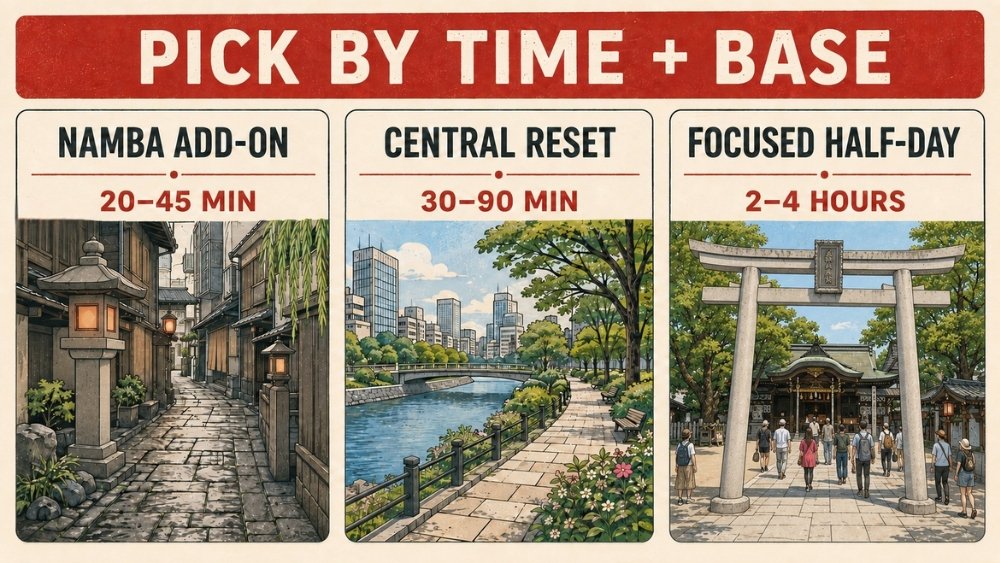
Five easy add-ons near routes first-time visitors already use
1. Hozenji Yokocho: the easiest Namba detour
Hozenji Yokocho is a narrow stone-paved dining lane a few minutes from Dotonbori. It feels more enclosed and meal-focused than the canal-side streets, but it is not reliably empty—especially around dinner. Use it as a short transition, a restaurant destination or an early-evening walk, not as proof that you have escaped central Osaka.
From the underground Namba Walk, the Hozenji access guidance points visitors toward Exit B16 from Namba or B18 from Nippombashi, both close to the temple area. Save Hozenji Yokocho on Google Maps before leaving the brighter main streets.
The lane is narrow and its entrances are working restaurant doorways. Walk in a small group, keep voices low, and do not stop the whole party across the path for photographs. If your evening is centered on Minami—Osaka’s southern downtown around Namba, Dotonbori and Shinsaibashi—pair it with the orientation in our Namba, Dotonbori and Shinsaibashi guide.
2. Hozenji Temple: a place of worship, not a photo prop
Hozenji Temple sits beside the alley and is known for Mizukake Fudo, a moss-covered figure of Fudo Myo-o, a Buddhist protective deity, over which worshippers pour water. “Mizukake” means pouring or splashing water; it describes a devotional practice, not an invitation to stage a long photo session around someone else’s prayer.
The temple’s official site says the grounds can be visited 24 hours, while the office for goshuin—commemorative worship stamps recorded in a visitor’s stamp book—charms and other items generally operates from 10:00 to 18:00. Treat those as different services and recheck the official page if receiving a stamp matters. Allow 15 to 25 minutes, give worshippers space, and save Hozenji Temple on Google Maps.
3. Nakanoshima Park: use the river, not only the roses
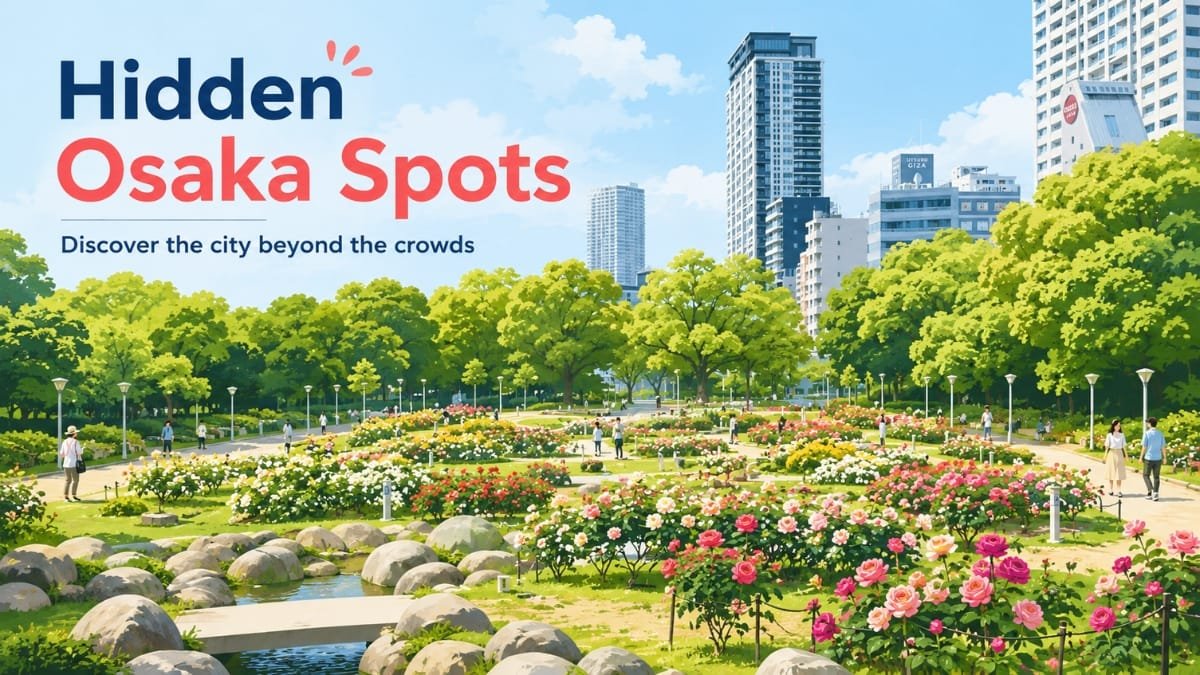
Nakanoshima Park sits between the Dojima and Tosabori rivers. Osaka City lists it as an always-open public park with separate hours for individual facilities. Its rose garden is a seasonal bonus rather than the whole reason to visit: the municipal guide identifies mid-May and mid-October as typical peak periods, while the riverside paths remain useful outside those windows.
Start near Kitahama or Naniwabashi for the eastern rose-garden side, or use Yodoyabashi when it fits a Umeda-to-central route. A 30-minute walk is enough for a reset; an hour lets you cross a bridge and return on the opposite bank. Check the official Nakanoshima Park information and save Nakanoshima Park on Google Maps.
This is weather-sensitive. Rose season and fine weekends can be busy, summer shade varies by section, and an exposed riverside walk is less rewarding in hard rain. Do not schedule it as a non-negotiable attraction.
4. Utsubo Park: the calmest useful pause near Hommachi
Utsubo Park is an elongated green space in the business district, divided into eastern and western sections by Naniwasuji. The eastern side contains tree-lined paths and a rose garden; tennis facilities occupy other parts of the park. It is a practical rest stop rather than a dramatic landmark.
Osaka City lists the park as always open, with separate operating hours for facilities. Hommachi Station’s official area map identifies Exit 28 for Utsubo Park, while Awaza Station identifies Exit 1 for the western side. Choose the exit that matches the part you want instead of walking the full length by accident. See the official park page and Utsubo Park on Google Maps.
Allow 30 to 60 minutes. It works best when someone needs shade, seating or a break from shops and museums; skip it when the group wants a headline sight.
5. Nakazakicho: small businesses inside a living neighborhood
Nakazakicho is useful because it changes the scale of an Umeda day. Low-rise lanes, converted older buildings, cafes, vintage shops and studios sit close to the major station district, yet there is no single must-see monument or official circuit.
Use the Tanimachi Line’s Nakazakicho Station as the cleanest start; the station has an elevator route to ground level. Save Nakazakicho on Google Maps, then pick one cafe or shop with current opening information instead of wandering with a fixed promise that everything will be open. Independent businesses often have different closing days and small capacity.
Visit in the late morning or afternoon, keep doorways and bicycles clear, and ask before taking close photographs of shop interiors or people. Some attractive facades are private homes. For a more deliberate coffee stop, use our Osaka cafe guide rather than treating every narrow lane as a cafe district.
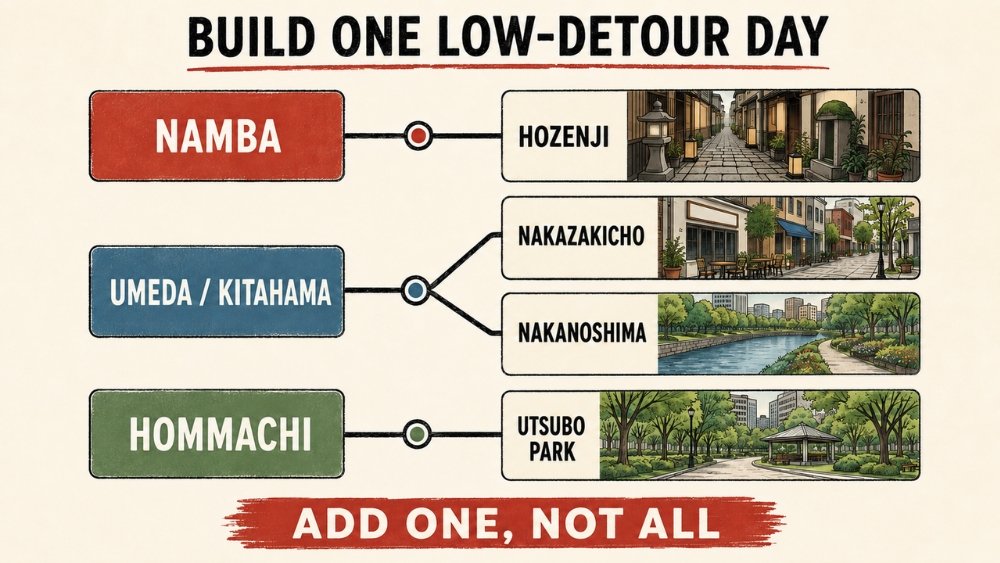
Five places that deserve a focused block
6. Sumiyoshi Taisha: the strongest cultural half-morning
Sumiyoshi Taisha is not unknown, but many first-time visitors miss it because it sits south of the central sightseeing loop. Its broad grounds, steep vermilion Sorihashi bridge and four main sanctuaries create a more substantial shrine visit than a quick city-center stop.
Nankai lists the local-train ride from Namba to Sumiyoshitaisha at about 10 minutes, and the station sits immediately beside the shrine area. The shrine’s official FAQ lists free admission and visiting hours of 06:00–17:00 from April through September and 06:30–17:00 from October through March. Check for festival-day changes, especially around New Year. Use the official shrine guide, the Nankai station page, and Sumiyoshi Taisha on Google Maps.
Allow 60 to 90 minutes on site. The arched bridge is steep and can be slippery after rain; it is a visual highlight, not a required accessibility route. Keep food and drinks outside the sacred grounds, do not fly a drone, and give active worship priority. Our Sumiyoshi Taisha guide explains the shrine terms and worship sequence in more depth.
7. Karahori Shopping Street: come to wander, not to complete a list
Karahori is a working covered arcade linked to sloping side streets, older row-house scale and small independent businesses. Its value is the transition between everyday commerce and the surrounding lanes—not one famous shop that every visitor must find.
The shopping street’s official access page currently directs visitors from Tanimachi 6-chome Exit 3 or Matsuyamachi Exit 3; it also warns that the normally convenient Tanimachi 6-chome Exit 4 is closed for construction. Because exit works change, check that page again on the day. Save Karahori Shopping Street on Google Maps.
Allow 60 to 90 minutes in daylight. Store hours and holidays vary, the streets slope, and bicycles or local deliveries may share the space. If most shutters are down, do not force the visit into a residential photo walk—move on.
8. Shinsekai side streets: the main district is not the hidden part
Shinsekai itself is a major visitor district. The useful “hidden” experience is the change in texture when you leave the most crowded central strip for public side lanes, smaller arcades and the old Shinsekai Market area. The neighborhood association’s official site describes Shinsekai as an active mix of food, games, lodging and nearby attractions, which is a better expectation than an abandoned retro quarter.
For a first visit, start in daylight or early evening, stay on active public streets, and choose a route with a clear exit toward Ebisucho, Dobutsuen-mae or Shin-Imamiya. Save Shinsekai on Google Maps. Our Shinsekai walking guide gives a one-way station-to-station route and current food-stop logic.
Do not photograph people at close range, enter apparently private passages, or assume every older storefront welcomes visitors. If the area feels too intense, return to the main public route rather than pushing deeper for a “local” image.
9. Osaka Tenmangu: a low-pressure shrine near Umeda
Osaka Tenmangu is an easy cultural stop when an Umeda day needs something smaller than a major attraction. The shrine is dedicated to Sugawara no Michizane, traditionally associated with learning, and remains an active place of worship rather than a decorative entrance to the shopping street.
The official access page directs Osaka Metro users from Minamimorimachi Exit 4 and JR users from Osaka-Tenmangu Exit 7, then about 50 meters east after turning from Tenjinbashisuji. Save Osaka Tenmangu on Google Maps. Allow 30 to 45 minutes, keep voices low near the main hall, and obey any event-day barriers or photography notices.
10. Tenjinbashisuji side lanes: choose a section, not all 2.6 kilometers
Tenjinbashisuji is a long covered shopping street, but the useful discovery for a first-time visitor is a short section plus the nearby food and working lanes. The shopping-street association says the arcade runs roughly 2.6 kilometers and identifies different stations for different numbered sections, or chome. A chome is simply a numbered subdivision of a neighborhood.
For the easiest pairing with Osaka Tenmangu, enter around Tenjin 2 or Tenjin 3 from Minamimorimachi or JR Osaka-Tenmangu. Continue only as long as the shops still add value; you do not need to reach Tenma or Tenjinbashisuji 6-chome. Check the official access guide and save Tenjinbashisuji Shopping Street on Google Maps.
Allow 45 to 90 minutes. Shop hours vary, bicycles and local shoppers use the arcade, and lunch can be busier than the phrase “hidden spot” suggests. Our shopping-streets guide helps compare this area with the more visitor-heavy arcades in Minami.
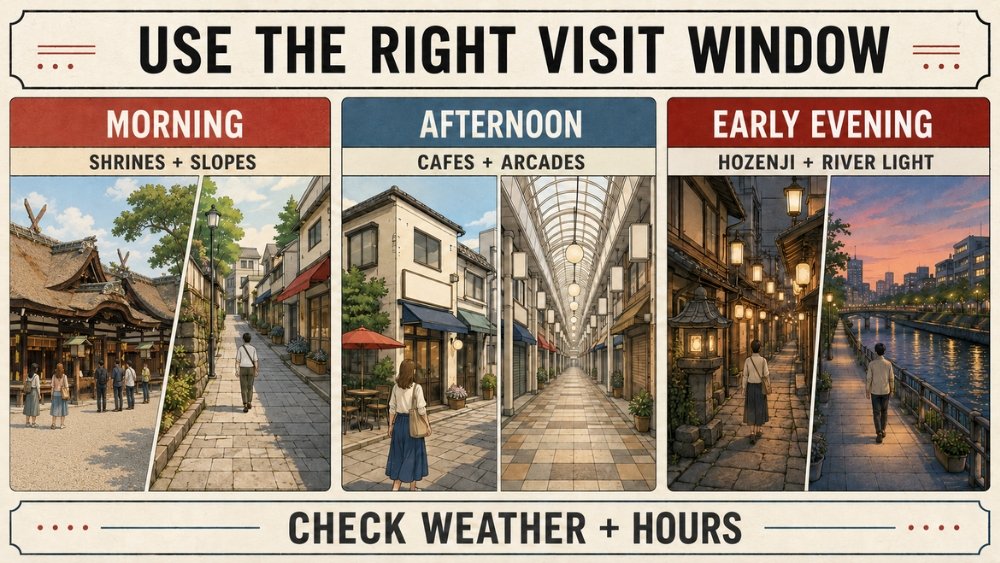
One place worth a dedicated half-day
11. Ishikiri approach streets: the route is the experience
Ishikiri sits at the foot of Mount Ikoma in Higashiosaka, east of central Osaka. The visit combines Ishikiri Tsurugiya Shrine with a sloping approach street of small shops, snacks and fortune-telling businesses. This is the least suitable place on the list for a spare 30 minutes and one of the most distinctive when you can protect half a day.
A practical one-way plan is to ride the Kintetsu Nara Line to Ishikiri Station, walk downhill through the approach streets to the shrine, and leave from Shin-Ishikiri Station on the Kintetsu Keihanna Line. Kintetsu lists the shrine at roughly 20 minutes on foot from Ishikiri Station and roughly 10 minutes from Shin-Ishikiri. Use the shrine’s official access page, and Ishikiri Tsurugiya Shrine on Google Maps.
The shrine grounds are open 24 hours, but its official site lists shorter service-desk and prayer-reception hours. The approach shops also keep individual schedules, so a morning-to-early-afternoon visit is safer than arriving near closing. Wear shoes suitable for a long slope, avoid the full route in extreme heat or hard rain, and use Shin-Ishikiri in both directions if downhill or uphill walking is a concern.
Decide whether to explore independently or use a guide
All eleven places can be visited independently, and most are free public spaces or places of worship. A guide becomes useful when cultural context, navigation and conversation matter more than choosing the lowest-cost route.
If that describes your trip, compare current Osaka highlights and hidden-gems tours on Klook. Klook lets you change the displayed language and currency, which can make inclusions and the final amount easier to compare. Confirm the actual stop list—do not assume a tour includes any particular place above—plus the meeting point, public-transport costs, food inclusions, private or group format, walking time, accessibility and cancellation terms.
For an independent day, build around one existing anchor:
- Namba evening: Hozenji Yokocho + Hozenji Temple.
- Umeda afternoon: Nakazakicho, or Osaka Tenmangu + a short Tenjinbashisuji section.
- Kitahama or Yodoyabashi gap: Nakanoshima Park.
- Hommachi break: Utsubo Park.
- Southern morning: Sumiyoshi Taisha, with Shinsekai only if energy and timing still work.
- Eastern half-day: Ishikiri by itself; do not bolt it onto a full central-Osaka schedule.
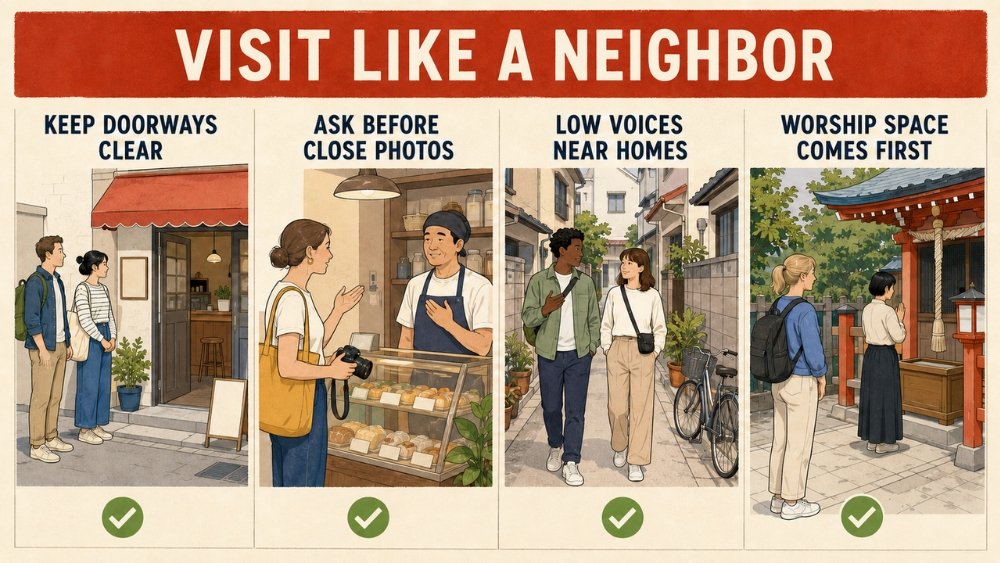
The best hidden spot is the one that reduces friction
For most first-time visitors, Hozenji is the easiest extra from Namba, Nakazakicho or Osaka Tenmangu is the easiest extra from Umeda, and Nakanoshima or Utsubo Park is the best central reset. Choose Sumiyoshi Taisha when you want a meaningful shrine morning, and choose Ishikiri only when the sloped approach itself is worth a half-day.
That is enough. A hidden-spots article should make Osaka feel more legible, not give you eleven more obligations.