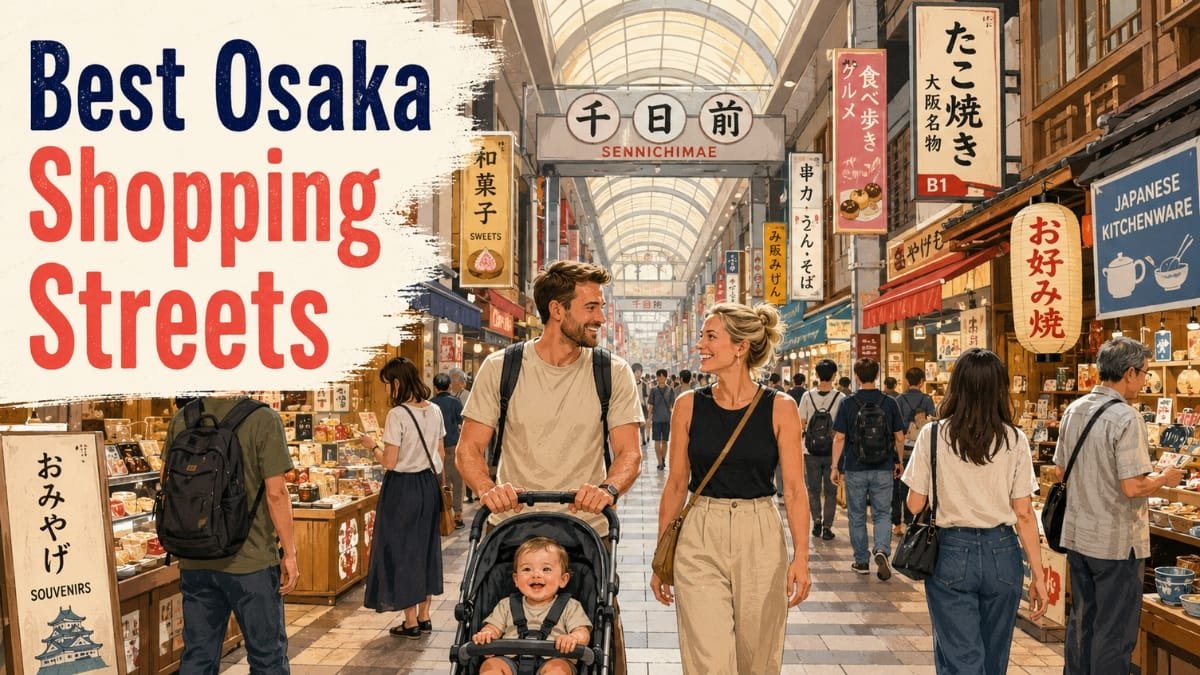
Osaka’s shopping streets are not interchangeable. One is best for mainstream fashion and cosmetics, another for cookware, another for anime goods, and another for an everyday neighborhood atmosphere. The right choice depends less on which street is “best” and more on what you want to buy, when you can arrive, and what else is already on your route.
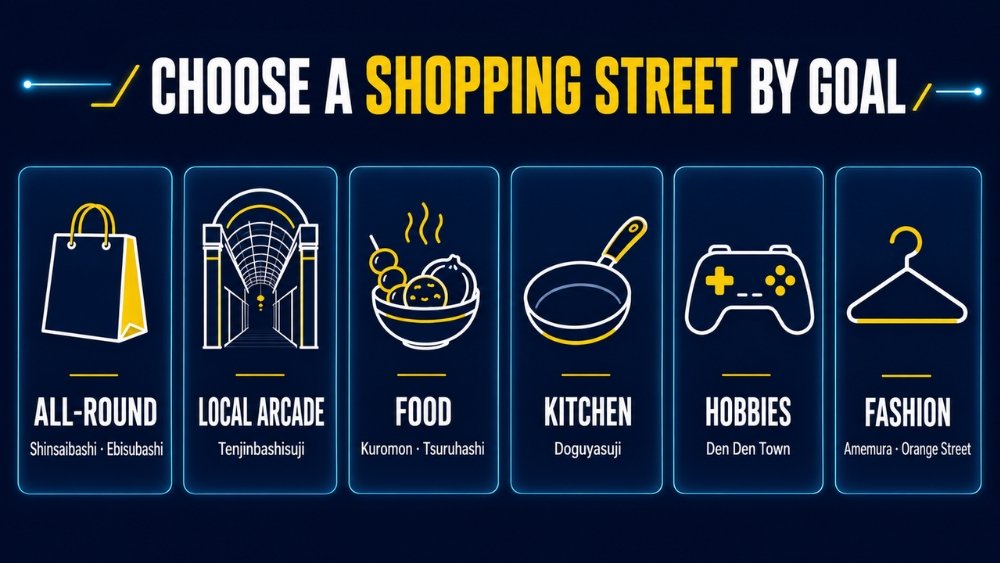
For a first visit, start with Shinsaibashi-suji and Ebisubashi-suji if you want variety and easy access from Namba or Dotonbori. Choose Kuromon Ichiba Market for food, Sennichimae Doguyasuji for kitchenware, and Den Den Town for electronics and hobby goods. Tenjinbashisuji deserves a separate half-day when local shops and ordinary Osaka life matter more than famous brands. For vintage and design, go west to Amerikamura and Orange Street. For Korean groceries and food, distinguish the lanes beside Tsuruhashi Station from Osaka Korea Town, which is farther east.
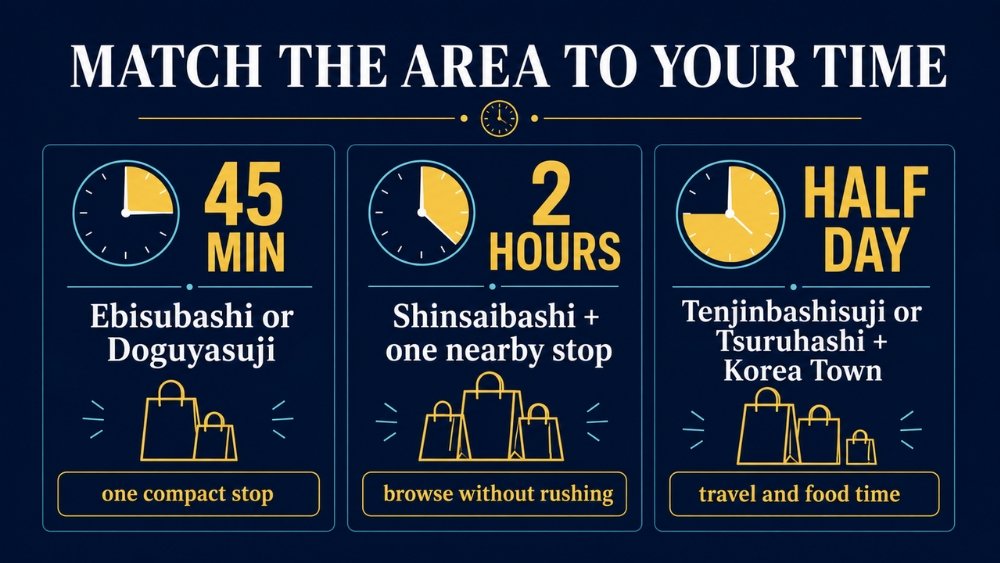
| Main shopping goal | Best first choice | Time to reserve | Important limitation |
|---|---|---|---|
| Broad fashion, cosmetics and souvenirs | Shinsaibashi-suji | 60–90 minutes | Dense crowds later in the day |
| Quick Namba shopping | Ebisubashi-suji | 30–45 minutes | Busy pedestrian flow |
| Everyday neighborhood arcade | Tenjinbashisuji | 90 minutes to half a day | Too long to “complete” casually |
| Food and market snacks | Kuromon Ichiba | 45–90 minutes | Hours and holidays vary by shop |
| Knives, tableware and cooking tools | Doguyasuji | 30–60 minutes | Fragile or restricted items need planning |
| Anime, games and electronics | Den Den Town | 90 minutes or more | Compatibility and condition checks matter |
| Vintage, streetwear and design | Amemura and Orange Street | 1–2 hours | Mostly outdoors; many shops open later |
| Korean groceries, cosmetics and food | Tsuruhashi and Osaka Korea Town | 2–3 hours | These are connected areas, not one compact arcade |
1. Shinsaibashi-suji: the easiest all-round choice
Shinsaibashi-suji is the safest starting point when a group has mixed shopping lists. The covered arcade runs for roughly 600 metres and combines major Japanese and international fashion, cosmetics, shoes, drugstores, gifts and casual food. It also connects naturally with Dotonbori at the southern end.
Use Shinsaibashi Station on the Osaka Metro Midosuji or Nagahori Tsurumi-ryokuchi line. The official shopping-street association provides a current store directory and access information. If you begin around Ebisubashi Bridge, you can enter from the south and walk north rather than making a separate train trip.
The arcade is covered, but the roof does not make the experience calm. Late afternoon, evenings and weekends can produce slow-moving pedestrian traffic. An earlier visit gives you more space, while a late-morning start gives more stores time to open. Those goals conflict, so check the specific stores you care about instead of relying on one supposed opening time for the entire street.
2. Ebisubashi-suji: a short link between Dotonbori and Namba
Ebisubashi-suji runs south from the Dotonbori side toward the Namba transport and department-store area. It is shorter than Shinsaibashi-suji and useful for affordable clothing, cosmetics, snacks and quick souvenir purchases. Its real strength is location: it belongs inside a Namba walk, not in a separate cross-city shopping mission.
Allow about 30–45 minutes if you are browsing. The street can feel especially compressed around Ebisubashi Bridge. Do not stop in the central flow to compare maps, photograph signs or reorganize bags. Step into a side area first.
Station names around Namba require attention. Nankai Namba, Osaka-Namba, JR Namba and the Osaka Metro Namba platforms are not a single set of gates. Save the railway company, line and exit for your next move. Our Namba and Tennoji comparison explains why the station label matters twice: once when arriving and again when leaving.
3. Tenjinbashisuji: choose a segment, not a completion challenge
Tenjinbashisuji offers the clearest contrast with tourist-heavy Minami. The long arcade extends through several chome, or numbered neighborhood sections, with inexpensive clothing, tea, groceries, bakeries, prepared food, restaurants and everyday services.
You do not need to walk it end to end. For the southern sections, use Osaka Tenmangu Station on the JR Tozai Line or Minami-morimachi Station on the Osaka Metro Tanimachi and Sakaisuji lines. Farther north, Ogimachi and Tenjinbashisuji Rokuchome provide other entry or exit points. Osaka Metro’s Tenjinbashisuji area guide lists the useful subway stations; use the one that matches the section you actually want.
A practical first visit is one to two hours around a chosen segment, perhaps combined with Osaka Tenmangu near the southern side. Smaller businesses set their own hours and holidays, English support varies, and cash may still be useful. That variability is part of a neighborhood arcade, not a defect that can be solved by one market-wide timetable.
4. Kuromon Ichiba Market: food shopping with shop-by-shop timing
Kuromon Ichiba is a covered food market near Nippombashi Station, within walking distance of Namba. Seafood, meat, fruit, tea, sweets, seasonings and ready-to-eat items share the arcade with specialist retailers. It is useful when food itself is the shopping goal rather than a break between clothing stores.
The market does not have one reliable opening and closing time. Kuromon’s official English directory lists different hours and holidays for individual businesses. Morning through early afternoon gives you a better chance of finding a wide selection, but verify a particular shop if it is the reason for your visit.
Compare the displayed price before ordering, especially for premium fruit, seafood and items priced by weight. Ask whether food should be eaten at the stall or in a designated space; walking while eating can obstruct the narrow flow and may conflict with a shop’s rules. Kuromon works best for a deliberate sample or purchase, not as a promise of Osaka’s cheapest meal.
If you would rather explore Kuromon and nearby food streets with an English-speaking guide, compare current Kuromon Market food tours on Klook. Check the included tastings, meeting point, walking distance, dietary policy and cancellation terms before booking.
5. Sennichimae Doguyasuji: compact and specific
Doguyasuji is a short kitchenware arcade near Nankai Namba and Nippombashi. Shops specialize in knives, pans, bowls, chopsticks, tea utensils, baking equipment, restaurant supplies and realistic food-display models. The street is compact enough to add after Kuromon or before a Namba meal.
The official association explains the street’s specialist identity, while Osaka Metro’s visitor information notes that hours and closing days vary by store. Reserve 30–60 minutes, then spend longer only if you are comparing knives or ceramics.
Before buying a blade, ask how it will be wrapped and check the current airline, airport-security and destination-country rules. Do not assume a staff member can decide whether it is permitted in your specific baggage. For ceramics, inspect the item, request protective wrapping and leave luggage space around it. Practical packing is part of the purchase decision.
6. Den Den Town: verify the product, not just the price
Den Den Town spreads along Sakaisuji and nearby streets south of Namba, with specialist shops covering electronic parts, models, anime, games and collectibles. The area is less like one covered street and more like a district with shops on multiple floors and side roads.
Approach from Nippombashi Station, Ebisucho Station, or on foot from Nankai Namba, depending on the store. The Nipponbashi district’s official site is a useful orientation point, but a saved shop address matters more than a general district pin.
For electronics, confirm voltage, plug shape, interface language, warranty coverage and region restrictions before paying. For used games, cameras, figures or hardware, read the condition label and ask what is missing. “Junk” can mean untested, incomplete or sold without a normal guarantee; a low price is not evidence that the item works.
7. Amerikamura and Orange Street: browse after lunch
Amerikamura, often shortened to Amemura, sits west of Shinsaibashi and focuses on youth fashion, streetwear, vintage clothes, sneakers, records and small independent shops. Nearby Tachibana-dori, better known as Orange Street, shifts toward furniture, design, fashion boutiques, ateliers and cafes. The Amerikamura Association provides local area information; for either district, save the exact shop rather than relying on a broad neighborhood pin.
This is an outdoor neighborhood walk, not a continuous covered arcade. Yotsubashi and Shinsaibashi stations are useful access points. Many independent stores start later than a morning market, so afternoon is usually a more productive browsing window. Check the exact business if one shop is essential.
Vintage sizing and condition vary. Try items on where permitted, inspect seams and stains, and ask whether returns are accepted before paying. A Japanese size label does not reliably translate to the size you buy at home.
8. Tsuruhashi and Osaka Korea Town: plan two linked zones
The dense passages beside Tsuruhashi Station contain Korean groceries, kimchi shops, restaurants, clothing and market stalls. JR, Kintetsu and the Osaka Metro Sennichimae Line all serve Tsuruhashi, but their gates and exits differ. Osaka Metro’s Tsuruhashi Korea Town listing places the station-side shopping area a short walk from Exit 7.
Osaka Korea Town commonly refers to the Miyuki-dori shopping streets farther east. It is not immediately outside the station. Allow roughly 15–20 minutes on foot depending on your gate, pace and crowd conditions, or approach from Momodani. Treat the station lanes and Miyuki-dori as two linked stops rather than promising that everything is in one arcade.
Reserve two to three hours if you want both zones and a meal. The narrow station-side lanes can be difficult with a suitcase or wide stroller, and smoke or food aromas from restaurants may cling to clothing. On a busy day, use a main road instead of forcing a large bag through the tightest passage.
Build one shopping route that fits the day
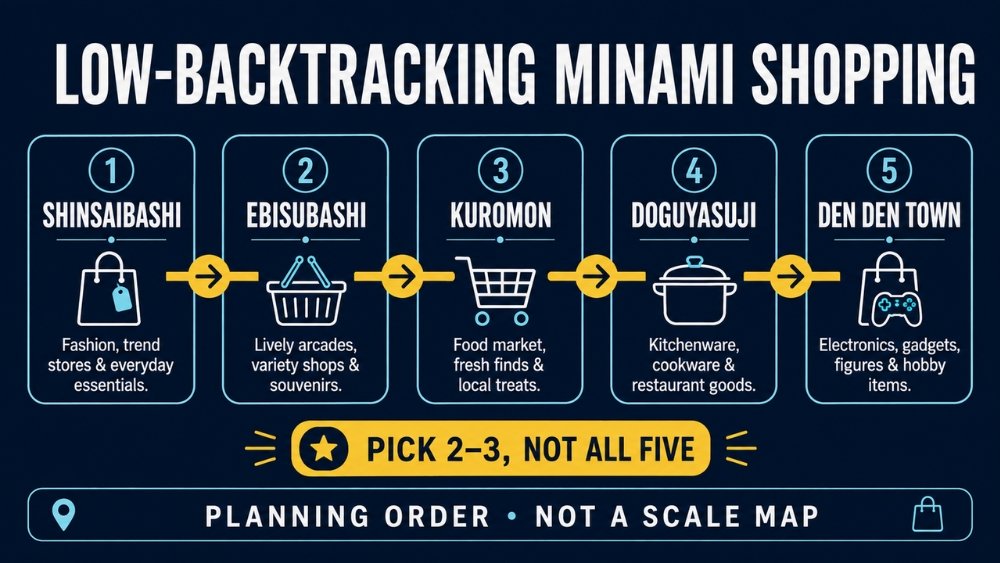
Five of the eight areas sit within or near Minami: Shinsaibashi-suji, Ebisubashi-suji, Kuromon, Doguyasuji and Den Den Town. They can form a north-to-south shopping day, but “nearby” does not mean you should visit all five. Choose two or three based on what you actually want to buy.
A simple sequence is:
- Start at Shinsaibashi when mainstream shops are the priority.
- Continue south through Ebisubashi toward Namba.
- Choose Kuromon for food or Doguyasuji for kitchenware.
- Continue to Den Den Town only when hobby or electronics shopping justifies the extra time.
- Save the exact railway station and entrance needed after shopping; “Namba” alone is not enough.
Tenjinbashisuji works better as a separate northern half-day. Tsuruhashi also deserves its own block if you intend to walk onward to Osaka Korea Town. Amemura and Orange Street can be paired with Shinsaibashi, but add them as an alternative fashion branch rather than another compulsory stop.
Before paying: tax-free, returns and baggage
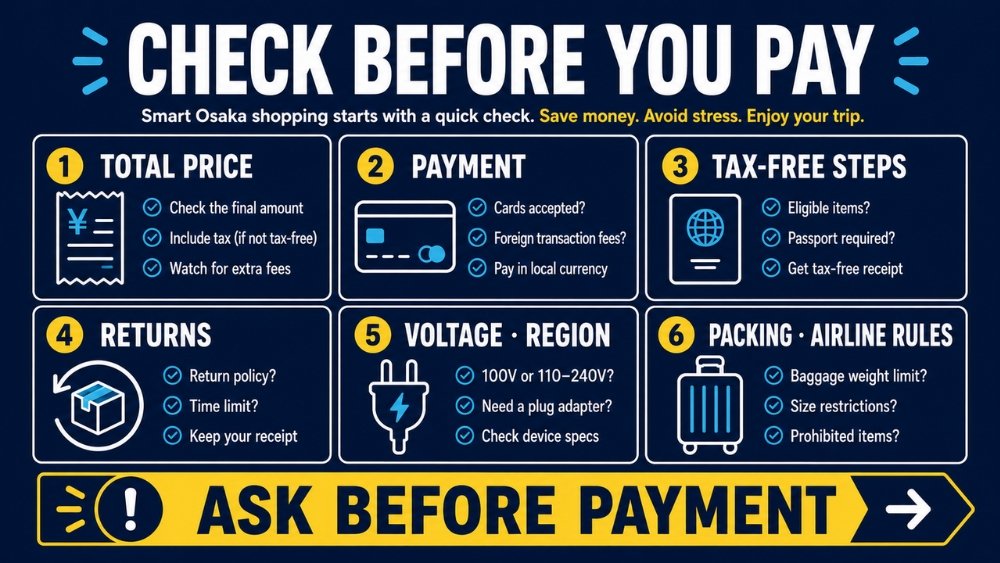
Payment rules belong to the individual store. Larger chains commonly accept cards, but a market stall or small specialist shop may prefer cash. An IC card such as ICOCA is primarily a rechargeable transit card; some shops accept it for payment, but the sticker at the register is the evidence that matters.
Tax-free shopping may be available to eligible visitors at participating stores. Rules and procedures can change, so carry the required original identification and ask before payment. Do not assume multiple receipts can be combined across unrelated stores or that every item follows the same handling rules.
Returns are often more restrictive than visitors expect. Confirm whether discounted, used, opened, consumable or tax-free goods can be returned. Keep the receipt and packaging until you know the item works and fits.
For anything fragile, sharp, battery-powered or bulky, think through the final journey before buying. Check airline restrictions, battery limits, customs rules and suitcase space using the responsible carrier or authority. The shop can explain the product; it cannot guarantee every rule on your route home.
The best Osaka shopping day leaves room to inspect, compare and change course. Pick the street that solves the main shopping goal, arrive when its type of business is likely to be active, and stop before bags or crowds make the rest of the day harder. One well-chosen arcade plus one specialist area is usually more useful than racing through all eight.