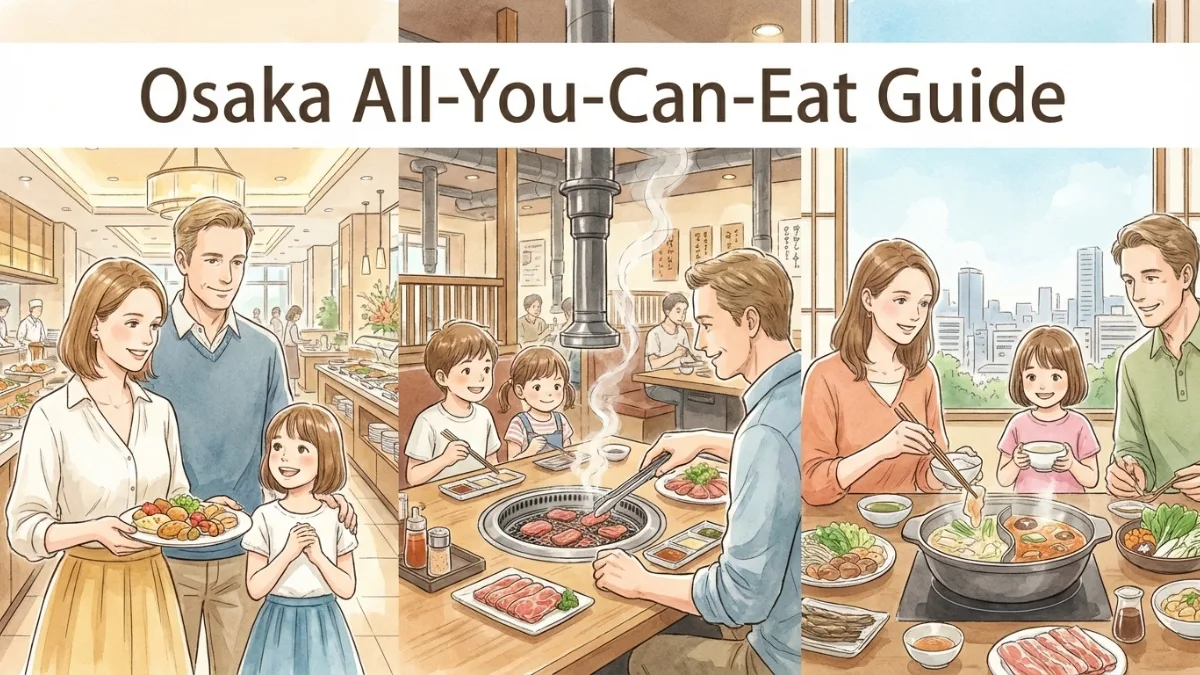
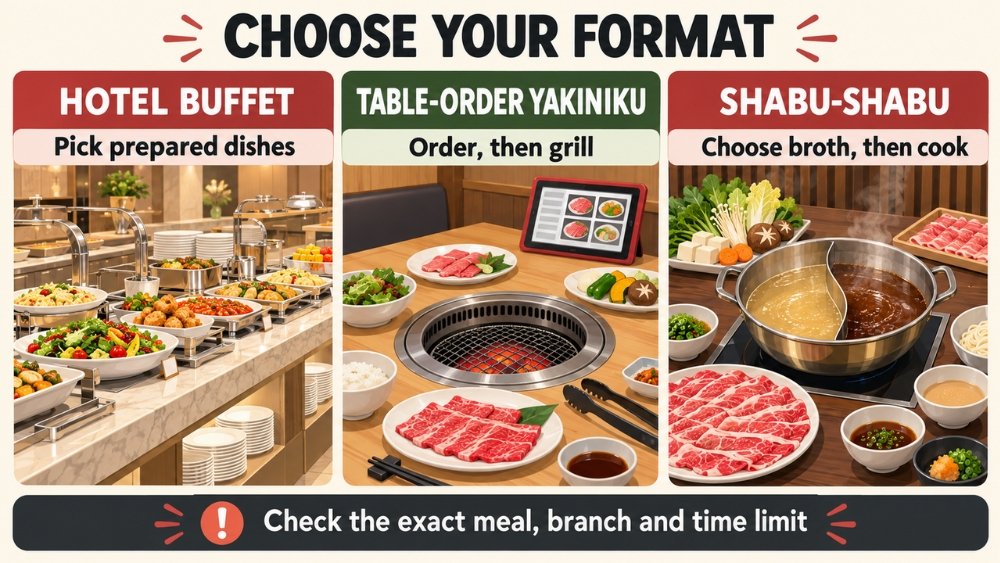
In Osaka, tabehodai means all-you-can-eat, but the experience changes completely depending on the restaurant. A hotel buffet lets you walk around and choose from many prepared dishes. At a yakiniku restaurant, you order meat to the table and grill it yourself. At a shabu-shabu restaurant, you cook thinly sliced meat and vegetables in a shared pot.
For a first visit, do not choose by price alone. Choose the service style your group will enjoy, then check the exact branch, course, time limit and last-order rule before reserving. Nomihodai means all-you-can-drink and is normally a separate option, not something automatically included with tabehodai.
| If you want… | Start with… | What you will do | Main detail to check |
|---|---|---|---|
| The widest choice and no cooking | Hotel buffet | Collect prepared dishes yourself; some plans include one plated main | Which meal period is actually a buffet |
| Meat and an active group meal | Table-order yakiniku | Order on a tablet or menu, then grill at the table | Course level, last order and whether drinks cost extra |
| A lighter, customizable meal | Shabu-shabu | Choose broth and a course, collect vegetables and cook at the table | Whether everyone must order the same course |
| Desserts as the main event | Sweets buffet | Choose small desserts during a fixed sitting | Days offered, start time and seating duration |
Understand the clock before you sit down
An all-you-can-eat reservation is not permission to order until the restaurant closes. It usually has at least two different times:
- Seating time: the total period you may use the table.
- Last order: the deadline for requesting more food or drinks.
For example, a 120-minute plan with last order at 90 minutes gives you 30 minutes after the ordering deadline to finish what is already on the table. Other restaurants use a 100-minute total or a 90-minute sitting. The clock may begin at the booked time, when everyone is seated, or when the staff starts the course. Ask if the explanation is unclear, especially if part of your group is late.
Do not plan to make one large final order. Kitchens and table service become busy, raw meat still needs cooking time, and restaurants may charge for excessive leftovers. Order a modest first round, learn how fast the food arrives, and add more while the last-order window is still open.

Five other rules prevent most surprises:
- The group may need one course. On-Yasai and Shabu-Yo explicitly require everyone in a group to choose the same all-you-can-eat course. Age-based child prices can still apply.
- Drinks may be separate. Soft-drink and alcohol plans often cost extra. A group drink plan can have its own time limit and glass-exchange rule.
- The branch matters. Prices, available courses, lunch offers, payment methods and closing times can differ within the same chain.
- Allergy help is not a guarantee of an allergen-free kitchen. Check the operator’s allergy information before booking and tell staff on arrival. A shared buffet, grill or pot can make strict avoidance difficult.
- Finish what you take. On-Yasai’s current multilingual menu warns that customers who leave food may face an extra charge. Even where no fee is stated, small repeat orders are the considerate approach.
Hotel buffets: choose the meal period, not just the hotel
Hotel dining is the easiest format when people in one group want different foods or do not want to cook. It is also the most expensive category here, and “buffet restaurant” does not mean every service is an unrestricted buffet.
NOKA Roast & Grill — Umeda
NOKA Roast & Grill at InterContinental Osaka is useful when you want a polished meal near Osaka Station. Breakfast is a buffet, while lunch and dinner are described as semi-buffets: you choose one main dish and use the buffet for appetizers and desserts. That distinction matters if you expected unlimited portions of the main course.
The published lunch hours are 11:30 a.m.–2:30 p.m., with last order at 2:00 p.m.; dinner is 6:00–9:00 p.m., with last order at 8:30 p.m. Current listed prices include tax but add a 15% service charge. Use the live booking page for the exact date and plan rather than calculating from an old menu screenshot. Open NOKA in Google Maps.
Folk Kitchen — Osaka Station
Folk Kitchen at Hilton Osaka is a conventional hotel-buffet choice with breakfast, lunch, sweets and selected dinner buffet plans. The theme and meal periods change seasonally. Some booking plans state that table use may be limited to 90 minutes when demand is high, so read the fine print attached to the date you reserve. Open Folk Kitchen in Google Maps.
Table36 — Namba
Table36 is on the 36th floor of Swissôtel Nankai Osaka, directly useful for a Namba-based day. It offers a breakfast buffet, a weekday lunch buffet, and a weekend or public-holiday brunch and sweets buffet. Dinner is not automatically the same buffet format, so select the named buffet plan rather than simply booking “dinner at Table36.” Open Table36 in Google Maps.
Atmos Dining — Nakanoshima
Atmos Dining at Conrad Osaka is the high-view option, on the 40th floor. Its current page publishes separate lunch, dinner and selected sweets-buffet periods. Prices include tax and service charge, but the theme, serving format and available dates still change. It makes most sense when the setting is part of the meal, not when your only goal is the lowest cost per dish. Open Atmos Dining in Google Maps.
Older Osaka lists may mention The Park at the Imperial Hotel as a meal buffet. The current official page for The Park describes a lobby lounge focused on drinks, desserts and afternoon tea. Do not make a buffet trip there without first finding a current, date-specific buffet offer from the hotel.
If Umeda station names are unfamiliar, use our Osaka Station area guide before choosing a hotel restaurant. In Namba, our Osaka Minami guide explains how Namba, Dotonbori and Shinsaibashi fit together.
Table-order yakiniku: unlimited food still needs careful pacing
Yakiniku is Japanese table barbecue. Staff bring raw meat and side dishes, and diners cook the meat on a built-in grill. At many tabehodai chains, a touch panel displays the remaining time and accepts repeat orders.
Aburiya — several central Osaka branches
Aburiya specializes in all-you-can-eat yakiniku and has branches around Umeda, Dotonbori and Sennichimae. Current official course pages show several meat levels rather than one universal price. The course at the main branch is two hours, with last order 30 minutes before the end, but the exact branch page remains the authority for your reservation.
The website and booking flow are mainly in Japanese. If you cannot confirm the course, child price or payment method from the branch page, ask your hotel or a Japanese-speaking companion to check before you commit. Find Aburiya near Dotonbori in Google Maps.
Yakiniku King namBaHIPS — Namba
Yakiniku King namBaHIPS is a practical central example of touch-panel, table-order yakiniku. The store page says meals run for 100 minutes and currently lists three food course levels. It also states that this branch does not sell the chain’s lunch all-you-can-eat course, even though it opens at 11:00 a.m. That is exactly why checking the branch is more reliable than checking only the brand.
The store’s last admission is one hour before its published closing time. A late reservation therefore needs more than a quick glance at “open until 11:00 p.m.” Open Yakiniku King namBaHIPS in Google Maps.
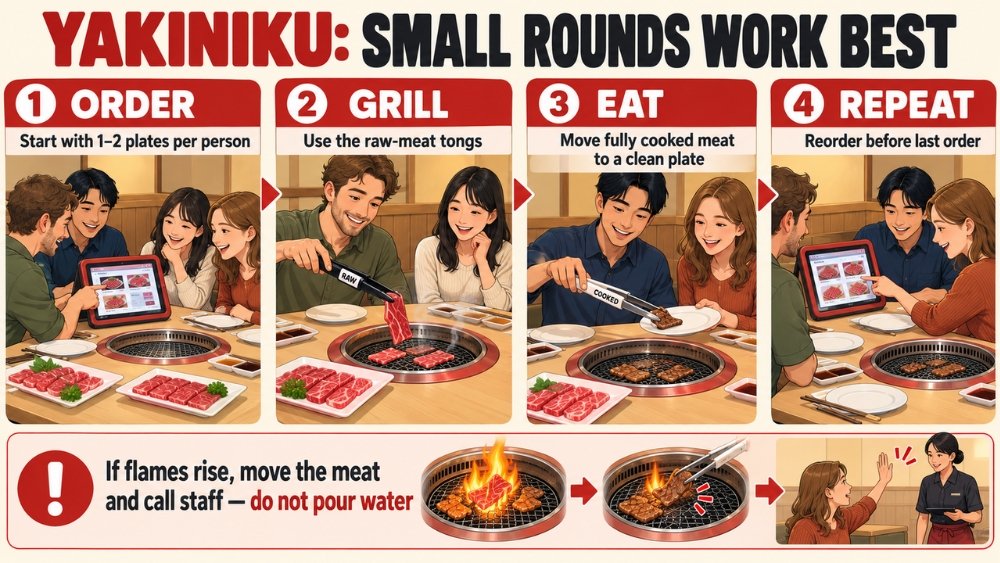
At the table, order one or two plates per person first. Put raw meat on the grill with the tongs provided, cook it fully, and use clean eating utensils for cooked food. Do not cover the entire grate at once: crowded meat cooks unevenly and makes it harder to track which pieces are ready. If flames rise from dripping fat, move the meat away and call staff rather than pouring water into the grill.
Shabu-shabu: the course is shared, the bowl is personal
Shabu-shabu uses thin slices of meat cooked briefly in hot broth. The pot may be divided so the table can choose two broths. Vegetables, noodles, rice, sauces and condiments are often collected from a buffet counter, while meat is ordered from staff or a tablet.
On-Yasai Shinsaibashi
On-Yasai’s multilingual menu makes the rules unusually clear for international visitors. Its current all-you-can-eat plans run for 120 minutes with last order at 90 minutes. Everyone in the group must order the same course, and the menu warns that leftover food may bring an extra charge. Drinks are a separate decision.
Choose the course together before ordering, especially if one person wants wagyu and another wants the basic pork plan. Then choose the broths and ask staff which utensils are for raw meat. Open On-Yasai Shinsaibashi in Google Maps.
Shabu-Yo in Umeda
Shabu-Yo is a casual all-you-can-eat shabu-shabu restaurant where meat is ordered at the table, while vegetables, sauces, condiments and selected side dishes are available from a self-service bar.
The Umeda NU Chayamachi branch is a convenient option for visitors exploring the Umeda area. According to the chain’s English menu, everyone at the same table must choose the same course. Prices and time limits can vary by location, so check the branch’s current menu and conditions before visiting.
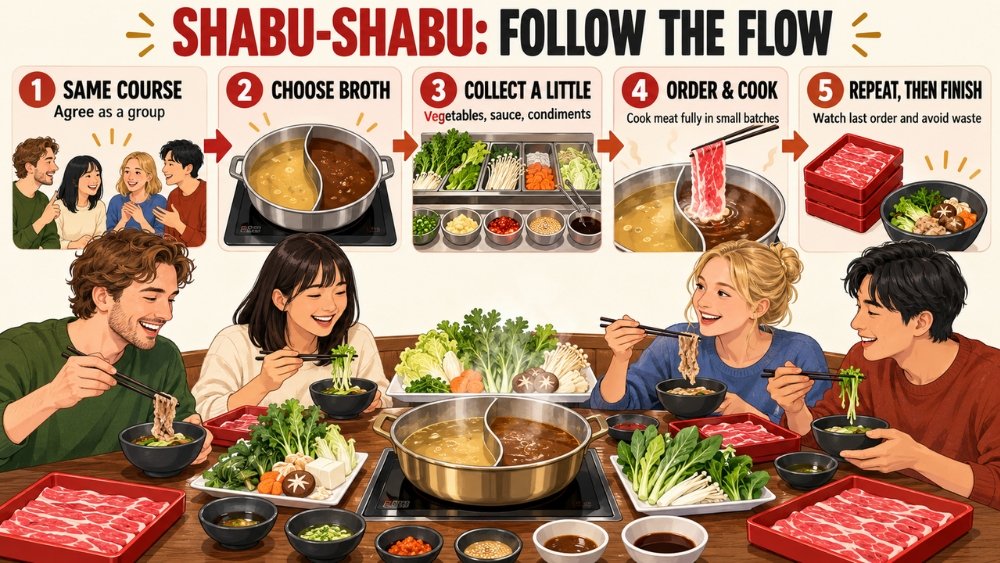
Start shabu-shabu with a small plate of vegetables and one meat order. Add ingredients gradually so the broth keeps simmering. Cook meat until no raw portion remains, and do not return a utensil that touched raw meat to your personal bowl unless the restaurant’s system clearly intends it. Leave noodles or rice for later only if there is still enough time before last order.
Reserve the exact plan you intend to eat
Before pressing the booking button, check these six items on one screen:
- exact branch and floor of the building;
- date and meal period;
- course name and what is unlimited;
- total seating time and last order;
- price, tax and service charge;
- cancellation rules, child prices and allergy information.
Save the confirmation email or booking screen. If the reservation is under a Roman-alphabet name, keep the spelling exactly as entered. Arrive with the full group a few minutes early; a busy restaurant may not extend the finish time because someone arrived late.
At hotel buffets, leave large luggage at your hotel or in suitable station storage. Buffet aisles and table spaces are not designed for suitcases. At yakiniku, expect heat and cooking smells on clothing. At both yakiniku and shabu-shabu, tell staff early if you do not understand the tablet, broth controls or raw-meat utensils.
The best first Osaka tabehodai meal is not automatically the biggest buffet. It is the one whose format, branch rules and time limit match your group. Decide how you want to eat, reserve the exact course, order in small rounds, and leave enough time to finish without rushing or wasting food.