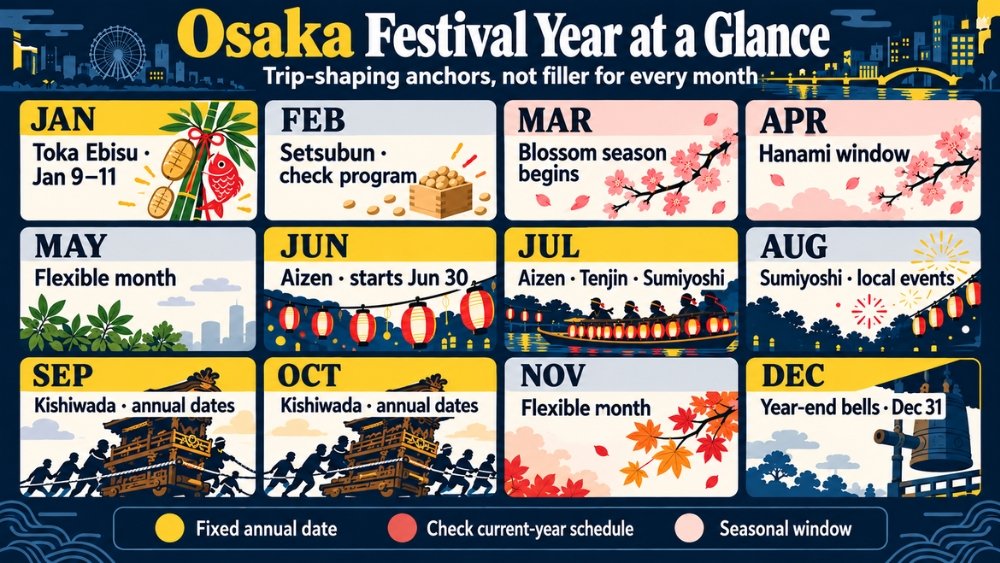
An Osaka festival calendar is useful only when it tells you which dates are dependable enough to shape a trip. A few major events return on fixed annual dates. Others publish their route, procession day or district schedule each year. Cherry blossoms and winter lights are seasonal windows, not single citywide festivals.
For the simplest first trip, build around Toka Ebisu on January 9–11, Aizen Matsuri from June 30 to July 2, or Tenjin Matsuri on July 24–25. Choose September or October for Kishiwada Danjiri Matsuri only after the current district calendar appears. If your dates fall in March, April, May or November, enjoy the season without forcing a festival into the itinerary.
This guide was checked on October 4, 2026. Most 2027 operating notices, traffic controls and detailed programs had not yet been announced. The fixed dates below are strong planning anchors, but the linked organizer notice should still be reopened before booking transport and again before departure.
| Month | Best planning anchor | How dependable is it? | Main trip decision |
|---|---|---|---|
| January | Toka Ebisu, January 9–11; Doya Doya, January 14 | Fixed annual dates; current program still matters | Choose energetic shrine crowds or a focused temple event |
| February | Setsubun programs | Date and activities require a current check | Do not assume every temple runs the same public program |
| March | Early cherry-blossom window in some years | Seasonal, weather-dependent | Keep the day flexible |
| April | Hanami and local blossom events | Seasonal, not one Osaka-wide festival | Plan around bloom status rather than a festival ticket |
| May | No single city-defining anchor needed | Flexible month | Use a festival only if a current local notice fits your route |
| June | Aizen Matsuri begins June 30 | Fixed annual start | Expect summer heat before peak July crowds |
| July | Aizen, Tenjin and Sumiyoshi festivals | Core dates are strong; operating details vary | Pick one major festival day, not all three |
| August | Sumiyoshi events on August 1; neighborhood festivals | Shrine core date is strong; local events vary | Confirm the exact venue and last train |
| September | Kishiwada Danjiri Matsuri | Published annually by district | Wait for the current schedule and traffic map |
| October | Kishiwada’s October districts | Published annually by district | Do not reuse September dates or last year’s map |
| November | No dependable citywide anchor required | Flexible month | Prioritize weather, foliage and a comfortable walking day |
| December | Year-end bells on December 31; winter lights | Temple rites may be fixed; light events vary | Decide between a late religious observance and an evening display |
First separate the three kinds of date
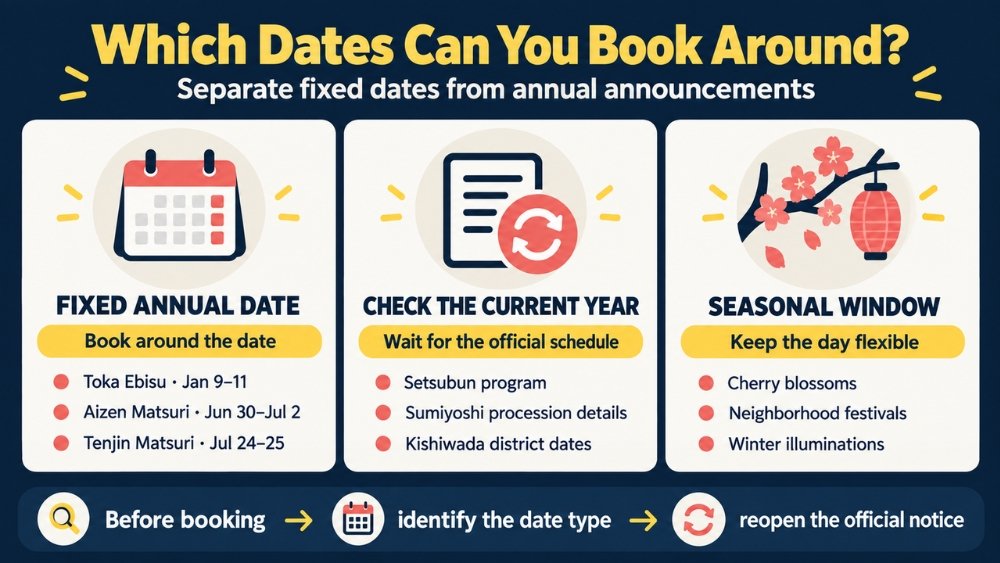
The safest way to use any festival calendar is to label the date before making a reservation.
A fixed annual date is stable enough to guide the trip. Toka Ebisu returns January 9–11, Aizen Matsuri runs June 30–July 2, and Tenjin Matsuri’s two main days are July 24–25. You still need the current notice for access, stalls, safety restrictions and weather changes.
A current-year date is not ready to book around until its organizer publishes the new schedule. Kishiwada’s September and October programs are the clearest example: the districts and dates are not one interchangeable event. Parts of the Sumiyoshi Matsuri sequence, especially the mikoshi procession, also need that year’s notice.
A seasonal window is even less exact. Cherry blossoms, illuminations and many neighborhood events can be excellent, but they should not be presented as one guaranteed festival on one universal Osaka date.
January: Toka Ebisu is the first strong anchor
Imamiya Ebisu Shrine’s annual schedule separates Toka Ebisu into three days: January 9 is Yoi Ebisu, January 10 is Hon Ebisu, and January 11 is Nokori Ebisu. January 10 is the central day, but that does not automatically make it the best choice for every visitor. Choose January 9 or 11 if your priority is the atmosphere rather than saying you attended the main day.
This is a worship event as well as a major public gathering. Follow the shrine’s current pedestrian flow, keep the entrance and amulet areas moving, and use rail access instead of building the day around nearby parking. If you dislike tightly packed spaces, do not place a timed restaurant booking immediately after the visit.
Another fixed January event is Doya Doya at Shitennoji on January 14. The temple’s January calendar places it at the end of the New Year observances and also lists the tondo bonfire that day. Treat it as a specific temple event, not a substitute for the different experience of Toka Ebisu.
Hatsumode—the first shrine or temple visit of the year—is broader than either event. Opening hours, stalls and entry controls can change each New Year. Our Sumiyoshi Taisha visitor guide helps with the normal visit, but the shrine’s current New Year notice should control a January 1–3 plan.
February to May: keep the calendar flexible
Setsubun falls in early February, but its exact date and public program should be checked for that year. Shitennoji’s current Setsubun Star Festival page is an example of a venue-specific notice. Do not assume that bean throwing, fire rituals, admission arrangements or photography rules are identical at every temple.
March and April are often more useful as a blossom window than as a festival search. Hanami means viewing and gathering around the flowers; it is not one Osaka-wide matsuri with one organizer and one start time. Use current bloom conditions and choose a park that fits your route. Our Osaka cherry-blossom guide compares the main options without turning the whole season into a single event.
May does not need filler. If no current local festival genuinely improves your route, use the month for outdoor sights, gardens or a neighborhood day. A calendar becomes less reliable when every blank month is padded with a loosely related event.
June and July: Osaka’s major summer sequence
Summer gives the calendar its most concentrated run of major dates, but it also brings the highest heat burden. Build around one anchor per day, carry water, and plan a direct route back rather than adding another distant evening stop.
Aizen Matsuri: June 30 to July 2
Aizen Matsuri at Aizendo Shoman-in runs June 30, July 1 and July 2. The temple’s current updates page should decide the year-specific parade, stall and access details. Its 2026 notice also warned that there was no car or bicycle parking, which is a useful reason to default to public transport even though future operations must be rechecked.
This is the first of the familiar major summer-festival sequence. It is a good choice when a late-June or early-July trip cannot include Tenjin Matsuri, but the weather can already be hot and humid. Keep the daytime schedule lighter and avoid arriving with a suitcase.
Tenjin Matsuri: July 24 and 25 are different days
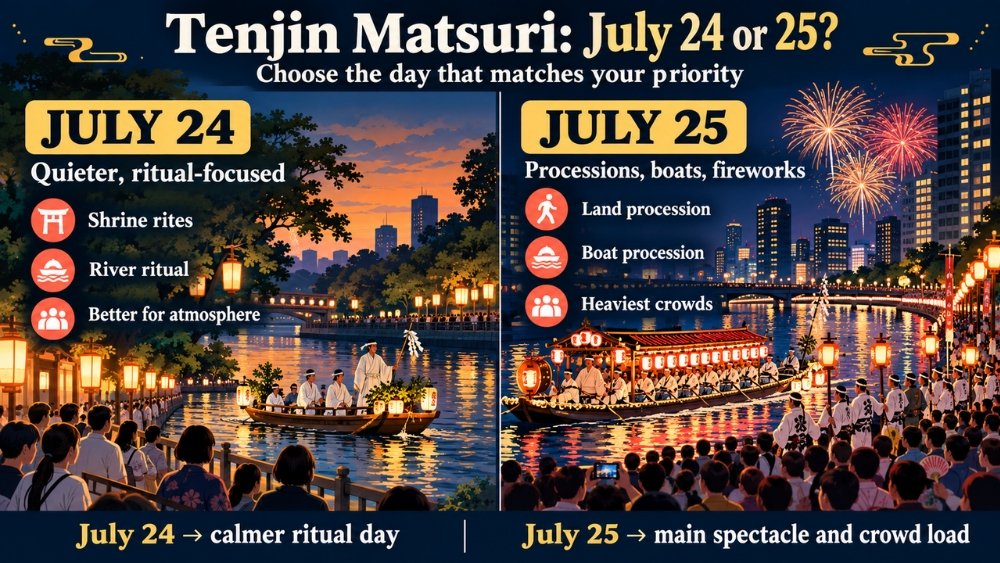
Osaka Tenmangu’s festival outline assigns different roles to the two main days.
July 24 is the eve festival, with shrine rites and the Hokonagashi river ritual. It is the better match when you value religious context and a relatively calmer atmosphere over the largest spectacle.
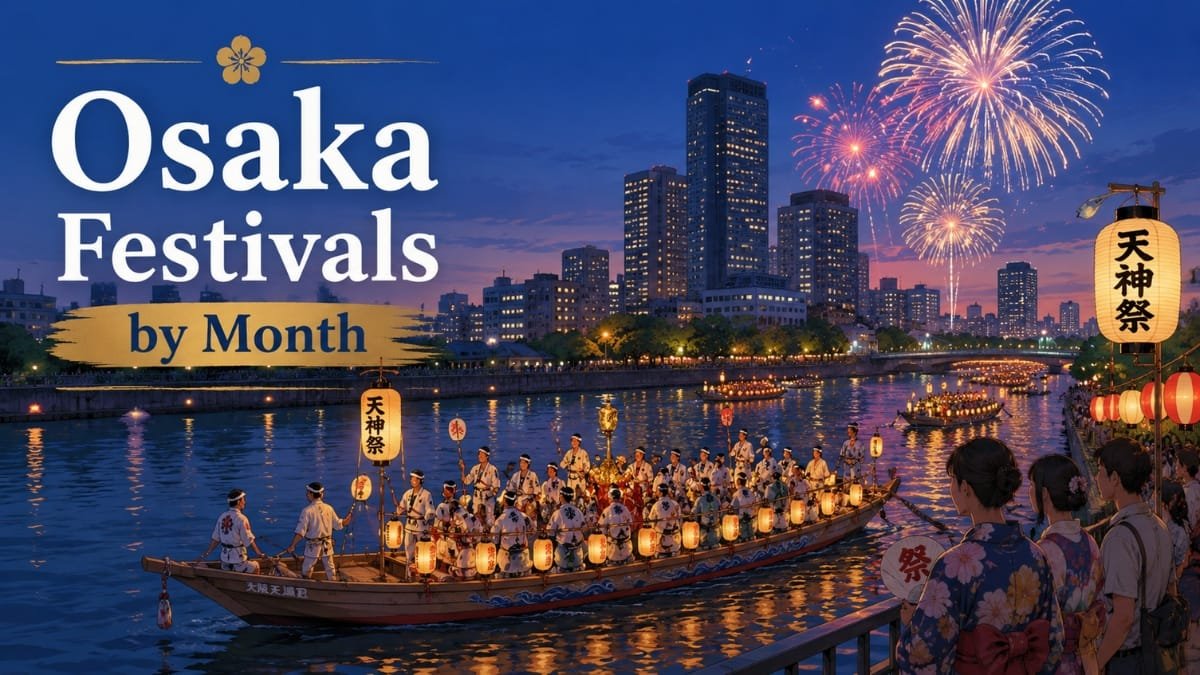
July 25 is the main festival day, with the land procession, boat procession and fireworks in the normal program. It is the choice for the classic evening view, but also the day with the heaviest crowd and transport pressure. Fireworks and procession operation should never be assumed from an older article; use the current annual notice.
Do not plan to move with the procession as if it were an ordinary walking tour. Pick one viewing area, approach by a direct rail line, and let the official pedestrian and traffic controls determine the final route. Eat before the busiest evening period if dietary restrictions make festival-stall food unreliable.
Sumiyoshi Matsuri: July 30 to August 1, with one moving part
Sumiyoshi Taisha describes the core festival sequence as July 30 to August 1. The shrine’s annual-event information lists the eve festival on July 30, Nagoshi purification and the annual festival on July 31, and Tongu rites on August 1.
The mikoshi procession is the detail most likely to cause a planning error. The shrine describes it as a late-July event, while the 2026 operating notice placed it on July 26. That is a reason to wait for the current-year notice—not a date to copy into a future itinerary. Stall hours, procession routing and parking treatment are also operational details, not permanent promises.
August: confirm the event, neighborhood and finish time
August 1 completes the core Sumiyoshi sequence. Beyond that, Osaka has local Bon dances and neighborhood summer events, but a general label such as “local festival” is not enough to travel across the city. Confirm the organizer, exact venue, start and finish time, rain policy and nearest station before adding one.
Summer evenings remain hot. A folding fan is useful, but water, breathable clothing and shoes suitable for long standing matter more. If you wear a yukata, allow shorter walking distances and more time for stairs and station transfers. It is perfectly acceptable to attend in ordinary clothes.
September and October: Kishiwada requires the annual district calendar
Kishiwada Danjiri Matsuri is not one floating date that can be copied from year to year. The Kishiwada City festival page publishes separate September and October schedules and notes that the October program differs by district.
For a date-stamped example, the 2026 schedule listed September trial pulls on September 6 and 18, the eve festival on September 19 and the main festival on September 20. The October schedule listed a trial pull on October 4, the eve festival on October 10 and the main festival on October 11. Those are 2026 dates, not a reusable 2027 calendar.
The signature fast turns need a clear street. Kishiwada’s place-holding notice tells spectators not to reserve public space with tape or markings and not to place chairs or stepladders in the roadway. Open the current traffic-control notice, stand where staff direct, keep exits clear, and move immediately when officials ask.
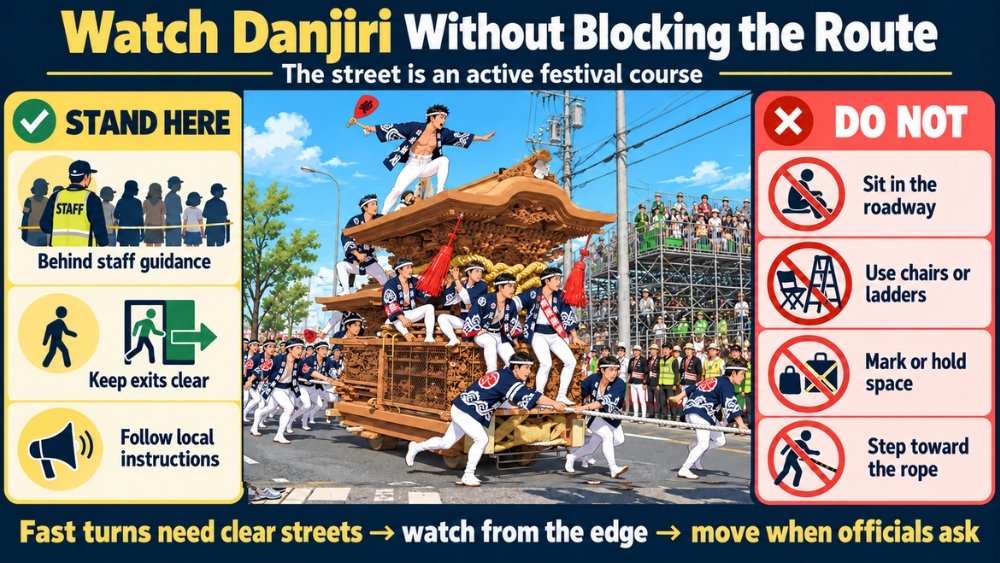
The pulling rope and danjiri are part of an active festival operation. Visitors should not step toward the rope, enter the course for a photograph or treat rooftop participants as a performance staged for individual cameras. If the edge becomes crowded, leave by the route staff indicate rather than pushing toward the next turn.
November and December: do not confuse a quiet month with an empty one
November has ceremonies and local events, but it does not need a single citywide festival label to justify the trip. Cooler weather can make it one of the easier months for long walks. Use a specific current notice if a ritual matters to you; otherwise let foliage, daylight and neighborhood plans lead the day.
December offers two different kinds of evening. On December 31, Shitennoji’s December calendar lists the year-end bell from 11:00 p.m., followed by other bell-ringing into the early morning in the normal program. A late religious observance affects trains, warmth and the following morning, so it should not be added casually after a full sightseeing day.
Winter illuminations are a separate seasonal choice, not a traditional festival category. Dates, hours and paid zones can change annually. Use our Osaka Christmas illuminations guide when lights—not a shrine or temple rite—are the real priority.
A festival day that works in practice
Start with the event that would be most disappointing to miss, then remove competing plans. Major festivals spread beyond a single pin, so save the correct station, viewing area and return route—not only the shrine name.
Before leaving, check:
- the organizer’s notice for the current year, including cancellation or weather changes;
- the exact day and component you want, especially July 24 versus 25 and September versus October districts;
- traffic controls, station exits and the last practical train;
- heat, rain and how long you may be standing;
- whether photography is permitted in the ritual area;
- food and allergy needs before relying on stalls; and
- whether the route is manageable without luggage, a tripod or a rigid dinner reservation.
Public transport is the default for Toka Ebisu, Aizen, Tenjin, Sumiyoshi and Kishiwada. Road closures and temporary parking rules are part of festival operation, and a car can leave you farther away than the train. An IC card helps with ordinary rail travel but does not reserve a viewing place or guarantee access through a controlled street.
Choose the month by the experience you actually want
Choose January for concentrated shrine and temple traditions, late June or July for Osaka’s major summer sequence, and September or October for danjiri—after the annual dates appear. Choose March or April for blossoms and December for bells or lights, while keeping those seasonal plans flexible.
The most dependable itinerary is not the month with the longest event list. It is the one built around a clearly identified date type, one realistic anchor and a fresh check of the organizer’s notice.