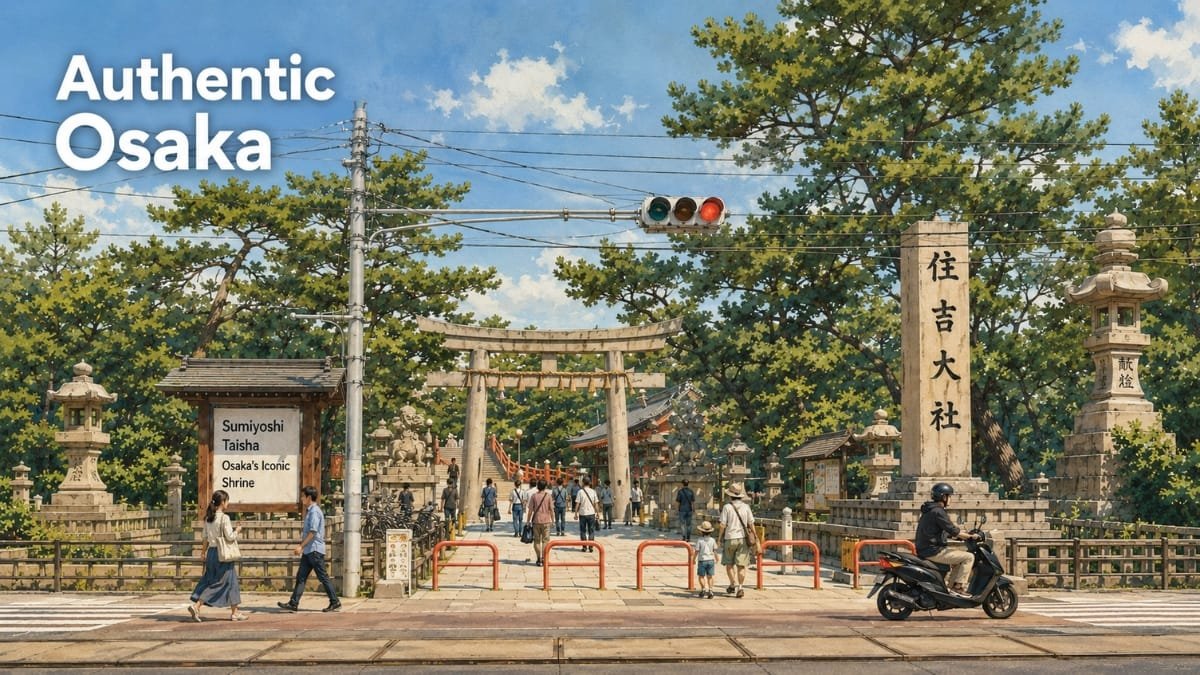
The most convincing Osaka experiences are not necessarily secret, remote or difficult to book. They are moments when the city is doing something it would do without you: a shrine receiving morning worshippers, a shopping arcade filling with lunch customers, a residential lane supporting tiny businesses, or a department-store food floor serving people on their way home.
For a first visit, the useful question is not “Where do tourists never go?” It is “Which Osaka rhythm do I want to spend an hour inside?” Choose one rhythm near a district already in your plan, arrive with a purpose, and leave enough time to notice how the place works.
Authenticity is a travel choice, not a hidden-place badge
Osaka does not become more “real” just because English is limited or the journey is inconvenient. Namba at night is real Osaka. So is a famous shrine, a busy market and a basement food hall. The difference is how you use the place.
An experience usually feels grounded when you can answer three questions:
- Why are you here? To pray, eat lunch, buy something, take a short walk or watch the city change pace.
- When does that activity make sense? A shrine morning, a shopping-street lunch and an evening food lane are not interchangeable.
- Can you join without getting in the way? Residents, worshippers and shop staff are people going about their day, not proof that you found an “authentic” backdrop.
This avoids the exhausting hunt for “locals-only” places. It also gives you permission to leave when a neighborhood is not a good fit. Lively can mean noisy; old buildings can mean steps and narrow doorways; a famous market can still feel commercial. Those are trade-offs, not failures.
Choose one Osaka rhythm that fits your day
| Experience | Best time to try it | Allow | What makes it work | Main trade-off |
|---|---|---|---|---|
| Sumiyoshi Taisha morning | After opening and before lunch | 60–90 minutes | An active shrine, distinctive architecture and a slower south-Osaka setting | The arched bridge is steep; the trip is south of the main sightseeing core |
| Nakazakicho old-new lanes | Late morning to late afternoon | 60–90 minutes | Small shops and cafés inside a low-rise residential neighborhood | Businesses keep individual hours, and many lanes are also people’s front doors |
| Tenjinbashisuji lunch hour | Late morning through lunch | 75–120 minutes | Everyday shopping, lunch counters and errands under a covered arcade | The full street is about 2.6 km; trying to “complete” it adds little |
| Shinsekai at street level | Late afternoon or early evening | 60–90 minutes | Dense signs, casual restaurants and an unpolished entertainment-district energy | It can be loud, crowded and visually intense rather than calm or hidden |
| Kuromon or an Umeda food floor | When you actually need food | 45–75 minutes | Buying a meal gives the visit a natural purpose | Shop hours, payment methods, seating and crowd levels vary |

Do not stack all five into a “real Osaka” checklist. One well-timed stop normally adds more to a day than three rushed detours.
A sacred morning at Sumiyoshi Taisha
Sumiyoshi Taisha is well known, but it is still an active place of worship. That makes it a better lesson in Osaka life than a supposedly unknown shrine visited only for a photograph.
The simplest route from Namba is a Nankai local train to Sumiyoshitaisha Station; only local trains stop there. Nankai identifies the station as NK08 and lists a transfer to the Hankai tram. From Tennoji or Abeno, the Hankai tram to Sumiyoshitoriimae puts the street-level ride into the experience. An IC card—such as ICOCA, Suica or PASMO—is a rechargeable transit card that you tap at compatible gates or onboard readers. The complete Osaka Map Sumiyoshi guide explains which route is easier from each starting area.
- Official Sumiyoshi Taisha website
- Official Nankai station information
- Sumiyoshi Taisha on Google Maps
The shrine currently lists visiting hours of 6:00 a.m.–5:00 p.m. from April through September and 6:30 a.m.–5:00 p.m. from October through March. Morning is useful because it leaves room to slow down; it is not a guarantee that the grounds will be empty. New Year and major festival dates are entirely different crowd conditions, so check the official site when your visit overlaps an event.
Look for features that make this shrine specific rather than treating it as another red building. Sorihashi is a steep vermilion arched bridge over a pond. Beyond it, the four main sanctuaries use bright vermilion beams, white wall panels and simple straight-gabled roofs covered in thin cypress shingles. The current sanctuaries date from 1810 and are designated National Treasures.
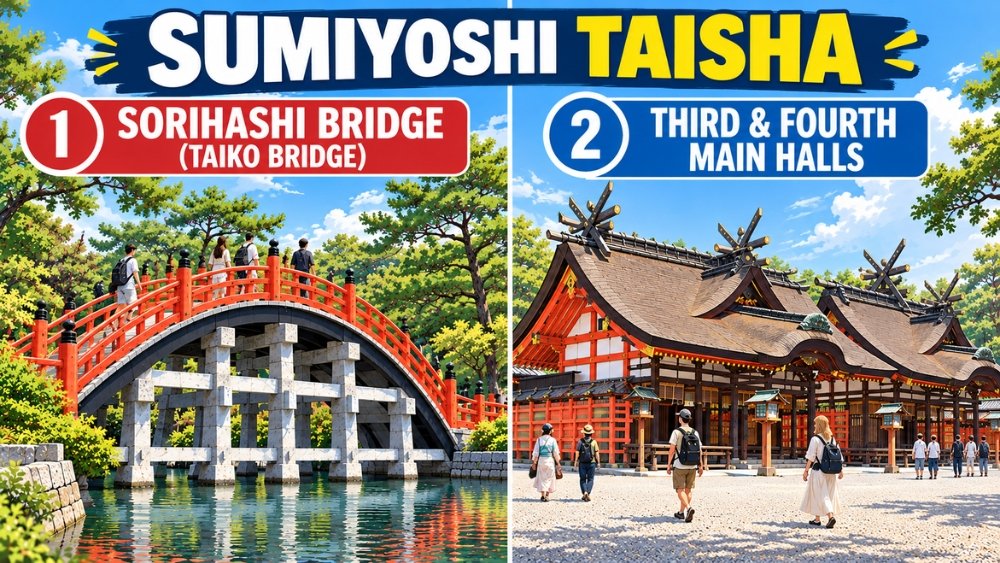
Sorihashi is not an obstacle you have to conquer. The shrine says its steepest slope exceeds 40 degrees. If balance, rain, footwear, a stroller or mobility makes the steps uncomfortable, do not force the crossing; ask the information desk about the current accessible route and restroom information.
Finish drinks before entering. The shrine asks visitors not to eat, drink or smoke inside the grounds. Bring Japanese yen if you may buy a charm or souvenir because its FAQ says cards are not accepted at the souvenir shop or Nankun-sha. Visitor Wi-Fi is not provided, so save your return station before you arrive.
Nakazakicho works because it is still a neighborhood
Nakazakicho sits one Osaka Metro stop from Higashi-Umeda on the Tanimachi Line, yet its lanes feel physically smaller than the station district beside it. Older low-rise buildings now share space with cafés, vintage shops and independent studios. Bicycles, potted plants, air-conditioning units and ordinary homes are part of the scene; it is not an outdoor set built for visitors.

Use Nakazakicho Station T19 rather than wandering out of Umeda without a reference point. The official exit guide lists Nakazaki 2- and 3-chome from Exit 2, and Nakazaki-nishi from Exit 4. Save the shop you most want to visit, then let the lanes between that shop and the station provide the walk.
Late morning or the afternoon is more practical than an early “discovery” walk because small businesses keep their own opening days and hours. Check the exact café or shop before making it the reason for the trip. If it is closed, treat the neighborhood as a short walk rather than searching residential alleys for a substitute.
The boundary between public and private space is the key. A menu board and open shop door invite a closer look; a closed gate, parked bicycle or house entrance does not. Keep doorways clear, ask before photographing a person or a shop interior, and avoid long photo setups in a narrow lane. Some old buildings also have a step at the entrance or tight interiors, so travelers who need step-free access should confirm the specific venue rather than assuming the whole neighborhood is accessible.
Nakazakicho pairs naturally with Umeda because it offers a change of scale without a long transfer. If Osaka Station already feels overwhelming, use the Osaka Station area guide first, then take the Tanimachi Line from Higashi-Umeda or walk only when the weather and your luggage make that sensible.
Tenjinbashisuji is better as lunch than as a challenge
A shotengai is a Japanese shopping street, often covered, where food shops, services and everyday retail sit side by side. Tenjinbashisuji is about 2.6 km long, but its value is not the claim that you walked every section.
For an easy first visit, focus on the official 2-chome and 3-chome area around Minamimorimachi and Osaka Tenmangu. The shopping-street association lists Minamimorimachi on the Osaka Metro Sakaisuji and Tanimachi lines, plus JR Osaka-Tenmangu Station, as the nearest stations for the southern sections. Its current maps show a practical mix of restaurants, tea and sweets, clothing, household services and other small businesses.
- Official Tenjinbashisuji 2- and 3-chome site
- Official access guide
- Tenjinbashisuji Shopping Street on Google Maps
Arrive with one ordinary task: find lunch, buy a snack for later, browse a stationery or household shop, or drink coffee. Then walk one or two sections. Individual businesses set their own hours and holidays, so the arcade itself being accessible does not mean every shutter will be open.
This is also a more comfortable place to practice small-shop dining than a famous nightlife street. Look at the menu before joining a queue, keep your group compact, and have some yen available even if many businesses accept cards or other cashless payments. If dietary restrictions are serious, carry a written Japanese allergy card; pointing at a dish is not enough to establish shared fryers, stocks or hidden ingredients.
Shinsekai is real because it is mixed, not because it excludes visitors
Shinsekai is not a secret district. Some restaurants actively serve visitors, while older entertainment, game and drinking businesses continue around them. The mixture is the point. Expect dense signs, lanterns, casual food, narrow pedestrian flows and a worn-in streetscape rather than a carefully preserved historical quarter.
Approach from Ebisucho K18 for the north side or Dobutsuen-mae M22/K19 for the south side and Janjan Yokocho. Osaka Metro’s current exit maps list Shinsekai from Ebisucho Exit 3 and Dobutsuen-mae Exit 5. Save the station you want to use on the way out; the district looks different after dark, and walking toward the wrong railway line creates an unnecessary detour.
- Official Ebisucho Station information
- Official Dobutsuen-mae Station information
- Shinsekai on Google Maps
Late afternoon into early evening shows the area changing from daytime sightseeing to dinner and drinks. Choose it if that energy appeals to you. Travelers looking for a quiet café, polished streets or an early night will get more from Nakazakicho or Sumiyoshi.
At Janjan Yokocho, the covered lane is narrow enough that stopping in the center for a photo can block everyone behind you. Move to the side, do not photograph diners at close range, and ask before aiming into a tiny counter restaurant. Choose a place because its menu, price and atmosphere suit you—not because the customers look “local enough.” The Shinsekai walking guide provides a fuller route and current decision points.
Let food give the visit a purpose
“Eat where locals eat” sounds useful but can turn residents into scenery. A better method is to choose a food format that fits your day.
At Kuromon Market, the official association describes a roofed market of about 580 meters with roughly 150 businesses. Its directory shows why one market-wide opening time is misleading: listed shops open and close at different times and observe different holidays. Check a specific vendor if it matters, or visit with flexible expectations.

The information center is currently listed from 9:00 a.m. to 6:00 p.m. with toilets, a free rest area and paid temporary luggage storage. Its visitor rules are more useful than an invented “eat like a local” formula: move to the side before stopping, return food waste to the seller or use the center’s sorted bins, do not put rubbish in residents’ bins, and do not smoke while walking. Large suitcases make a busy arcade harder for everyone; use hotel storage, a station locker or the market’s paid storage before browsing.
If you are already in Umeda, a department-store basement can be a better everyday food stop than crossing town. Hankyu Umeda Main Store’s current B1 guide lists bento, sushi, prepared dishes, bread and sweets; B2 lists fish, meat, fruit, vegetables and pantry foods. Japanese speakers often shorten “department-store basement” to depachika. Browse with a real purchase in mind, but do not assume you may open food beside the display counters. Use a designated eating space, take it back to your accommodation, or ask staff where eating is permitted.
- Hankyu Umeda Main Store B1 food guide
- Hankyu Umeda Main Store B2 food guide
- Hankyu Umeda Main Store on Google Maps
For more ways to choose between arcades, markets and food lanes, see the Osaka food street guide.
The guest test is simple
Before calling an experience authentic, ask whether your behavior would still make sense if no one were watching.
- Buy something only when you want it; browsing is fine, but a tiny shop is not a free photo studio.
- Keep entrances, tactile paving, bicycle space and narrow lanes clear.
- Photograph buildings from a public path, but ask before photographing people or interiors.
- Follow the venue’s eating and rubbish rules instead of applying one rule to all of Japan.
- Carry some Japanese yen, especially for shrine purchases and small businesses, while checking each venue’s actual payment options.
- Use a quiet voice at worship spaces and residential doors; match the room rather than performing a ritual you do not understand.
These habits do not make you blend in, and they do not need to. They simply let the place continue working while you enjoy it.
Build the day around contrast
The easiest authentic Osaka plan uses one famous anchor and one ordinary hour:
- Umeda + Nakazakicho: handle shopping or transport in Umeda, then spend 60–90 minutes in the smaller lanes.
- Namba + Kuromon: give the market a food purpose, then return to Namba without turning the morning into a citywide hunt.
- Tennoji + Shinsekai: use one station area and let street-level dinner energy be the contrast.
- Namba + Sumiyoshi: take the Nankai local south for a calm shrine visit, then return to the center when you are ready for crowds.
Leave a gap rather than adding another attraction. That spare half-hour is often when Osaka begins to feel less like a list: you notice which shop has a queue, which lane becomes residential, when an arcade changes from errands to lunch, or how a shrine settles after a group leaves.
The “real Osaka” is not a prize hidden from visitors. It is the city continuing to function around you—and your willingness to take part without demanding that every moment prove something.