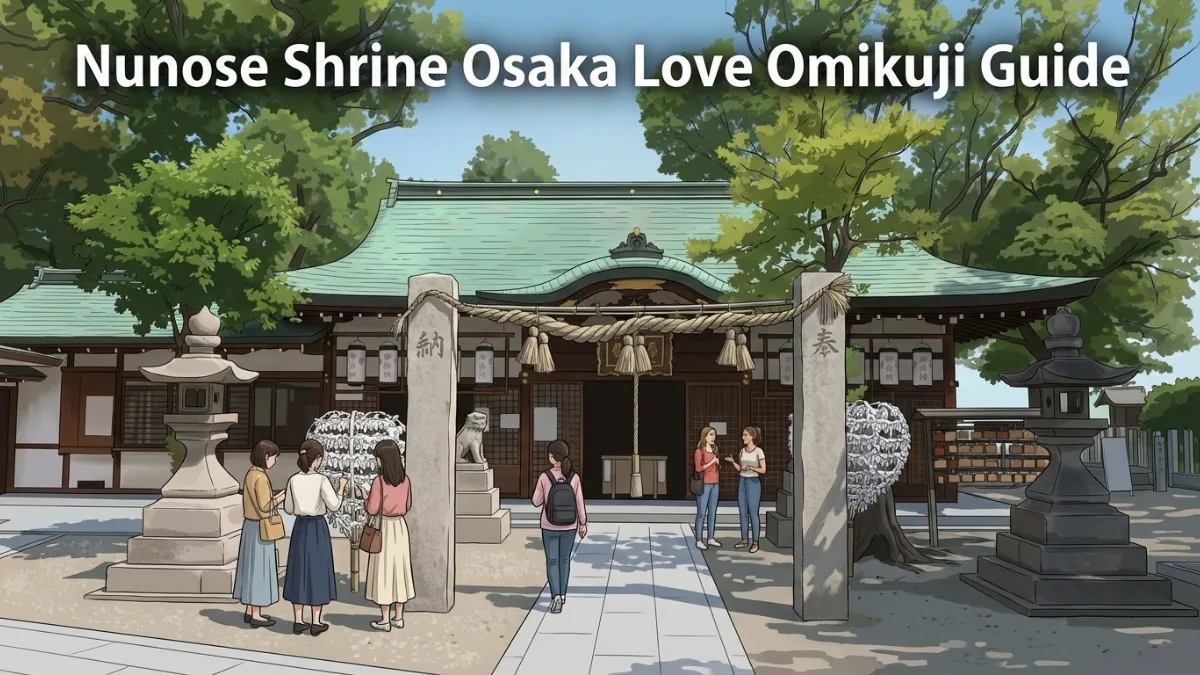
Nunose Shrine is worth the detour if you want a small, active neighborhood shrine with one genuinely unusual feature: a postcard-size love omikuji created with contemporary artist Hiroko Ichihara. An omikuji is a paper fortune, but this one does not rank your luck as great, good or bad. It presents a short piece of text to interpret for yourself.
Plan about 30–45 minutes at the shrine. Travel during the staffed office window, use a local train to Nunose Station, and bring ¥300 in cash. The shrine has not published a dependable card-payment method for the omikuji, so cash is the safer choice.
| Plan around | Practical answer |
|---|---|
| Address | 2-4-11 Kitashinmachi, Matsubara, Osaka |
| Nearest station | Nunose Station (F08), Kintetsu Minami Osaka Line |
| Train from central Osaka | Local train from Osaka-Abenobashi (F01), beside Tennoji |
| Walk from Nunose Station | About 5 minutes |
| Shrine grounds | 6:00 a.m.–6:00 p.m. |
| Shrine office and love omikuji | 9:00 a.m.–5:00 p.m.; regular closure rules apply |
| Love omikuji | ¥300 |
| Map | Nunose Shrine on Google Maps |
| Official information | Nunose Shrine |
Start at Osaka-Abenobashi—and board a local train
The simplest route from central Osaka begins at Osaka-Abenobashi Station (F01), the Kintetsu terminal next to the Tennoji and Abeno station area. Take a local train on the Kintetsu Minami Osaka Line and get off at Nunose Station (F08).
The word “local” matters. Express and semi-express trains on this line skip Nunose. Check the departure display before boarding; the stopping pattern is more useful than choosing a train only by its destination. Kintetsu publishes both a station page for Nunose and an English timetable.
An IC card—a rechargeable transit card such as ICOCA, Suica or PASMO—can be used for an ordinary Kintetsu ride. Tap in at Osaka-Abenobashi and tap out at Nunose. The IC card pays your train fare; it does not confirm how the shrine office accepts payment.
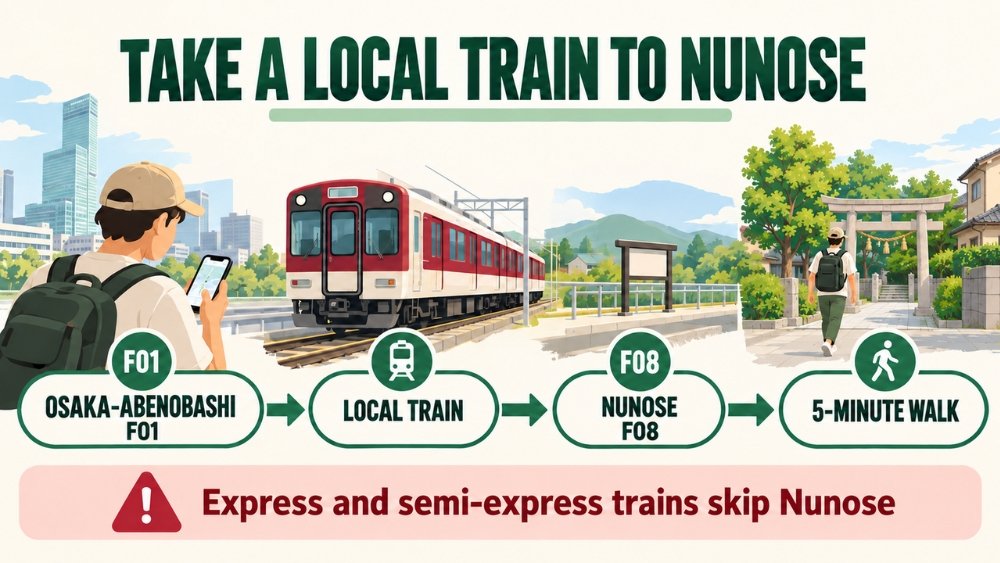
From Nunose Station, the shrine is about a five-minute walk through a residential part of Matsubara. Use the exact map pin for the final turns rather than expecting a large tourist approach. This is a compact local shrine, not a monumental complex visible from far away.
If you have a suitcase, leave it at your hotel or in suitable station storage before travelling. The shrine does not advertise visitor luggage storage, and neither the neighborhood walk nor the small grounds are improved by pulling a large case.
The love omikuji is artwork, not a luck score
Nunose Shrine introduced its love omikuji on September 24, 1999, working with Hiroko Ichihara. Its format is deliberately different from a conventional fortune slip:
- there is no good-or-bad luck grade;
- the paper is closer to postcard size than a narrow folded strip;
- “love” can mean a partner, family, friends, work, study, hobbies or something else you care about;
- the shrine asks visitors to take the card home and reflect on it.
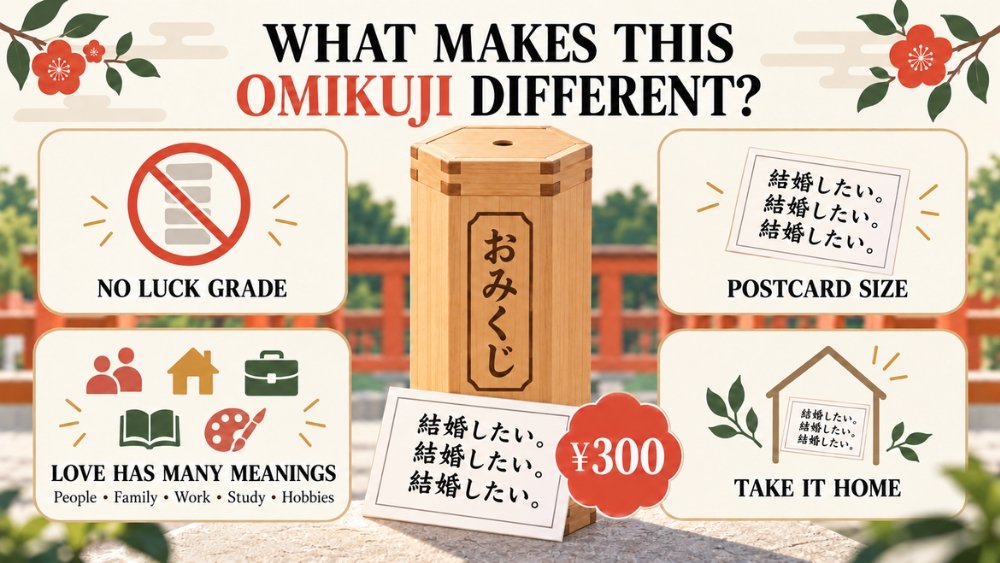
The shrine recommends drawing one card as the basic approach. It also says that you may draw up to three and combine the meanings if one is difficult to interpret. That is permission, not a target: one careful draw is enough for most visitors.
The text is short and direct, which is part of the work. A camera-translation app may help you identify the words, but it may flatten wordplay or tone. Save a clear photograph and ask a Japanese speaker for context if the phrasing remains unclear. Do not assume that a severe-sounding sentence predicts a bad event; the omikuji is designed for personal interpretation rather than fortune ranking.
The official fee is now ¥300, effective from April 1, 2026. Older pages may show another price or say that the current amount is uncertain. Use the shrine’s official love omikuji explanation as the current reference.
Visit in this order: worship, draw, translate, keep
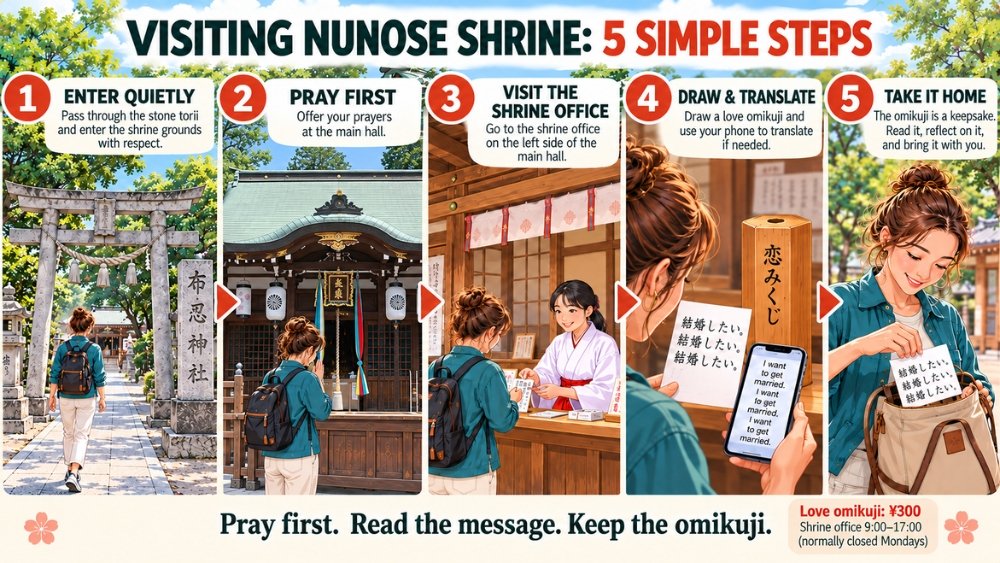
You do not need to know Japanese or belong to the Shinto faith. A calm sequence is enough:
- Enter without blocking the torii gate. A small bow before passing through is customary.
- Visit the worship hall first. If the purification basin is in use, follow the instructions there. At the hall, an offering is optional; a common shrine pattern is two bows, two claps, a quiet prayer or thanks, then one final bow.
- Go to the shrine office during staffed hours. Ask for the love omikuji and have ¥300 ready.
- Draw one card and translate it away from the counter. Give the next visitor space rather than starting a long translation session at the service window.
- Take the card home. Nunose Shrine presents this omikuji as something to keep and reconsider, not something you must tie to a rack before leaving.
Photography is secondary to worship. Avoid close photographs of other people praying, keep voices low, and follow any temporary notice restricting photography or access. Ceremonies always take priority over the usual visitor flow.
Office closures matter more than gate hours
The grounds are normally open from 6:00 a.m. to 6:00 p.m., but the shrine office operates from 9:00 a.m. to 5:00 p.m. You cannot rely on drawing the love omikuji simply because the gate is open. Aim to arrive by about 4:30 p.m. so a delayed train or short wait does not push you past the counter window.
The office is normally closed on Monday. The rule changes when Monday is a public holiday, a substitute holiday, or the 1st or 15th of the month, when monthly observances are held: in those cases, the office closure moves to Tuesday. The shrine also announces additional two-day closures after Golden Week and after Silver Week.

Check the date on the official shrine homepage shortly before travel. A special ceremony, seasonal holiday or newly posted closure should override a generic weekly plan.
The shrine has only limited parking and asks visitors to avoid arriving by car. If driving is unavoidable, use nearby paid parking rather than assuming a shrine space will be available.
Look beyond the fortune slip
Nunose Shrine is not only an omikuji counter. Its main hall dates from the Edo period and is designated a tangible cultural property by Osaka Prefecture. The prefectural cultural-property register records the designation from January 29, 2002.
Give yourself a few minutes to notice the compact worship space, mature trees and role the shrine still plays in its residential neighborhood. The love omikuji became better known after appearing in a Google commercial in November 2017, but its value here comes from the contrast: a contemporary text artwork encountered inside a historic local shrine.
The shrine does not publish a complete English step-free route or detailed accessibility guide. If surfaces, gate width, steps or restroom access will determine whether you can visit, check the latest Kintetsu station facilities and contact the shrine before making the trip. Do not assume that a short five-minute walk automatically means a barrier-free route.
When Nunose Shrine fits your Osaka plan
Nunose is a focused visit rather than a major half-day attraction. It fits especially well when you:
- are staying around Tennoji or Abeno;
- want a quieter shrine outside the busiest visitor districts;
- are interested in contemporary art, language or an unconventional omikuji;
- can travel during the office window without making the day rushed.
It is less suitable if you have only a short first day in Osaka, need guaranteed step-free access without advance checking, or are travelling on a Monday with no flexibility.
For a larger historic shrine experience, compare it with Sumiyoshi Taisha. For a compact shrine in central Namba with a dramatic lion stage, see our Namba Yasaka Shrine guide. Our guide to Osaka’s best shrines helps match the visit to your interests and available time.
Nunose Shrine works best when you treat the journey and the omikuji with the same care: board a local train, arrive while the office is open, worship before drawing, and take time to understand the words you carry home.