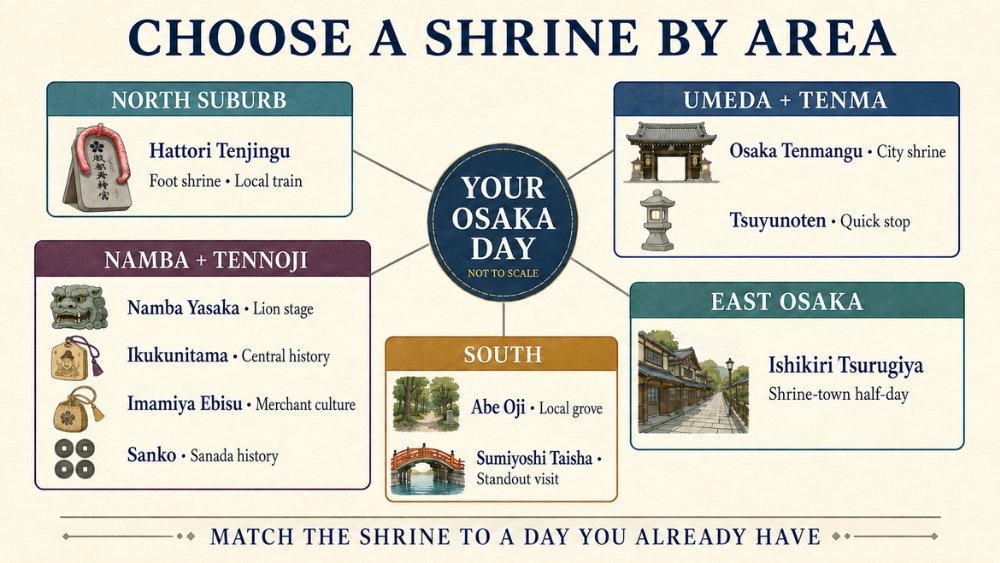
If you visit only one shrine in Osaka, choose Sumiyoshi Taisha for its scale, history and distinctive architecture. Choose Namba Yasaka Shrine when you want a short, memorable stop near Namba; Osaka Tenmangu or Tsuyunoten Shrine when you are based around Umeda; and Ishikiri Tsurugiya Shrine when the shrine-town approach is worth a dedicated half-day.
The best choice is not simply the most famous name. A shrine that fits an area you already plan to explore will usually give you a calmer, more meaningful visit than one that forces a rushed trip across the prefecture.
Eight places below are in Osaka City. Hattori Tenjingu is in Toyonaka City, north of central Osaka, and Ishikiri Tsurugiya Shrine is in Higashiosaka City, east of the center. Both are in Osaka Prefecture, but neither is a quick central-city add-on.
Match one Osaka shrine to your route
| # | Shrine | Best access anchor | Allow on site | Best reason to choose it | Main planning caution |
|---|---|---|---|---|---|
| 1 | Sumiyoshi Taisha | Nankai Sumiyoshitaisha or Hankai Sumiyoshitorii-mae | 60–90 min | One substantial, unmistakably Osaka shrine visit | Its arched bridge is steep; protect a south-Osaka block |
| 2 | Namba Yasaka Shrine | Nankai Namba and Motomachi | 25–40 min | Giant lion-head stage close to Namba | Compact grounds and shorter daytime access |
| 3 | Osaka Tenmangu | Minamimorimachi or JR Osaka-Tenmangu | 30–45 min | Active city shrine tied to learning and Tenjin Matsuri | Event days can change access and crowd levels |
| 4 | Ikukunitama Shrine | Tanimachi 9-chome | 30–45 min | Historic shrine without leaving central Osaka | Best as a nearby stop, not a cross-city mission |
| 5 | Hattori Tenjingu | Hankyu Hattori-tenjin | 30–45 min | A neighborhood shrine associated with feet and mobility | Use a local train; Hankyu express trains do not stop |
| 6 | Abe Oji Shrine | Hankai Matsumushi and Abeno | 30–45 min | Kumano-route history and a quiet sacred grove | Worth prioritizing mainly when you are already in south Osaka |
| 7 | Imamiya Ebisu Shrine | Imamiyaebisu, Daikokucho or Ebisucho | 20–35 min | Osaka’s merchant culture and Ebisu worship | Major roof works are scheduled through 2027 |
| 8 | Ishikiri Tsurugiya Shrine | Ishikiri or Shin-Ishikiri | 60–90 min at the shrine; 2–3 hr with the approach | A local shrine-town outing where the route is part of the visit | The traditional approach is long and sloped |
| 9 | Tsuyunoten Shrine | Higashi-Umeda | 20–30 min | The easiest compact shrine stop near Umeda | Urban and small rather than spacious or secluded |
| 10 | Sanko Shrine | JR or Osaka Metro Tamatsukuri | 25–40 min | Sanada history near the old Osaka Castle battlefield area | The famous tunnel is normally locked |
1. Sumiyoshi Taisha: the best single shrine visit for most travelers
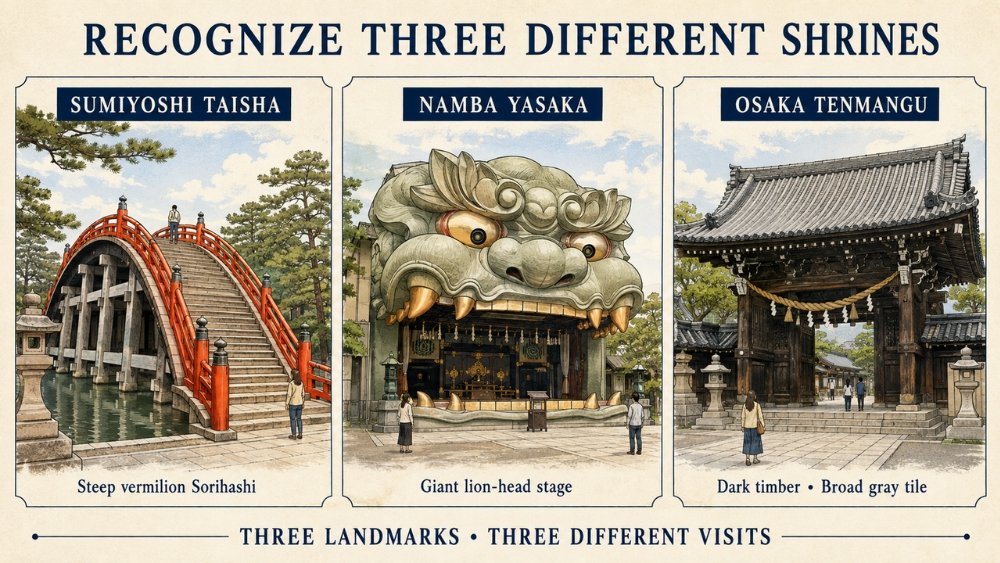
Sumiyoshi Taisha is the strongest all-round choice when a shrine should be a meaningful part of the day rather than a five-minute photo stop. The official history traces its foundation to 211, and its four main sanctuaries use sumiyoshi-zukuri, an old shrine architectural style with straight roof lines and a form that predates many later influences. The current main sanctuaries date from 1810 and are National Treasures.
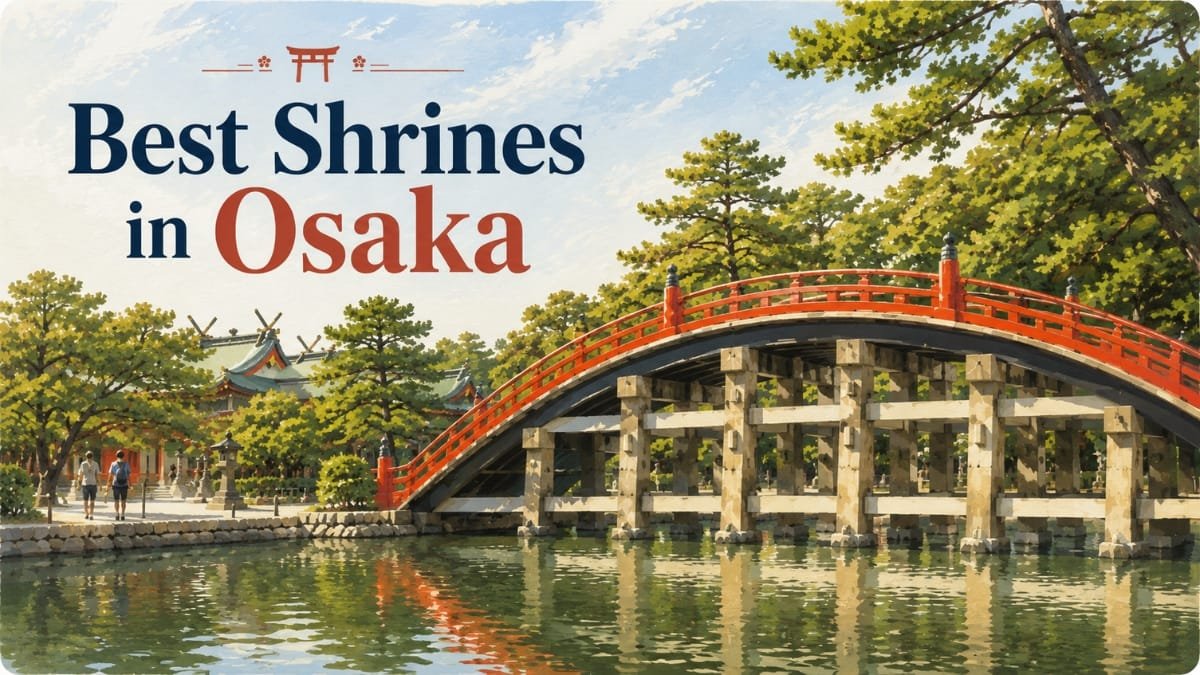
The best-known feature is Sorihashi, the vermilion arched bridge over the pond. The shrine describes it as about 21 metres long, 5 metres high and steeper than 40 degrees. It is beautiful but not an accessibility route. After rain, use the level route around it if the steps look uncomfortable or slippery.
The shrine is south of central Osaka, so do not squeeze it between two timed reservations. Arrive via Nankai’s Sumiyoshitaisha Station or the Hankai tram’s Sumiyoshitorii-mae stop, allow at least an hour, and check the official visitor information for seasonal gate times and special-event changes. Save Sumiyoshi Taisha on Google Maps. Our step-by-step Sumiyoshi Taisha guide covers the station approach, bridge and worship sequence in more detail.
You can visit independently for free. If you want a guide and a full-day itinerary rather than a self-guided shrine morning, Klook lets you switch the displayed language and currency, which can make inclusions and the final price easier to compare. Compare the Osaka private day tour on Klook, then confirm the current stop order, pickup area, guide language, transport, group format and cancellation terms before booking.
2. Namba Yasaka Shrine: the easiest high-impact Namba stop
Namba Yasaka Shrine is compact, urban and visually unlike the other shrines on this list. Its giant lion-head stage is approximately 12 metres high, 11 metres wide and 10 metres deep. The open mouth forms the stage, while the eyes and dramatic teeth give the structure its unmistakable face.
This is a practical add-on from Nankai Namba and the Motomachi side of the district. Allow 25 to 40 minutes rather than building a half-day around it. The grounds are an active place of worship, not only a photo location, so keep the approach clear and wait if someone is praying in front of the stage or main hall.
Use the shrine’s official page for current notices and save Namba Yasaka Shrine on Google Maps. The Osaka Map Namba Yasaka guide explains how to fit it into a Namba walk without backtracking.
3. Osaka Tenmangu: a shrine that belongs to everyday city life
Osaka Tenmangu is dedicated to Sugawara no Michizane, who is closely associated with learning. It is also central to Tenjin Matsuri, when the surrounding streets and riverside operate very differently from an ordinary visit.
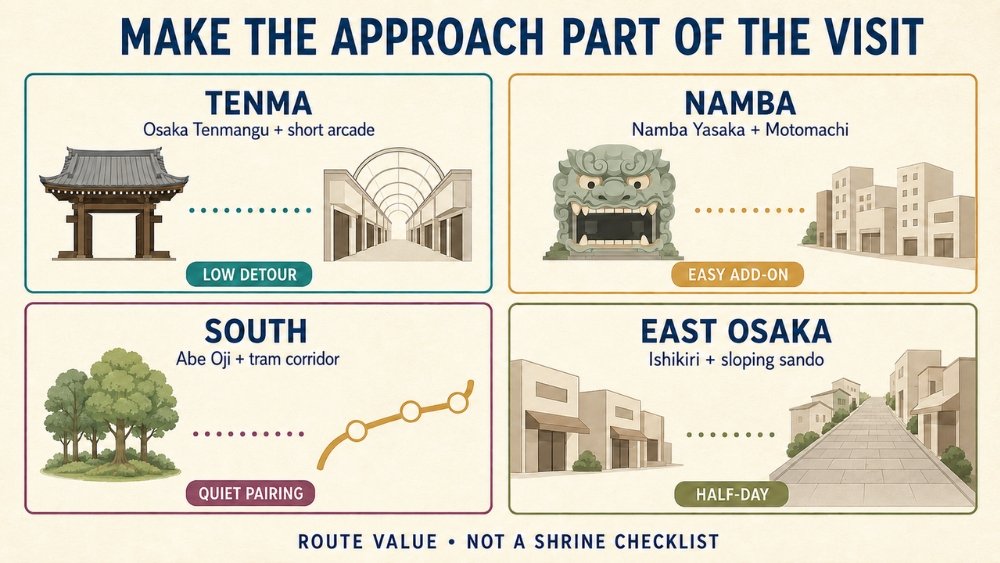
Outside the festival, the shrine works well with a short section of Tenjinbashisuji Shopping Street. Osaka Metro users can start from Minamimorimachi Exit 4; JR users can start from Osaka-Tenmangu Exit 7. The official access page gives the final turn from the covered arcade. Save Osaka Tenmangu on Google Maps.
The main approach is recognizable by the dark-timber Omote Daimon gate beneath a broad gray tiled roof. It is not a generic bright-red shrine entrance. Allow 30 to 45 minutes for the grounds, then decide whether the shopping street still adds value instead of automatically walking its full length.
4. Ikukunitama Shrine: central, historic and easy to fit around Uehommachi
Ikukunitama Shrine, often shortened to Ikutama Shrine, is near Tanimachi 9-chome and the Uehommachi side of central Osaka. It suits travelers who want an established shrine without leaving the central sightseeing area or giving the visit half a day.
The value here is practical rather than spectacular. Its grounds provide a clear break from the dense streets nearby, but this is not the place to prioritize solely for one dramatic landmark. Allow 30 to 45 minutes, combine it with a plan already using Tanimachi 9-chome or Osaka-Uehommachi, and save Ikukunitama Shrine on Google Maps.
Check the official page before visiting if a goshuin—a calligraphic record of worship placed in a special book—or a specific shrine-office service matters. Grounds access and office hours are not necessarily the same.
5. Hattori Tenjingu: a distinctive foot shrine north of central Osaka
Hattori Tenjingu is known as the “Foot Shrine.” Its identity is connected to a tradition that Sugawara no Michizane recovered from leg trouble here on his journey to Dazaifu. The shrine’s foot amulets are designed to be tied to shoelaces, which makes the connection unusually tangible.
This shrine is in Toyonaka City, not Osaka City. From Umeda, use the Hankyu Takarazuka Line and make sure the train stops at Hattori-tenjin; the shrine explicitly warns that express trains do not stop. It lists opening hours of 06:00–19:00 from April through September and 06:00–18:00 from October through March, with exceptions around festivals and New Year.
Choose Hattori Tenjingu when the theme of feet, mobility, walking or sport matters to you, or when you want a neighborhood shrine beyond the usual central list. It is less convincing as a detour on a very short first trip. Save Hattori Tenjingu on Google Maps.
6. Abe Oji Shrine: a quiet stop on Osaka’s old Kumano route
Abe Oji Shrine stands in Abeno on an old Kumano pilgrimage route. Its official site identifies it as the guardian shrine of the Abeno area and highlights a sacred camphor tree around 600 years old. Nearby Abe Seimei Shrine is a separate associated site, so do not confuse the two entrances or treat them as one building.
The cleanest public-transport approach is the Hankai Uemachi tram to Matsumushi, followed by the shrine’s signed neighborhood route. The official access information also explains approaches from Osaka Metro and city bus stops. Save Abe Oji Shrine on Google Maps.
This is a rewarding local stop when your day already includes Abeno, Tennoji or the tram corridor. It is not a substitute for Sumiyoshi Taisha if you want a large destination shrine. Keep voices low around the grove and avoid turning a small neighborhood entrance into a group photo bottleneck.
7. Imamiya Ebisu Shrine: merchant culture with a current construction caveat
Imamiya Ebisu Shrine is closely tied to Ebisu worship and business prosperity. Its Toka Ebisu period around January 9–11 is a major event, with crowd conditions completely different from an ordinary weekday.
There is an important current limitation. The shrine’s official restoration plan schedules roof and precinct work in two phases: February–December 2026 and February–around June 2027. Scaffolding, restricted areas or changed sight lines may affect a visit. The grounds remain a place of worship, but do not plan the stop around an unobstructed architectural photograph while the work is active.
The shrine lists general gate access from 06:00 to 17:00, with the south gate open later, and office hours from 09:00 to 17:00. It asks visitors to use public transport while construction limits parking. Use the official access page, save Imamiya Ebisu Shrine on Google Maps, and allow roughly 20 to 35 minutes outside the January festival.
It can be paired with Ebisucho or a street-level Shinsekai walk, but the shrine itself is the reason for the stop. Do not let a crowded entertainment route turn the visit into hurried photography.
8. Ishikiri Tsurugiya Shrine: make the approach part of the visit
Ishikiri Tsurugiya Shrine is in Higashiosaka at the foot of Mount Ikoma. The traditional approach from Kintetsu Ishikiri Station descends through Ishikiri Sando, a sloping shopping street with small restaurants, sweets, religious goods and fortune-telling businesses. If the slope or extra walking is a problem, use Shin-Ishikiri Station for a shorter approach to the main shrine.
The shrine is known for ohyaku-do mairi, a repeated prayer circuit between two stones. This is an active devotional practice. Give participants space, do not cross their path for a photograph, and never treat another person’s prayer as a performance.
The official site says the grounds are open 24 hours, while the main service counter operates 08:00–16:30 and prayer reception has still shorter sessions. Approach-street businesses keep their own days and hours, so morning to early afternoon is the most reliable window if the street is part of your plan.
Allow two to three hours for the train journey, sando and shrine rather than treating Ishikiri as a spare 30-minute slot. Use the official access map, save Ishikiri Tsurugiya Shrine on Google Maps, and see our Ishikiri guide for the two-station route.
9. Tsuyunoten Shrine: the simplest shrine stop near Umeda
Tsuyunoten Shrine, commonly called Ohatsu Tenjin, sits in Sonezaki within walking distance of the Umeda and Osaka Station district. Its association with Chikamatsu Monzaemon’s Sonezaki Shinju gives the small urban shrine a strong literary and relationship theme.
The shrine lists grounds hours of 06:00–24:00 and office hours of 09:00–18:00. That makes the grounds easier to fit around dinner or shopping than many shrine offices, but a late visit does not guarantee access to charms, omikuji fortune slips or goshuin. There is no shrine parking.
Use the official access map to approach from Higashi-Umeda or the wider station complex, and save Tsuyunoten Shrine on Google Maps. Choose it for convenience and city context, not for seclusion.
10. Sanko Shrine: compact history near Tamatsukuri
Sanko Shrine sits on Sanadayama near Tamatsukuri. Its connection to Sanada Yukimura and the siege-era history of Osaka gives it a more specific historical role than the broader wish-based identities of several shrines above.
The site’s “Sanada escape tunnel” needs a clear expectation. The shrine says it is normally locked and can be seen only through bars. It opens once a year during the Sanada Festival on the final Sunday of October, currently from 10:00 to 12:00. Do not plan an ordinary visit on the assumption that you can enter it.
The shrine lists about five minutes on foot from JR Tamatsukuri or two minutes from Osaka Metro Tamatsukuri Exit 2. Office hours are 09:00–15:00 on weekdays and 09:00–16:00 on weekends and holidays. Save Sanko Shrine on Google Maps.
Three route combinations that do not waste the day
- Umeda and Tenma: visit Osaka Tenmangu, walk only the useful Tenjinbashisuji section, and add Tsuyunoten later if you still want a compact second shrine. They are different urban settings; neither needs a long isolated block.
- Abeno and south Osaka: pair Abe Oji with Sumiyoshi Taisha along the Hankai tram corridor. Make Sumiyoshi the anchor and treat Abe Oji as the quieter companion, not the other way around.
- Namba and the southern center: add Namba Yasaka before or after a Namba meal. Add Imamiya Ebisu only when Ebisucho or Daikokucho already fits; do not create a shrine checklist across every southern neighborhood.
Ishikiri and Hattori Tenjingu are better as separate, intentional outings. Sanko Shrine fits a Tamatsukuri or east-central Osaka day. Ikukunitama is easiest when Tanimachi 9-chome or Uehommachi is already on the route.
A simple, respectful way to visit a Shinto shrine
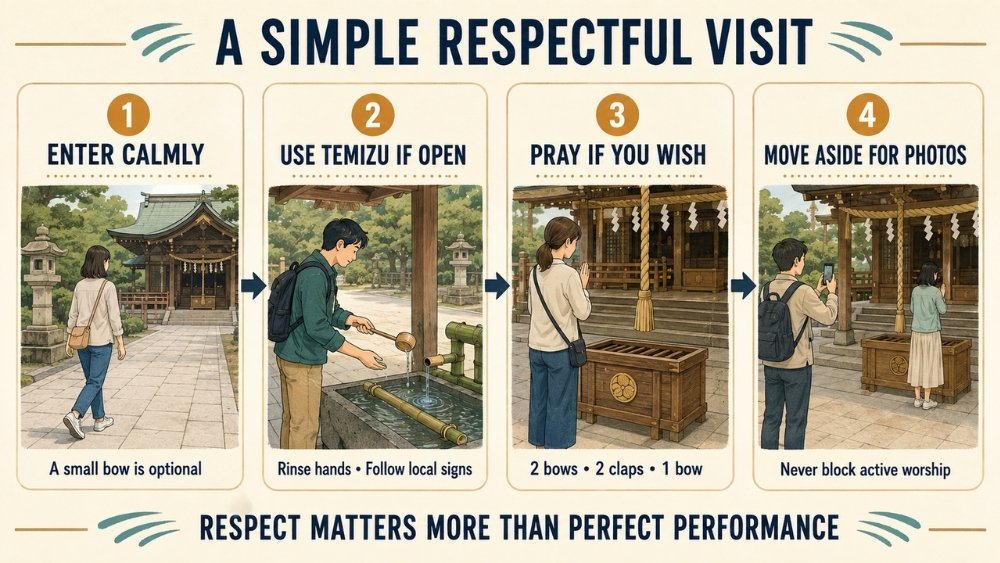
A Shinto shrine is called a jinja in Japanese. A torii marks the boundary of the sacred area. Many visitors pause for a small bow before entering, but respectful behavior matters more than copying every gesture perfectly.
If a purification font is open, use the ladle to rinse your hands. Traditional guidance also includes placing water in your hand to rinse your mouth; never touch the ladle to your lips and follow any current posted instructions. Some shrines change or suspend water use, so do not assume every font works the same way.
At the prayer area, an offering is optional. The common sequence is two deep bows, two claps, a quiet prayer, then one deep bow. Follow local signs when a shrine uses a different practice. Keep the center in front of the hall clear, do not enter roped or fenced spaces, and move away before taking a long series of photographs.
Goshuin, charms and omikuji usually depend on shrine-office hours even when the grounds open earlier or close later. Bring some yen, receive a goshuin after worship, and treat it as a record of the visit rather than an attraction stamp. Festival days, ceremonies and construction can change normal movement through the grounds.
Which Osaka shrine should you choose?
Choose Sumiyoshi Taisha when you want one complete shrine experience. Choose Namba Yasaka for the easiest memorable addition to Namba, Osaka Tenmangu for a Tenma day, Tsuyunoten for a short Umeda pause, and Ishikiri when an old approach street and local devotional atmosphere are worth the extra time.
The other five are not lesser versions of those names. Ikukunitama, Hattori Tenjingu, Abe Oji, Imamiya Ebisu and Sanko work because each solves a more specific route or interest. Pick one that belongs to the day you are already building, leave space for active worship, and let the visit slow the itinerary rather than complicate it.