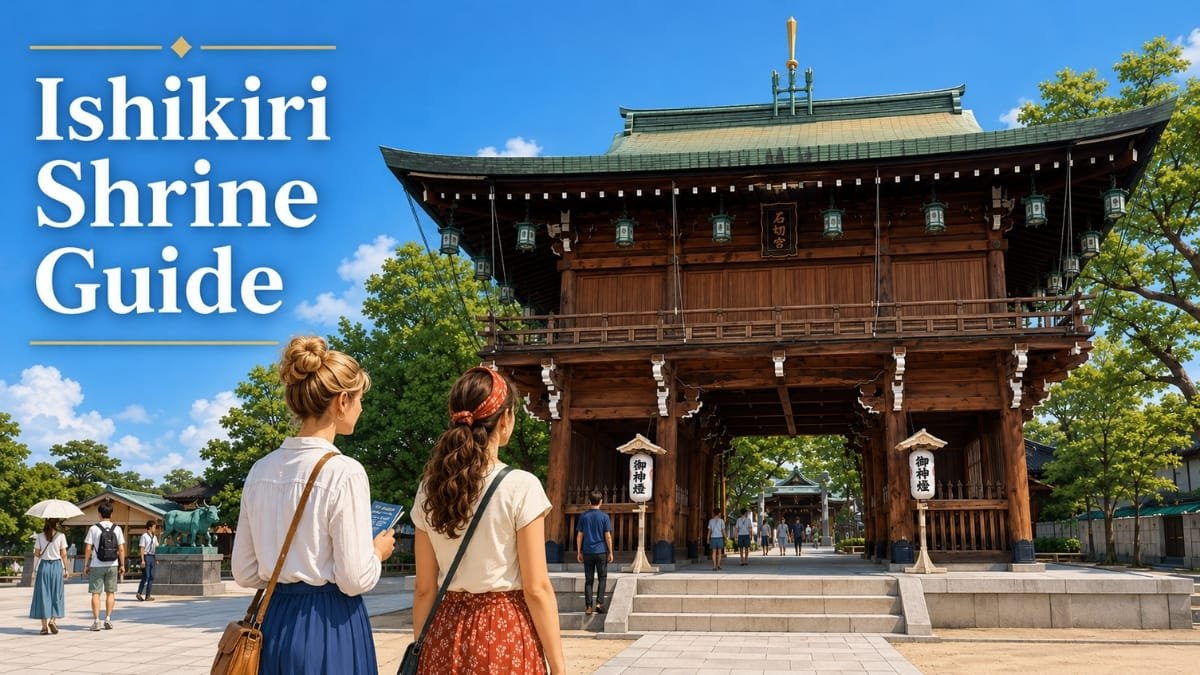
Ishikiri Tsurugiya Shrine—usually called Ishikiri-san—is a working Shinto shrine in Higashiosaka where many people pray for recovery from illness. Its best-known practice is ohyakudo-mairi: repeated prayer walks between the main worship area and a stone marker.
For a first visit, make one decision before boarding the train. Use Shin-Ishikiri Station for the more direct walk to the main shrine, or start at Ishikiri Station if the sloping approach and its old shopping street are part of the experience you want. Ordinary worship needs no reservation. Formal prayer, amulets and staff help follow daytime reception hours even though the grounds themselves remain open 24 hours.
Quick answer: choose the visit before the train
| Your priority | Best plan | Important limit |
|---|---|---|
| The simplest first visit | Kintetsu Keihanna Line to Shin-Ishikiri, then follow the official route to the main shrine | Allow at least 10 minutes for first-time navigation and more if you need lifts |
| The full local approach | Kintetsu Nara Line to Ishikiri, then descend through Ishikiri Sando Shopping Street | The route is sloping; individual shops keep their own hours |
| Ordinary worship | Visit the main shrine without a booking | Grounds are open 24 hours, but late visits have no normal daytime services |
| Amulets or staff assistance | Arrive while the main offering office is open, currently 8:00–16:30 | Selection and instructions can change |
| Gokaji and formal prayer | Individuals can apply on arrival during reception, currently 9:00–11:30 and 13:00–15:30 | Not offered on the 9th, 19th or 29th; ceremony times can change for rites and events |
| Ohyakudo-mairi | Choose a manageable number of circuits and keep the prayer route clear | One hundred is not compulsory; the route closes at specified New Year and ritual times |
| Kaminosha upper shrine | Treat it as a separate second site near Ishikiri Station | Its offering office is currently 8:00–16:00 and closes on the 9th, 19th and 29th |

The main shrine is at 1-1-1 Higashi-Ishikiri-cho, Higashiosaka. Check the official shrine website for current notices, use the official access routes for the final walk, and open Ishikiri Tsurugiya Shrine in Google Maps when you are close.
Why people come to Ishikiri-san
The shrine enshrines Nigihayahi no Mikoto and Umashimade no Mikoto, a parent and child in the shrine’s tradition. The name Ishikiri Tsurugiya expresses divine power compared with a sword and arrow strong enough to cut and pierce rock. You do not need to memorize the mythology to visit, but that image helps explain the shrine’s identity.
Ishikiri-san is especially associated with prayers for byōki heiyu, meaning recovery from illness. The local word denbo can refer to a swelling or lump; the shrine explains that the name is also linked in its tradition to denpō, the rite handed down by the shrine family. These are matters of faith and cultural history—not claims that a shrine visit cures disease.
Prayer can sit alongside medical care, but it must not replace diagnosis, treatment or a clinician’s advice. That distinction is especially important here because many people around you may be carrying serious private worries. Treat the grounds as a place of worship rather than a “power spot” photo set.
For a broader comparison of religious sites, see Osaka Map’s guide to the best shrines to visit in Osaka. Ishikiri feels very different from the spacious ceremonial grounds described in the Sumiyoshi Taisha guide: the repeated prayer route is active in the center of the main courtyard.
Make an ordinary visit first
You can worship without doing ohyakudo-mairi or booking a formal ceremony. A simple first visit is complete on its own:
- Bow lightly before entering through the torii gate.
- If the purification basin is open, rinse your hands without touching the ladle to your mouth.
- Approach the worship area without stepping into the repeated-walking route.
- Place an offering in the box if you wish.
- Bow twice, clap twice, pray silently, then bow once.
- Move aside before checking your phone or deciding what to do next.
Follow any posted instruction if it differs from this general Shinto pattern. Kami is a useful first-visit term for the sacred beings or divine presences worshipped in Shinto. A shrine is therefore not the same institution as a Buddhist temple, even when both appear in the same neighborhood.
The shrine permits personal landscape photography in ordinary allowed areas, but its current rules prohibit photography inside the worship hall and kagura hall, in marked no-photo zones, and of priests, shrine attendants, staff or other visitors without permission. Do not occupy a path with a tripod or stage a photograph where it interferes with worship. Around the ohyakudo route, the safest rule is simple: photograph the setting only when no one’s prayer becomes your subject.
Ohyakudo-mairi is repeated prayer, not a race
Ohyakudo-mairi literally suggests one hundred visits. At Ishikiri, worshippers repeat a route between the worship area and the ohyakudo-ishi, the stone marker near the torii. The shrine’s own guidance makes two points that many short travel guides miss: the practice is not compulsory, and you may choose a number below one hundred according to the weather and your condition.
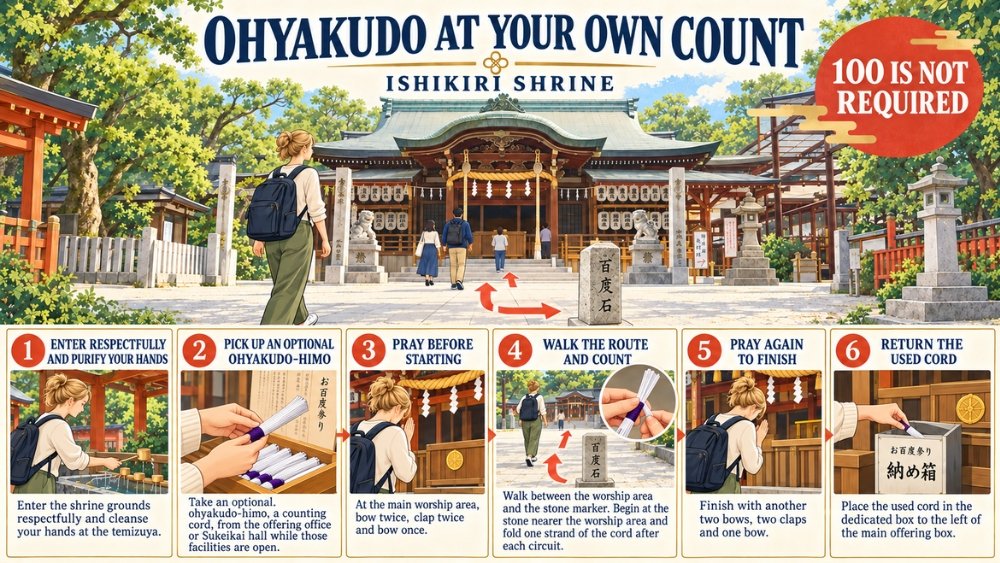
The official ohyakudo guide gives this general sequence:
- Enter respectfully and purify your hands.
- Pick up an optional ohyakudo-himo, a counting cord, from the offering office or Sukeikai hall while those facilities are open.
- Bow twice, clap twice and bow once at the main worship area before starting.
- Walk between the worship area and the stone marker. Begin at the stone nearer the worship area and fold one strand of the cord after each circuit.
- Finish with another two bows, two claps and one bow.
- Place the used cord in the dedicated box to the left of the main offering box.
The cord helps count; it is not required. Choose fewer circuits if heat, rain, fatigue, mobility, pregnancy, illness or traveling with children makes repetition unwise. Ordinary worship is not a lesser visit.
Stay out of the line if you are not participating. Do not cross immediately in front of a person who is focused on a circuit, walk against the flow for a photograph or stop between the worship area and the marker. If you need to understand the movement first, watch quietly from the side.
Although the grounds are normally open around the clock, ohyakudo-mairi is not always available. The shrine states that it cannot be performed from 10:00 p.m. on December 31 through the first three days of January, and it can pause during shrine rites. Check notices before a festival or New Year visit rather than assuming that 24-hour grounds mean a 24-hour ritual.
Ordinary worship and formal prayer are different choices
Most travelers need only ordinary worship. A gokitō is a formal prayer conducted by shrine priests. Gokaji is Ishikiri’s distinctive individual rite, which the shrine describes as strengthening the connection between the worshipper and the enshrined deities. These are religious services, not medical procedures.
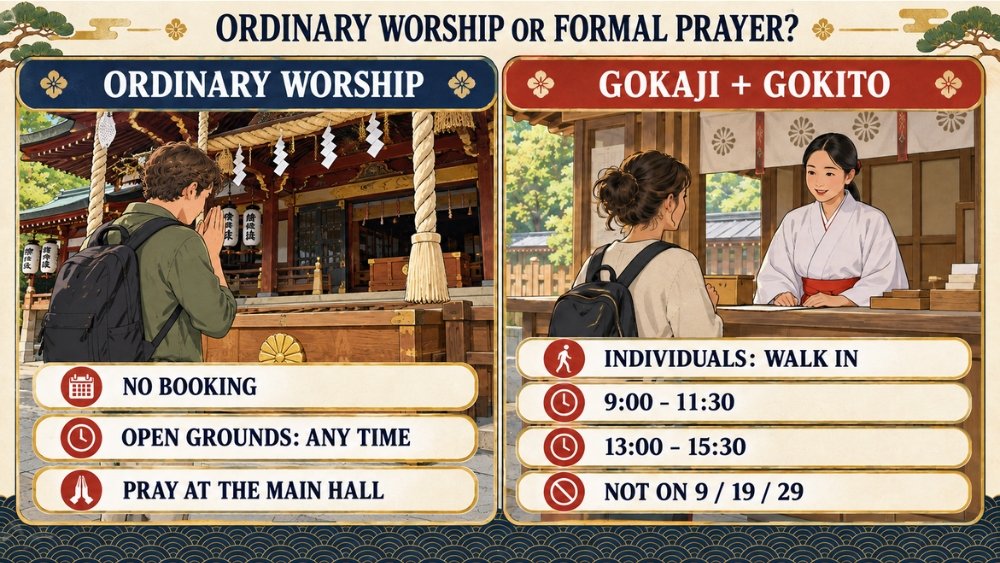
For an individual, advance booking is normally unnecessary. During reception hours you fill in an application, take it to the prayer desk, receive the gokaji or a pre-blessed prayer paper when direct gokaji is unavailable, attend the formal prayer, then collect the sacred item provided at the end. Groups and companies need advance arrangements.
The current main-shrine reception window is 9:00–11:30 and 13:00–15:30, excluding the 9th, 19th and 29th. Ceremonies can change for shrine events, and the shrine posts the following month’s schedule around the middle of each month. Check the formal-prayer page and current schedule before making a special journey.
The shrine’s current standard offering begins at ¥3,500 for one “week.” In this system, that means the application day plus seven further days—eight days of prayer in total. Two weeks are listed at ¥7,000 and three at ¥10,500. Because offerings and procedures can change, use those figures for planning and confirm them on the official page before you go.
Treat amulets as optional, not guaranteed stock
An omamori is a shrine amulet connected with a particular prayer or form of protection. If you want one, visit the main offering office during its published 8:00–16:30 hours, look at the current selection and ask staff about any item whose use is unclear.
Older guides often describe a body-touch amulet called a nade-mamori and give a detailed one-week ritual. The shrine’s current public website does not list that amulet’s availability or current instructions. Do not build the visit around obtaining it, and do not copy an old blog’s method. If it is being offered, follow the packet and the staff’s current explanation.
An amulet is a sacred item, not proof of a medical outcome. Do not stop treatment or delay care because of it. A small amount of yen in cash is useful for offerings and shrine items because payment methods should not be assumed.
Choose between the direct approach and the shopping street
Shin-Ishikiri: the low-friction first visit
Shin-Ishikiri Station is on the Kintetsu Keihanna Line. From Hommachi, take the Osaka Metro Chuo Line east and use a train that continues toward Gakken-Nara-Tomigaoka, following the route display for Shin-Ishikiri. From Umeda, a straightforward plan is the Midosuji Line to Hommachi, then the Chuo Line east.
The station-to-shrine walk is the more direct choice, but keep the official route open because the final streets do not feel like a single ceremonial avenue. Allow at least ten minutes for first-time navigation. If step-free access matters, check the station’s lift information and allow extra time; do not assume that the quickest walking line is barrier-free.
Ishikiri: choose it for the approach
Ishikiri Station is on the Kintetsu Nara Line and suits travelers starting around Osaka-Namba who want the approach to be part of the visit. Check the stopping pattern in the official Kintetsu route planner because train types differ.
From the station, the route descends toward the main shrine through Ishikiri Sando Shopping Street. The official shopping-street site lists food, fortune-telling, traditional medicine, clothing and everyday goods among the mix. This is a lived-in approach rather than a curated mall, and each business sets its own hours. Arriving very early may give you the street without the shops; arriving late may leave shutters down even though the shrine grounds are open.
If you try fortune-telling, check the price, session length and available language before sitting down. It is an optional commercial service, not part of shrine worship. Open the shopping street in Google Maps for the approach, but follow signs and do not block narrow storefronts while checking your phone.
An IC card is a rechargeable transit card such as ICOCA, Suica or PASMO. You tap it at compatible ticket gates instead of buying a separate paper ticket. It makes these ordinary Osaka Metro and Kintetsu journeys easier, but it does not decide which station fits your visit. Osaka Map’s ICOCA guide explains charging, tapping and common first-use mistakes.
Kaminosha is a separate second stop
The Kaminosha, or upper shrine, is not a hidden building behind the main worship hall. It is a separate site at 2-34-14 Kamiishikiri-cho, closer to Ishikiri Station. The shrine’s history connects it with the older worship site on the Ikoma side; the present Kaminosha was re-established in 1972.
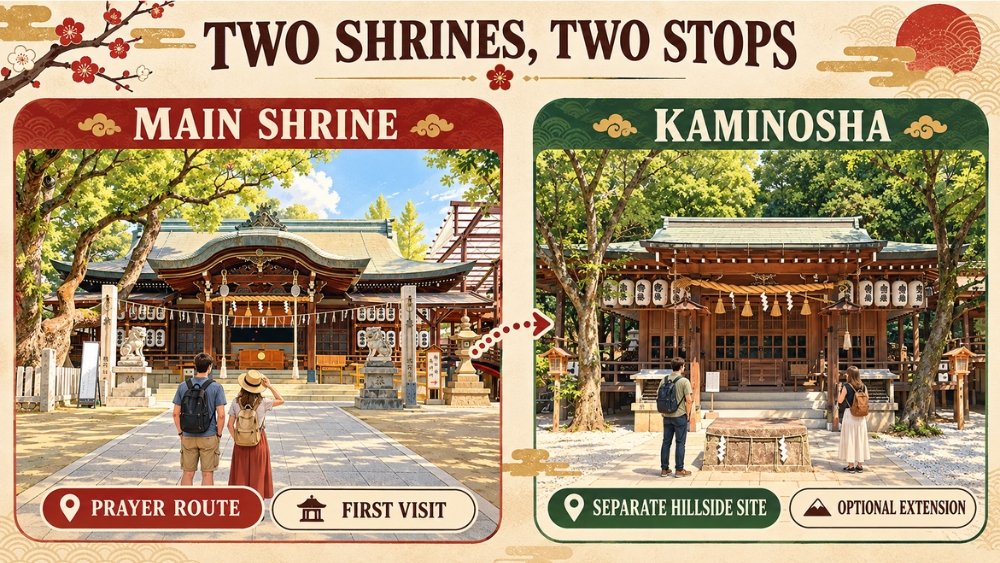
Add it only if you genuinely want a second sacred site and have time for the hillside route. Use the shrine’s official access page rather than drawing a straight line between the two compounds. Its offering office is currently open 8:00–16:00 and closes on the 9th, 19th and 29th. Check Kaminosha in Google Maps separately so you do not mistake it for part of the main grounds.
For a compact trip, visit the main shrine and shopping street and leave Kaminosha for another day. Adding every ritual and both sites can turn a reflective visit into a checklist.
Plan around the service you actually need
If you have 45–60 minutes
Use Shin-Ishikiri, worship at the main hall, observe the ohyakudo route from the side and leave without forcing an extra circuit or shopping detour.
If you want the local approach
Start at Ishikiri Station, allow about two hours, walk through the shopping street and finish at the main shrine. Add food or a shop only when it is open and appealing, rather than treating every sign as a required stop.
If formal prayer is the reason for the trip
Choose the date from the shrine’s current schedule first, arrive well before the end of a reception window and allow time for the application and ceremony. Do not plan around the 9th, 19th or 29th. Bring the name and prayer intention you need to write down, plus enough cash for the current offering.
If you are driving
The shrine asks visitors to use public transport when possible because parking is limited. The current posted charge is ¥300 for the first hour and ¥100 for each additional 30 minutes. The south lot is listed as 24-hour access; the north lot is open 4:00–19:00, with exit still possible for vehicles already inside. Festival and New Year traffic can erase any convenience gained by driving.
Ishikiri-san does not require a dramatic experience. Choose the station that matches your energy, keep the repeated-prayer path clear and let ordinary worship be enough. If you need an amulet or formal prayer, arrive for the relevant daytime service and verify the current schedule. That simple plan respects both the traveler’s limits and the people who come here with deeply personal prayers.