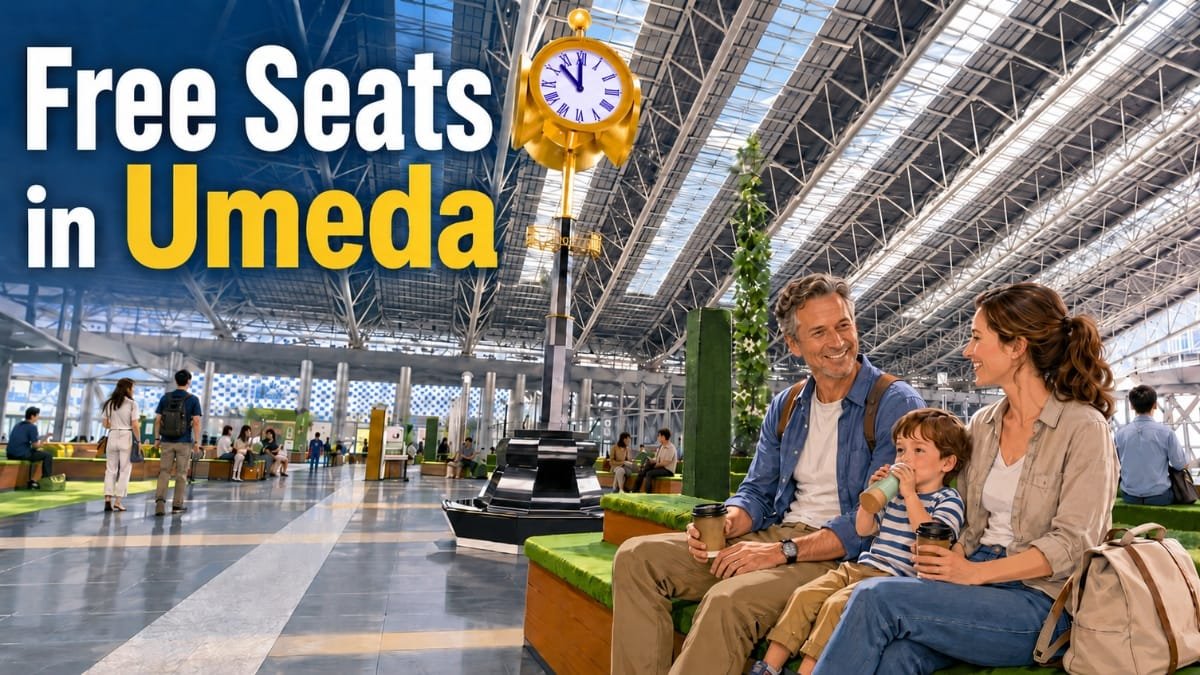
The most reliable free place to sit near JR Osaka Station is Toki no Hiroba on the 5th floor. It is central, covered by the station’s huge roof and open from 8:00 to 23:30. If you want fresh air, continue to the north-side gardens. If you need air-conditioning, stay on your current side of the station and use a clearly marked rest space inside Hankyu or Hanshin department store during building hours.
That last point matters. Umeda is large enough that crossing the district for a supposedly “perfect” bench can make a tired day worse. Choose by your current station side, the weather and how many stairs or lifts you are willing to use.
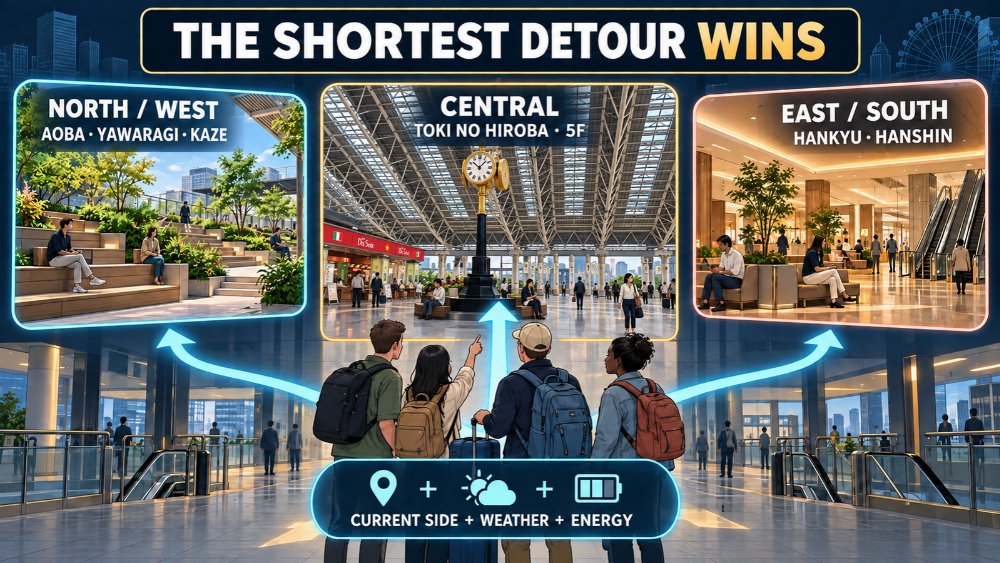
Pick a seat without crossing Umeda
| Free rest spot | Best for | Weather | Important limit |
|---|---|---|---|
| Toki no Hiroba · Map | The easiest central meeting or recovery stop | Covered, but not an enclosed air-conditioned room | 5F; 8:00–23:30; seating can be affected by events |
| Aoba no Hiroba and Midoribe no Oka · Map | A north-west-side outdoor pause near Umekita Green Place | Outdoor | Use only if you are already on the Umekita or west side; no dedicated hours are published on the plaza pages |
| Yawaragi no Niwa · Map | A calmer garden stop without climbing to the roof farm | Outdoor garden | North Gate Building 10F; 7:00–23:30 |
| Kaze no Hiroba · Map | A longer fresh-air break with more open space | Outdoor | North Gate Building 11F; 7:00–23:30; event restrictions are possible |
| Tenku no Noen · Map | A quiet rooftop-garden walk when you still have energy | Outdoor | 14F; 7:00–18:00; stairs only from 11F; no vending machine |
| Hankyu Umeda Main Store 9F · Map | An indoor east-side break around Shukusai Plaza | Indoors | The plaza hosts events, so seats and access vary |
| Hankyu Umeda Main Store 13F · Map | An east-side rooftop pause | Outdoor | Weather, rooftop events and building hours affect use |
| Hanshin Umeda Main Store 4F · Map | A small indoor south-side rest | Indoors | A practical short stop, not a large lounge; follow store hours |
Japanese place names often describe the type of space: hiroba means plaza, niwa means garden, and noen means farm. All of the places above are outside railway ticket gates. No admission or purchase is normally required to use the shared seating, but temporary closures, events and facility rules take priority.
Start with Toki no Hiroba if you are near JR Osaka Station
Toki no Hiroba is the safest default because it sits directly above JR Osaka Station rather than in a separate mall. Escalators and lifts connect the station levels to the 5th-floor bridge plaza. The gold and silver clocks make useful meeting landmarks, and the broad station roof protects the plaza from most rain.
Do not confuse covered with indoors. The plaza is open-sided, so summer heat, winter cold and wind still matter. It is excellent for a five- or ten-minute reset, checking a route or meeting another traveler. On an extremely hot day, an enclosed department-store rest area is more comfortable.
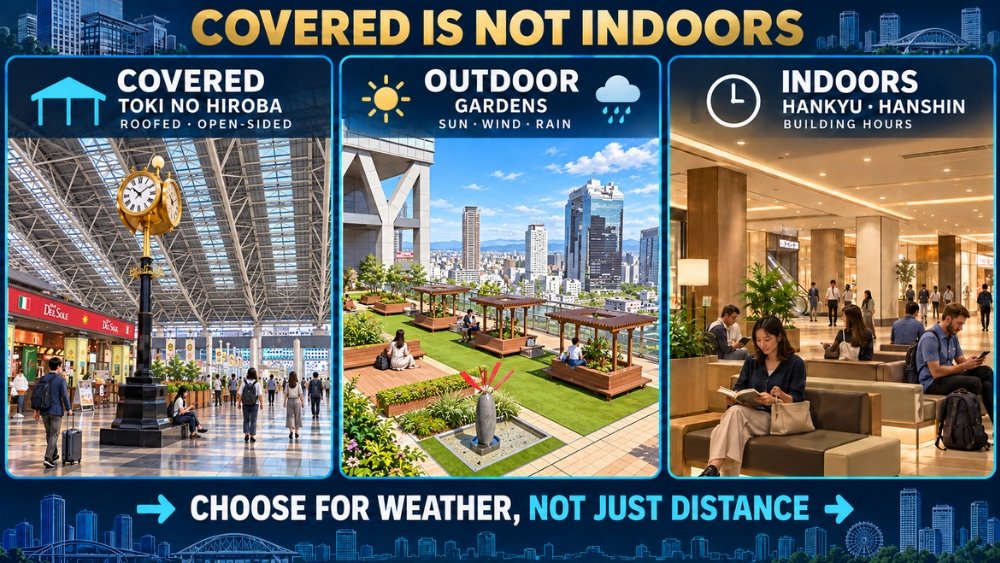
The official hours are 8:00–23:30. The plaza also hosts seasonal displays and events, which can reduce ordinary seating. If every bench is occupied, do not circle the whole station. Move to the closest option on the side you need next.
Use the north-side garden stack for a longer break

Osaka Station City has several elevated gardens in the North Gate Building. They are on different floors and suit different energy levels. The simplest approach is to stop as soon as you find a space that meets your need rather than treating all the gardens as a sightseeing checklist.
Aoba no Hiroba and Midoribe no Oka: useful on the Umekita side
The current Osaka Station City guide identifies Aoba no Hiroba across the 1st to 3rd floors of Umekita Green Place as a space for resting and meeting. Beside it, Midoribe no Oka uses the broad planted staircase as an informal green hillside.
These are sensible choices when you have arrived through the Umekita Underground Gate, West Gate or the newer north-west developments. They are not a reason to cross from the Hankyu side with heavy luggage. The official plaza pages do not publish dedicated opening hours, so treat them as daytime or building-hours options and follow any barriers or event signs you find.
Yawaragi no Niwa: the lower, calmer garden
Yawaragi no Niwa is on the 10th floor of the North Gate Building and is open from 7:00 to 23:30. Its name means “garden of ease” or “garden of calm.” The landscaping uses stone, clipped greenery and seasonal plants to create a quieter atmosphere than the main station concourse.
This is a good compromise when you want a garden setting but do not need a wide skyline view. Osaka Station City’s own reporting has shown tables and benches in this garden area, but furniture and access can change. Think of it as a shared garden with places to pause, not a guaranteed private table.
Kaze no Hiroba: the best open-air reset
Kaze no Hiroba—“Wind Plaza”—is one floor higher on the 11th floor. It combines wooden decks, planting, lawn-like surfaces and several styles of shared seating. It works well for a 20- to 30-minute recovery break, especially when a crowded concourse feels exhausting.
The official hours are 7:00–23:30. This is an exposed elevated space, so choose another option during heavy rain, strong wind or dangerous heat. Osaka Station City sometimes restricts part of Kaze no Hiroba for event setup or operation. Check the latest official notices if this plaza is important to your plan.
Tenku no Noen: only climb if the garden is the point
Tenku no Noen is the rooftop farm on the 14th floor. It is peaceful, but it is not the easiest answer to “Where can I sit now?” Access from the 11th floor is by stairs only, the official hours are 7:00–18:00, and there is no vending machine in the farm.
Visit when you actively want the rooftop garden and can manage the climb. Travelers using a wheelchair, anyone avoiding stairs and groups with heavy suitcases should stop at a lower level. Buy a drink before going up if needed, carry out your rubbish, and leave enough time to descend before closing.
Bad weather: let the nearest department store do the work
For rain, humidity or mid-summer heat, a department-store rest area is often more useful than an outdoor plaza. The trade-off is shorter access: these spaces follow building hours, and event floors may be rearranged.
East side: Hankyu Umeda Main Store
On the 9th floor, Shukusai Plaza is a high-ceilinged event space with broad steps that are commonly used as seating. The official floor guide also marks rest facilities. This is convenient if your next train is from Hankyu Osaka-Umeda Station or you are already east of JR Osaka Station.
The important caveat is in the name: it is an event plaza. Exhibitions, sales and stage programs can occupy the floor, increase crowds or change where sitting is allowed. Check the current Hankyu event schedule before relying on it for a group meeting.
The 13th floor has a rooftop plaza and marked rest facilities. Choose it for fresh air rather than climate control. Beer-garden operations, rooftop events, weather or temporary barriers may affect the usable area.
Hankyu’s main sales floors generally list 10:00–20:00, while restaurant and event areas can differ. Use the official store information for the day’s hours instead of assuming that an upper floor remains open late.
South side: Hanshin Umeda Main Store 4F
Hanshin’s 4th-floor guide marks a rest space among the fashion and café floor. It is not a destination-sized lounge, but it is a useful short indoor pause if you are heading toward Hanshin Osaka-Umeda Station, Higashi-Umeda or the south side of JR Osaka Station.
The store generally lists 10:00–20:00, with exceptions by floor or facility. Because this is retail-floor seating, keep the stop compact and leave priority space for anyone who clearly needs it more.
Do not detour for seating that is not guaranteed
Umeda has many benches that appear, move or disappear as tenant layouts and events change. Grand Front Osaka, LINKS UMEDA, Diamor Osaka and the 2nd-floor Atrium Plaza may offer an incidental place to pause when you are already there, but their current official public guides do not promise a dependable free rest area in the same way as the locations above.
That distinction prevents a common travel mistake: walking ten minutes through an unfamiliar complex because an old article or photo showed a bench. If you can see an available public seat and no sign limits its use, take the short break. If not, return to a verified nearby option or use a café rather than continuing a bench hunt.
Match the seat to your real constraint
If you have a suitcase
Use a wide plaza on the same level as your route, keep the case upright and close, and never block a tactile paving strip, lift door or passage. Toki no Hiroba is usually easier than the rooftop farm. For more than a short pause, hotel storage or a station locker is better than occupying extra seats with bags; locker availability is not guaranteed at busy times.
If step-free access matters
Avoid Tenku no Noen because the final route from the 11th floor is stairs only. For other spaces, use official lift signs rather than copying an escalator route. In Umeda, the nearest visible vertical route is not always step-free. Osaka Map’s Osaka Station area guide explains the separate operators, named gates and building anchors that make these routes easier to plan.
If it is raining or dangerously hot
Choose Hankyu 9F or Hanshin 4F if either store is already on your side. Toki no Hiroba is rain-covered but not fully climate-controlled. Kaze, Yawaragi, Tenku, Aoba and the rooftop plaza should be treated as outdoor choices.
If you need more than a short rest
A free bench is not a substitute for a private lounge, workspace or café table. If you need a meal, a long conversation, charging or an hour of laptop work, choose a paid venue. Compare calm daytime options in the Umeda scenic café and lunch guide. After department stores close, the Umeda night café guide is more realistic than searching dark upper floors for a bench.
Use free seating as shared space
“Free” means no admission or purchase is normally required; it does not mean the seat becomes a private base. A few habits keep these spaces usable:
- take one seat per person and keep luggage close rather than spreading it across a bench;
- use headphones and keep calls brief and quiet;
- do not sleep, lie across seats or hold a long online meeting;
- eat only where the facility permits it, and carry away all rubbish;
- keep children within reach in open or elevated areas;
- follow staff instructions, event barriers and temporary closure signs; and
- offer accessible or easy-to-reach seats to people who need them more.
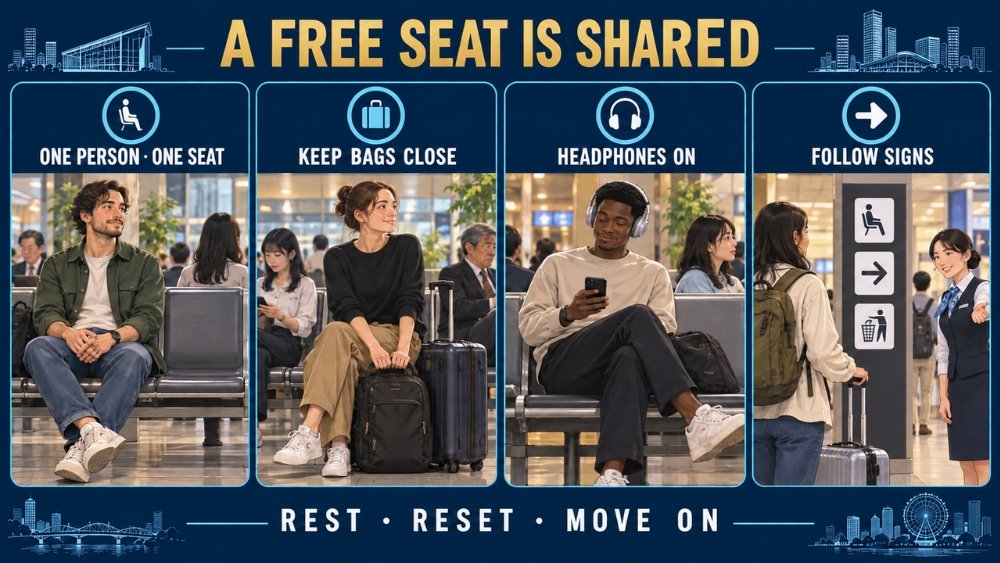
You do not need to collect every rest spot in Umeda. For a quick central pause, use Toki no Hiroba. For fresh air on the north side, stop at Yawaragi or Kaze and climb to Tenku only if the garden itself is worth the stairs. For bad weather, choose the department store already on your route. The best free seat is usually the one that lets you recover without creating another journey.