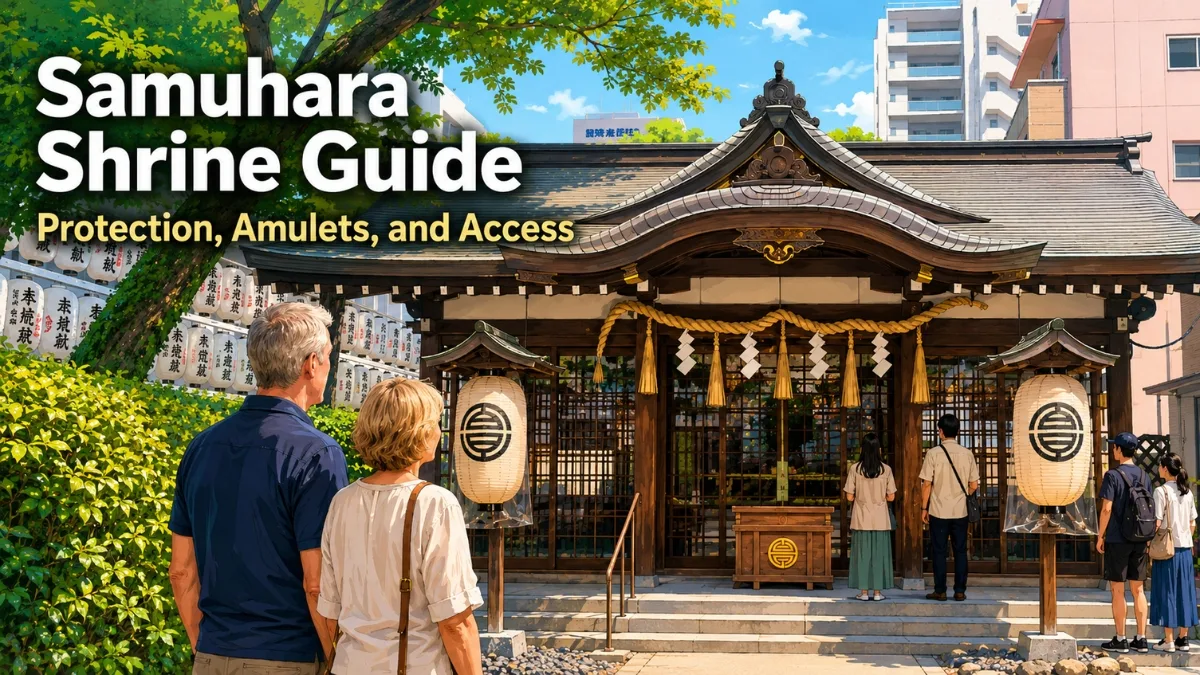
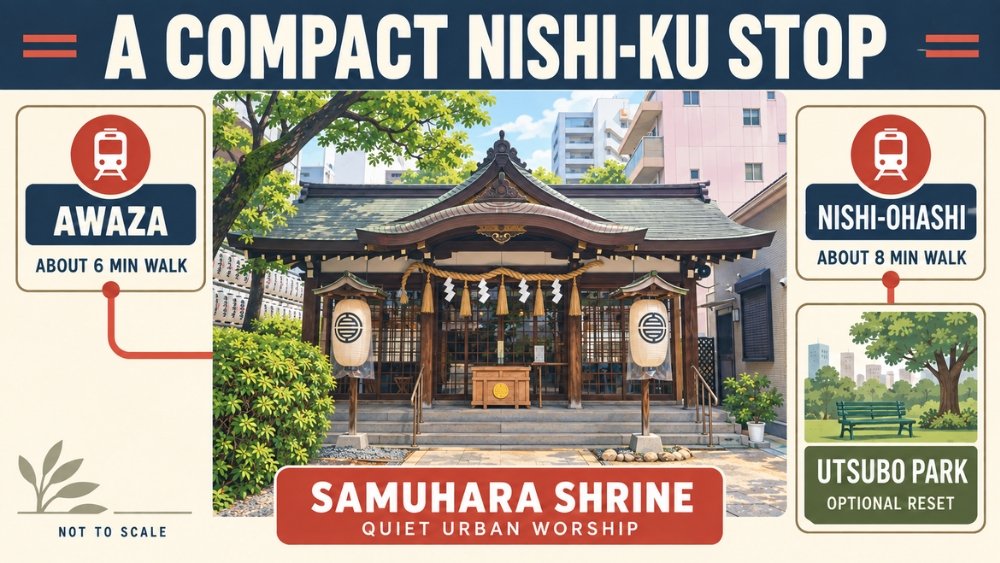
Samuhara Shrine is a compact urban Shinto shrine in Osaka’s Nishi Ward, about a six-minute walk from Awaza Station or eight minutes from Nishi-Ohashi Station. It is best approached as a quiet place to pray for protection and safety—not as a shop where a famous ring is guaranteed to be available.
The shrine’s current notice says applications for its Goshinkan ring have been temporarily closed since late November 2025. Ordinary worship remains open, and the small scale makes Samuhara easy to add to a central Osaka day without turning it into a major detour.
Samuhara Shrine at a glance
| Plan around | What to know |
|---|---|
| Location | 2-5-26 Itachibori, Nishi Ward, Osaka |
| Best for | A calm, focused prayer for protection, travel safety, family safety or health |
| Nearest stations | About 6 minutes on foot from Awaza; about 8 minutes from Nishi-Ohashi |
| Ordinary worship | Welcome without a reservation |
| Formal prayer | Contact the shrine in advance; formal prayers are not offered on Wednesdays |
| Goshinkan ring | Applications are temporarily closed; applicants without an address in Japan are not accepted |
| Other amulets | Several protective and traffic-safety amulets are normally listed by the shrine; selection can change |
| Time needed | Usually a short visit unless you have arranged a formal prayer |
| Not the same place | The Okunomiya is a separate rural sanctuary in Tsuyama, Okayama Prefecture |
For current notices, use the official Samuhara Shrine website. For the last part of the walk, open Samuhara Shrine in Google Maps.
Why Samuhara feels different
Samuhara does not have the monumental grounds of Osaka’s largest shrines. A stone torii leads into a compact courtyard surrounded by the modern city, and the worship hall is close enough that the visit feels immediate and personal. That contrast is part of its character: busy streets are only moments away, but the atmosphere inside is restrained.
The shrine enshrines three deities associated with creation in Shinto tradition: Amenominakanushi Ōkami, Takamimusubi Ōkami and Kamimusubi Ōkami. Its unusual name is written with sacred characters historically treated as protective symbols against calamity and injury. The modern Osaka shrine traces its tradition to the Tsuyama area of Okayama; the Osaka branch was established after the war and moved to its present Itachibori location in 1961.
Online descriptions sometimes call Samuhara “scary,” “intense” or a place that only certain people are “called” to visit. Those phrases are better understood as expressions of awe and personal belief, not warnings that the shrine is dangerous or that an ordinary visitor needs a supernatural invitation. You can visit respectfully whether or not you feel a dramatic spiritual response.
Prayers for health or safety are religious acts, not guarantees of an outcome and not substitutes for medical care, insurance or ordinary travel precautions.
Visit for prayer, not the ring
Samuhara is widely associated with the Goshinkan, a silver protective ring. That fame can distort expectations. The shrine describes the ring as a sacred item connected with protection, not a fashion accessory or a collectible to be bought and resold.
The official Goshinkan notice currently states that:
- applications have been temporarily closed since the end of November 2025;
- production takes considerable time;
- people without an address in Japan cannot apply; and
- the shrine does not take written reservations for the ring.
In practical terms, an international traveler should not plan a visit around obtaining a Goshinkan. Do not rely on old blog posts, marketplace listings or social posts that imply it is a same-day souvenir. Check the shrine’s own notice again shortly before visiting because the application system may change.

The shrine lists other protective items, including a coin-shaped personal amulet and traffic-safety amulets. Availability and offering amounts can change, so ask calmly at the shrine office rather than treating any particular item as assured. If no item is available or suitable, the visit is still complete: worship itself is the purpose.
A quiet visit sequence
You do not need specialist knowledge to pray at Samuhara. A simple sequence is enough:
- Bow once before passing through the torii gate.
- Walk in calmly and avoid blocking the approach or shrine office.
- At the worship hall, place a coin in the offering box if you wish.
- Bow twice, clap twice, make your prayer silently, then bow once more.
- Step aside before checking your phone or deciding what to do next.
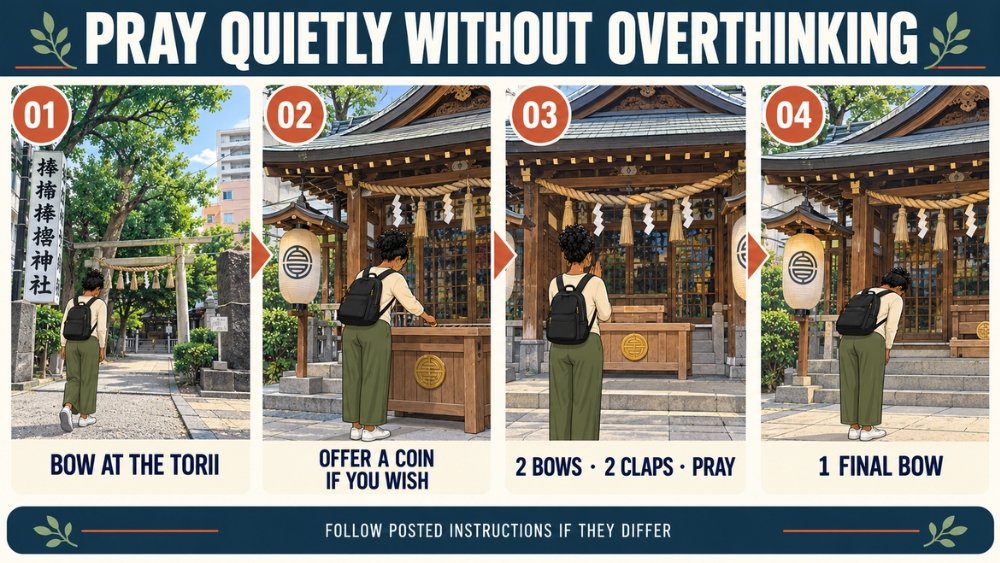
Follow any instructions posted at the shrine if they differ from this general Shinto pattern. Keep voices low, ask before photographing people or a staffed counter, and do not handle sacred objects or cross barriers. The grounds are small, so a tour group, tripod or extended photo session can obstruct other worshippers quickly.
Ordinary worship does not require a booking. A formal prayer—a ceremony conducted by shrine staff—is different. The shrine asks visitors to make contact in advance, and formal prayers are not available on Wednesdays. Its worship information lists prayers for matters such as family safety, freedom from accidents, traffic safety, travel safety, health and recovery. Contact the shrine directly if you need to confirm the ceremony, language support, offering or arrival procedure.
Choose the station that fits your route
Samuhara sits between two useful Osaka Metro approaches:
- Awaza Station: about six minutes on foot. Awaza is served by the Chuo Line and Sennichimae Line. It is the simplest choice from Namba on the Sennichimae Line or from Hommachi on the Chuo Line.
- Nishi-Ohashi Station: about eight minutes on foot. It is useful when you are already traveling on the Nagahori Tsurumi-ryokuchi Line.
From Umeda, a straightforward option is to take the Midosuji Line to Hommachi and transfer to the Chuo Line for Awaza. Check the official Osaka Metro route and station information on the day, especially if an elevator or step-free route matters.
An IC card is a rechargeable transit card such as ICOCA, Suica or PASMO. You tap it at the ticket gates instead of buying a separate paper ticket for each eligible journey. The major cards are interoperable on Osaka Metro, so visitors arriving with one from another Japanese city can usually keep using it.
The last streets are ordinary city blocks rather than a dramatic temple approach. Keep your map open, watch for the stone torii, and allow a few extra minutes if it is your first walk through Itachibori.
Osaka shrine and Okayama Okunomiya are different visits
The shrine’s Okunomiya—an inner or associated sanctuary—is not hidden behind the Osaka worship hall. It is a separate rural destination in the Kamo area of Tsuyama, Okayama Prefecture.
| Samuhara Shrine in Osaka | Samuhara Okunomiya in Okayama | |
|---|---|---|
| Setting | Compact urban shrine in Itachibori | Rural, wooded sanctuary in Tsuyama |
| Practical access | Walk from Osaka Metro | The shrine recommends traveling by car |
| Staffing | Shrine office at the Osaka site | No priest is normally stationed on site |
| Best use | Short, respectful stop within an Osaka day | Separate destination requiring advance transport planning |

Do not add the Okunomiya to an Osaka itinerary as though it were a nearby annex. If it is genuinely your destination, read the official Okunomiya access notes first and use Google Maps for the Tsuyama site. The official page warns that some navigation searches can lead toward the wrong mountain road; it provides a neighboring address to use when the sanctuary’s address is not recognized.
Add Utsubo Park only if you want a slower finish
If you would like somewhere to decompress after the shrine, Utsubo Park is a natural optional continuation through Nishi Ward. It works better as a flexible walk or rest stop than as another item to rush through.
Travelers interested in a larger, more expansive shrine experience can instead compare Samuhara with Osaka Map’s guide to the best shrines in Osaka or plan a separate visit using the Sumiyoshi Taisha guide.
Samuhara is most rewarding when the plan stays simple: choose the station that suits your route, arrive for a quiet prayer, and let any amulet be secondary. That expectation matches the shrine as it exists today—and avoids turning a small place of worship into a ring-hunting stop.