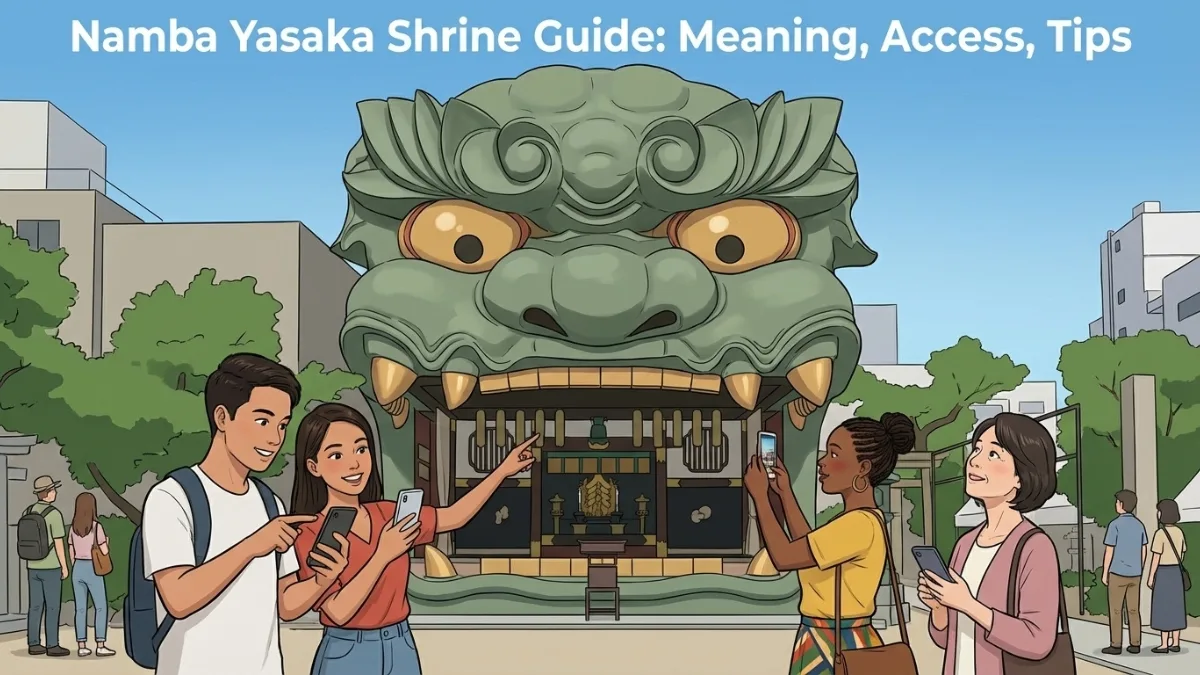
Namba Yasaka Shrine is one of the easiest meaningful shrine visits to add to a day in central Osaka. It is close to Nankai and Osaka Metro Namba, free to enter, and compact enough for a 25–40 minute visit. The giant lion-head building is the reason many people come, but this is an active Shinto shrine rather than a photo set: visit the main hall, pray quietly if you wish, then take time to understand the lion stage.
The simplest plan is to arrive during daylight, bring a few coins or small notes, and use the shrine’s exact map pin for the last part of the walk. Published walking estimates begin at different station exits or gates, so allow more time than the shortest number suggests.
| Plan around | Practical answer |
|---|---|
| Address | 2-9-19 Motomachi, Naniwa-ku, Osaka 556-0016 |
| Time on site | About 25–40 minutes; longer during a ritual or festival |
| Gate access | Normally 6:00 a.m.–5:00 p.m.; special New Year and festival hours can differ |
| Admission | Free |
| Best starting points | Nankai Namba; Osaka Metro Namba on the Midosuji or Yotsubashi Line; Daikokucho |
| Official information | Namba Yasaka Shrine |
| Map | Namba Yasaka Shrine on Google Maps |
Choose the right Namba starting point
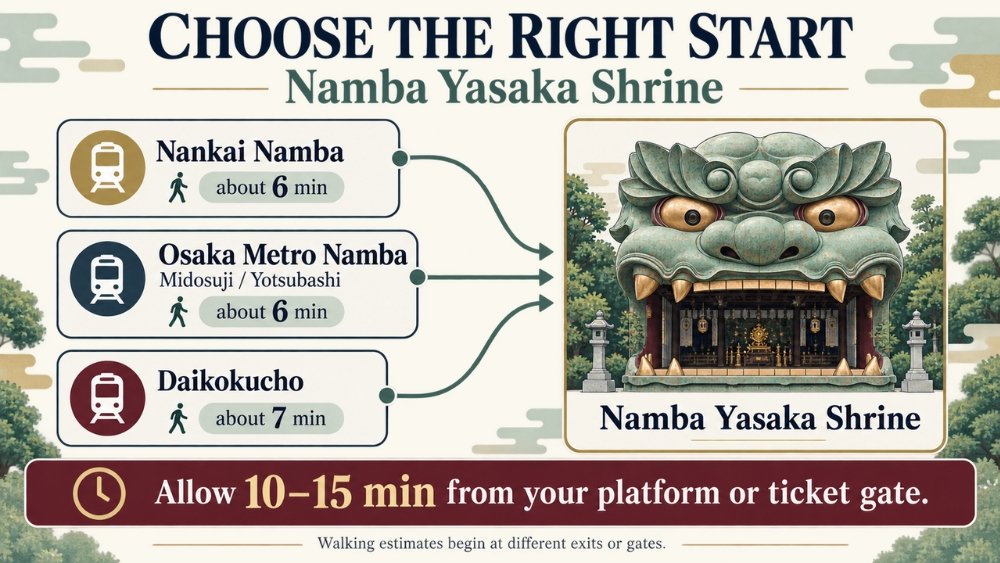
“Namba Station” is not one doorway. Nankai, Osaka Metro, JR, Kintetsu and Hanshin all use Namba or Osaka-Namba names in a wide station district. The shrine’s official access page gives approximate walks of six minutes from Nankai Namba, six minutes from Osaka Metro Namba on the Midosuji or Yotsubashi Line, and seven minutes from Daikokucho. Nankai’s own station guide lists the shrine as about 10 minutes from its station. These figures are not truly contradictory: they start at different gates or street points.
For a first visit, budget 10–15 minutes from the platform or ticket gate, especially inside the larger Namba complex. Reach street level, confirm that you are heading toward Motomachi, and then follow the exact map pin. If you arrive at JR Namba or Osaka-Namba for Kintetsu or Hanshin, do not assume the six-minute estimate applies; those facilities begin farther west or north.
An IC card—a rechargeable tap-to-pay transit card such as ICOCA, Suica or PASMO—works for ordinary rides on Osaka Metro and Nankai where accepted. It pays the train fare, not anything at the shrine. See our ICOCA guide for Osaka if this is your first time using one.
What the giant lion stage actually means
The famous structure is the Shishiden, or lion stage. It is not the shrine’s main worship hall. The shrine says it stands 12 metres high, 7 metres wide and 7 metres deep and was completed with the present main hall in May 1974. The open mouth forms a performance stage used for offerings of music, dance and martial arts during events.
Look closely rather than taking only one front-facing photograph. The lion has 24 teeth; its eyes function as lights and its nose contains speakers. Hand-carved phoenix panels decorate the coffered ceiling inside the mouth. The hall enshrines the ara-mitama of Susanoo-no-Mikoto—often explained as the deity’s vigorous or active aspect.
The shrine describes the great mouth as calling in victory, swallowing evil and inviting good fortune in competition and business. Visitors also pray for learning, employment, entrance examinations and company development. Treat these as the shrine’s living beliefs, not as a guaranteed result from taking a photograph.

The shrine’s exact founding date is unknown. Its own history says it was traditionally called Naniwa Shita-no-Miya and served as a guardian shrine for the Namba area. The present main hall is a postwar reconstruction, while the lion stage was completed alongside it in 1974. The worship and local festivals connect both modern buildings to a much older religious history.
Follow a respectful 25–40 minute visit
You do not need to be Shinto or know Japanese to visit. A calm sequence is enough:
- Pause at the torii gate. A small bow is customary before entering. Walk without blocking the central approach, which is traditionally treated as the way for the kami, the sacred beings worshipped in Shinto.
- Use the purification basin if it is open. Follow the posted method and avoid drinking directly from a ladle. If the basin is closed or has a different contact-free system, simply follow the arrangement in front of you.
- Visit the main hall before making the lion stage your photo stop. An offering is optional. The usual shrine pattern is two bows, two claps, a quiet prayer or thanks, then one final bow.
- View the lion stage from the courtyard. Give worshippers room, keep voices low and do not step onto the performance area unless a sign or staff member clearly permits it.
- Use the shrine office only if you need it. The office is west of the main hall and handles formal prayer enquiries. Charms (omamori), wooden wish plaques (ema), paper fortunes (omikuji) and a calligraphic shrine seal (goshuin) may be available while the counter is staffed.
- Bow once more when leaving if you wish.

The gate can be open when the office is not. The official site does not publish one permanent English reception timetable for every counter service, so do not arrive near closing if a goshuin or charm is important. Check the latest shrine notices or call +81-6-6641-1149 before making a special trip for a staffed service or formal prayer.
Bring small-denomination cash. Do not assume that the office accepts cards, that a particular lion-themed item is in stock, or that a goshuin will always be written directly into your own book. Procedures can change with staffing, ceremonies and busy dates.
Photos, luggage and accessibility
Photographing the lion stage from the courtyard is a normal part of many visits, but let shrine use come first. Avoid close photographs of strangers praying, do not hold a long photo session in the main approach, and obey any temporary no-photography sign. Earlier in the day may give you more room, but it is not a promise of an empty courtyard.
The grounds are compact and do not publish visitor luggage storage. Leave a suitcase at your hotel or use suitable station storage before walking over; locker availability is never guaranteed. The shrine also does not publish a detailed English step-free route or accessibility guide. If gate width, surface conditions or restroom access will determine whether you can visit, call the shrine before travel rather than relying on a general map.
Event days change the experience
On an ordinary day, Namba Yasaka is a short neighborhood shrine visit. Two annual periods are very different:
- Tug-of-War Ritual — third Sunday of January: the shrine makes a great rope in the form of the eight-headed, eight-tailed serpent from the Susanoo myth, draws it in the year’s auspicious direction and prays for protection, livelihood, household safety and business prosperity. The shrine says the rite has long historical roots and was designated an Osaka City intangible folk cultural property in 2001.
- Summer Festival — July 13 and 14: the evening festival is held on July 13 and the main festival on July 14. Processions and performances take place, and a boat procession is held on the Dotonbori River as part of the festival tradition.
These can be rewarding dates if the ritual itself is your reason to go. They are poor choices if you want a quick, quiet photograph on a rigid schedule. Confirm the year’s programme on the official festival calendar because event access, timing and crowd movement can change.

Make it part of a Namba half day
The shrine does not need a cross-city itinerary of its own. Pair it with one nearby interest:
- For a slower break, continue to Namba Parks and its elevated garden areas. Open Namba Parks in Google Maps.
- For kitchen knives, cookware, tableware and food-sample shops, walk toward Sennichimae Doguyasuji Shopping Street. Open Doguyasuji in Google Maps.
- For a broader explanation of Namba, Dotonbori and Shinsaibashi, use our Osaka Minami area guide.
If you are choosing between Osaka shrines, Namba Yasaka is the compact, high-impact option. Sumiyoshi Taisha is the more substantial visit and needs considerably more time. Our 10 best shrines in Osaka guide compares the practical fit.
Namba Yasaka works best when you give it a little more respect than a landmark photo: choose the correct station side, visit the main hall, understand why the lion is also a sacred performance stage, and leave enough flexibility for the shrine’s real religious life to continue around you.