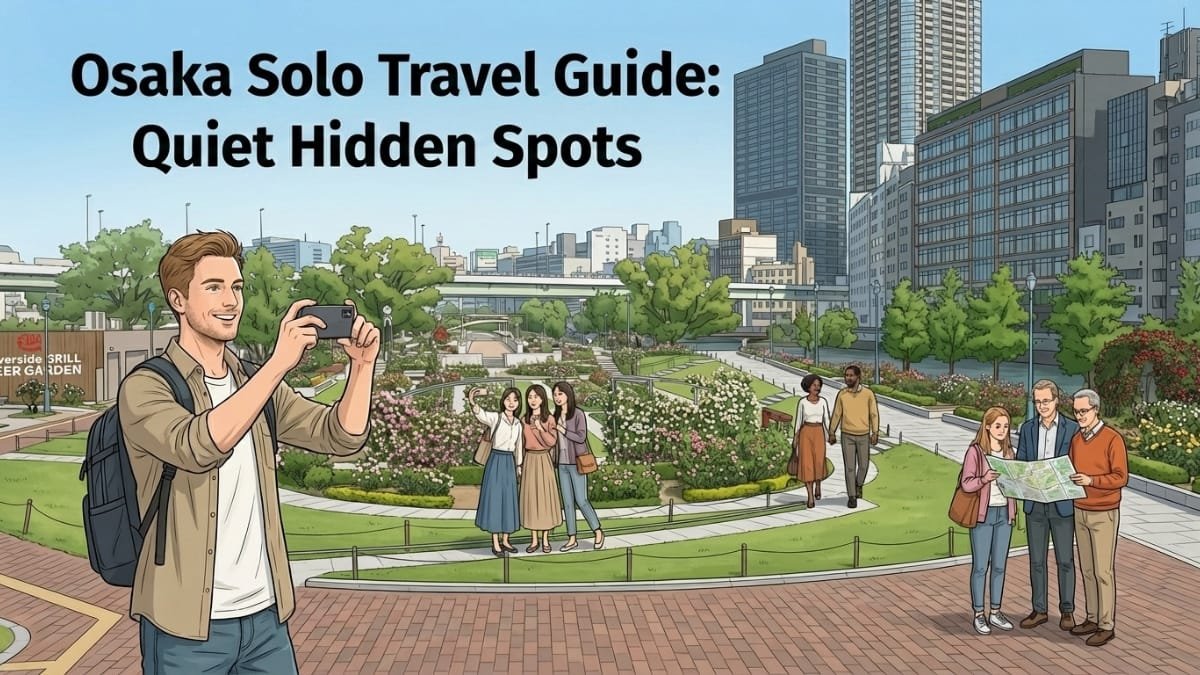
Osaka is easy to enjoy alone once you stop treating it as a race between landmarks. For a calmer first visit, choose one area for each half day, give yourself one place you genuinely want to see, and keep the rest flexible.
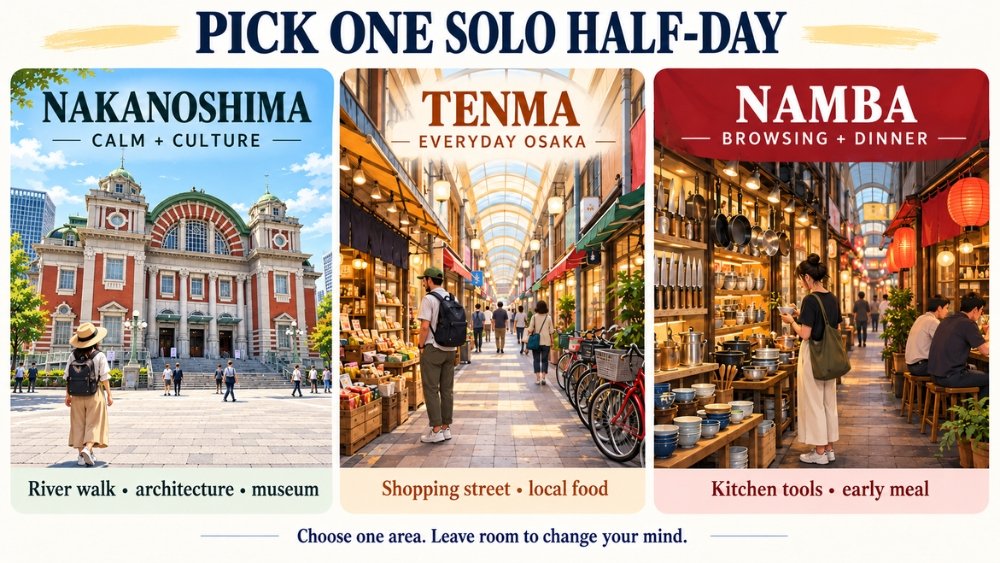
The best first choice is Nakanoshima for riverside walking, architecture, and museums. Choose Tenma for an everyday shopping street and casual food, or Namba for kitchenware browsing followed by an early dinner. None of these areas is a secret or guaranteed to be silent. Their advantage is that you can slow down, change the plan, and leave when your energy runs out.
| Area | Best for | A comfortable half day | Important trade-off |
|---|---|---|---|
| Nakanoshima | The calmest first choice; rivers, architecture, art | Park and historic buildings, plus one museum | Museums and the library have different closed days |
| Tenma | Everyday Osaka, a covered shopping arcade, casual meals | Walk part of Tenjinbashisuji and stop when something interests you | It becomes lively around meal times; the full street is much longer than you need |
| Namba | Compact browsing and an easy transition into dinner | Doguyasuji, a break, then an early meal | Convenient rather than quiet; evenings become busier |
If you want places that feel quieter still, see our guides to quiet places in Osaka and less obvious local spots. This guide focuses on routes that are realistic for a solo traveler on a first visit.
Nakanoshima: the easiest calm half day
Nakanoshima is a long island between the Dojima and Tosabori rivers. Its eastern end combines a public park, two early-20th-century civic buildings, and a ceramics museum in a compact area. It is central without feeling like a shopping district.
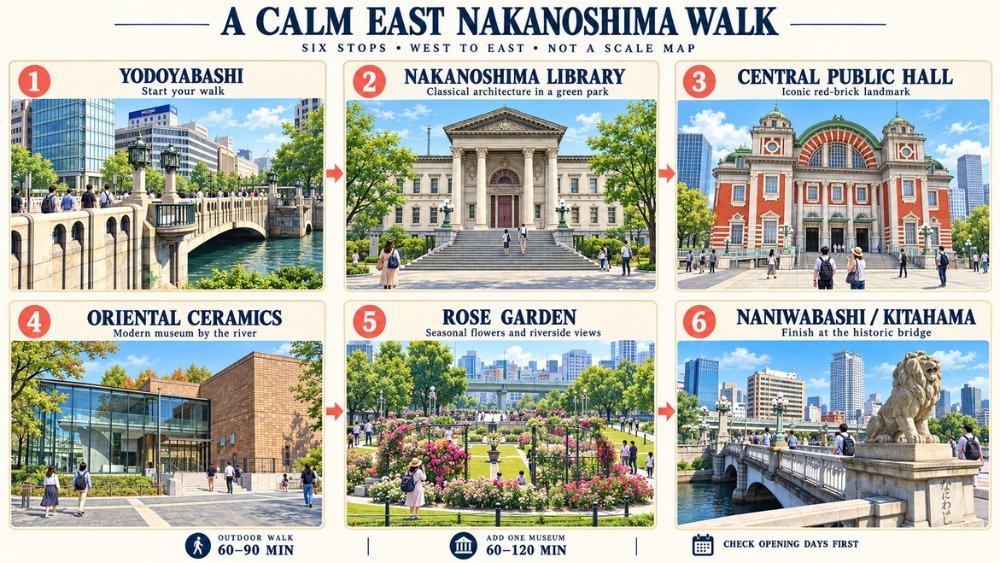
Start from Yodoyabashi Station. The Osaka Prefectural Nakanoshima Library is about 300 meters northeast of Exit 1. The main building dates from 1904, with a columned stone entrance and a domed central hall. It is still a working library, not an attraction built only for visitors, so keep your voice low and follow any photography signs.
The official library hours are 9:00 a.m.–8:00 p.m. Monday to Friday and 9:00 a.m.–5:00 p.m. Saturday. It closes on Sundays, national holidays, the second Thursday of March, June and October, and during the year-end/New Year period. Check the current calendar before making the interior your anchor. Open the library in Google Maps.
Immediately east is the red-brick Osaka City Central Public Hall. The exterior is worth seeing even when you do not enter. The building is an active event facility: its published opening hours do not mean that every hall or historic room is freely open for sightseeing. Check the official news page if a guided interior visit matters to you. Open the public hall in Google Maps.
Continue through the park to the Museum of Oriental Ceramics, Osaka. Current general hours are 9:30 a.m.–5:00 p.m., with last admission at 4:30 p.m. It normally closes on Mondays, the day after a Monday national holiday, over the year-end/New Year period, and between exhibitions. The current adult general-admission price is ¥1,600, but exhibition schedules and prices can change. Open the museum in Google Maps.
Finish with the rose garden and riverside paths, then leave from Naniwabashi or Kitahama. The outdoor part can take 60–90 minutes at an unhurried pace. Add 60–120 minutes for one museum.
If modern art is the priority, do not force it into the same short loop. The Nakanoshima Museum of Art, Osaka and the National Museum of Art, Osaka are farther west. Both currently open at 10:00 a.m. and normally close on Mondays; ticket prices depend on the exhibition. Choose one western museum as the day’s anchor, then add a river walk. Trying to cover the eastern buildings and both western museums turns a calm day into a long checklist.
A simple Nakanoshima plan
- Arrive at Yodoyabashi and find the library.
- See the library and public hall exteriors; enter only where public access is clear that day.
- Choose the ceramics museum or continue outdoors through the park.
- Stop for coffee or a bench break before deciding whether to add anything else.
On hot, cold, or rainy days, reverse the emphasis: make one museum the anchor and treat the outdoor walk as the optional part.
Tenma: local shopping without walking the whole arcade
Tenjinbashisuji Shopping Street is a shotengai—a traditional Japanese shopping street, much of it covered. It runs for roughly 2.6 kilometers through several neighborhoods. That length is useful because you can enter and leave at different stations; it is not a challenge you need to complete.
For a first visit, begin around Minamimorimachi / Osaka Tenmangu and walk north, or start at Tenjinbashisuji 6-chome and walk south. Browse a manageable section, look at ordinary food shops and household stores, and stop for lunch when you find a place that feels comfortable. The shopping-street associations list shops and events on the official Tenjinbashisuji 1–3-chome site. Individual businesses keep their own hours and closed days, so the arcade itself being accessible does not mean every shutter will be open. Open Tenjinbashisuji in Google Maps.
The original route paired the street with the Osaka Museum of Housing and Living. That museum is normally a strong indoor anchor, but its official site states that it is closed for renovation from September 1, 2026 through January 5, 2027. Do not build a current trip around it. Recheck the museum’s official visitor page because construction dates can change.
During the closure, the better Tenma plan is simpler: walk one section of the arcade, take a café or lunch break, then decide whether to continue toward the next station. Tenma is more everyday and less polished than Nakanoshima, but it is not always quiet. Lunchtime, dinner, and event days bring more foot traffic.
Namba: kitchenware first, dinner second
Namba is the least quiet of the three choices, yet it works well alone because the route is compact and there is no pressure to stay for a fixed amount of time.
Begin at Sennichimae Doguyasuji Shopping Street, a covered arcade specializing in cooking tools. Shops sell knives, pots, tableware, lacquerware, noren fabric curtains, restaurant signs, and realistic food samples. Noren are short fabric dividers hung across a shop or restaurant entrance. Store hours and closed days vary, so visit in the late morning or afternoon rather than assuming the whole street opens early. Open Doguyasuji in Google Maps.
Browse slowly and ask before photographing inside a small shop. If you buy a kitchen knife, ask the shop to package it safely and check your airline and airport-security rules before packing; do not assume it can travel in hand luggage.
After Doguyasuji, choose one low-effort continuation:
- take a break in or around Namba Parks;
- continue to a specific shop you already saved;
- eat an early dinner around Ura-Namba before the evening crowd builds;
- end the route and return to your hotel.
You do not need to add Dotonbori just because it is nearby. If that is a separate priority, our Namba at night guide will help you plan it as a deliberate evening rather than an accidental extension of an already long day.
Quiet alternatives when the three main routes do not fit
The original guide included several useful alternatives. Keep them as substitutes, not as extra stops to collect.
Utsubo Park works well if you are staying near Hommachi. It has long paths and a rose garden, and it is easier to use as a slow morning or decompression stop than as a major attraction. Open Utsubo Park in Google Maps.
Kema Sakuranomiya Park offers a long riverside walk along the Okawa River. Outside cherry-blossom season it can feel spacious; during peak bloom it becomes a major seasonal destination, so do not choose it for guaranteed quiet. Open Kema Sakuranomiya Park in Google Maps.
Tsuruhashi Market is better for narrow lanes and market energy than for silence. Choose it only if that liveliness is what you want. Sakai City Hall’s 21st-floor observation lobby is a more substantial side trip and makes sense when you are already exploring Sakai; it is not an efficient add-on to a central Osaka half day.
The Bay Area viewpoints from the original article can also provide space, but the travel time changes the character of the day. Save them for an itinerary already built around Osaka Bay rather than crossing the city only to make a list longer.
How to eat alone without overthinking it
Eating alone is common in Osaka’s ramen, udon, curry, sushi, café, and casual bar settings. The easiest venue is usually one with visible counter seats, a clear queue, and a menu you can understand before entering.
At a small restaurant:
- Wait at the entrance until staff indicate a seat; do not choose a stool automatically unless the shop clearly uses open seating.
- Follow that shop’s order system. Some use a ticket machine before you sit, while others use a paper menu, tablet, QR code, or spoken order.
- Keep a backpack or suitcase out of the aisle. Large luggage is better left at your hotel or in suitable station storage, but locker availability is never guaranteed.
- Expect each diner to order something where the menu or staff requires it.
- Carry some cash. Card and mobile-payment acceptance varies, especially at small independent places.
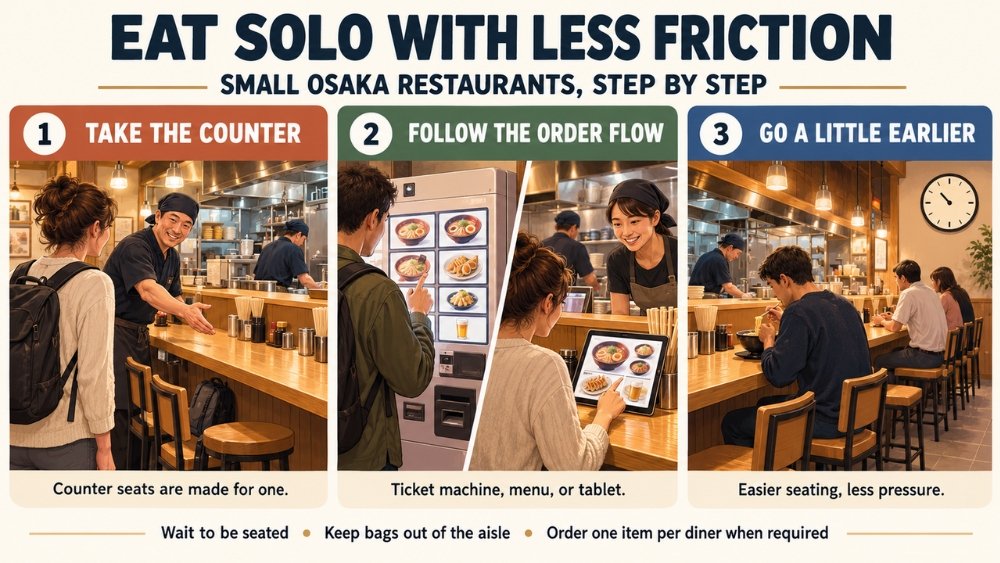
An early lunch or dinner often feels easier because more counter seats may be open and staff are not yet handling the busiest rush. If you want a dependable choice near your accommodation rather than a food-area crawl, see our guide to eating near Osaka Station.
Build flexibility into the route
The most useful solo itinerary has four parts: one anchor, one flexible stop, one meal, and an easy exit. The anchor is the place you would regret missing. The flexible stop can be shortened or dropped. The meal prevents tiredness from making every later decision harder. The exit is the station, hotel, or next reservation you can reach without improvising across the city.
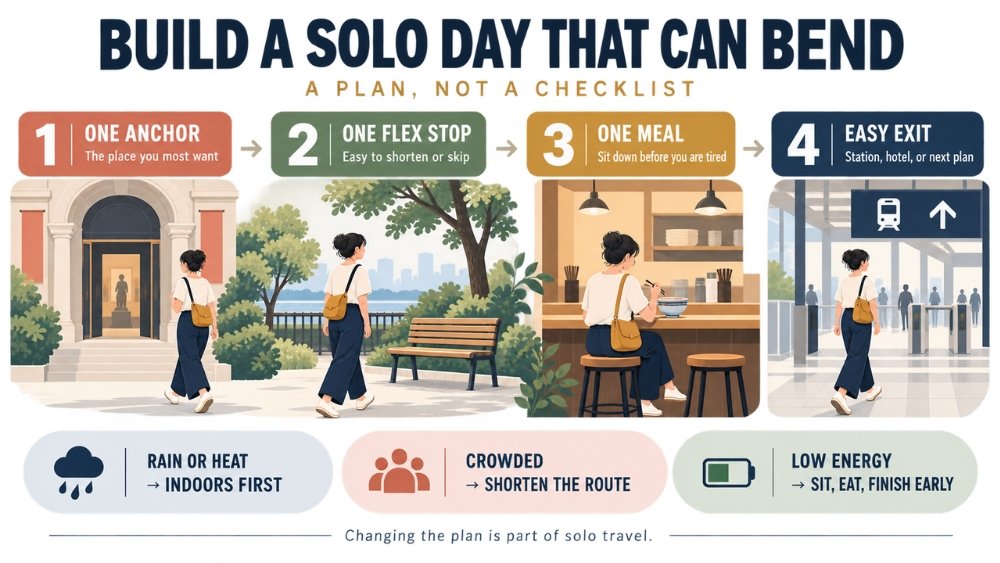
Before leaving in the morning, check the weather and the official calendar for the anchor. Museums can close between exhibitions, libraries close on particular holidays, and special events can make an otherwise calm park or shopping street busy. Save each place in your map app, but do not schedule every minute.
For ordinary trains and subways, an IC card such as ICOCA, Suica, or PASMO lets you tap through compatible gates instead of buying a separate fare each time. Our ICOCA guide explains the basics. Keep the card separate from other contactless cards when tapping.
A share cycle can help between some neighborhoods, but it adds another system to manage. With HELLO CYCLING, check the app for an available bicycle and a valid return station; the service lets users reserve a return port shortly before arrival because stations can fill. Use a bicycle only if you are comfortable with local traffic and parking rules. For a first solo day, walking plus the Metro is usually simpler.
A realistic first solo day
If this is your first day in Osaka, start with Nakanoshima in the morning. Walk the eastern loop, choose one museum only if it genuinely interests you, and eat before you become tired. Return to the hotel for a break or continue to one evening area—not three.
On another half day, choose either Tenma for everyday shopping-street life or Namba for kitchenware and dinner. Quiet does not have to mean empty, remote, or undiscovered. In Osaka, it often means choosing a route where you can hear yourself think, understand what you are seeing, and change direction without inconveniencing anyone else.