The best hidden local spots in Osaka are not necessarily secret. They are places where the city changes pace: a shrine approach used by worshippers, a working market beside a station, a shopping arcade built around everyday errands, or a riverside district that feels calm between commuter hours.
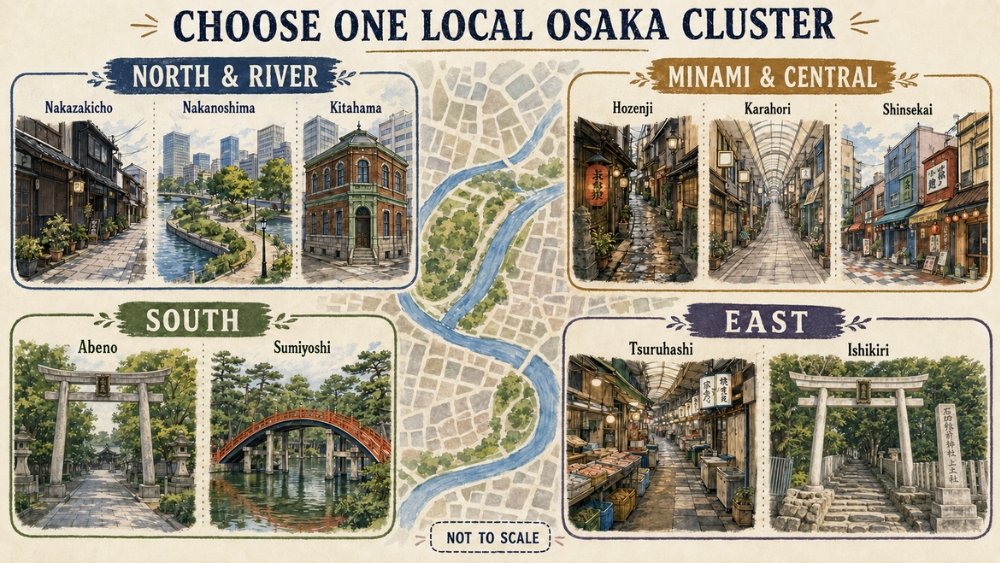
For a first trip, the smartest plan is to choose one local-feeling area near the major district already in your day. Nakazakicho fits naturally with Umeda. Hozenji and Karahori work from Namba. Abeno and Shinsekai pair with Tennoji. Sumiyoshi, Tsuruhashi, and Ishikiri are better treated as deliberate southern or eastern outings.
This guide keeps the original ten choices, but makes each one usable with a best time, a realistic time block, an official information source, and an exact Google Maps pin.
Quick answer: which local Osaka area should you choose?
| Choose this place | Best for | Best window | Sensible time block | Pair it with |
|---|---|---|---|---|
| Sumiyoshi Taisha | A calm shrine visit and old southern Osaka | Morning | 1.5–2 hours | Southern Osaka or Sakai-bound plans |
| Hozenji Yokocho | Old Namba atmosphere without a detour | Early morning or evening | 20–45 minutes | Dotonbori and Namba |
| Karahori Shotengai | Everyday shops and a retro arcade | Late morning to mid-afternoon | 1–1.5 hours | Tanimachi or Namba |
| Nakazakicho | Small cafes, galleries, and reused wooden houses | Late morning or afternoon | 1–2 hours | Umeda |
| Ishikiri Sando | A sloping shrine approach with traditional shops | Morning to early afternoon | Half a day | Eastern Osaka |
| Shinsekai side lanes | Retro street life beyond the busiest strip | Morning or late afternoon | 1–1.5 hours | Tennoji |
| Nakanoshima Park | River space and an easy reset | Weekday morning | 45–90 minutes | Yodoyabashi or Kitahama |
| Tsuruhashi market streets | Dense food-market energy | Mid-morning to mid-afternoon | 1–2 hours plus a meal | Osaka Castle or eastern Osaka |
| Abeno Oji and Abe Seimei shrines | A specific, quiet Abeno walk | Morning or afternoon | 1–1.5 hours | Tennoji and Abeno |
| Kitahama river corners | Polished calm, coffee, and historic architecture | Weekday morning or late afternoon | 1–1.5 hours | Nakanoshima |
These are recommendations, not fixed opening times. Individual shops, cafes, and restaurants keep their own schedules, so recheck the official page or map listing on the day you go.
If you want local context without planning every lane yourself, compare current Osaka tours on Klook. Klook lets you change the display language and currency, which is useful when comparing meeting points, walking distances, inclusions, and cancellation terms. A guide is most valuable when you want interpretation or food-ordering help; it is unnecessary for a simple park or shrine walk.
What “hidden” means in this guide
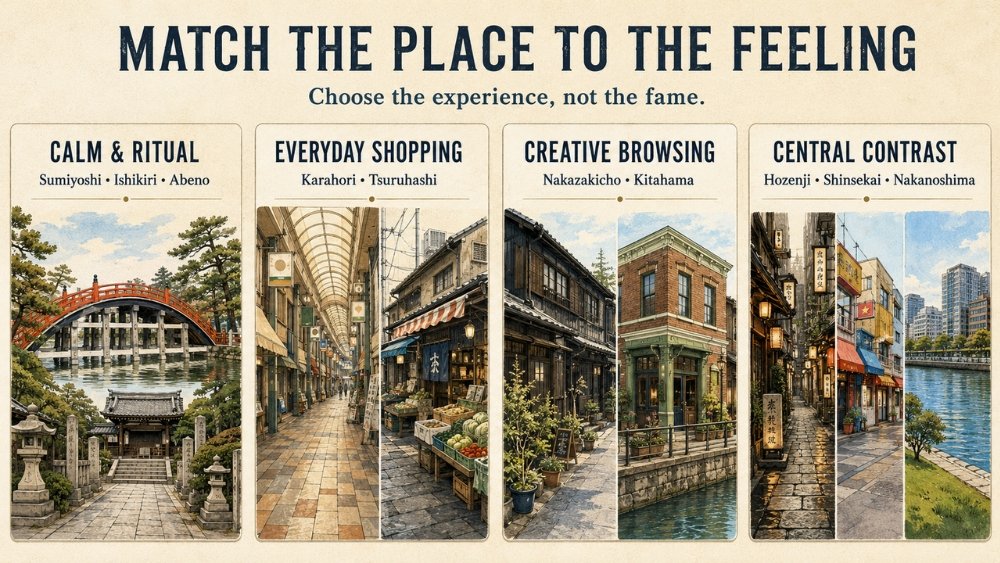
Hozenji, Shinsekai, and Nakanoshima are well known. They are included because the experience changes when you alter the timing or move away from the obvious photo point. Karahori, Ishikiri, and the Abeno shrines require more intention, but none should be treated as a stage set waiting for tourists.
A useful local stop should do at least one of three things:
- show you a side of Osaka that differs from Umeda or Dotonbori;
- fit a real itinerary without exhausting you with cross-city transfers;
- give you a reason to slow down, shop, eat, pray, or sit rather than collect another photo.
The goal is contrast, not a checklist of all ten.
1. Sumiyoshi Taisha and its surrounding streets
Sumiyoshi Taisha is one of Osaka’s major Shinto shrines, yet its setting feels far removed from the commercial intensity of Namba. The unmistakable landmark is Sorihashi, the steep vermilion arched bridge over the pond. It should not be confused with a generic red shrine gate: the bridge, the straight-roofed Sumiyoshi-zukuri main sanctuaries, and the surrounding trees are distinct parts of this site.
Arrive in the morning, walk the grounds first, and then continue through the low-rise streets around the shrine rather than returning immediately to the station. Nankai’s Sumiyoshitaisha Station is the most straightforward rail arrival; the Hankai tram stop Sumiyoshi-toriimae gives you a street-level approach. Nankai’s station page confirms the shrine beside the station.
The shrine is free to enter. Its official hours are 6:00 a.m.–5:00 p.m. from April through September and 6:30 a.m.–5:00 p.m. from October through March. Eating, drinking, smoking, and drones are prohibited inside the grounds. Sorihashi is genuinely steep; if steps or gradients are difficult, consult the official precinct map or staff instead of treating the crossing as compulsory.
Plan it: official visitor information · Google Maps · Osaka Map’s detailed Sumiyoshi Taisha guide
2. Hozenji Yokocho, when the timing is right
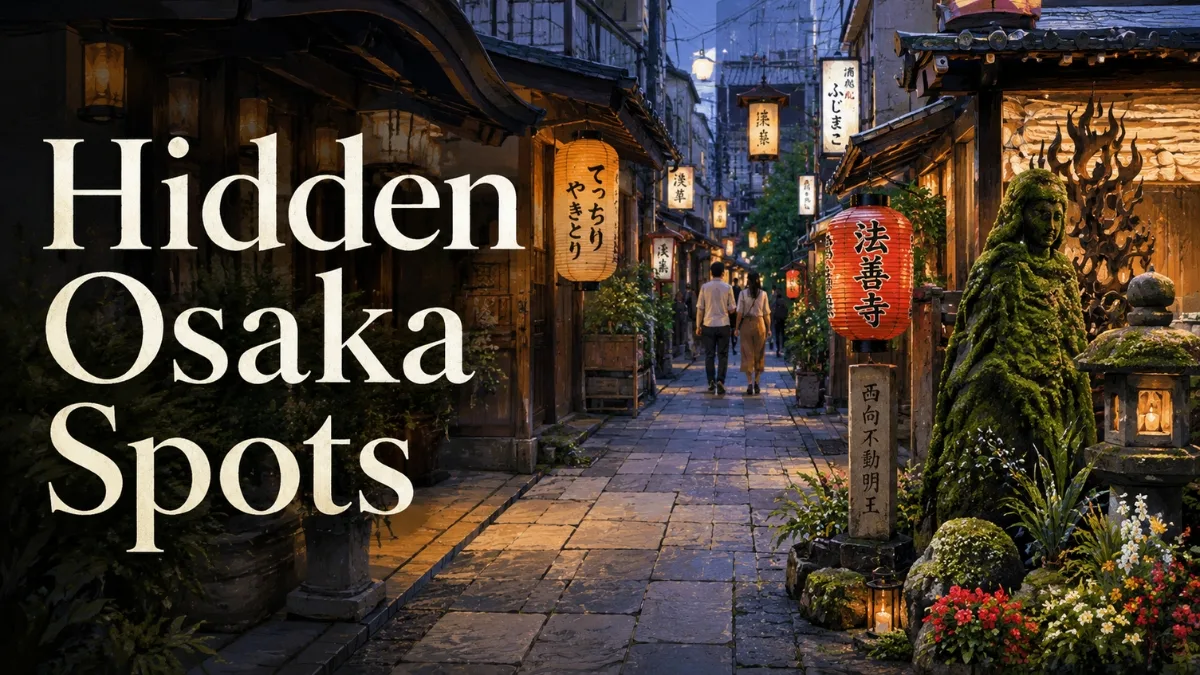
Hozenji Yokocho is a narrow stone-paved restaurant lane beside Hozenji Temple, only a small turn away from Namba’s busiest streets. It is not a secret, but it can feel completely different at 8:00 a.m., during a quiet gap, or after the lanterns come on.
The temple’s moss-covered Mizukake Fudo is an active place of worship. Visitors pour water over the statue as part of prayer; observe first, keep the approach clear, and do not turn someone else’s worship into a staged photo. The temple grounds are open 24 hours, while the office for amulets and stamps operates 10:00 a.m.–6:00 p.m. Restaurants in the yokocho—an alley or narrow lane—set their own hours and may require reservations.
From Namba Walk, the official directions use Exit B16; from Nipponbashi, use Exit B18. This is the easiest choice in the list when you want an atmospheric stop without adding another train ride.
Plan it: Hozenji official site and access · Google Maps · how to explore Dotonbori beyond the crowds
3. Karahori Shotengai
Karahori Shotengai is a covered shopping street running downhill between the Tanimachi and Matsuyamachi sides of central Osaka. Shotengai means a shopping street or arcade. Here, the useful detail is not one landmark but the mixture of food shops, household businesses, cafes, and older storefronts serving a neighborhood that still uses the arcade for everyday errands.
The wider Karahori shopping route extends for roughly 800 metres, while the official promotion association covers about 300 metres of it. Individual businesses have different closing days—Sunday closures are common—so late morning through mid-afternoon gives you a better chance of finding shutters open than an early start.
The official access page currently directs visitors from Tanimachi 6-chome Station Exit 3 because Exit 4 is closed for construction. Matsuyamachi Station Exit 3 is another approach, but the street rises from the Matsuyamachi side. That gradient matters for wheelchairs, strollers, heavy luggage, and anyone who tires easily.
Plan it: official Karahori access · Google Maps · Osaka’s best shopping streets
4. Nakazakicho’s backstreets
Nakazakicho sits close to Umeda but feels smaller in scale. Older wooden row houses and townhouses have been reused as cafes, galleries, salons, and independent shops. The pleasure is in browsing two or three lanes, choosing one place to sit, and leaving room for an unplanned discovery.
This is also a residential neighborhood. A lane that looks picturesque may lead to someone’s front door, not a public attraction. Keep voices low, do not block doorways, and ask before photographing shop interiors or people. Many small businesses open later and keep idiosyncratic days off, so an afternoon visit is safer than planning breakfast around one independent cafe.
Osaka Metro’s Nakazakicho Station is T19 on the Tanimachi Line. The official station guide shows elevators, including a ground-level route at Exit 4. The neighborhood itself still has narrow streets and uneven thresholds, so station accessibility does not mean every shop is step-free.
Plan it: Nakazakicho Station information · Google Maps · Osaka Map’s Osaka Station and Umeda guide
5. Ishikiri Sando shopping street
Ishikiri is the most deliberate outing in this list. Its sando—the approach road to a shrine—runs on a real slope between the upper side near Ishikiri Station and Ishikiri Tsurugiya Shrine. The route is lined with traditional sweets, food shops, herbal and health-related businesses, and services used by worshippers.
This is not simply a themed retro street. People come to the shrine with serious personal intentions, including prayer for health. Browse with curiosity, but give worshippers space and avoid photographing rituals or people at close range without permission.
The official access page lists two useful stations: Ishikiri on the Kintetsu Nara Line and Shin-Ishikiri on the Kintetsu Keihanna Line. The first gives access from higher on the slope; the second approaches the main shrine from below. Check the route before choosing, especially if steep walking is a concern. The shrine grounds are open 24 hours, but the main service counter operates 8:00 a.m.–4:30 p.m. and the shopping street is primarily a daytime experience.
Plan it: official access and current hours · shrine on Google Maps · Ishikiri Sando on Google Maps
6. Shinsekai’s side lanes beyond the busiest strip
Shinsekai is famous, so the “hidden” part is your route through it. Most visitors concentrate around the biggest signs and central sightline. Walk the smaller cross streets, look for an old kissaten—a Japanese-style coffee shop—and notice how quickly the district changes from spectacle to ordinary storefronts.
Morning shows the neighborhood before its busiest meal period. Late afternoon works if you want more energy without committing to the most crowded dinner window. The side lanes can still be tight and active, so keep moving when deliveries arrive and do not use shop entrances as portrait backdrops.
Dobutsuen-mae on the Midosuji and Sakaisuji lines and Ebisucho on the Sakaisuji Line are the most useful subway approaches. The point is not to hunt for an allegedly secret alley. Give yourself an extra hour around a visit you were already making and turn away from the densest pedestrian flow.
Plan it: official Shinsekai neighborhood site · Google Maps · Osaka Map’s Shinsekai walking guide
7. Nakanoshima Park on a weekday morning
Nakanoshima Park occupies the river island between Osaka’s business districts. On a weekday morning, office workers cross the bridges while the paths and lawns offer breathing room before the city’s shopping areas fully wake up.
The park is always open, although individual facilities keep separate hours. Osaka City lists about 310 rose varieties and 3,700 plants, with the main seasonal displays around mid-May and mid-October. Outside rose season, the rivers, bridges, civic buildings, and open sky are enough reason to come.
Yodoyabashi, Kitahama, and Naniwabashi stations all provide access. Choose the station that matches your next stop rather than chasing a single “main entrance.” This is one of the easiest places in the article for a short reset, but riverside weather can feel hotter, colder, or windier than the forecast suggests.
Plan it: Osaka City park information · Google Maps
8. Tsuruhashi’s station-side market streets
Tsuruhashi is not one market hall. Narrow shopping arcades and food streets interlock around JR, Kintetsu, and Osaka Metro Tsuruhashi stations. This section means the station-side Tsuruhashi Shopping Street and adjacent market lanes—not Ikuno Korea Town farther east. Both are worth visiting, but they are different places and should not share one vague map pin.
Come from mid-morning through mid-afternoon, when food shops and grocers are more likely to be active. Expect narrow passages, queues, aromas from grills, and shoppers making purposeful purchases. Large suitcases are a poor fit. Carry some cash, step aside before checking your phone, and ask before taking close photographs of shop displays or staff.
The association’s access page places the shopping street immediately beside Tsuruhashi Station and identifies the JR West and Central exits. Store hours vary; the association office’s 10:00 a.m.–5:00 p.m. hours are not a promise that every shop follows the same schedule.
Plan it: official shopping-street access · Google Maps · Tsuruhashi Station guide
If food is the main reason for your neighborhood day and you would value help with context or ordering, compare current Osaka food tours on Klook. Check the exact district and stops before booking: an “Osaka food tour” may focus on Namba or Shinsekai rather than Tsuruhashi.
9. Abeno Oji Shrine and Abe Seimei Shrine
The original idea of “Abeno’s quieter edges” becomes much more useful with two exact pins: Abeno Oji Shrine and nearby Abe Seimei Shrine. They sit in a low-rise part of Abeno beyond the department stores and observatory traffic around Tennoji.
Abeno Oji is the only surviving Oji shrine in Osaka Prefecture on its original site, according to its official history. Abe Seimei Shrine is a smaller associated shrine at a separate address about 50 metres away. It honors Abe no Seimei, the Heian-period practitioner of Onmyodo, a historical system combining calendrical knowledge, astronomy, divination, and ritual. This is the Osaka shrine linked to Seimei’s reported birthplace; do not confuse it with the better-known Seimei Shrine in Kyoto.
The official directions describe the two shrines in sequence along the old Kumano route, with Abe Seimei Shrine first and Abeno Oji shortly after. The Hankai Uemachi Line streetcar makes a distinctive approach from the Tennoji area, while the official page also gives routes from Osaka Metro and city buses. Treat this as a real worship stop, not merely “something behind Abeno Harukas.”
Plan it: official history and addresses · Abeno Oji Shrine on Google Maps · Abe Seimei Shrine on Google Maps · Namba vs Tennoji for visitors
10. Kitahama’s cafe and river corners
Kitahama is a working financial district, which is exactly why its river edge feels rewarding between commuter peaks. Office towers face the Tosabori River, cafe terraces look toward Nakanoshima, and early twentieth-century buildings interrupt the modern streetscape.
For one concrete destination, save Kitahama Retro, a compact brick tea room in a historic building beside the river. Its scale and arched facade are easy to miss between taller buildings. Check its current official posts before making a special trip; small venues can change service procedures, closing days, or queue rules.
Kitahama Station serves both Osaka Metro and Keihan. A practical route is to start near the river, cross into Nakanoshima Park, and finish at Yodoyabashi rather than walking back over the same ground. Kitahama offers polished calm rather than the old-market texture of Karahori or Tsuruhashi.
Plan it: Kitahama Retro official updates · Google Maps · Osaka Map’s cafe guide
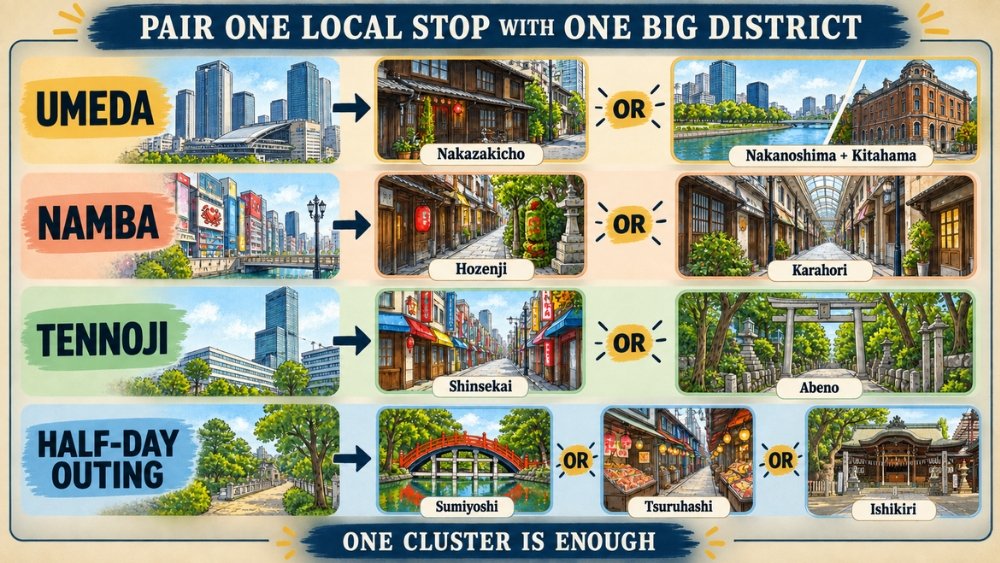
Four easy ways to fit one local stop into your Osaka itinerary
From Umeda: choose texture or open space
Pick Nakazakicho if you want small shops and a cafe. Pick Nakanoshima and Kitahama if you want rivers, architecture, and a walk with fewer commercial decisions. Trying to do all three before lunch turns a slow morning into another checklist.
From Namba: choose the size of the detour
Hozenji is the almost-zero-logistics option. Karahori needs a separate time block but gives you a functioning shopping arcade rather than a short atmospheric lane. Shinsekai works when your day is already moving south toward Tennoji.
From Tennoji: choose retro energy or a quiet shrine walk
Choose Shinsekai for signs, eateries, and active streets. Choose Abeno Oji and Abe Seimei shrines for a calmer neighborhood route. They answer different moods and should not be sold as interchangeable “old Osaka.”
For a half-day: choose one direction
Sumiyoshi works for southern Osaka, Tsuruhashi for market energy on the eastern side of the center, and Ishikiri for a longer shrine-and-sando outing. Do not combine Sumiyoshi and Ishikiri simply because both involve shrines; the cross-city travel weakens the day.
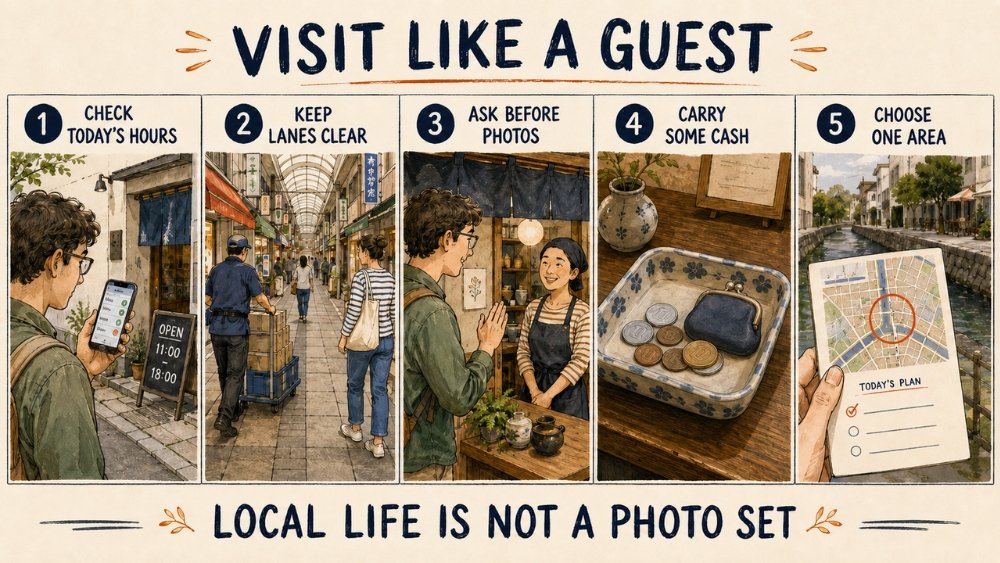
Practical rules that matter in local neighborhoods
Check the exact pin and current hours
Area names can cover more ground than expected, and similar names can point to different places. Save the Google Maps pin for the station, shrine, market, or cafe you actually intend to use. Recheck same-day opening information for small businesses.
Bring a small amount of cash
Osaka is increasingly card-friendly, but cash remains useful for shrine offerings, amulets, traditional shops, older cafes, and small purchases. Do not assume every independent counter supports your preferred contactless method.
Travel without large luggage
Karahori and Ishikiri have slopes. Tsuruhashi has narrow market lanes. Nakazakicho has small thresholds, and Sumiyoshi’s signature bridge is steep. Leave suitcases at your hotel or a station locker and choose footwear for real walking rather than photos.
Treat worship and commerce as real activity
At shrines and Hozenji, pause to see how people approach the site before copying a ritual. In markets and shopping streets, keep shop doors, delivery routes, and queues clear. Ask before photographing interiors, staff, worshippers, or merchandise at close range.
Stop after one good neighborhood
The easiest way to ruin these places is to rush through them. One local area plus one major district usually produces a better day than four “hidden gems” scattered across the city.
What should a first-time visitor prioritize?
If you have room for only three choices, start with the one closest to your plans:
- Near Namba: Hozenji for a short contrast, or Karahori for a fuller neighborhood block.
- Near Umeda: Nakazakicho for browsing, or Nakanoshima–Kitahama for river calm.
- Near Tennoji: Abeno Oji and Abe Seimei shrines for quiet, or Shinsekai’s side lanes for energy.
- For a dedicated outing: Sumiyoshi for a major Osaka shrine, Ishikiri for the sando experience, or Tsuruhashi for market life.
There is no single “authentic Osaka” hidden behind the famous districts. The city’s local character appears in different forms: worship before work, shutters opening in an arcade, lunch shoppers moving through a market, an old townhouse reused as a cafe, and office workers crossing a river island. Choose one form that genuinely interests you, give it enough time, and let it change the rhythm of the day.