If you need one simple answer, choose by the time and energy you have now. With less than 45 minutes, stay inside or directly connected to Osaka Station and use a noodle counter, Hanshin Snack Park, or Daimaru Umeda’s basement food floor. For a first Osaka specialty, choose takoyaki, okonomiyaki, negiyaki, or kushikatsu only when you can accept a queue. For a calmer dinner, go to an upper restaurant floor and reserve when the restaurant allows it.
This is not an area where you need one universally “best” restaurant. Osaka Station and Umeda form a layered network of station buildings, department stores, underground passages, and dining floors. The best meal is the one that fits your train, luggage, budget, party size, and willingness to wait.
Choose by the time you actually have
| Your situation | Best first move | A practical choice | Main trade-off |
|---|---|---|---|
| 20–30 minutes, solo, no large bag | Pick a counter or standing-food hall before crossing the district | Jinrui Minna Menrui Premium or Hanshin Snack Park | A queue can use the whole window; leave immediately if it is long |
| 30–45 minutes before check-in or a train | Buy a prepared meal rather than waiting for a table | Daimaru Umeda B1 food floor | It is takeaway; confirm where you may eat it |
| 45–75 minutes and you want an Osaka classic | Try one nearby specialty, with a backup already chosen | Hanadako, Kiji, or Negiyaki Yamamoto | Compact shops and popular counters may have lines |
| 60–90 minutes with a companion | Use a larger restaurant in a connected building | Kushikatsu Daruma at LUCUA 1100 | It is a full sit-down meal, and the branch requires one drink per person except young children |
| 90 minutes or more for a relaxed meal | Reserve a restaurant with seating and a clear menu | THE COSMOPOLITAN or a restaurant on Hankyu’s 12F–13F dining floors | Higher price and more time than a quick station meal |
| A plant-based or gluten-free preference | Start with a restaurant that labels suitable dishes | Cosme Kitchen Adaptation | A menu label is not a guarantee against allergens or cross-contact |
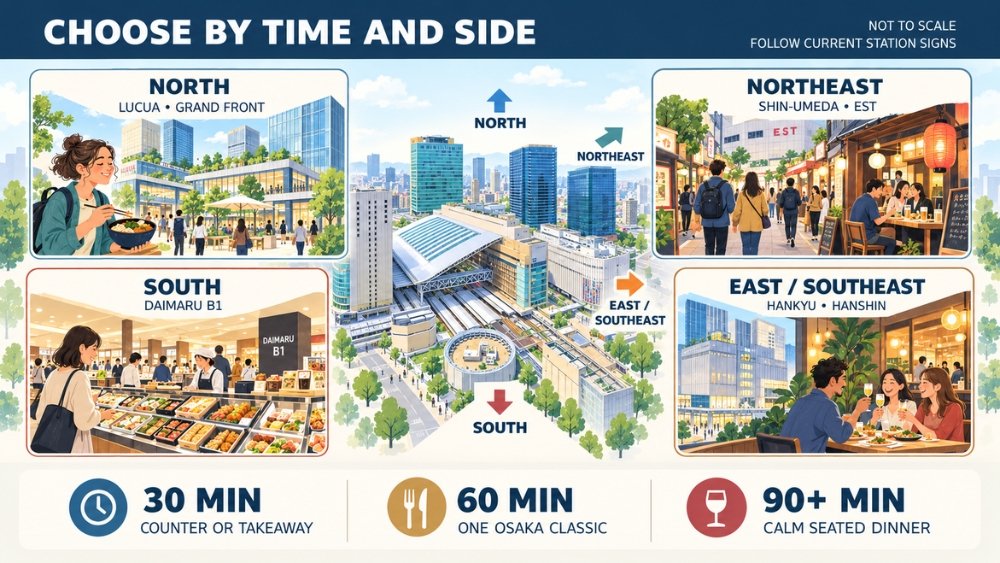
The building names become easier when you use four rough anchors. LUCUA and LUCUA 1100 are on the north side of JR Osaka Station. Daimaru Umeda is in the South Gate Building. Hanshin and Hankyu are southeast and east of the JR station. Shin-Umeda Shokudogai and EST are toward the northeast side of the wider Umeda district. This is a planning shortcut, not a substitute for the station’s current signs.
When you want an Osaka classic
Hanadako for takoyaki without turning it into a full meal
Hanadako’s official Shin-Umeda Shokudogai page describes a small counter where the takoyaki is cooked in view of customers. It lists counter seating only, no reservations, takeaway, and no card payment. That makes Hanadako useful when you want a recognizable Osaka snack and are comfortable with a compact, fast-moving format. It is a poor match for a large group, a suitcase, or a schedule with no queue buffer.
Takoyaki are round pieces of soft batter cooked with octopus. They are extremely hot inside when fresh, so open one before eating rather than putting a whole piece straight into your mouth. The official page identifies regular takoyaki and a version covered with green onion and mayonnaise as popular choices.
Check the current hours on the official page and bring yen. Save Hanadako on Google Maps.
Kiji for okonomiyaki when the queue still fits your day
Kiji’s official page places the restaurant upstairs inside Shin-Umeda Shokudogai and lists 20 seats, no reservations, no takeaway, and no card payment. This is a small, focused okonomiyaki meal, not the place to arrive with ten people and several suitcases.
Okonomiyaki is a savory griddled pancake, usually built around cabbage and batter with other ingredients. Kiji’s official page also highlights its modern-yaki, which combines noodles and egg in the restaurant’s own style. Choose Kiji if watching the cooking and eating from the hot griddle are part of what you want. If the line is longer than your available time, do not let one famous name decide the rest of the evening.
Confirm the day’s hours and closing information before going, bring yen, and save Kiji on Google Maps.
Negiyaki Yamamoto for a more spacious green-onion pancake meal
Negiyaki is related to okonomiyaki but uses a generous amount of green onion and is usually thinner. The official Umeda EST listing for Negiyaki Yamamoto lists 42 seats, a counter, and takeaway. It also explains that the dish began as a staff meal at the original family shop before becoming a named Osaka specialty.
This branch is a useful alternative when you want an Osaka griddle dish but do not need the very compact atmosphere of Shin-Umeda Shokudogai. EST is not inside JR Osaka Station, so protect enough time to walk there and find the correct restaurant zone. Check the host-building page for current hours, then save Negiyaki Yamamoto Umeda EST on Google Maps.
Kushikatsu Daruma when you want variety at one table
Kushikatsu are skewers of meat, seafood, vegetables, or other ingredients coated and deep-fried. They work well for couples and small groups because each person can order a different mix. Kushikatsu Daruma’s official LUCUA 1100 branch page lists the restaurant on the 10th floor, 80 seats, card and electronic payments, and no reservations. It also states that each guest must order at least one drink, except children of elementary-school age and younger.
This branch is easier for a seated meal than the smallest counters, but it is not an instant stop. Read the current menu, last-order time, and one-drink rule before joining the queue. Save Kushikatsu Daruma LUCUA 1100 on Google Maps.
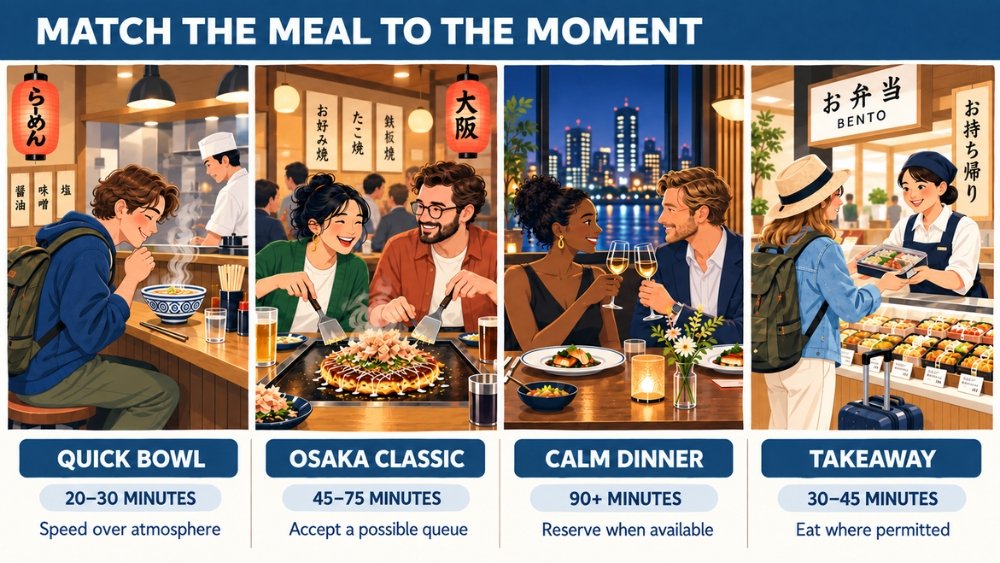
When speed matters more than atmosphere
Jinrui Minna Menrui Premium for a solo-friendly bowl
The official LUCUA listing for Jinrui Minna Menrui Premium places it in B2F Balchika, with 33 seats, counter seating, and a “solo-friendly” tag. You may see the brand’s Japanese name, 人類みな麺類Premium, on local listings. It is practical when you want one bowl and a straightforward ordering decision without leaving the station-connected complex.
Do not assume a ramen shop will always be faster than a restaurant. If there is a substantial line, switch to another noodle, curry, or rice-bowl counter in the same complex. Save Jinrui Minna Menrui Premium on Google Maps.
Hanshin Snack Park for the widest quick fallback
Hanshin Umeda Main Store’s official Snack Park page describes the B1 space as a quick, inexpensive standing-food area and provides a current tenant list. The selection includes noodles, curry, rice bowls, sushi, okonomiyaki, takoyaki, and Hanshin’s well-known ikayaki—a thin griddled snack made with squid.
Snack Park is valuable because you can change your decision after seeing the queues. It is not a quiet seated restaurant, and some members of a group may find standing dining uncomfortable. Check the department store’s current hours and the individual stall information, then save Hanshin Snack Park on Google Maps.
Daimaru Umeda B1 when takeaway is the smarter meal
A depachika is the basement food floor of a Japanese department store. Daimaru Umeda’s official floor guide lists prepared dishes, bento, sushi, sweets, tea, and an eat-in area on B1. This is one of the best solutions when you are tired, your hotel room is close, or a train timetable matters more than restaurant atmosphere.
Look at the use-by time, whether reheating is needed, and whether disposable cutlery is included. Do not treat station stairs, platforms, or shopfronts as an informal dining area. Take the food to your hotel, a designated eat-in space, or another place where eating is permitted. Save Daimaru Umeda on Google Maps.
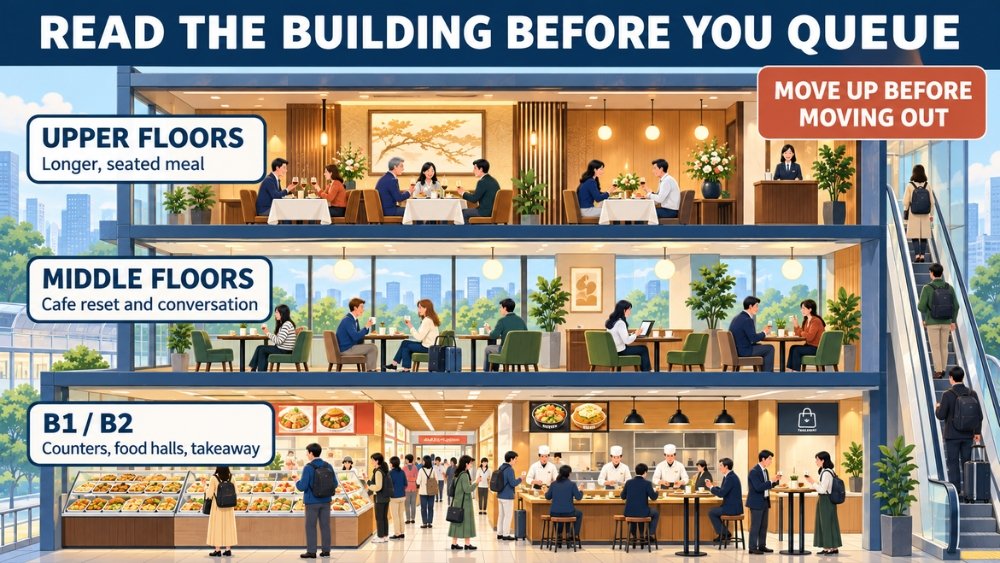
When comfort, conversation, or dietary choice matters
Cosme Kitchen Adaptation for clearly identified plant-forward choices
Cosme Kitchen Adaptation’s official site places its Osaka branch on Hanshin Umeda Main Store’s 3rd floor and explains that the menu includes items identified as vegan and gluten-free. It is a calmer starting point for mixed dietary preferences than hoping a small specialty counter can modify its core dish.
“Vegan” and “gluten-free” describe ingredients or preparation standards used for marked menu items; they do not automatically mean a dish is safe for a severe allergy. Ask staff about ingredients and cross-contact before ordering, especially for wheat, soy, sesame, nuts, egg, milk, fish, or shellfish. The official site offers reservations and lists a children’s menu. Save Cosme Kitchen Adaptation Hanshin Umeda on Google Maps.
THE COSMOPOLITAN for a reserved meal with space
THE COSMOPOLITAN’s official site places the restaurant on the 9th floor of Grand Front Osaka South Building. It lists separate lunch and dinner periods, a large dining room, bar seating, and reservations. Choose it when conversation, a table, and a slower pace matter more than eating a specifically Osaka dish.
This is the higher-cost option in this guide, and the direct elevator to the 9th floor has its own access hours. Confirm the current menu, dress expectations if any, elevator route, cancellation policy, and last order before reserving. Save THE COSMOPOLITAN on Google Maps.
Hankyu’s upper restaurant floors when the group cannot agree
The official Hankyu Umeda restaurant guide groups restaurants on the 12th and 13th floors and lets visitors filter for reservations, children’s menus, child seats, foreign-language menus, and other practical needs. This is a strong fallback when a group wants different cuisines but still wants to compare menus in one controlled area.
Choose the building first, then the restaurant. That avoids sending the group back into the station maze whenever a queue looks too long. Save Hankyu Umeda Main Store on Google Maps.
Three rules for escaping a long queue
- Set a waiting limit before you arrive. If a queue would consume more than one third of the time you have for the entire meal, use the backup. A famous counter is not worth missing a train or arriving late for a reservation.
- Change floors before changing neighborhoods. Basement food zones and upper restaurant floors often give you many alternatives inside one building. This is usually faster than walking across Umeda for another popular name.
- Change the meal format. A takeaway bento, counter bowl, or standing snack can solve the same hunger problem as a full restaurant. Save the destination meal for a time when you can enjoy it.
Peak lunch and dinner periods can make even fast restaurants slow. If your schedule is flexible, an earlier lunch or dinner may be easier, but always check the individual restaurant’s service hours and last order rather than assuming continuous service.
How ordering works near Osaka Station
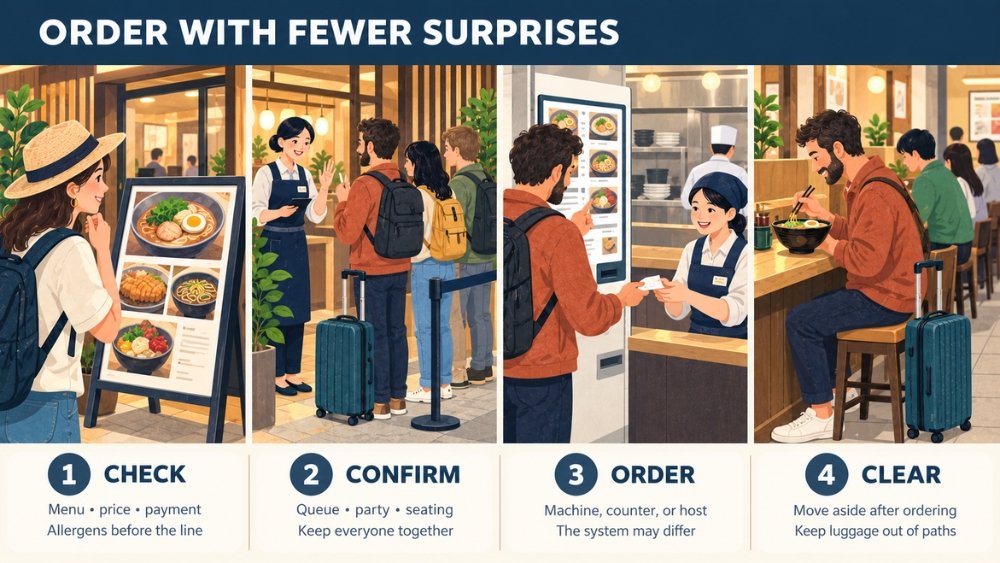
Before joining a line, identify three things: whether you pay at a ticket machine or at the counter, whether the line is for ordering or for a table, and whether everyone in your party must be present. Menu photos and food models help, but prices, portion sizes, and set requirements still matter.
At a ticket-machine restaurant, choose and pay first, then give the ticket to staff or wait for your number. At a department store food counter, tell staff the item and quantity, pay, and step away while it is packed. At a sit-down restaurant, a host may ask your party size before assigning seats. A small restaurant may not be able to split a group across several tables or store luggage safely.
Cashless acceptance varies. Hanadako and Kiji officially list no card payment, while Kushikatsu Daruma’s LUCUA 1100 branch lists cards and electronic payments. Bring some yen even if most of your trip is cashless, and check the correct branch rather than relying on a chain-wide assumption.
Allergies, vegetarian requests, children, and luggage
Japanese soup stocks, sauces, batters, and seasonings may contain ingredients that are not visible. A vegetable skewer can share oil with meat or seafood; okonomiyaki sauce can contain ingredients not obvious from its English name; ramen broth may use pork, chicken, fish, or multiple bases. If an allergy is serious, show the specific ingredient in Japanese, ask about cross-contact, and be prepared to leave if staff cannot confirm safety.
Vegetarian does not always mean vegan, and “no meat” may still include fish-based dashi stock. A restaurant that marks vegan items is a better starting point than asking a highly specialized counter to rebuild its signature dish during a rush.
With children, check whether the restaurant has seats rather than only standing counters, whether a child seat or children’s menu is listed, and whether every guest must order. With luggage, use an available locker or leave bags at your accommodation when possible. JR’s official Osaka Station page lists coin lockers as an available station service, but availability is not guaranteed at busy times.
Rain, late hours, and the last part of the day
The station-connected buildings are useful in rain, but “connected” does not mean every route is obvious or open at every hour. Follow current building signs and do not assume the daytime underground route will remain available late at night.
If dinner is finished but you still need somewhere to sit, use our Umeda night cafe guide and check last order, not only closing time. For a daytime coffee break with a view, compare the Umeda scenic cafe and lunch guide. These are separate decisions from choosing dinner; a cafe that is useful at 16:00 may be closed when you need it after 22:00.
The simplest answer
Use Osaka Station as a food hub, not a test of whether you can find one viral restaurant. Choose Hanadako, Kiji, Negiyaki Yamamoto, or Kushikatsu Daruma when an Osaka specialty is worth the wait. Choose Jinrui Minna Menrui Premium, Hanshin Snack Park, or Daimaru B1 when speed is the real priority. Choose Cosme Kitchen Adaptation, THE COSMOPOLITAN, or Hankyu’s upper floors when seating, dietary choice, or conversation matters more.
Check the official page for the correct branch before you go. Decide your queue limit and backup in advance. Near Osaka Station, flexibility is not settling for less—it is usually how you get the meal that best fits the trip.