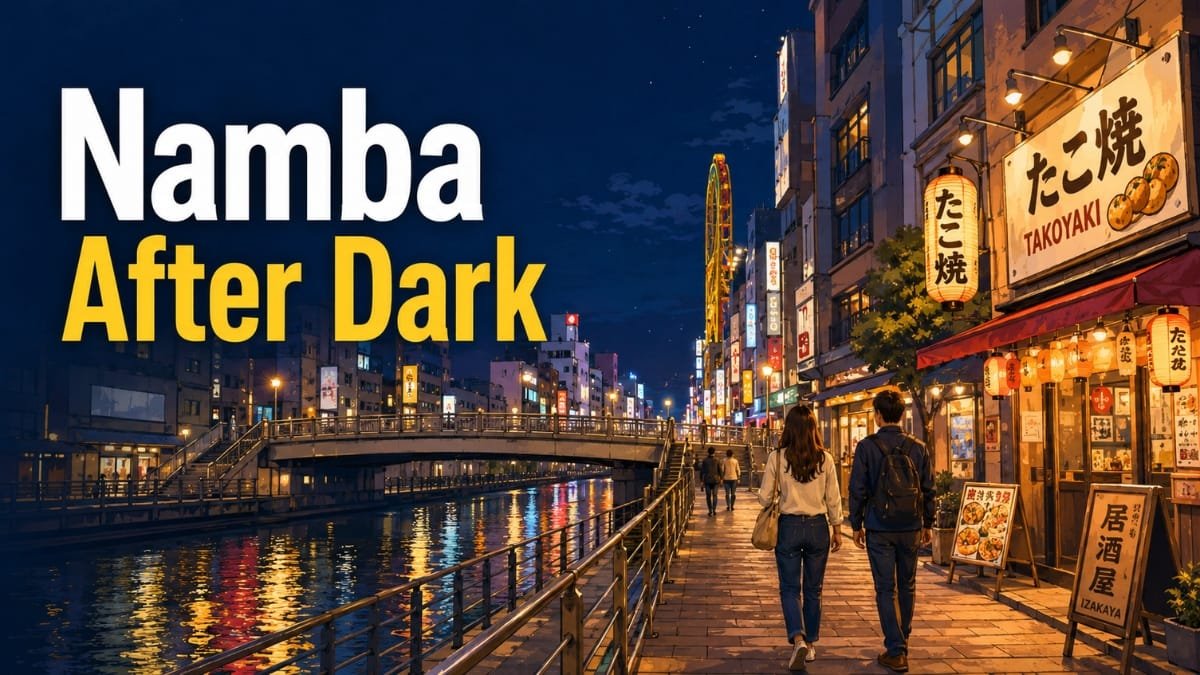
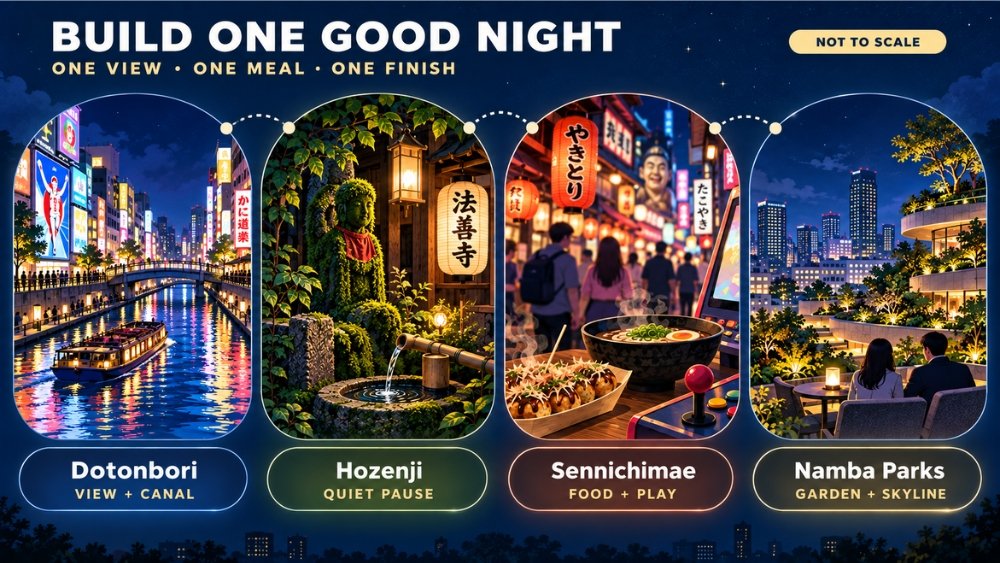
The best way to spend a night in Namba is to choose three or four compatible stops, not race through a list of 12. For a first visit, start with the signs and canal at Dotonbori, add either a street-food stop or a reserved dinner, then finish with one activity: a river cruise, comedy show, arcade, rooftop garden or city-view drink.
Namba is the transport core of Minami, the southern downtown area of Osaka. Dotonbori, Sennichimae, Hozenji, Amerikamura and Namba Parks are nearby, but they do not form one straight street. Different rail companies also use separate Namba stations. Save the exact entrance you need before the evening gets busy, and leave enough time for the final walk back.
Build the night around one main decision
| If you have… | Start with | Add one | Finish with | Main caution |
|---|---|---|---|---|
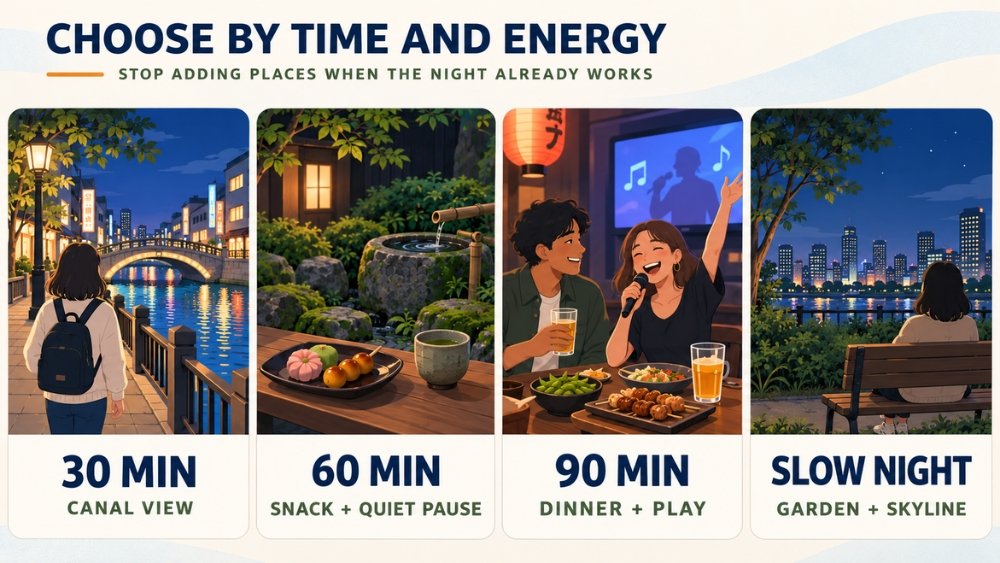
| 45–60 minutes | Ebisu Bridge and Tombori River Walk | Takoyaki | Return to your saved station | Crowds can make short distances slow |
| About 2 hours | Dotonbori | Hozenji and dinner | Arcade or canal walk | Restaurant queues can consume the whole block |
| About 3 hours | Early Amerikamura detour or Dotonbori | Cruise, comedy or a reserved meal | Namba Parks | Check the timed activity before choosing dinner |
| A slow evening | Dotonbori at dusk | One seated meal | Garden or rooftop drink | Last orders and last trains are different deadlines |
1. See Dotonbori from Ebisu Bridge
Ebisu Bridge is the simplest first stop for a first Namba night. It crosses the Dotonbori River at the center of the illuminated commercial district, with the canal below and large signs around it. Arrive near dusk if you want to see the area change from daylight to full illumination without making a separate return trip.
The bridge is a public crossing, not a viewing deck. Take a quick look, keep the walking line open and move to the river promenade for a slower pause. The center can become congested, especially on weekends and event nights. If one side is blocked, do not push through a crowd for a particular photograph.
Use the city’s official bridge information for the access context and save Ebisu Bridge on Google Maps. Osaka Metro Namba Exit 14 is a useful street-level reference, but your best exit depends on the Namba line and station you actually use.
2. Walk one section of Tombori River Walk
Tombori River Walk is the promenade beside the Dotonbori River. It puts you below much of the street traffic and gives a different view of the bridges, boats, shopfront light and reflections. You do not need to walk its full length. A 20- to 30-minute out-and-back section is enough when dinner or a show has a fixed start.
Stairs and access points are distributed along the canal, so choose the section that keeps you on the correct side for your next stop. Wet paving, delivery activity and event restrictions can change the easiest path. Treat the promenade as a public route: do not block stairs, landings or narrow stretches for photographs.
Save Tombori River Walk on Google Maps. For a quieter route beyond the busiest bridge, see our guide to exploring Dotonbori beyond the crowds.
3. Ride the Tombori River Cruise
The Tombori River Cruise is an approximately 20-minute open-boat circuit through Dotonbori. It works best when you want the canal to be the main event rather than just the background to a walk. The boarding point is at the Tazaemonbashi pier; save Tombori River Cruise boarding on Google Maps.
This is a timed choice. Check the operator’s current sailing calendar, ticket method, departure availability and cancellation notices before building dinner around it. Weather, river conditions and events can change operations. The boat is open, umbrellas cannot be used on board, and same-day availability is not guaranteed. Keep a canal-walk backup in case the cruise does not operate or the useful departure sells out.
4. Pause at Hozenji Temple and Hozenji Yokocho
Hozenji is a small Buddhist temple close to Dotonbori. It is not a Shinto shrine. The best-known focus is Mizukake Fudo, a moss-covered image of the Buddhist deity Fudo Myoo. Worshippers pour water as part of prayer, which is why the surface has developed its distinctive moss.
The surrounding Hozenji Yokocho is a narrow stone-paved lane of restaurants and bars. Its value comes from the contrast with the larger Dotonbori streets, not from treating the lane as a private photo set. Keep voices low at the temple, stay out of the prayer line and do not photograph people at close range while they worship.
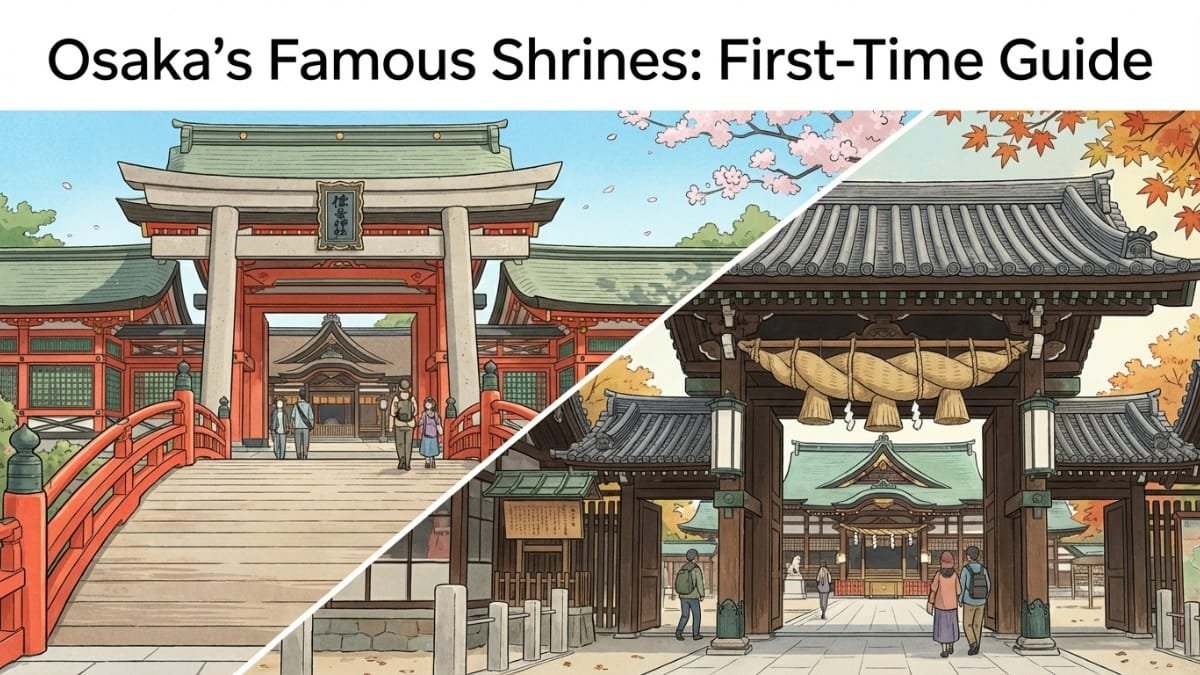
Allow 15 to 25 minutes unless you have a reservation in the alley. Save Hozenji Temple on Google Maps. A dark timber-and-stone approach is the relevant visual cue here—there is no generic vermilion torii entrance to look for.
5. Try takoyaki at Wanaka’s Sennichimae main shop
Takoyaki Wanaka is a practical Sennichimae stop for takoyaki: small round batter dumplings cooked in a molded iron pan, usually with pieces of octopus inside. Its Sennichimae main shop is close to Namba Grand Kagetsu, making it easy to combine with comedy or the nearby arcade district.
Order one portion first rather than turning the stop into a tasting contest. Fresh takoyaki can be extremely hot inside even when the surface is manageable. Eat where the shop directs, keep food and sauce away from moving crowds, and do not assume a public curb or temple approach is a dining area.
Check the official Wanaka site for current shop information and save Wanaka Sennichimae Main Shop on Google Maps. If the queue is longer than the value of the stop, move to your planned meal rather than losing a timed show or cruise.
6. Eat okonomiyaki at Mizuno
Mizuno is a long-running Dotonbori okonomiyaki restaurant. Okonomiyaki is a savory griddled dish built from batter, cabbage and chosen toppings. Mizuno has a small first-floor counter and additional upstairs seating, so a line outside does not tell you exactly how fast a table will turn.
Choose Mizuno when this dish is the meal you care about, not as a compulsory box to tick. Check the current opening day, last order and payment information on the official shop page. If your evening contains a fixed cruise or performance, eat after it or set a firm queue limit. Small venues are also awkward with large suitcases, so use station storage before joining the line.
Save Mizuno on Google Maps. For more branch-specific meal alternatives, use our guide to where to eat in Namba.
7. Have an izakaya and robatayaki dinner at Rikimaru Tanukichaya
Rikimaru Tanukichaya is a Sennichimae izakaya, a casual Japanese pub where groups commonly share several dishes with drinks. Its specialty is robatayaki, a grill-centered style; at this restaurant, cooked items are handed across on long wooden paddles.
This is a better choice for a full dinner than for a five-minute snack. Review the current menu, service hours and reservation terms on the official branch page. Ask about the seating format if stairs, counter seating or smoke sensitivity matter, and state allergies before ordering rather than inferring safety from a photograph or translation app. Cross-contact is possible in a shared grill environment.
Save Rikimaru Tanukichaya on Google Maps. Alcohol in Japan is for people aged 20 or older; staff may request identification.
8. Play at ROUND1 Stadium Sennichimae
ROUND1 Stadium Sennichimae combines bowling, amusement games, karaoke, darts and Spo-Cha activities in one building. It is useful when the weather turns, when a group wants different activities, or when conversation alone is not enough to carry the rest of the night.
Do not assume every activity keeps the same hours as the building. Check the official facility page for the current schedule and fees. The branch’s age-restriction page says visitors under 16 cannot enter after 19:00, though they may stay until 22:00 with a legal guardian, and visitors aged 16 or 17 cannot enter after 22:00. Valid identification may be required; recheck the rule before visiting because local restrictions can change.
Save ROUND1 Stadium Sennichimae on Google Maps. Decide the activity before entering so a quick arcade stop does not silently become a multi-hour package.
9. See a scheduled show at Namba Grand Kagetsu
Namba Grand Kagetsu is Yoshimoto Kogyo’s major Namba theater. Programs can combine manzai two-person stand-up, rakugo comic storytelling, conte sketches and Yoshimoto Shinkigeki comedy theater. Most spoken performance is in Japanese, so the best fit depends on your language comfort and interest in physical or situational comedy.
Check the actual performance schedule and ticket information before the day. The theater’s visitor guidance says main programs are commonly around 130 to 140 minutes, while its FAQ warns that listed end times are estimates and can shift. Do not place a non-refundable dinner reservation immediately after a show.
Save Namba Grand Kagetsu on Google Maps. Arrive with enough time to find the correct entrance and handle tickets; “near Namba” is not a useful navigation plan inside the evening crowd.
10. Decompress in Namba Parks’ rooftop garden
PARKS GARDEN rises through the upper levels of Namba Parks as a free, terraced rooftop garden. Its curved planted paths and city views provide a calmer final chapter after the canal, shopping streets or an arcade. It is particularly useful for mixed-energy groups because no one must order another meal or drink to stay together.
The official page currently lists garden access from 10:00 to midnight, subject to facility closure days and special restrictions. Recheck on the day, especially during severe weather or events. The garden spans several levels, so choose a short loop if anyone is tired rather than climbing every terrace.
Save PARKS GARDEN at Namba Parks on Google Maps. Use the Nankai Namba side as the exit anchor afterward; do not assume every indoor connection remains open as late as the outdoor garden.
11. Have a city-view drink at Smoke & Spin
Smoke & Spin is the top-floor lounge at Centara Grand Hotel Osaka, on the 33rd floor above the Namba Parks side of the district. It is a deliberate finish for a skyline view and a seated drink, not a necessary part of a budget Namba night.
Check the hotel’s current restaurant page and reservation link for opening hours, last orders, age or dress conditions, minimum spend, event closures and cancellation terms. A hotel lounge and an open-air rooftop deck are not interchangeable; confirm which venue you are booking. If the view matters, also check the weather before committing.
Save Smoke & Spin at Centara Grand Osaka on Google Maps. Keep enough time to return through Namba Parks and find the correct railway station afterward.
12. Make an early-evening Amerikamura detour
Amerikamura is the youth-fashion, vintage, music and street-culture district west of Shinsaibashi. Its compact center is Mitsu Park, commonly called Triangle Park or Sankaku Koen. This is most useful in the late afternoon or early evening, when independent shops are more likely to be open, before continuing south toward Dotonbori.
Amerikamura is a district rather than a single attraction. Choose it when browsing clothing, records and street style matters; skip it if your night is already built around Dotonbori and Sennichimae. Individual shops keep their own hours. The district association advises visitors to refuse unwanted sales approaches clearly. Do not follow a solicitor into an unchosen bar, club or shop; Osaka City regulates touting in Minami, but avoidance is still the simplest rule.
Use the association’s area information and save Mitsu Park in Amerikamura on Google Maps. From there, allow roughly 15 to 25 minutes on foot to reach the Dotonbori core, depending on crowds and your exact route.
Three Namba night combinations that work
The first-night classic: about 2 hours
Start at Ebisu Bridge, walk one section of Tombori River Walk, pause at Hozenji, then choose either Wanaka or one seated dinner. This route protects the essential Namba atmosphere without requiring a reservation or late finish.
The timed-activity night: about 3 hours
Book the cruise or Namba Grand Kagetsu first. Add only one meal that fits on the correct side of the start time, then finish with a short canal walk. A timed ticket is the anchor; everything else is optional.
The lower-noise finish: 2½ to 3 hours
Begin in Dotonbori before peak congestion, eat in Sennichimae, then walk south to PARKS GARDEN. Add Smoke & Spin only when a rooftop drink is genuinely the goal and the current venue conditions suit the group.
If you prefer a hosted food-and-drink route, Klook lets you switch the displayed language and currency before comparing the final price. Compare the current Osaka night food and drinking experience on Klook, then verify the meeting point, walking distance, guide language, food and drink inclusions, age rules and cancellation terms before booking. A tour is optional; the routes above work independently.
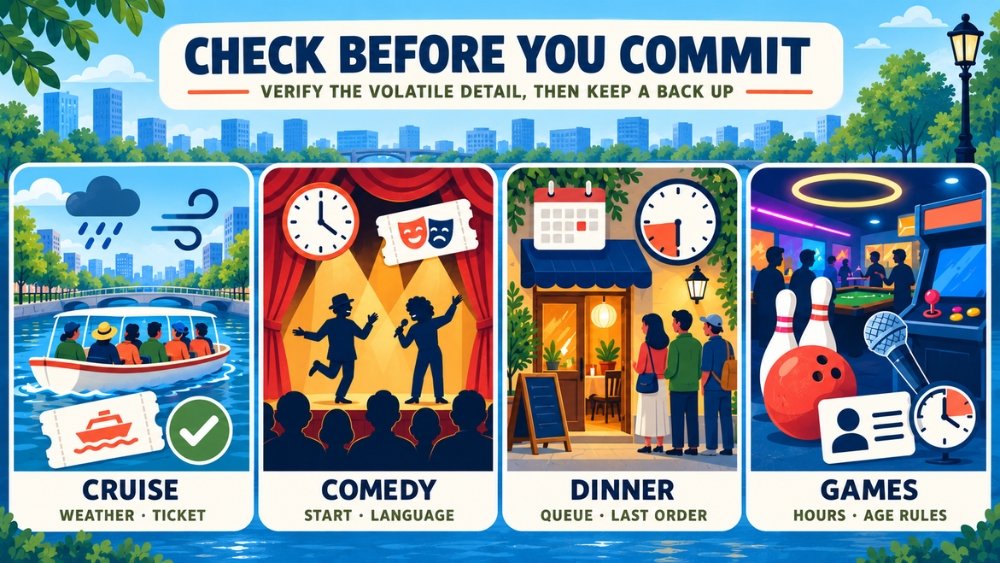
Before committing to a queue, ticket or table
- Cruise: confirm today’s operating notice, departure, boarding point, weather policy and ticket status.
- Comedy: confirm the date, start time, expected duration, spoken language and ticket collection method.
- Dinner: confirm the exact branch, queue or reservation, last order, payment method, seating needs and allergy limitations.
- Games or karaoke: confirm the activity’s hours and price, not only the building hours, plus any age restriction and identification requirement.
For restaurants, set a queue limit before arriving. If a wait threatens a ticket or the last train, use a saved backup in the same subarea rather than crossing Namba for another famous name. For food allergies, show the ingredient in Japanese as well as English and ask about broth, sauces and shared grills; “vegetarian-looking” is not a safety guarantee.
Getting home without turning Namba into a maze
“Namba Station” can mean Osaka Metro, Nankai, JR or the nearby Kintetsu/Hanshin Osaka-Namba station. Save the exact operator, line and entrance that serves your accommodation. A route to Nankai Namba is not automatically a route to JR Namba.
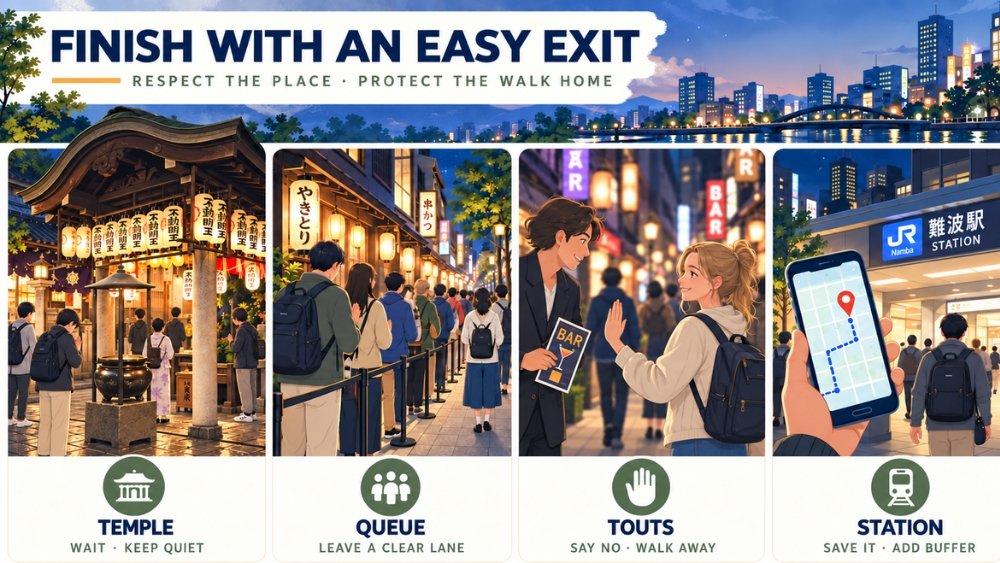
Last-train times vary by line, direction, day and disruption. Check the current operator route before ordering the final drink and leave a buffer for crowds, underground passages and the platform walk. If using a taxi, go to a marked rank or use a trusted dispatch method rather than accepting an unsolicited street offer.
Keep valuables zipped in dense crowds, do not stand in the road for a photograph, and refuse anyone pressuring you toward an unchosen venue. If a situation feels wrong, move into a staffed shop, hotel or station area. The useful goal is not to stay out as late as possible; it is to finish near the route you can still navigate comfortably.
What should you do in Namba tonight?
For a first visit, choose Dotonbori, one food stop and one finish. Make the Tombori River Cruise or Namba Grand Kagetsu the anchor when you have a timed ticket. Choose ROUND1 for an indoor group activity, PARKS GARDEN for a free and calmer finish, Smoke & Spin for a planned skyline drink, and Amerikamura only when browsing street culture is part of the point.
The strongest Namba night is compact. Protect the reservation that matters, keep one same-area backup, and stop adding places once the route already contains a view, a meal and a satisfying final hour.
If you are still deciding whether Namba suits your group, compare it with Umeda, Shinsekai and other districts in our guide to the best areas in Osaka for nightlife.