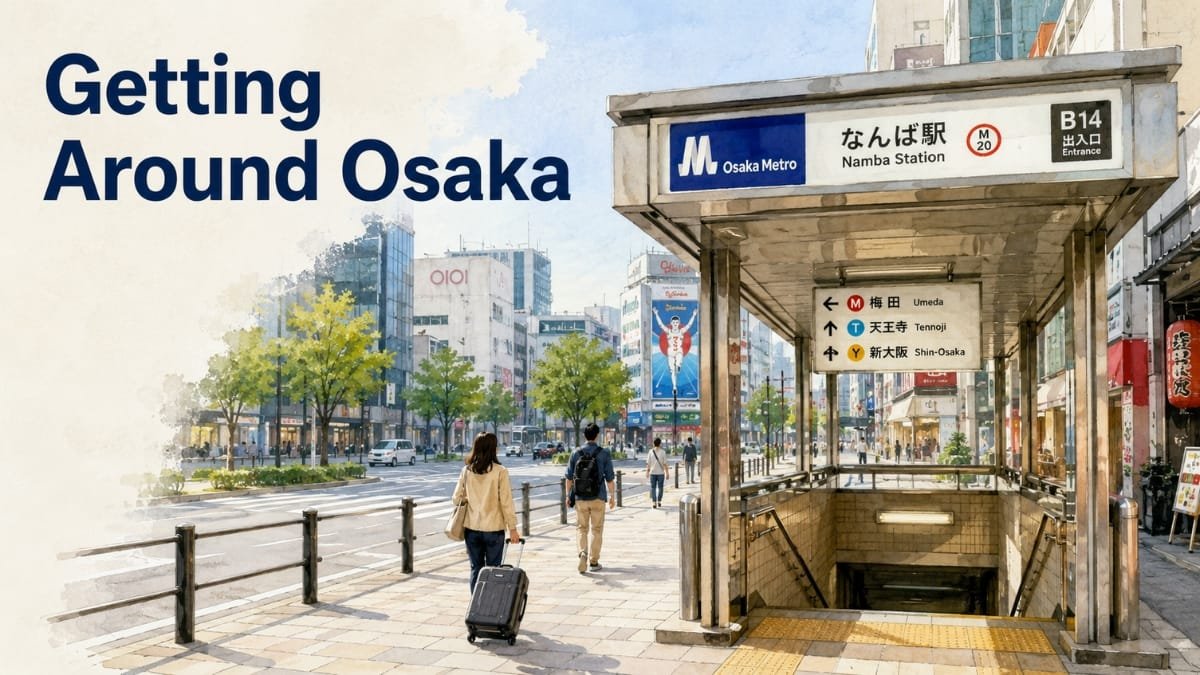
Osaka becomes much easier to navigate when you stop treating its transport network as one system. For each journey, make three decisions in order: which operator serves the destination, which station entrance or gate you need, and whether walking, rail, bus, or a short taxi ride removes the most difficult handoff.
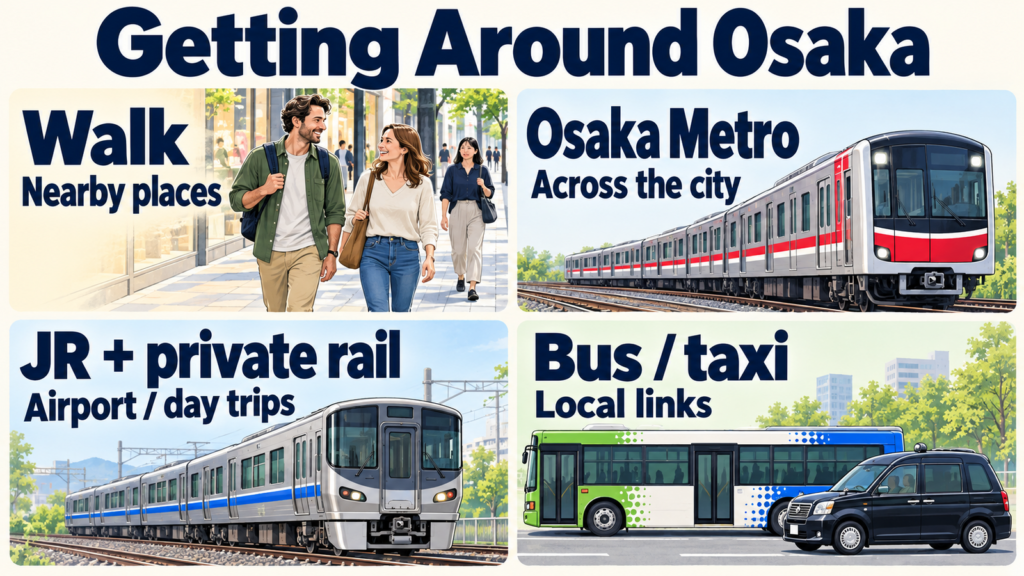
Rail is the default for most cross-city journeys. Osaka Metro is especially useful between central visitor areas; JR and the private railway companies become important for airports, regional trips, and destinations tied to a particular operator. Once you reach the right neighborhood, walking is often simpler than making one more transfer.
| Use | Usually the easiest choice | Check before leaving |
|---|---|---|
| One compact neighborhood | Walk | The actual distance from the correct station exit, not from the center of the station pin |
| Shin-Osaka, Umeda, Shinsaibashi, Namba, or Tennoji on one central spine | Osaka Metro Midosuji Line | Station code, terminal direction, and destination exit |
| Kansai Airport, Osaka Station, Universal City, Nara, Kobe, Kyoto, or another operator-specific destination | JR or the private railway named in the route | Company name, exact station, required ticket, and transfer gate |
| A direct local link, a difficult final walk, or a luggage-heavy last segment | Osaka City Bus or taxi | Bus number and destination, or the exact vehicle pickup point |
Build each trip from the destination backward
A route app can find a fast train while still leaving you with the wrong station building, a long underground walk, or an awkward street crossing. Start with the exact entrance of the hotel, attraction, restaurant, or venue. Then work backward through these questions:
- Which station is genuinely closest to that entrance?
- Which company operates that station?
- Which line and station code identify it?
- Which terminal name identifies the correct platform direction?
- Which exit, gate, or landmark should you follow at the destination?
The operator matters because names repeat. “Namba” can refer to Osaka Metro, Nankai, JR, Kintetsu, and Hanshin facilities in the same wider district. “Umeda” can place you at Osaka Metro, Hankyu, or Hanshin, while JR uses Osaka Station. These stations connect the same part of the city, but they do not share one universal gate or platform area.
This also changes the best airport route. Nankai serves Nankai Namba from Kansai International Airport. JR services are useful for Tennoji, Osaka Station, Shin-Osaka, and onward travel on applicable trains. Choose from the hotel entrance backward rather than selecting whichever airport train has the shortest advertised time. Our Kansai Airport to Osaka guide compares the main routes in more detail.
Save a route that still works in a crowded station
A destination pin alone is not enough when you are below ground. Before entering a station, save five fields in a note or screenshot:
- Operator: Osaka Metro, JR West, Nankai, Kintetsu, Hankyu, Hanshin, or another company.
- Line and station code: for example, Midosuji Line and Umeda M16.
- Terminal direction: the end station shown on the platform sign, such as “for Nakamozu.”
- Platform: useful as an advance clue, but recheck it on the departure board because assignments can change.
- Exit or landmark: a numbered exit, named gate, hotel, department store, or street-level landmark.
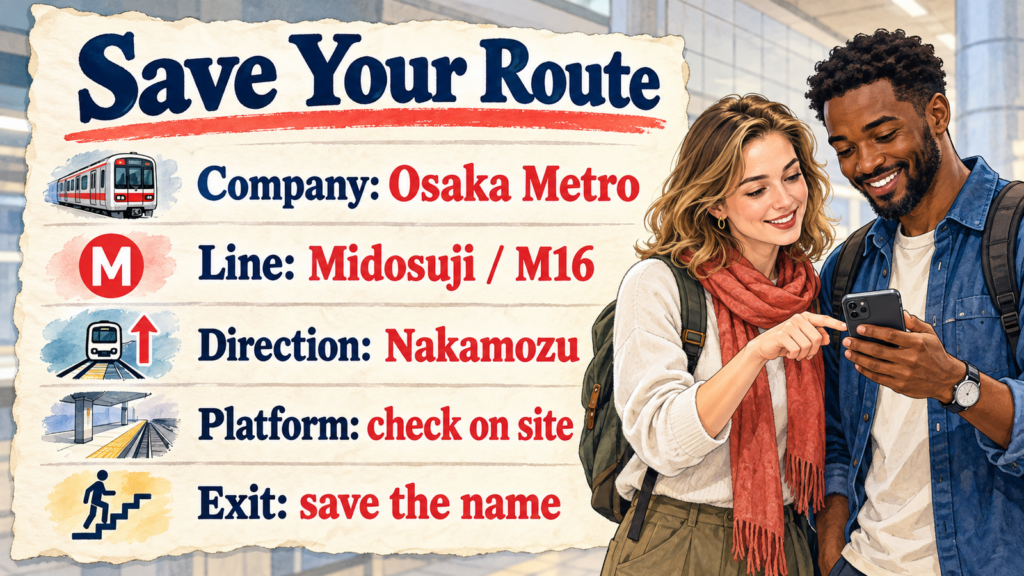
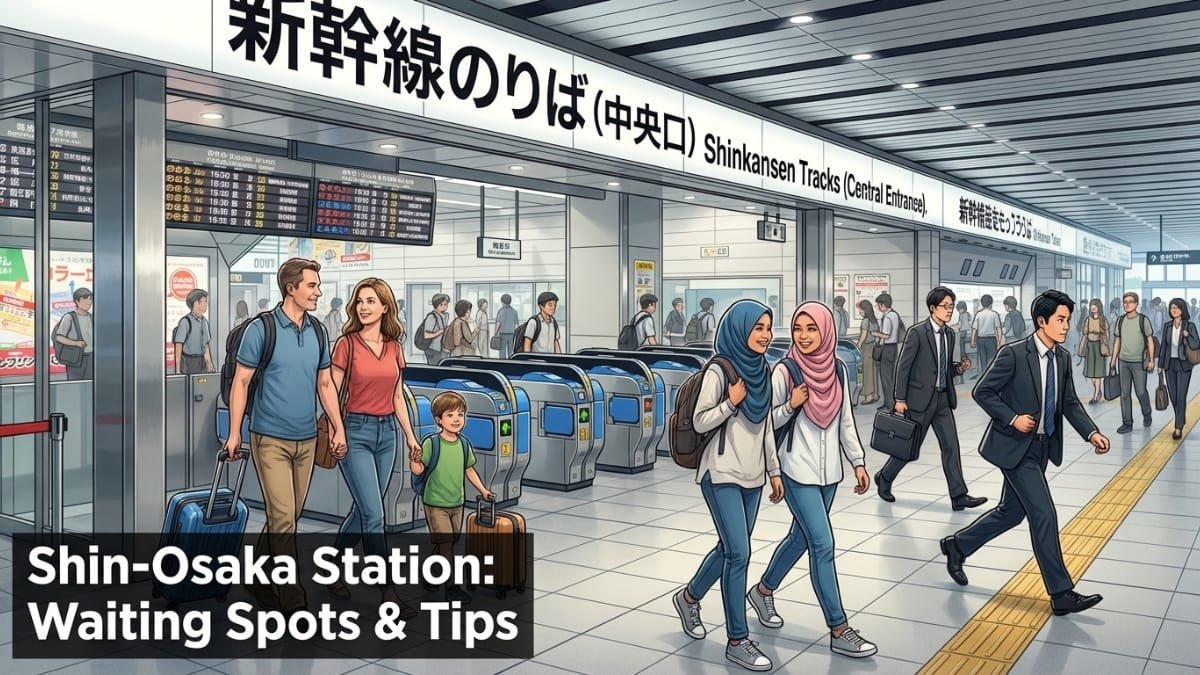
Osaka Metro station codes are particularly useful for international visitors. The red Midosuji Line uses the letter M: Shin-Osaka is M13, Umeda M16, Shinsaibashi M19, Namba M20, and Tennoji M23. The official Osaka Metro route map shows every line and code, while the route and fare search confirms a specific journey.
Do not translate terminal names into “north” or “south” unless a sign does so. Platforms are commonly labeled by the train’s terminal. You do not need to ride to that terminal; its name simply confirms which side carries you toward your stop.
For JR, use the official JR West route maps and timetables when the journey is time-sensitive. For a large interchange, save the station map as well as the timetable. Our Osaka Station navigation guide is designed for the wider Osaka–Umeda complex.
Use one payment method from entry to exit
For ordinary pay-as-you-go travel, an IC card such as ICOCA, Suica, or PASMO is the most flexible option. An IC card is a rechargeable stored-value card: tap it at a compatible entry gate, travel, and tap the same card when you leave. It does not automatically make the ride free, and one card pays for one passenger.
Using an IC card reduces ticket-machine decisions, but it does not erase operator boundaries. A limited express, Shinkansen, or reserved-seat service can require an additional ticket. A pass also has a defined coverage area; do not assume that a train continuing onto another company’s tracks remains fully covered.
Osaka Metro also accepts eligible contactless bank cards and linked devices at dedicated readers. That option is useful for an adult making ordinary Metro rides, but acceptance is not universal across every railway in Osaka. Osaka Metro charges the regular adult fare when a bank card or device is used, so it is not the right method for a child fare. The operator’s contactless-payment page shows the current scope and reader.
If you plan several covered journeys in one day, compare the actual fares with the Enjoy Eco Card. Its current adult price is ¥820 on weekdays and ¥620 on Saturdays, Sundays, and holidays; the child price is ¥310. The pass does not make JR or the private railways free, and exclusions apply, including travel to or from Yumeshima.
Our ICOCA guide covers purchase, recharge, low-balance recovery, and end-of-trip decisions. For the complete gate-to-platform sequence, use How to Ride Osaka Subway Without Stress rather than trying to learn every detail from a citywide overview.
Choose rail by the job it needs to do
Osaka Metro for central cross-city movement
The Midosuji Line is the easiest first spine to remember because it directly links five stations that appear repeatedly in visitor itineraries: Shin-Osaka, Umeda, Shinsaibashi, Namba, and Tennoji. Other Metro lines are useful when they serve the exact destination, but there is little value in memorizing them before you need them.
At the destination, treat the exit as part of the route. A station can cover a large underground area, and the nearest staircase is not always the nearest usable exit. Open the individual station page and match the exit with the destination pin before you board.
JR for Osaka Station, airport services, and regional connections
JR is central to journeys through Osaka Station, Tennoji, Shin-Osaka, Universal City, and many regional routes. “JR” means Japan Railways; in the Osaka region, the relevant passenger operator is usually JR West. Check the line and service name rather than following any sign that says JR.
For an airport day, confirm whether the specific train serves your destination and whether a reserved or additional ticket is needed. For a day trip, check the return service before leaving Osaka instead of assuming that the outbound pattern continues unchanged late at night.
Private railways for the destinations they serve best
Osaka’s private railways are not secondary versions of JR. They often provide the most direct route for a specific place. Nankai links Kansai Airport and Namba and also serves southern destinations including Sumiyoshi Taisha. Kintetsu is important for many Nara journeys; Hankyu and Hanshin are useful toward Kobe and parts of the northern region; Keihan serves a different corridor toward Kyoto.
At Kansai Airport, Nankai currently describes the Limited Express Rapi:t to Namba as taking as little as 34 minutes and requiring an additional limited-express ticket. Its Airport Express takes about 45 minutes and needs only the normal fare. Check the current Nankai airport timetable and service explanation before travel.
Osaka City Bus has one clear local sequence
Osaka City Bus can solve a journey that rail makes indirect, particularly when it connects two places along one street or removes a difficult final walk. It is less useful when a traveler chooses it only because the stop looks closer on a small map; road traffic and an unfamiliar stop can add more uncertainty than a train.
The current local sequence is:
- Check the route number and destination on the front and side display.
- Board through the rear-side entrance. Do not take a numbered ticket and do not tap at boarding on a standard Osaka City Bus.
- Watch or listen for the next stop and press a stop-request button.
- At the front, pay with cash, a supported IC card, or supported contactless payment.
- Leave through the front-side exit.
The standard flat fare is currently ¥210 for an adult and ¥110 for a child. The farebox gives change, so exact coins are not required. The official Osaka City Bus boarding guide shows the doors, payment order, and farebox interaction.
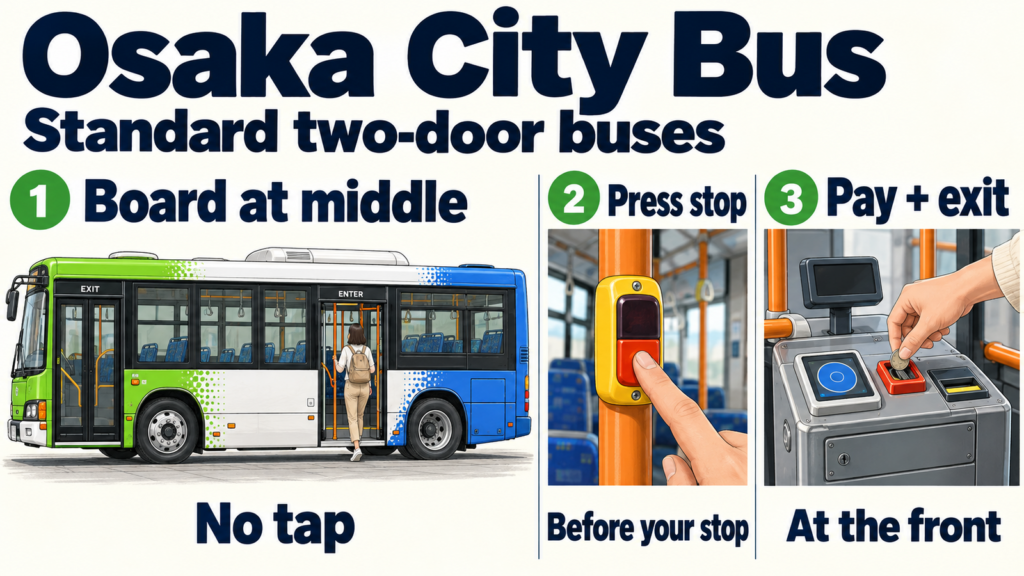
This sequence is local to Osaka City Bus. A bus in another Japanese city—or an airport, hotel, highway, or private-company bus in Osaka—may use a different door, ticket, or payment order. Read that operator’s instructions instead of generalizing the Osaka City Bus pattern.
Walk within an area, not between every name on the map
Walking is often the best transport once you are in the right district. Shinsaibashi, Dotonbori, Hozenji, and Namba can form one continuous Minami walk. Umeda and Osaka Station are also a single wider city-center area, although their underground levels and crossings make the walking route less obvious.
The useful calculation is exit to entrance, not station-center pin to attraction-center pin. Two places that look 600 meters apart can require a longer path around a large station, river, multilane road, or private building. Conversely, changing trains for one stop can take longer than continuing on foot along a direct shopping street.
Group nearby places before choosing transport. If the next stop is in the same neighborhood, walk unless weather, mobility, or luggage makes that a poor choice. If it is in another city center, use rail. If only the final block is difficult, use a taxi for that block rather than replacing the entire rail journey.
Let luggage change the route before you leave the airport
With a suitcase, the fewest train minutes may not be the easiest journey. Compare three practical shapes:
- Direct rail: best when the destination station is close to the hotel and the step-free route is clear.
- Rail plus a short taxi: useful when rail handles the long distance well but the last street segment has stairs, slopes, heat, rain, or a confusing entrance.
- Storage before sightseeing: useful before check-in, after check-out, or during a daytime stop—provided the hotel or service confirms its hours and conditions.
Osaka Metro states that all 133 Metro and New Tram stations have at least one wheelchair-accessible “one route” between ground level and the platform. This does not mean every entrance is step-free or that the elevator appears beside the shortest stairs. Use the official accessibility information and the individual station map, and allow extra time for the accessible route.

Ask the hotel whether it will hold bags before check-in or after check-out, including any same-day or size restriction. Station lockers are useful, but availability at the bank nearest your platform is not guaranteed. A confirmed staffed option is safer when a reserved train or flight depends on the timing.
Recover calmly when the route goes wrong
Missing a stop is usually a small problem. Leave at the next station, check the line and direction again, and follow signs for the opposite platform. Do not assume it is directly across from the arrival platform; station layouts differ.
If a ticket gate closes, step away from the lane and read the display. A low IC-card balance can often be fixed at a fare-adjustment or recharge machine inside the paid area. If the problem involves a paper ticket, a reserved service, or an unmatched entry record, show the ticket or card to staff before trying several other gates.
During disruption, separate the decisions again: operator, present station, desired destination, and available alternative. Check the operator’s official service status rather than relying only on an old route screenshot. A taxi can be a useful fallback for a short final segment, but it is rarely the first response to a cross-city railway delay.
For your first Osaka journey, choose a direct route even if an app shows a slightly faster transfer. Save the operator, station code, terminal direction, and exit. Once those four details become familiar, the city stops feeling like a single complicated network and becomes a series of small, recoverable decisions.