
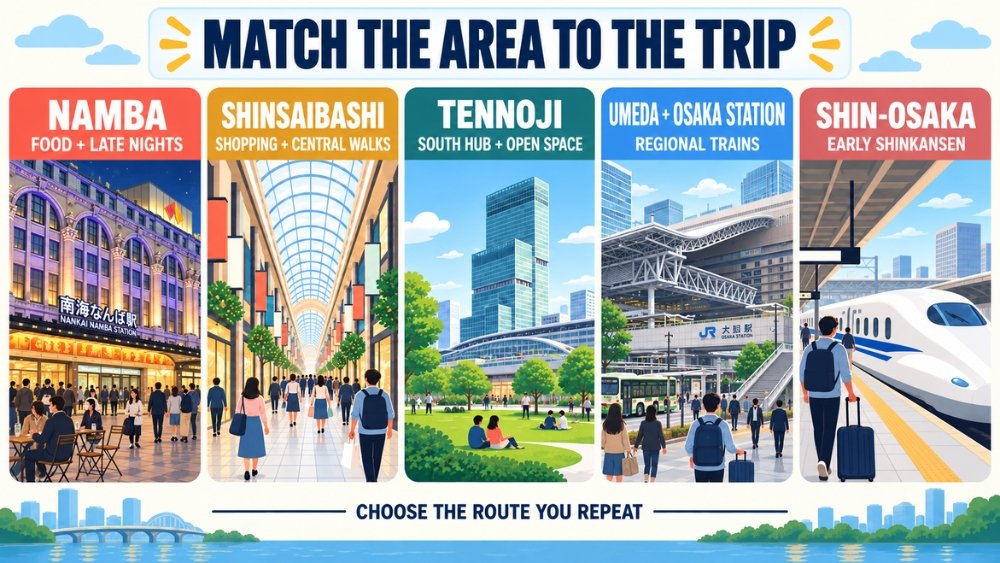
For most first-time visitors, Namba is the easiest all-round base for food and late evenings, while Umeda and the Osaka Station area are better when several mornings begin with regional trains. Choose Shinsaibashi for central shopping and walkable access to Minami without sleeping at Dotonbori’s busiest edge, Tennoji for a well-connected southern base with more open space nearby, and Shin-Osaka only when an early, late, or repeated Shinkansen journey is the deciding factor.
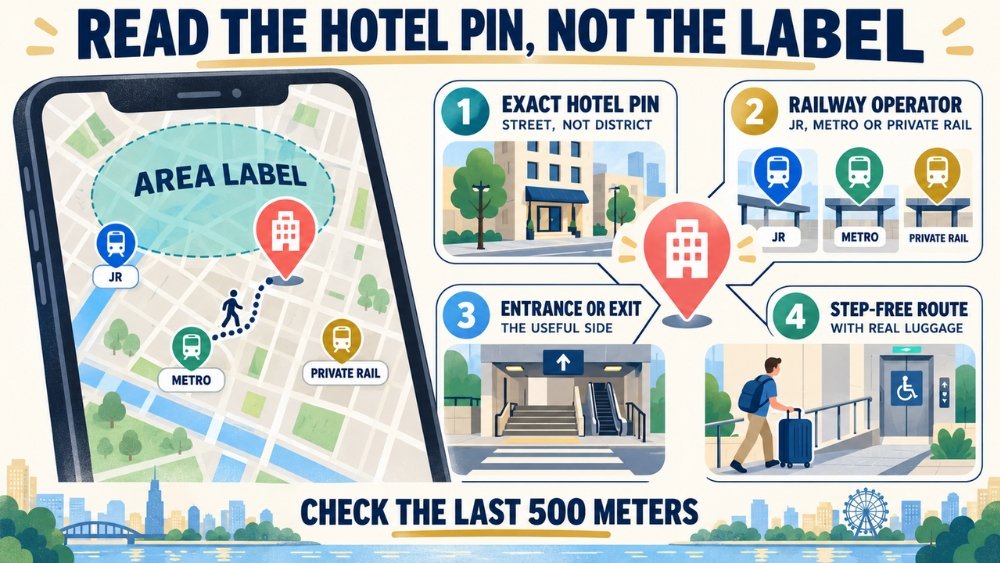
The neighborhood name is only the first filter. In Osaka, two hotels marketed under the same area can lead to different railway operators, station entrances, underground walks, and evening environments. Make the final choice from the exact hotel pin and room—not from the district label alone.
Quick answer: which Osaka area fits your trip?
| Hotel-search label | What it means in practice | Best fit | Main trade-off to check |
|---|---|---|---|
| Namba | Several nearby Namba stations operated by Nankai, Osaka Metro, JR, Hanshin, and Kintetsu | First Osaka visit, Minami evenings, Nankai airport access, Kintetsu trips toward Nara | The correct station and the late-night noise on the exact block |
| Umeda | The commercial district surrounding JR Osaka Station and multiple private-railway and subway stations | Kyoto/Kobe-oriented days, department stores, broad dining choice, north-Osaka connections | Large station complex and a potentially long walk to the advertised “Umeda” hotel |
| Shinsaibashi | Central Minami around Shinsaibashi Station and the covered shopping arcade | Shopping, walking to Namba, central evenings without choosing Dotonbori itself | A listing may be closer to Namba, Nagahoribashi, or Yotsubashi than its label suggests |
| Tennoji | JR and Osaka Metro at Tennoji, with Kintetsu Osaka-Abenobashi nearby | Southern Osaka, JR airport travel, families who value shops and park space | Less convenient when most mornings and evenings are in northern Osaka |
| Osaka Station area | The JR-centered part of the same wider district visitors call Umeda | Short stays, luggage-heavy rail arrivals, frequent JR journeys | “Near Osaka Station” can still mean the opposite side of a very large complex |
| Shin-Osaka | Osaka’s Shinkansen gateway, also served by JR local lines and Osaka Metro | Early/late Shinkansen, one-night rail stop, repeated long-distance train days | A functional transport base rather than the best default for Osaka evenings |
First decode the labels on hotel sites
Umeda and Osaka Station are one connected city-center cluster
Umeda is the wider district name; Osaka Station is the main JR station inside it. Nearby are Osaka-Umeda stations used by Hankyu and Hanshin, plus Osaka Metro’s Umeda, Higashi-Umeda, and Nishi-Umeda stations. These are connected at street level and through underground passages, but they are not one small set of platforms behind a single gate.
That distinction matters with a suitcase. A room convenient for the Hankyu side may be less convenient for a JR airport train, while a hotel south of Osaka Station may be closer to Nishi-Umeda or Higashi-Umeda than to the entrance you first pictured. The official Osaka Metro Umeda station page shows transfers, exits, and barrier-free routes. Use it with Osaka Station in Google Maps and the hotel’s own access page.
Namba is also a cluster, not one station building
“Namba Station” can refer to Nankai Namba, Osaka Metro Namba, JR Namba, or the connected Hanshin and Kintetsu facilities at Osaka-Namba. The official Osaka Metro Namba page lists its transfers and station maps. If your arrival plan uses Nankai from Kansai International Airport, check Nankai Namba Station in Google Maps rather than measuring from a generic “Namba” pin.
Nankai currently describes its Rapi:t limited express as taking as little as 34 minutes from Kansai Airport to Namba, while its Airport Express takes about 45 minutes; the Rapi:t requires the appropriate limited-express ticket. Recheck the official Nankai airport-access information for your date and time.
Use three tests before comparing hotels
1. The first-morning test
Map the first important journey after breakfast. Start at the hotel entrance, not the neighborhood name, and include the walk to the correct railway operator, the station interior, and any transfer. Repeat this for two or three mornings. A base that saves 15 minutes on a journey you make four times may be more useful than one that is closest to a single attraction.
2. The 8 p.m. test
Ask what you want outside the hotel after a full sightseeing day. Namba puts food and nightlife close at hand. Shinsaibashi keeps you in central Minami with strong shopping access. Umeda gives you large commercial complexes and easy meals around a major transport hub. Tennoji can feel less centered on visitor nightlife. Shin-Osaka works when being near the train matters more than extending the evening.
Then inspect the block. A lively district can contain a quiet rear-facing room, and a supposedly calm district can place you beside tracks or a major road.
3. The luggage-route test
Trace arrival and departure with the bags you will actually carry. Check stairs, elevators, large crossings, pedestrian decks, and the final hotel entrance. Official station maps are more reliable for the internal route than a hotel site’s neighborhood label. Travelers with limited mobility should confirm the step-free route with both the operator and the hotel when any part is unclear.

Namba: best when Osaka evenings are part of the plan
Choose Namba when you expect several evenings around Dotonbori, Hozenji, Kuromon Market, or the wider Minami dining area. It also makes sense when the direct Nankai connection to Kansai International Airport or Kintetsu services toward Nara matches your itinerary. Kintetsu’s current sample itinerary gives about 40 minutes from Osaka-Namba to Kintetsu-Nara; treat that as a planning reference and check the timetable for your train.
Do not book “Namba” before deciding which Namba you need. A hotel south of Nankai Namba may suit an airport arrival but add distance to JR Namba. A room near Dotonbori may make dinner effortless but require more care with street noise. Our guide to choosing a hotel near Namba Station explains the station cluster in more detail.
If Namba fits your trip, compare current Namba hotel prices and availability on Klook. Klook lets you switch the displayed language and currency, which can make the first comparison easier in a familiar format. Recheck the exact property, room category, cancellation terms, taxes, and final total before paying.
Umeda: best for a north-Osaka transport base
Choose Umeda when several days begin toward Kyoto, Kobe, or other destinations served conveniently from the north-Osaka rail network. JR, Hankyu, and Hanshin do not serve every destination in the same way, so check the operator used by each actual journey. Umeda also works for travelers who prefer department stores, large indoor commercial complexes, and many dinner options without centering the stay on Dotonbori.
The main drawback is scale. The station district is navigable, but a route that looks short on a city map may include several underground turns or an elevated walkway. Open the hotel pin alongside Umeda Station in Google Maps and confirm the entrance named by the hotel.
If Umeda or the Osaka Station area fits your trip, compare current Umeda hotel prices and availability on Klook. Treat Umeda and Osaka Station as one broad search zone, then judge each property’s exact side of the complex.
Shinsaibashi: best for a central Minami compromise
Shinsaibashi suits travelers who want the covered Shinsaibashi-suji shopping arcade, easy access to central Minami, and the option to walk toward Namba without choosing Dotonbori’s busiest blocks as the hotel address. Osaka Metro’s official Shinsaibashi station page shows the Midosuji Line connection and transfers to the Nagahori Tsurumi-ryokuchi and Yotsubashi lines.
The hotel pin matters because “Shinsaibashi” stretches across listings. Check whether the nearest useful station is actually Shinsaibashi, Yotsubashi, Nagahoribashi, or Namba, and open Shinsaibashi Station in Google Maps. If you are choosing specifically between the two Minami bases, use our Shinsaibashi vs Namba guide.
If Shinsaibashi fits your trip, compare current Shinsaibashi hotel prices and availability on Klook. Check the walking route after the arcade closes as well as the daytime route.
Tennoji: best for a connected southern base
Tennoji combines JR and Osaka Metro at Tennoji Station, with Kintetsu’s Osaka-Abenobashi Station nearby. The Midosuji Line runs directly to Namba, Umeda, and Shin-Osaka, while JR services include airport connections. JR West’s current HARUKA information lists Tennoji among its Kansai Airport destinations; check the train, ticket, and eligibility rules that apply to your trip.
The station area also puts major shopping buildings and Tennoji Park within reach. It can suit families and travelers who want a practical hub without planning every night around Minami. It is a weaker fit if several days begin from Osaka Station or most nights end in Umeda.
Use the official Osaka Metro Tennoji page for exits and barrier-free routes, and compare the hotel pin with Tennoji Station in Google Maps. Nearby Osaka-Abenobashi is a different station name, not a spelling variation.
If Tennoji fits your trip, compare current Tennoji hotel prices and availability on Klook. Some broad search results can extend well beyond the station, so reject any property whose actual map position does not fit your route.
Osaka Station area: choose the useful side of Umeda
The Osaka Station area is not a separate competitor located away from Umeda. It is the JR-centered part of the same wider district. Choose this label when JR Osaka Station is the repeated anchor: perhaps you arrive with luggage, make several JR day trips, or leave early on the final morning.
Check whether the hotel is north, south, east, or west of the station and whether the route stays indoors. A property described as close to Osaka Station may still require a substantial station crossing. Our Osaka Station area guide helps decode the surrounding landmarks and station sides. Use the same Umeda-area comparison above rather than treating this as a materially different hotel market.
Shin-Osaka: best for a timetable-driven stay
Shin-Osaka should win only when the Shinkansen schedule saves more friction than another neighborhood adds. Good reasons include a very early departure, a late arrival followed by sleep, a one-night rail stop, or several long-distance train days. It is not automatically the best base merely because your train from Tokyo arrives there; Osaka Metro’s Midosuji Line and JR local services connect the station with the rest of the city.
The official Osaka Metro Shin-Osaka page identifies transfers to JR and the Shinkansen and provides station maps. Open Shin-Osaka Station in Google Maps and confirm whether the hotel route begins at the Shinkansen gates, JR local-line gates, or Osaka Metro. Our Shin-Osaka vs Osaka Station guide covers that choice in more detail.
If Shin-Osaka fits your timetable, compare current Shin-Osaka hotel prices and availability on Klook. Do not pay a station-premium price unless the saved transfer is useful on your actual arrival or departure.
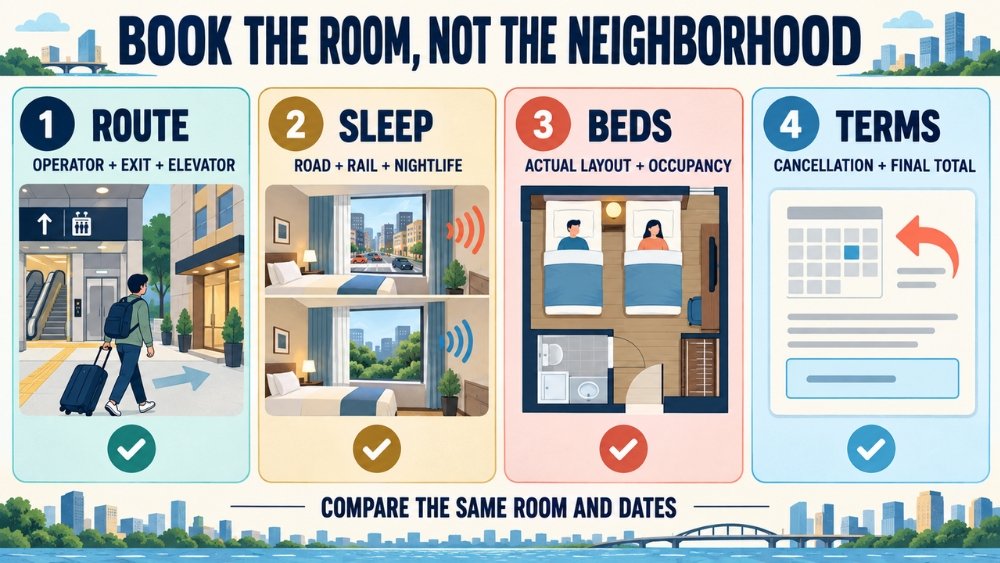
Book the room, not just the neighborhood
Run these checks on the exact room before paying:
- Route: Map the operator, station entrance, elevator-friendly path, and final walk with luggage.
- Sleep: Read recent room-specific comments for road, railway, corridor, lift, and nightlife noise. Ask about room orientation when it matters.
- Occupancy: Confirm the actual beds and permitted number and ages of guests. “Twin,” “double,” and “family” do not guarantee the layout you expect.
- Terms: Compare the same room and dates, then check breakfast, taxes, payment timing, cancellation deadline, and final total.
- Arrival details: Confirm check-in hours, late-arrival procedure, luggage storage, and whether the hotel currently accepts forwarded luggage.
For a wider set of bases beyond the six labels on this page, see our guide to Osaka’s best areas for tourists. If you are still split between the two most common first-time choices, the Namba or Umeda comparison tests their station clusters and day-trip patterns directly.
Final recommendation
Choose Namba when food and Minami evenings define the stay. Choose Umeda or the Osaka Station area when regional rail and easy north-Osaka connections define it. Choose Shinsaibashi for a central Minami base built around shopping and walking, Tennoji for a practical southern hub, and Shin-Osaka only when the Shinkansen timetable is unusually important.
Once the area is clear, compare current Osaka hotel prices and availability on Klook, then return to the exact pin, room, and cancellation conditions before booking. A less famous room beside the correct station entrance can be a better Osaka base than a highly rated hotel on the wrong side of your daily route.