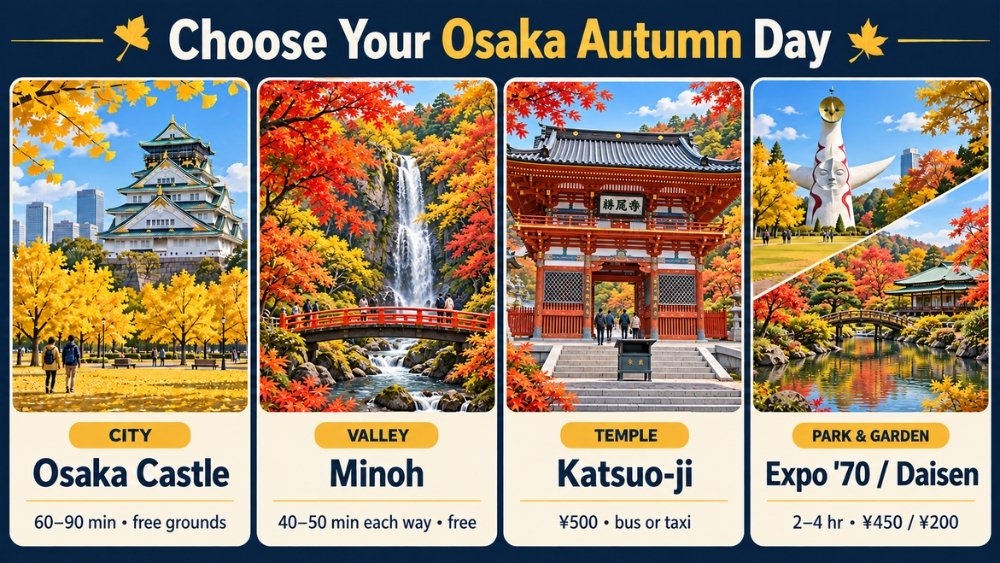
Osaka’s autumn leaves are easiest to enjoy when you choose one kind of day, not the longest list of famous places. For a simple city walk, start with Osaka Castle Park. For a classic valley route, walk from Hankyu Minoh Station to Minoh Waterfall. Choose Katsuo-ji for temple scenery, Expo ’70 Commemorative Park for space and variety, or Daisen Park Japanese Garden for a quieter paid garden.
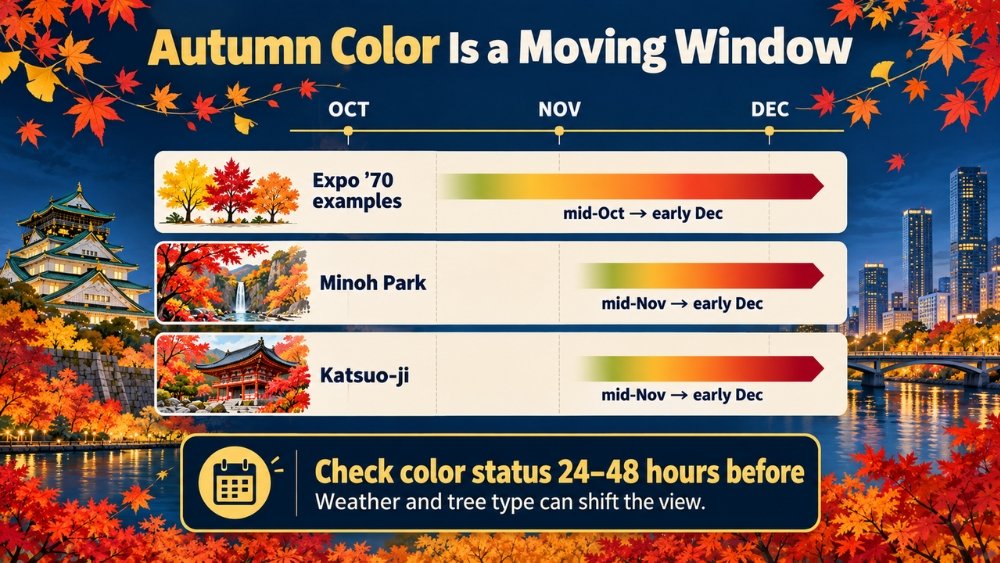
The broad planning window is mid-November to early December, but there is no single Osaka-wide peak day. Different trees change at different times, mountain valleys can move before central-city parks, and warm or wet weather can shift the view. Check the venue’s current color report and access notice again one or two days before you go.
This guide was checked on October 4, 2026. Three current details deserve attention: Minoh Park’s 2026 color updates are due to begin on November 1; Expo ’70 Park will not accept ordinary park admission on October 31 or November 1 during a separately ticketed event; and the usual riverside approach from Kisaichi Station to Hoshi no Buranko is currently closed.
| If you want… | Start with | Time on site | Main cost | Main trade-off |
|---|---|---|---|---|
| The easiest central option | Osaka Castle Park | 60–90 minutes | Park grounds are free | Urban rather than mountain scenery |
| A classic riverside autumn walk | Minoh Park | 2–3 hours | Free | About 40–50 minutes’ walking each way to the waterfall |
| A temple and evening-light atmosphere | Katsuo-ji | 1.5–2.5 hours | ¥500 for adults | Bus, taxi or car planning is essential |
| A spacious park with several tree types | Expo ’70 Commemorative Park | 2–4 hours | ¥450 for adults; junior-high age and younger free | Large grounds and a 4:30 p.m. last entry |
| A calm, compact Japanese garden | Daisen Park Japanese Garden | 45–90 minutes | ¥200 for adults | South of central Osaka and closed on most Mondays |
| A more active forest outing | Hoshi no Buranko | Half a day | Ordinary entry is free | Current access disruption, steep paths and parking pressure |
1. Plan for a color window, not one promised peak date
Minoh Park and Katsuo-ji both describe their usual autumn window as mid-November to early December. That is a useful range, not a reservation-quality promise. Color can differ between the bottom and top of the same valley, and a windy or rainy day can shorten the best-looking stage.
Expo ’70 Park shows why a single “peak” date is misleading. Its current autumn guide lists different periods for different trees and areas: American sweetgum can begin around mid-October, maple areas are generally strongest during November, and metasequoia can continue into early December. A visit can still be worthwhile when one tree type is early or late because another part of the park may be changing.
Use a three-step check:
- Choose a date inside the broad venue window.
- Open the venue’s current color or seasonal page 24–48 hours before the visit.
- Keep one flexible city alternative if the mountain color, weather or access is poor.
The Minoh Park autumn-color page says its 2026 status updates will begin on November 1. The Expo ’70 autumn-spots page is useful when you want to match the walk to the trees currently changing.
2. Choose the outing by walking load and transport, not fame
The best place is the one that fits the energy you actually have that day.
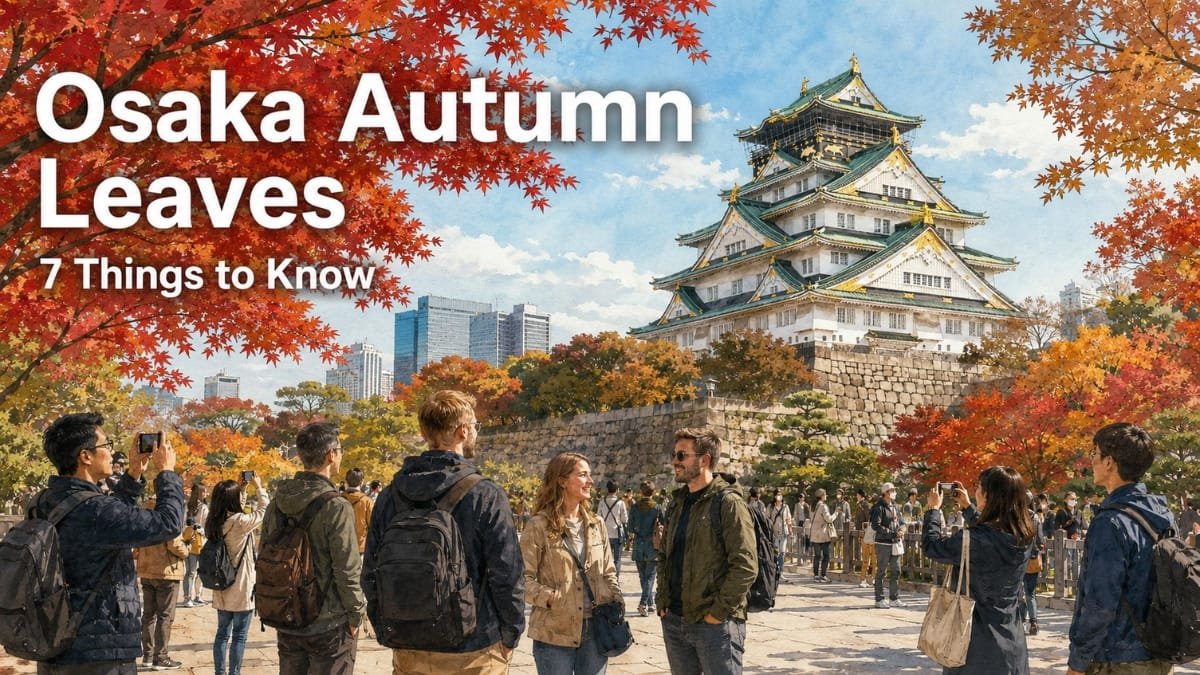
Choose Osaka Castle Park when you have only an hour or want a low-commitment city option. The broad grounds, moats and castle views work well with yellow ginkgo and later-season city foliage. The park walk is free; entering Osaka Castle Museum is a separate, paid decision. Do not add the museum automatically if your main goal is outdoor color and daylight is limited.
Choose Minoh when you are comfortable with a sustained out-and-back walk. The waterfall is the destination, but the riverside path is the experience. This is not a five-minute photo stop from the station.
Choose Katsuo-ji when the temple setting matters more than a long forest walk. It has a defined admission fee and transport bottleneck, so the bus or taxi plan is part of the visit.
Choose Expo ’70 Park when a group needs space, toilets, rest points and several possible walking areas. Choose Daisen when you prefer a smaller garden, pond and strolling path. Keep Hoshi no Buranko for a more active day only after checking the live access notice.
Trying to combine Minoh, Katsuo-ji and Hoshi no Buranko in one public-transport day creates more waiting and road uncertainty than autumn viewing. One major destination plus a simple dinner plan is usually better.
3. Minoh and Katsuo-ji are different trips
Minoh Park and Katsuo-ji are both in Minoh City, but they should not be treated as adjacent stops.
Minoh Park: walk from the station
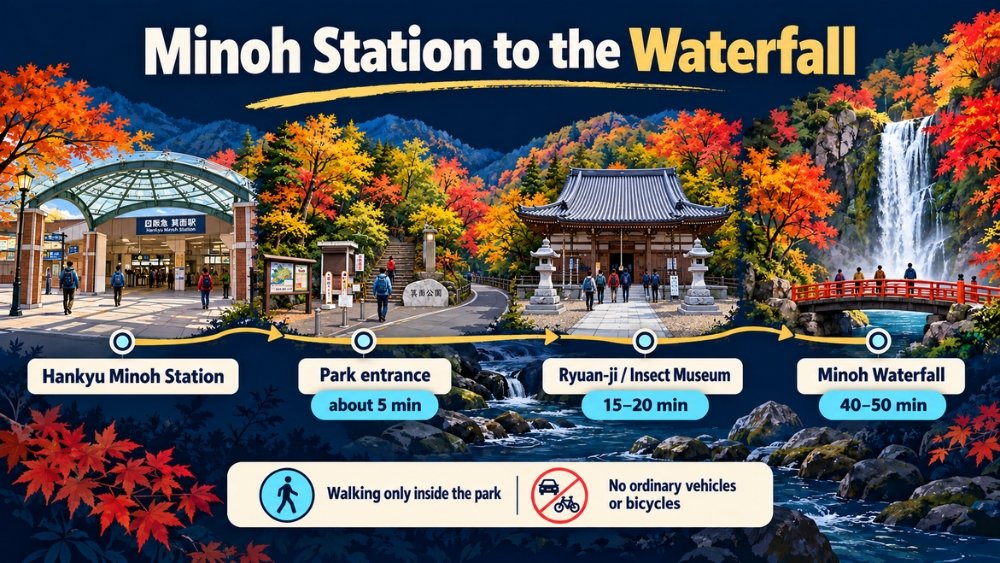
From Hankyu Minoh Station, the park entrance is about five minutes away. The official access guide places the insect museum area at roughly 15–20 minutes and Minoh Waterfall at roughly 40–50 minutes from the station. Those are walking estimates before photo stops, snacks or time at the waterfall.
Ordinary vehicles and bicycles are not permitted inside the park, and there is no visitor parking within it. Public transport is the practical default. If you arrive via Minoh-kayano Station on the Midosuji/Kita-Osaka Kyuko corridor, the official Minoh access page lists local bus connections to Hankyu Minoh Station. If you use a wheelchair, the park office also publishes information about electric-assist wheelchair loans; contact the office before relying on availability.
Katsuo-ji: solve the return ride first
Katsuo-ji’s current access page lists a direct-route bus from Minoh-kayano Station. When checked, buses were published at approximately 10-minute intervals from 9:00 a.m. to 3:00 p.m., but the return timetable and seasonal crowd notices should control your plan. A taxi is listed at about 15 minutes from Minoh-kayano Station or about 20 minutes from Hankyu Minoh Station.
Admission is ¥500 for high-school-age visitors and adults, ¥400 for elementary- and junior-high-school students, ¥100 for preschool children, and free for children aged two and under. The official web admission ticket can reduce the arrival queue, but it does not reserve your bus or guarantee an uncongested road.
Regular hours are 8:00 a.m.–5:00 p.m. on weekdays, Sundays and public holidays, with final admission at 4:30 p.m.; Saturdays run to 6:00 p.m., with final admission at 5:30 p.m. Seasonal operation can change. If you drive, check the parking rule before departure: weekends, public holidays and specified dates may require a parking reservation.
4. Osaka Castle, Expo ’70 and Daisen reduce friction in different ways
These three are useful when a mountain route feels too demanding, but they are not interchangeable.
Osaka Castle Park: the flexible city fallback
Use Osaka Castle Park when you want no admission deadline for the outdoor walk, several rail approaches and an easy exit if the weather worsens. A practical route is to enter from the side most convenient to your next plan, walk toward the castle keep, then leave through another side instead of forcing a full loop. The grounds are extensive, so save both your start station and intended finish station.
Expo ’70 Park: the widest range of autumn trees
The park is open 9:30 a.m.–5:00 p.m., with entry until 4:30 p.m. It is normally closed on Wednesdays, although it has no regular Wednesday closure in October or November. Adult admission is ¥450 for the Natural and Cultural Gardens plus the Japanese Garden; visitors of junior-high-school age and younger enter those areas free.
The official autumn-spots guide separates plane trees, sweetgum, maples, metasequoia and the Japanese Garden, which makes the park a strong choice when the season is uneven. Wet leaves, moss and riverside surfaces can become slippery, so grip matters more than fashionable shoes.
For 2026, ordinary park tickets and annual passes will not provide admission on October 31 and November 1 during KAMIGATA EXPO PARK FES; only the dedicated event ticket is valid. The park also lists free short autumn guides on November 17, November 23 and December 1, with park admission still required and rain cancellation possible. Recheck the current visitor guide, special admission notice and autumn guide event page before traveling.
Daisen Park Japanese Garden: the compact quiet option
Daisen Park Japanese Garden is open 9:00 a.m.–5:00 p.m., with entry until 4:30 p.m. Adult admission is ¥200 and elementary- or junior-high-school admission is ¥100. It normally closes on Monday, or the next weekday when Monday is a public holiday.
This is the better fit when you want a contained strolling garden rather than a long valley or huge park. Allow about an hour for the garden itself, and add time only if you also plan to explore Daisen Park or nearby Sakai sights. Special night openings can use separate admission, so do not assume the ordinary daytime ticket covers an event.
5. Hoshi no Buranko is not the default first trip right now
Hoshi no Buranko is a 280-meter suspension bridge set roughly 50 meters above the forest floor. It can be impressive in autumn, but the current access situation makes it the least forgiving choice in this guide.
The official Hoshida Forest access notice says the usual riverside path from Kisaichi Station is closed, so you cannot currently use the familiar station-to-park walk described in older guides. The published public-transport alternative is to take the Orhime Bus from Keihan Katano-shi Station to Minamihoshidai, then walk about 40 minutes. Walking from JR Hoshida Station takes about 70 minutes.
If you drive, check the live parking camera before entering the area. The parking lot can fill during autumn weekends, and roadside waiting on Route 168 is prohibited. From the parking side, reaching the bridge still involves a substantial approach with steep or unpaved sections.
The facility normally operates 9:00 a.m.–5:00 p.m., while the bridge operates 9:30 a.m.–4:30 p.m. Weather or maintenance can change access. Treat the official notice—not an old route article or saved map—as the final authority on the day.

6. Last entry and light-up plans can change the whole route
Autumn daylight disappears earlier than many visitors expect. Work backward from the final admission time, not from the time you hope to leave the hotel.
For a daylight visit, aim to reach Minoh Station early enough to walk 40–50 minutes, pause at the waterfall and return before the valley becomes dark. At Expo ’70 and Daisen, a 4:30 p.m. last entry does not leave enough time for a relaxed first visit if you arrive at 4:20.
Katsuo-ji’s autumn page describes after-dark illumination during the foliage season, but exact event dates and operating arrangements should come from the current official notice. Do not build a late trip around a previous year’s schedule. A normal Saturday closing time and a special seasonal light-up are not automatically the same thing.
Night color is attractive, but it adds bus queues, darker walking surfaces and a colder wait. If the light-up is the priority, visit one venue and secure the return route before arrival. If natural color is the priority, morning or early afternoon is simpler.
7. Shoes, luggage and accessibility matter more than camera gear
Autumn leaves can hide uneven edges and make stone, moss and slopes slippery after rain. Wear shoes with grip. A light layer is useful because shaded valleys and evening temple grounds can feel cooler than central Osaka even when the afternoon starts mild.
Leave suitcases at the hotel or a confirmed storage facility. Minoh’s long riverside walk, Katsuo-ji’s bus queue and Hoshida’s steep approach are all poor places to manage large luggage. A small day bag, water and a charged phone are enough for most visits.
For a stroller, wheelchair or limited walking range, compare the complete route, not only the destination entrance. Osaka Castle Park and Expo ’70 Park usually provide more route choices and rest opportunities, but large grounds still create distance. Minoh publishes an electric-assist wheelchair service, yet the waterfall route remains long. Hoshi no Buranko should not be assumed step-free because the bridge itself looks level in photographs.
Keep tripods and long photo stops out of the walking flow. At temples and gardens, follow posted photography rules and do not enter planted areas for a cleaner angle. The best photo is not worth blocking a narrow valley path or missing the last bus.
Three plans that work without rushing
| Available time | Simple plan | Why it works |
|---|---|---|
| 60–90 minutes in central Osaka | Osaka Castle Park outdoor loop | Free, flexible and easy to shorten |
| Half a day | Hankyu Minoh Station → Minoh Waterfall → return | One clear route with color along the walk |
| Half to full day | Expo ’70 Park, focusing on two or three autumn areas | Several tree types without a mountain transport bottleneck |
Katsuo-ji can also fill a half day when you reserve enough time for both directions of the bus or taxi journey. Daisen works well as a shorter garden visit paired with another Sakai plan. Hoshi no Buranko requires the most live access checking and should remain a standalone outing.
If your day uses multiple rail companies, an IC card such as ICOCA, Suica or PASMO is usually easier than buying a separate ticket for each ordinary ride. It does not reserve a bus seat or venue ticket. Our guide to getting around Osaka explains how Osaka Metro, JR and private railways fit together.
Check these five things the night before
- Open the current color-status page, not only a seasonal forecast.
- Confirm the route notice and return transport, especially for Katsuo-ji and Hoshi no Buranko.
- Recheck hours, last entry, closures and event-only dates.
- Look at rain and wind, then choose shoes and layers for the surface.
- Save the exact station, entrance and return point; a general area pin is not enough.
The simplest first Osaka autumn day is usually Osaka Castle for convenience, Minoh for a classic walk, Katsuo-ji for temple atmosphere, Expo ’70 for variety, or Daisen for a calm garden. Pick one, check the live conditions, and leave enough daylight to enjoy it without turning the visit into a race.