A Japan travel eSIM can get you online as soon as you land, without collecting a router or changing a physical SIM. The difficult part is choosing a plan whose rules are as convenient as the technology.
The lowest headline price is rarely enough. You also need to know when the validity period starts, how much full-speed data “unlimited” includes, whether hotspot use is allowed, and what happens if the eSIM will not connect.
Quick answer: the best Japan travel eSIM for each type of traveler
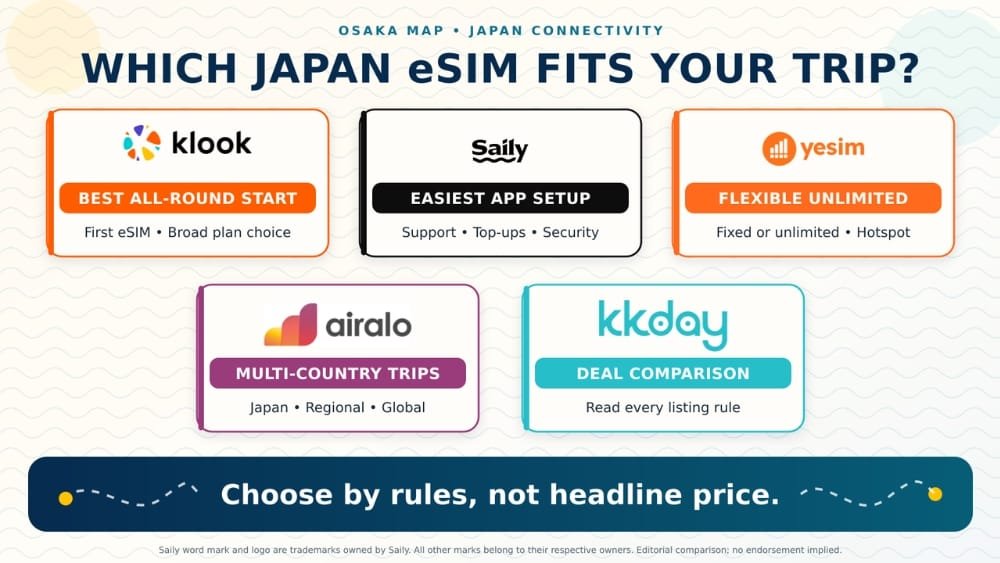
- Best overall for most first-time visitors: Klook — a broad choice of total-data, daily-data, and unlimited packages, with clear network and speed details on its main Japan listing.
- Best for simple app-based setup and support: Saily — automatic activation on arrival, in-app top-ups, 24/7 chat, and built-in security features.
- Best for flexible fixed and unlimited plans: Yesim — a wide range of plan sizes and durations, hotspot support, and automatic network switching.
- Best for a multi-country trip: Airalo — Japan-only, regional, and global products inside one established app.
- Best for careful deal hunters: KKday — many supplier listings and promotions, but package rules require closer reading.
For a typical 7- to 14-day trip using maps, train searches, messaging, translation, and some social media, 10GB is a sensible planning point. Choose 20GB or an unlimited plan if you expect frequent video, large uploads, remote work, or regular hotspot use.
Klook is the strongest all-round starting point for most first-time visitors, but the exact package matters more than the marketplace name. Before paying, compare the current Klook Japan eSIM package details, including the network, activation trigger, and full-speed allowance.
Plan details, prices, exchange rates, discounts, and network partners can change. Product information in this article was checked on July 31, 2026. Confirm the selected package at checkout.
Japan travel eSIM comparison table
| Provider | Best for | Setup and management | Data choices | Hotspot | Main watch-out |
|---|---|---|---|---|---|
| Klook | Most first-time visitors | Klook app, QR code, or manual installation on the main listing | Total data, daily data, and unlimited | Supported on the reviewed main listing | Networks, limits, and rules vary by package |
| Saily | Easy setup, support, and security tools | App-led setup with automatic activation on arrival | Fixed data and unlimited | Supported | Plans have an activation window; the public page does not name one fixed Japanese network partner |
| Yesim | Flexible fixed or unlimited plans | App and QR-code setup with one-click options | Fixed data, unlimited, and pay-as-you-go options | Supported | Unlimited service may be slowed under network fair-use rules |
| Airalo | Repeat and multi-country travelers | App-based purchase, installation, monitoring, and top-ups | Japan-only, regional, and global products | Supported when the device, network, and selected plan allow it | Local, regional, and global products have different inclusions |
| KKday | Promotion and package comparison | QR code; one-click installation is available on some supported iPhones | Varies widely by supplier listing | Varies by listing | Activation, APN, cancellation, and refund rules are product-specific |
There is no universal winner. Klook reduces decision friction for a first purchase. Saily makes ongoing management easier. Yesim gives heavy users more duration choices. Airalo is useful when Japan is one stop on a larger trip. KKday can be competitive when you are prepared to inspect every condition.
Who should not choose an eSIM?
An eSIM is not automatically the best option for every Japan trip.
Consider a physical SIM, pocket Wi-Fi, or your home carrier’s roaming plan if:
- your phone does not support eSIM;
- your phone is locked to your home carrier;
- you need a Japanese phone number for standard calls or SMS;
- several people need to connect multiple devices through one shared connection;
- you need dependable laptop connectivity for long work sessions;
- you prefer face-to-face help at an airport counter;
- you cannot risk reduced speeds after heavy data use.
Many standard travel eSIM packages are data-only. Internet-based calls and messages can still work, but do not assume that a local number, ordinary voice calls, or SMS are included. Some providers sell separate phone-number or call-and-text products, so check exactly what the selected Japan package contains.
A pocket Wi-Fi router may be more practical for a family carrying several phones and tablets. The trade-off is that someone must carry it, keep it charged, and return it. An eSIM is usually simpler for one person using one primary phone.
How these five eSIM options were compared
The comparison focuses on what matters after purchase, not only the advertised price.
Plan clarity
Can you tell whether the allowance is total data, a daily amount, or an unlimited plan with a full-speed threshold? A useful product page should make the validity period and speed policy understandable before checkout.
Setup and activation
Some plans start when the eSIM first connects in Japan. Others may start at installation or must be activated within a set window after purchase. That difference can cost several days of service if you install the wrong product too early.
Hotspot and top-ups
Hotspot use matters if you plan to connect a laptop or share data. Top-ups matter if you underestimate your usage. Neither feature should be assumed across every listing.
Support and refund conditions
An unused eSIM may qualify for a refund with one provider, while another product becomes non-refundable after the QR code is issued or scanned. Support hours and troubleshooting instructions also affect the value of a plan.
Fit for a real Japan itinerary
A useful eSIM should keep maps, digital tickets, train searches, translation, and messaging available when you need them. The right plan for a one-week Osaka stay is not necessarily the right plan for a month across Japan and South Korea.
1. Klook Japan eSIM: best overall for most first-time visitors
Klook’s main Japan eSIM listing is unusually broad. When checked, it offered 1- to 30-day validity options, total-data and daily-data packages, and an unlimited option. The reviewed listing identified SoftBank 5G for daily-data products and Docomo 4G LTE for total-data products.
The main advantage is transparency at the package level. The product page states the service type, local network, hotspot availability, and the full-speed rule for its unlimited option. It also supports installation through the Klook app, a QR code, or manual details.
Installation can be completed before departure on the reviewed product, while usage and validity begin after the eSIM connects at the destination. Klook also states that cancellation before connection can qualify for a full refund; outcomes after activation depend on usage and the issue.
Best for
- a first eSIM purchase;
- trips from a few days to one month;
- travelers who want total-data, daily-data, and unlimited choices in one place;
- visitors already using Klook for Japan bookings;
- occasional hotspot use.
Watch out for
- Klook sells more than one Japan eSIM product;
- two packages on the same marketplace can use different networks or suppliers;
- “unlimited” includes a full-speed threshold on the reviewed main listing;
- promotions and displayed currencies can vary;
- the cheapest option may not be the easiest one to understand.
Verdict: Klook is the best starting point for most visitors because its main listing covers many trip lengths and explains the deciding technical details. Read the selected package, not only the product title.
If Klook sounds like the best fit after reviewing its strengths and limitations, check the current Klook Japan eSIM packages before choosing the network, data allowance, validity period, and activation rule.
2. Saily Japan eSIM: best for easy setup and built-in support
Saily is the clearest choice for travelers who want one consistent app rather than a marketplace of supplier listings. Its Japan page offers fixed-data and unlimited plans, app-based management, automatic activation on arrival, in-app top-ups, optional automatic top-ups, and 24/7 chat support.
The service also includes tools such as an ad blocker, protection against potentially malicious sites and trackers, and a virtual-location feature. Those extras are useful, but they should not replace the basic checks: allowance, validity, coverage, and support still matter more.
Saily’s public Japan page does not commit every user to one named Japanese carrier. Speed can be 3G, 4G, LTE, or 5G depending on the available local network and location. Its plans also have an activation window, so this is not a product to buy many months before departure without checking the current rule.
Best for
- first-time eSIM users who want guided app setup;
- travelers who may need a top-up during the trip;
- a 10- to 14-day itinerary;
- business travelers using email, messaging, and occasional hotspot;
- repeat travelers who want to manage future destinations in the same app.
Watch out for
- the local network partner is not presented as one fixed carrier for every user;
- unlimited plans still separate unrestricted-speed data from reduced-speed data;
- the easiest setup and management experience depends on the app;
- an activated plan cannot simply be paused;
- the purchase-to-activation window requires attention.
If this balance fits your trip, review the current Saily Japan eSIM plans and activation terms before choosing your data allowance.
Verdict: Choose Saily when a clean setup process, top-ups, around-the-clock chat, and security extras are more important than selecting a specific Japanese carrier.
3. Yesim Japan eSIM: best for flexible fixed and unlimited plans
Yesim offers a wide spread of Japan options, from smaller fixed allowances to unlimited and pay-as-you-go products. The exact prices change, but the selection makes it easy to match a plan to a short stop, a two-week holiday, or a longer stay.
Its Japan page supports hotspot mode and promotes automatic switching to the strongest available partner signal, including 5G where available. Setup is handled through the app or a QR code, and the provider offers 24/7 support.
The important caution is the word “unlimited.” Yesim explains that mobile operators may apply fair-use rules. That means the service can continue while maximum speed is reduced after heavy use. Check the current product details rather than treating the infinity symbol as a promise of permanent peak speed.
Best for
- travelers who know their trip length but are unsure about total usage;
- heavy users who prefer a fixed-duration unlimited option;
- couples who each want an individual eSIM;
- hotspot use with a phone, tablet, or laptop;
- travelers who value automatic network switching.
Watch out for
- full-speed limits may depend on the mobile network’s fair-use policy;
- standard travel data does not automatically provide a Japanese phone number;
- top-up availability depends on the selected plan;
- promotional prices can change quickly;
- connection quality still depends on location, congestion, device, and partner network.
To match a duration and data allowance to your itinerary, compare the current Yesim Japan eSIM plans and read the fair-use details before payment.
Verdict: Yesim is the strongest fit when flexible unlimited durations matter, provided you understand that unlimited data and unlimited maximum speed are not the same promise.
4. Airalo Japan eSIM: best for Japan plus other countries
Airalo is most useful for travelers who want one account for many destinations. It offers Japan-only products as well as regional and global options, all managed through the same app.
That matters for an itinerary combining Japan with South Korea, Taiwan, Hong Kong, or several other destinations. A regional product can remove the need to install and manage a separate eSIM at every border.
Airalo states that most plan validity periods begin when the eSIM connects to a supported network in the coverage area, but the activation policy must still be checked for the exact product. Personal hotspot use is available when supported by the device, network, and selected package. Unlimited packages may continue at slower speeds after heavy use.
Best for
- Japan as one stop in a wider Asian trip;
- frequent international travelers;
- users already familiar with the Airalo app;
- travelers who want local, regional, and global choices;
- in-app monitoring and top-ups.
Watch out for
- a Japan-only holiday may have cheaper marketplace options;
- local, regional, and global packages can have different inclusions;
- unlimited packages may include speed management;
- hotspot support should be confirmed on the selected product;
- too many product types can make a quick comparison harder.
If you want one account across several countries, compare Airalo’s current Japan, regional, and global eSIM options before deciding which coverage area fits the whole trip.
Verdict: Airalo is the practical choice for multi-country convenience, not necessarily the lowest-cost choice for Japan alone.
5. KKday Japan eSIM: best for careful comparison shoppers
KKday lists Japan eSIMs from different suppliers. That creates more chances to find a useful promotion, but it also creates the greatest risk of buying by headline alone.
On a Japan listing reviewed in Japanese, the validity period began when data roaming was enabled and the eSIM connected, one-click installation required a supported iPhone with iOS 17.4 or later, and the unlimited option had a stated daily full-speed allowance. The same listing was data-only and became non-refundable after successful installation.
Those details do not automatically apply to every KKday eSIM. Another listing may use a different network, activation trigger, hotspot policy, APN procedure, or cancellation rule.
Best for
- experienced eSIM users;
- travelers willing to compare supplier-specific terms;
- people already using KKday for Japan bookings;
- promotion hunters who can verify the final product;
- users with a backup connection during installation.
Watch out for
- cancellation and refunds can become unavailable quickly;
- some products require special APN steps;
- hotspot rules vary;
- a QR code may be usable only once and on one device;
- installation can start the service on some products;
- machine-generated product text may require extra care.
If you are comfortable checking the supplier, activation timing, high-speed allowance, hotspot policy, and refund rule, compare the current KKday Japan eSIM listings before buying.
Verdict: KKday can reward careful comparison, but it is the least suitable of the five for someone who wants one simple, universal set of rules.
How much mobile data do you need in Japan?
Your behavior matters more than the number of days. A traveler who uses maps and messages can consume less in two weeks than someone uploading video consumes in one afternoon.
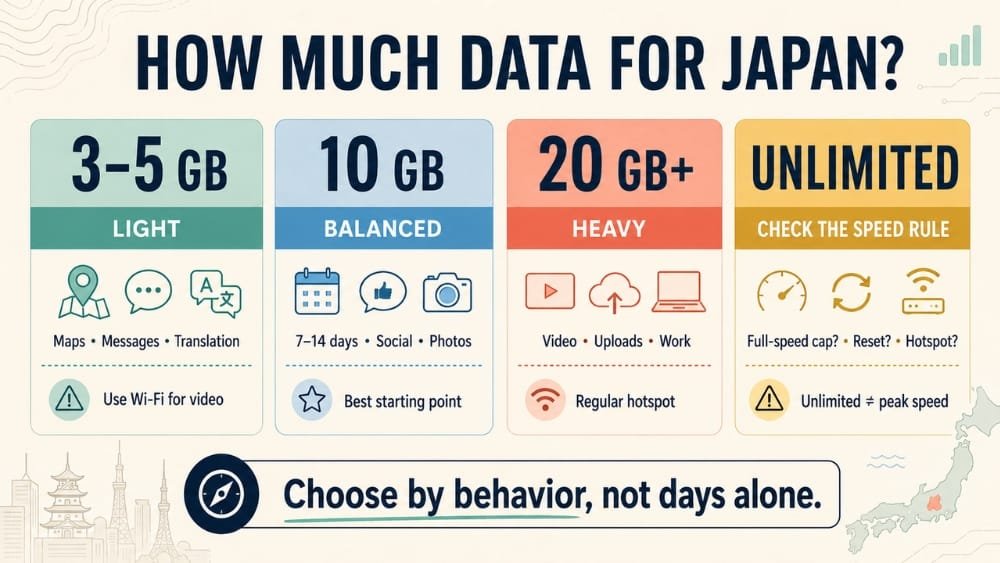
3–5GB: light use
This range can work for a one-week trip if you mainly use:
- maps and train searches;
- messaging;
- translation;
- restaurant research;
- digital tickets;
- accommodation Wi-Fi for updates and uploads.
Avoid long mobile video sessions and automatic photo backup.
10GB: the balanced choice
For many 7- to 14-day trips, 10GB offers a comfortable margin for:
- daily navigation and transit planning;
- regular browsing and messaging;
- social-media feeds;
- music streaming;
- photo uploads;
- occasional short video.
If you are using mobile data to navigate Osaka’s large station areas, our guide to riding the Osaka subway without stress explains what to check before boarding.
20GB or more: heavy use
Choose a larger allowance if you expect:
- frequent video;
- cloud photo and video uploads;
- video calls;
- remote work;
- regular hotspot use;
- limited access to accommodation Wi-Fi.
Unlimited: convenience with a speed-policy check
Unlimited data is useful when you do not want to monitor a balance, but it does not always mean permanent maximum speed. Before buying, identify:
- the amount of full-speed data;
- whether the limit resets daily;
- the reduced speed after the limit;
- whether hotspot use has a separate restriction;
- whether heavy use can trigger another fair-use measure.
A clear 20GB plan can be more useful than an unlimited plan whose reduced-speed rule is difficult to find.
Seven checks before buying any Japan eSIM
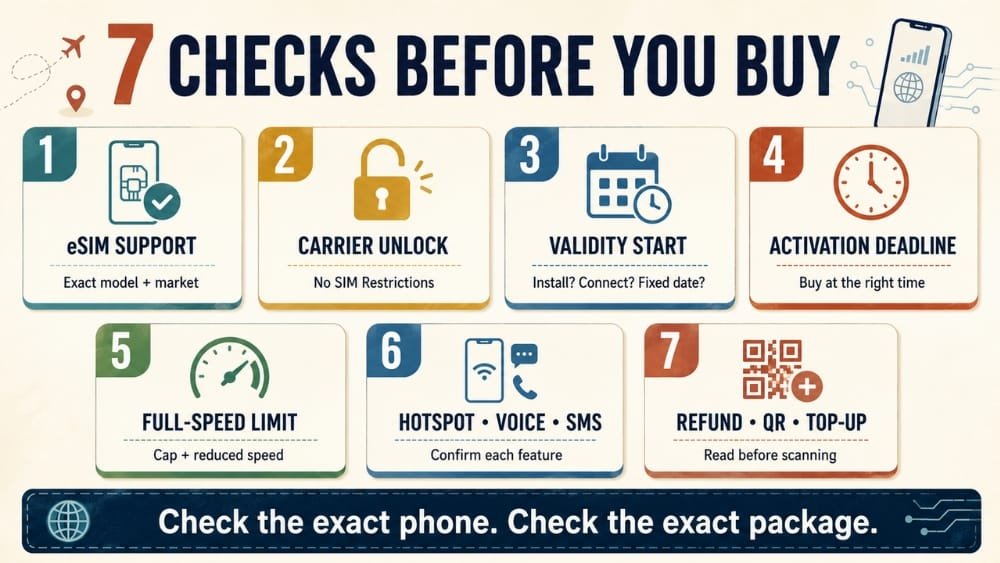
1. Confirm that your exact device supports eSIM
Check the model number and country of purchase, not only the phone name. Devices sold under the same family name can have different SIM hardware in different markets.
2. Confirm that the phone is carrier-unlocked
On an iPhone, open:
Settings → General → About → Carrier Lock
An unlocked iPhone should show No SIM Restrictions. Apple’s international travel eSIM instructions explain this check and the available travel setup options.
Android menus vary by manufacturer and carrier. Confirm unlock status with the company that sold or financed the phone, then check the device maker’s eSIM support page.
3. Check when validity starts
Look for one of these triggers:
- installation;
- manual activation;
- first connection to a supported network in Japan;
- a fixed date selected at purchase.
Do not assume that every provider starts the clock after landing.
4. Check the activation deadline
A plan may need to connect within 30, 90, or another number of days after purchase. Buying too early can be as problematic as buying at the airport.
5. Read the high-speed rule
For unlimited products, find the daily or total full-speed allowance and the reduced speed after it is reached. For fixed-data products, check what happens when the allowance runs out.
6. Confirm hotspot, voice, and SMS
Hotspot support is a product feature, not a universal eSIM feature. Standard travel packages are also often data-only. If you need a number for calls, SMS, reservations, or verification, confirm that separately.
7. Read the refund, QR-code, and top-up rules
Find out whether:
- an unused plan can be refunded;
- scanning the QR code ends cancellation rights;
- the QR code can be used only once;
- deleting the eSIM makes it unusable;
- more data can be added;
- support is available when you land.
How to install your eSIM before flying
If the selected provider permits advance installation, set up the eSIM on a stable internet connection before departure. Installation and activation are not always the same event.
- Confirm the phone is unlocked and eSIM-compatible.
- Buy the correct Japan package.
- Save the order number, QR code, and support instructions somewhere accessible offline.
- Install the eSIM through the provider’s app, QR code, or manual details.
- Label the new line Japan eSIM.
- Keep your home line as the normal voice line if needed, but do not let it use travel data accidentally.
- Leave the travel line off until the provider’s instructions say to enable it.
Do not delete an installed eSIM while troubleshooting unless the provider specifically instructs you to do so. Many profiles and QR codes cannot simply be reused.
Five steps to get online after landing in Japan
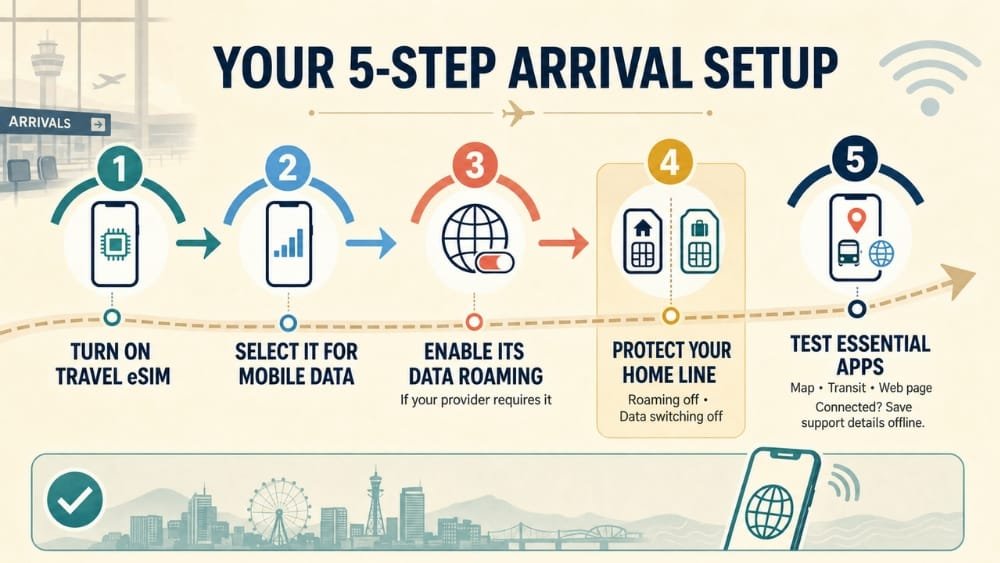
Phone menus differ, but the safe sequence is usually:
- Turn on the Japan eSIM line.
- Select it as the mobile-data line.
- Enable data roaming for the travel eSIM if the provider requires it.
- Disable data roaming and automatic data switching on your home line.
- Test a map, a transit search, and a normal web page.
If you arrive at Kansai International Airport, get connected before leaving the terminal, then use our Kansai Airport to Osaka transport guide to choose the route that matches your hotel.
Keeping the home SIM active may allow incoming calls or verification messages, but your home carrier can still charge for roaming calls, SMS, or background activity. Check its rules before departure.
What to do if the eSIM will not connect
Work through the simple checks before changing advanced settings:
- Confirm the eSIM line is turned on.
- Confirm it is selected for mobile data.
- Confirm data roaming is enabled on the travel eSIM if required.
- Turn airplane mode on, wait briefly, then turn it off.
- Restart the phone.
- Check the provider’s APN instructions.
- Check that the plan has activated and has not expired.
- Contact the provider using your saved order details.
Do not delete the eSIM as a first troubleshooting step. If airport Wi-Fi is unstable, move to another connection before reinstalling an app or downloading instructions.
Final verdict: which Japan travel eSIM should you buy?
Choose Klook if you want the strongest balance of plan choice, clear package details, hotspot support, and a comparatively flexible pre-connection cancellation rule on the reviewed main listing.
Choose Saily if guided app setup, automatic activation, top-ups, 24/7 chat, and security extras matter most.
Choose Yesim if you want several fixed and unlimited durations and are comfortable checking fair-use limits.
Choose Airalo if Japan is part of a multi-country trip or you already manage travel data in its app.
Choose KKday if you enjoy comparing promotions and will read every supplier-specific condition before installation.
For most 7- to 14-day visitors, start by comparing 10GB plans. Move to 20GB or unlimited only when video, large uploads, remote work, or hotspot use justifies it. The best eSIM is not the one with the loudest unlimited claim; it is the one whose activation, speed, and refund rules you understand before takeoff.
Once connectivity is settled, continue with our simple first-trip planning guide for Osaka to choose a base and group your days by area.