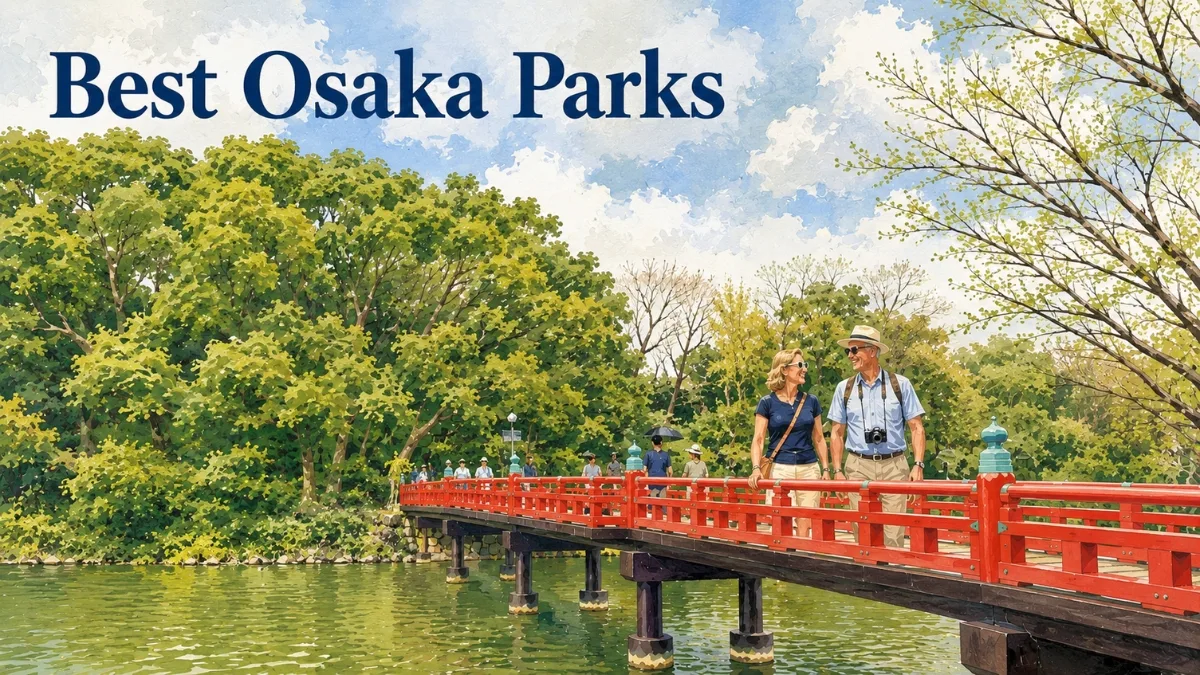
Osaka has parks for very different kinds of pauses. Nakanoshima Park can fit into 30–60 minutes between Umeda and Kitahama. Tennoji Park gives families and tired walkers a convenient lawn beside a major transport hub. Osaka Castle Park needs more walking than its central location suggests, while Expo ’70 Commemorative Park is a half-day destination rather than a gap-filler.
Choose by time first, then by location. A beautiful park on the wrong side of the city can turn a rest into another transfer. For most first-time trips, Osaka Castle Park, Nakanoshima Park and Tennoji Park are the easiest to place naturally. Save Expo ’70, Tsurumi Ryokuchi or Nagai Park for a day when green space is part of the plan.
Match the park to the day you already have
| Park | Best use | Sensible time | Useful station |
|---|---|---|---|
| Osaka Castle Park | Landmark views and a substantial walk | 2–3 hours with the castle area | Morinomiya, Osakajokoen or Tanimachi 4-chome |
| Nakanoshima Park | A riverside reset between central stops | 30–60 minutes | Kitahama, Naniwabashi or Yodoyabashi |
| Tennoji Park / Tenshiba | Lawn time, children, cafés and nearby attractions | 45–90 minutes | Tennoji |
| Expo ’70 Commemorative Park | A spacious half-day outdoors | 3–5 hours | Banpaku-kinen-koen |
| Tsurumi Ryokuchi | Flowers, greenhouse and broad local parkland | 2–4 hours | Tsurumi-ryokuchi |
| Nagai Park | Park walk plus botanical garden, museum or sport | 2–4 hours | Nagai or Tsurugaoka |
These are planning ranges, not admission promises. Weather, seasonal blooms, events and paid facilities can change the useful length of a visit.
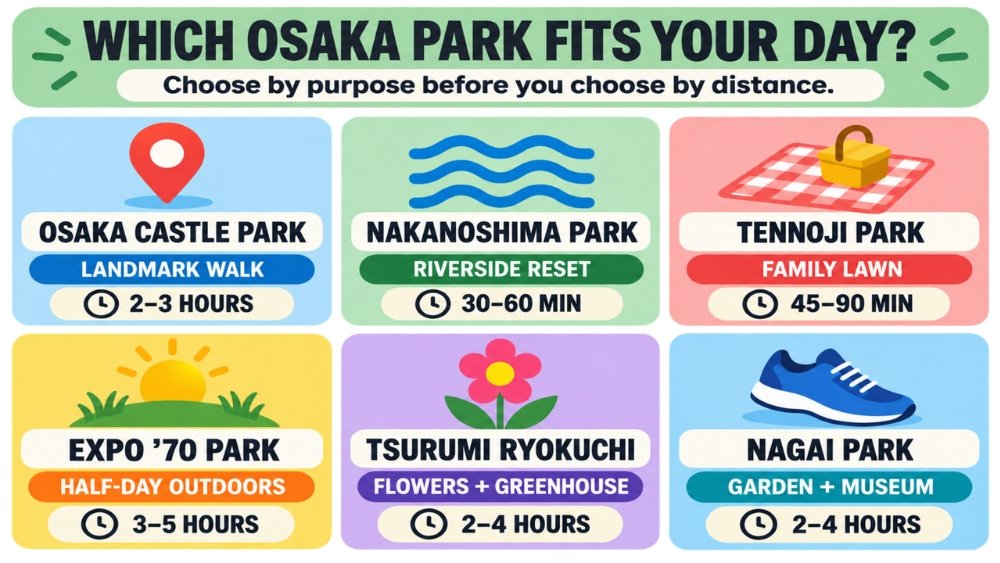
Start with the reason you want a park: a landmark, a central pause, family space or a half-day outdoors.
Osaka Castle Park: choose your entrance, not just the landmark
Osaka Castle Park surrounds the castle complex with moats, broad paths, lawns and historic stonework. It is the strongest first-trip choice when the castle is already on your itinerary, but it is not a five-minute photo stop. The nearest station and the castle tower are separated by a meaningful walk.
Arriving at Morinomiya or Osakajokoen makes sense when you want a straightforward approach from the JR Osaka Loop Line. Tanimachi 4-chome can suit a western approach and connects with the Osaka Metro Tanimachi and Chuo lines. If steps are difficult, the park’s official FAQ points to the Otemon approach as comparatively gentle for reaching the tower area without stairs.
Allow roughly two hours for one deliberate route through the grounds and longer if you enter the castle tower or Nishinomaru Garden. The general park and individual paid facilities do not share one universal ticket or timetable. Open the Osaka Castle Park official site for current conditions and Osaka Castle Park in Google Maps to choose the entrance that fits your next stop.
Nakanoshima Park: the easiest central reset
Nakanoshima Park sits between the Dojima and Tosabori rivers. Its narrow shape makes it feel more like a waterside promenade than a large nature reserve, which is exactly why it works well between museums, cafés, offices and other central stops.
The park is always open, although facilities inside and around it keep their own hours. Osaka City lists Yodoyabashi, Kitahama and Naniwabashi among the useful nearby stations. The rose garden has about 310 varieties and 3,700 plants, with the main bloom periods normally around spring and autumn; exact timing moves with the weather.
Choose this park when you want a short walk with no need to “complete” an attraction. A 30-minute east-end loop around the rose garden is enough for a reset. With an hour, walk beside the river and continue toward the historic buildings farther west. Weekday lunch brings office workers, so morning or later afternoon feels more spacious.
Use the Osaka City Nakanoshima Park page for facilities and bloom information, and save Nakanoshima Park in Google Maps before deciding which station to use.
Tennoji Park: a practical pause with children or a mixed group
The Tenshiba entrance area of Tennoji Park places a roughly 7,000-square-metre lawn, cafés, restaurants and family facilities immediately beside the Tennoji transport hub. It is more useful than secluded: weekends can be lively, but that activity often makes the lawn an easier choice for children than a formal garden.
Tenshiba currently opens 7:00–22:00, while shops, the zoo, museum and other facilities use separate schedules and tickets. The official rules prohibit ball and frisbee play on the lawn, fire, and ordinary tents that require pegs or ropes. Small open sun shelters are permitted only within stated size and time conditions, so read the current signs instead of assuming any picnic setup is acceptable.
Allow 45–90 minutes for the lawn and a drink. Add the park before or after our Shinsekai walking route when your group needs open space between busier streets. Check Tenshiba’s official site and open Tenshiba in Google Maps for the station-side entrance.
Expo ’70 Commemorative Park: make it the destination
Expo ’70 Commemorative Park occupies the former site of the 1970 world exposition in Suita. At about 260 hectares, it combines broad lawns, wooded areas, seasonal flower gardens, the Japanese Garden, museums and the Tower of the Sun. Its scale is the attraction—and the reason it should not be squeezed between timed central-Osaka plans.
The useful rail stop is Banpaku-kinen-koen Station on the Osaka Monorail. Most central-city journeys require at least one transfer. An IC card is a rechargeable transit card that you tap at gates; our ICOCA guide explains the Osaka version if this is new to you.
Set aside three to five hours and choose one or two areas before arrival. The park has admission, operating days and final-entry times, while museums and the Tower of the Sun can have separate rules. Do not build the day around entering the tower until you have checked its current reservation page.
Use the Expo ’70 Commemorative Park official site for live schedules and maps, the Tower of the Sun official booking guidance when the interior matters, and Expo ’70 Commemorative Park in Google Maps for the station-to-gate route.
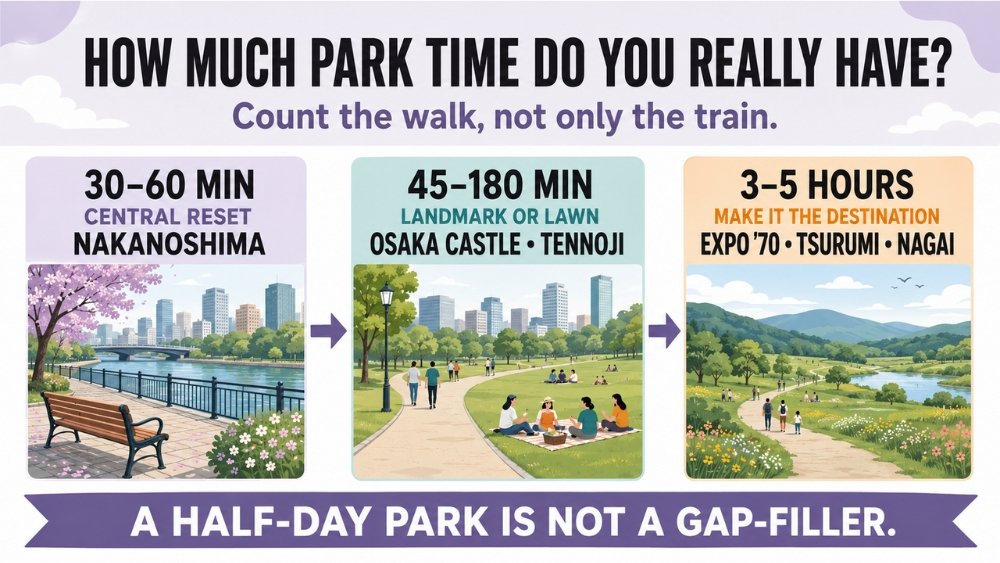
A short opening belongs to a central park. A half-day park is a destination, not a rest stop between reservations.
Tsurumi Ryokuchi: flowers and space without a central landmark
Tsurumi Ryokuchi is the better alternative when flowers, open ground and a greenhouse interest you more than castle views. Tsurumi-ryokuchi Station on the Osaka Metro Nagahori Tsurumi-ryokuchi Line is immediately beside the park, so the final approach is simple even though the location is east of the main visitor districts.
General park entry is free. Much of the park is accessible around the clock, but the hilly area uses seasonal daytime hours and individual facilities such as Sakuya Konohana Kan set their own admission and schedules. The former internal park bus ended in March 2025, so plan to walk rather than counting on a ride between distant areas.
Give the park two to four hours. The official map covers about 121.7 hectares, making “see everything” a poor target. Choose the flower areas, greenhouse or family facilities that justify the trip, then leave the rest for another visit.
See the Tsurumi Ryokuchi official site and its official access page, then save Tsurumi Ryokuchi in Google Maps for the station exit and central gate.
Nagai Park: combine the walk with a specific interest
Nagai Park is a 66.3-hectare sports and green-space complex in southern Osaka. Its value comes from combinations: a walk with the botanical garden, the Osaka Museum of Natural History, a sports event or an evening program. If none of those interests you, Tennoji Park is usually the simpler southern-city pause.
Osaka Metro Nagai Station Exit 3 is immediately beside the park. JR Nagai Station is about five minutes on foot, and JR Tsurugaoka Station is also useful for some entrances and facilities. Events can change pedestrian flow, especially around the stadiums, so check what is happening before choosing the park for a quiet break.
Use the Nagai Park official guide, the official access page, and Nagai Park in Google Maps. Treat the botanical garden, museum and ticketed evening installations as separate visits with their own current rules.
Make the park feel like a break
The most useful Osaka park is rarely the one with the longest list of features. It is the one that removes effort from the day.
Travel light, use a station that matches the next stop, and avoid dragging luggage across large grounds. In hot, humid weather, move the walk to morning or late afternoon, carry water and shorten the route. After heavy rain, lawns and unpaved areas may be less practical even when the park remains open.
Parks are shared public spaces. Keep sound low, stay out of planted beds, take rubbish with you when bins are limited, and follow area-specific signs for picnics, pets, smoking, photography and seasonal flower viewing. During cherry-blossom season or special events, temporary rules and crowd controls can override normal use.
For a first Osaka trip, make the choice simple: Nakanoshima for the smallest central pause, Tennoji for flexible family space, Osaka Castle for a landmark walk, and Expo ’70 when the park itself deserves half a day. Tsurumi Ryokuchi and Nagai Park become stronger when flowers, museums, sport or a slower local outing are already part of the reason to go.