
For most first-time visitors, Osaka is worth adding when the trip has room for two or three nights. It is especially rewarding if you want relaxed food, lively evenings and one convenient base for the wider Kansai region. Osaka is less essential when a very short itinerary is already split between Tokyo and Kyoto, or when temples, preserved streets and quiet nights are your main priorities.
The useful question is therefore not whether Osaka has enough sights. It does. The decision is whether its casual, modern energy improves your Japan trip enough to justify another hotel change.
Osaka is a strong fit for this kind of trip
Osaka works best when you enjoy cities after the headline attraction has closed. Namba and Umeda remain useful into the evening, with restaurants, shops and transport concentrated around major stations. You can eat without building the entire day around one famous reservation, then walk through a busy district or return to a quieter base.
The city is also practical for travelers who prefer one hotel over repeated packing. Kansai International Airport connects directly with central Osaka: Nankai’s airport access guide lists the Limited Express Rapi:t to Namba in as little as 34 minutes and the Airport Express in about 45 minutes. JR West’s HARUKA information covers the airport limited express toward major cities, including Osaka.
An IC card, such as ICOCA, is a rechargeable tap-to-pay transit card. It handles many ordinary local journeys, although limited-express and Shinkansen services may require an additional ticket. The Osaka Metro ICOCA page explains the local card system, while our ICOCA guide for Osaka covers the practical boundaries.
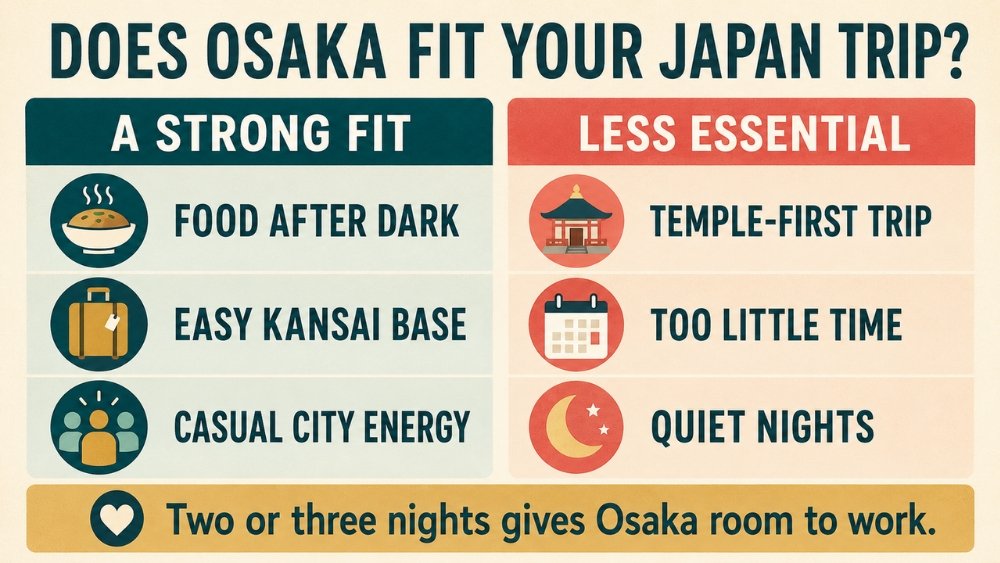
Osaka earns its place through food, evening energy and a useful Kansai base. It becomes less necessary when time is tight or the trip is built mainly around traditional architecture and early nights.
What Osaka adds beyond a list of attractions
Osaka’s advantage is concentration. A visitor can spend a substantial morning around Osaka Castle, return to the center for lunch and finish around Namba without turning the day into a sequence of long transfers. The city supports improvisation: if a queue is too long, another restaurant or indoor stop is usually close.
Food is part of that value, but not because every meal must be a famous Osaka specialty. Takoyaki, okonomiyaki and kushikatsu are easy to find, yet the more important advantage is the depth of casual choices near stations and shopping streets. If raw seafood is not comfortable for you, cooked dishes, noodles, curry, department-store food halls and international options make an easy alternative. Our Osaka food street guide explains how the main areas differ.
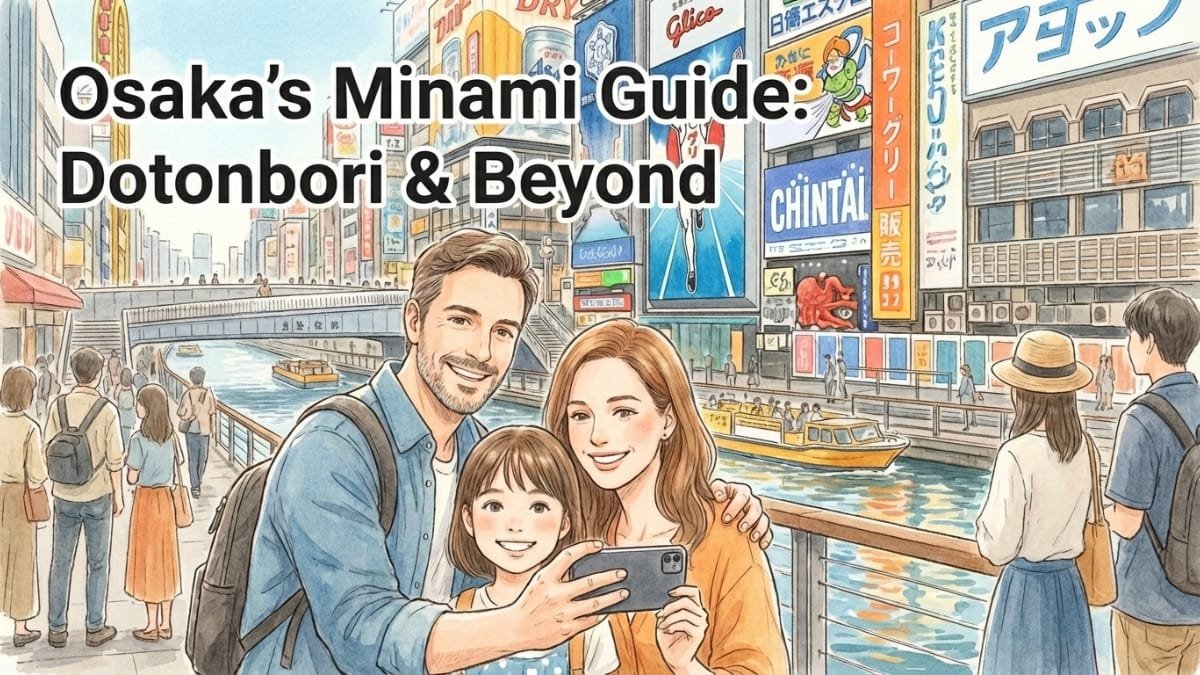
After dark, Dotonbori gives you Osaka at its loudest and brightest. It is worth seeing, but it should not be treated as the whole city. Use our guide to Dotonbori beyond the crowds and save Dotonbori in Google Maps for the public canal area. There is no single operator page governing the entire streetscape, so conditions, shop hours and crowd levels must be checked place by place.
When Osaka may not earn another hotel change
A four- or five-night Japan trip can become weaker when it tries to include Tokyo, Kyoto and Osaka as separate bases. Each move consumes more than the train time: there is packing, checkout, luggage storage, station navigation and another check-in. If Osaka would receive only a late arrival and an early departure, keeping the existing base may be the calmer choice.
Osaka is also not a substitute for Kyoto’s concentration of temples and preserved historic streets. It has important shrines, museums and historic sites, but the dominant impression is a working modern city. Travelers who want silent mornings, traditional architecture and an early night may prefer to allocate more time elsewhere and visit Osaka only when a specific district, meal or event genuinely matters.
Crowd tolerance changes the answer too. Central Namba is exciting precisely because it is busy, commercial and visually intense. A hotel beside Dotonbori can be convenient for late dining and tiring for light sleepers. If you want Osaka’s transport without its loudest streets, consider Umeda, Honmachi, Yodoyabashi or Tennoji, then visit Namba rather than sleeping at its busiest point.
How many nights should you give Osaka?
One night can work when Osaka is a deliberate evening stop. Choose one district, eat well and resist the temptation to cross the city for several icons. Namba is the natural choice for food and late activity; Umeda works better when the next train or regional journey leaves from the north side.
Two nights is the practical minimum for a first visit. It gives you one full Osaka day plus two evenings or travel-day fragments. That is enough to combine one major daytime anchor with Namba or Umeda after dark, without making every hour carry a reservation.
Three nights gives the city room to breathe. You can spend one full day in Osaka, keep another day flexible for neighborhoods or shopping, and add one full-day outing. Universal Studios Japan is a day in itself for most groups; its official hours page shows that opening and closing times vary by date, and the official app is part of current park planning. Save Universal Studios Japan in Google Maps for the final approach.
Four or more nights can make sense when Osaka is your Kansai base and you actively prefer returning to the same hotel. The extra nights do not mean you must collect more Osaka attractions. Their value may be the absence of luggage moves and the ability to eat or rest in a familiar neighborhood after a regional day out.
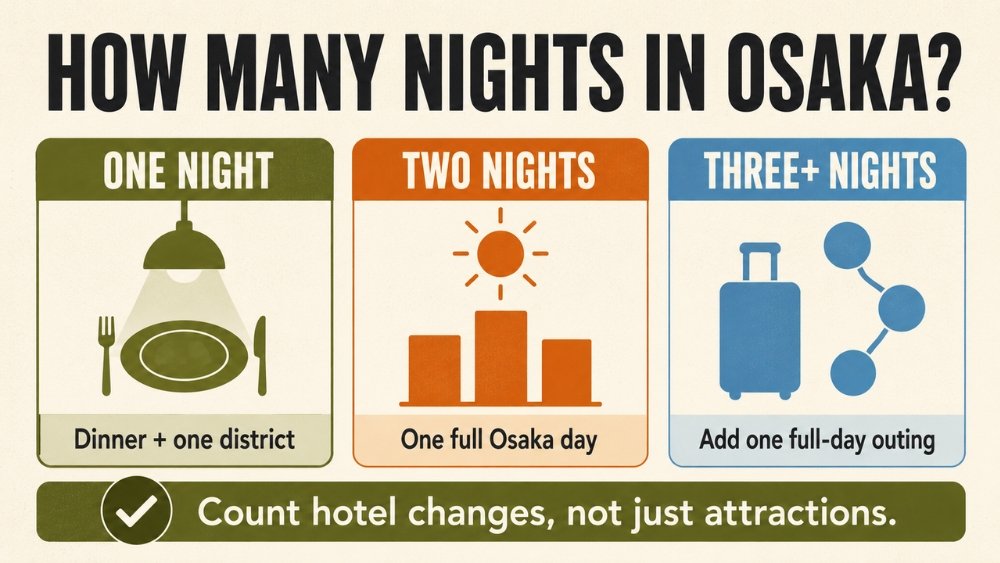
One night is an evening sample, two nights gives you one full Osaka day, and three or more nights creates room for a full-day outing. Count hotel changes as part of the itinerary cost.
Choose the base that matches the rest of the trip
Umeda and the Osaka Station area are usually stronger when the itinerary includes frequent trips toward Kyoto or Kobe, department-store shopping, or a quick connection to Shin-Osaka. The trade-off is navigation: Osaka Station, Umeda Station and the surrounding underground complexes are connected but not interchangeable names for one simple building. Our Osaka Station navigation guide is useful before the first arrival.
Namba is stronger for Dotonbori, Shinsaibashi, late dining and direct Nankai access to Kansai International Airport. It also contains several operator-specific stations using Namba or Osaka-Namba in the name. Match the hotel to the exact railway entrance, not merely to the word “Namba.” Our Namba or Umeda comparison helps with that decision.
For a quieter compromise, Honmachi and Yodoyabashi keep central access without placing you in the busiest nightlife zone. Tennoji can suit travelers who want southern Osaka connections and a less compressed evening atmosphere. Whichever area you choose, open the walking route from the station exit to the hotel. A short distance on a map can become a long underground transfer with luggage.
Three anchors are enough for a first Osaka day
A first day does not need a catalogue of sights. One daytime landmark, one food or neighborhood block and one evening district create a more coherent introduction.
Osaka Castle Park can be the daytime anchor. The official park site provides current facility information, while Osaka Castle Park in Google Maps helps you choose an entrance. The park is substantial, and the castle tower interior is a museum rather than an original palace interior. Visit for the grounds, views and historical context rather than expecting a preserved residential castle.
For the middle of the day, choose an area that fits your pace instead of chasing a famous queue. Namba suits food and shopping; Umeda suits indoor browsing and transport convenience; a quieter riverside or neighborhood stop can balance the evening crowds.
End in the district closest to dinner and the hotel. This order matters more than squeezing in another attraction. Osaka’s value appears when the plan leaves enough energy for the city after dark.
The practical answer
Osaka is worth visiting when it makes the trip easier and adds something you genuinely want: casual food, evening atmosphere, urban variety or one stable Kansai base. Give it two nights for a clear introduction and three when a full-day outing matters.
Skip the extra hotel move when Osaka would become only a rushed photo stop. The city is most convincing when you can stop optimizing, choose one neighborhood for the evening and let the next meal be nearby.