
The Osaka Amazing Pass can be excellent value, but only when it matches the day you already want to spend in Osaka.
For 2026, the standard pass costs ¥3,500 for one day or ¥5,000 for two consecutive days. It combines unlimited rides on the covered transport network with admission to about 40 participating attractions. The one-day version can pay for itself with two high-value attractions and several covered rides. It is a poor buy for a slow neighborhood day, a trip centered on free sights, or an itinerary built around JR trains, Kansai Airport, Universal Studios Japan, Kyoto, or Nara.
Quick verdict: Choose the one-day pass for one active, carefully routed sightseeing day. Choose the two-day pass only when both consecutive days contain enough included attractions. Skip both if you would be adding stops merely to recover the ticket cost.
Compare the current Osaka Amazing Pass options on Klook only after choosing your sightseeing date and checking the official attraction restrictions for that day.
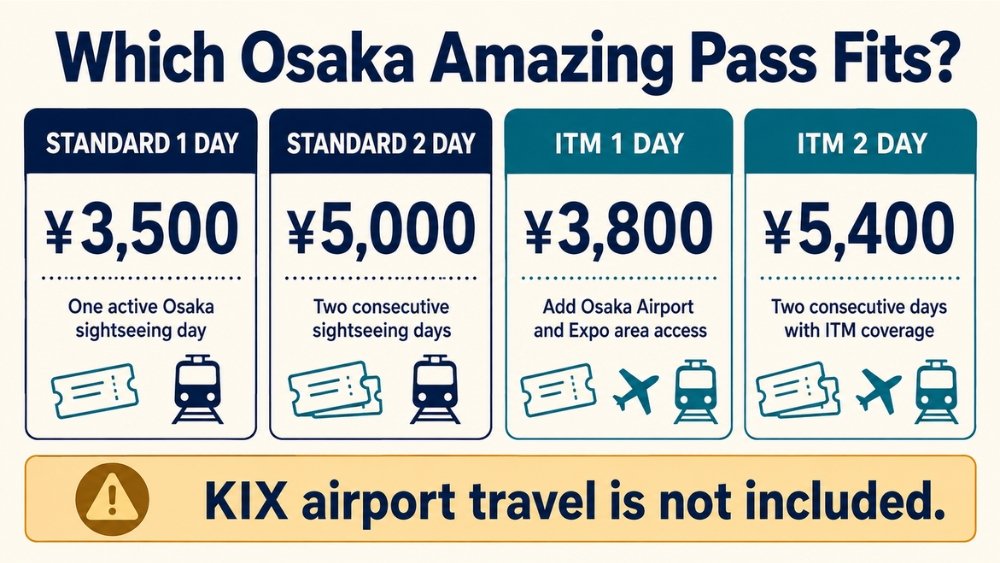
Osaka Amazing Pass prices and versions for 2026
The official 2026–2027 sales period runs from March 25, 2026 to March 31, 2027. A ticket must be activated within three months of purchase and no later than March 31, 2027. The two-day ticket may cover March 31 and April 1, 2027 when activated on the final permitted start date.
| Version | Price | Best for | Important limit |
|---|---|---|---|
| Standard 1-day | ¥3,500 | One active Osaka sightseeing day | Valid for one service day, not 24 hours |
| Standard 2-day | ¥5,000 | Two consecutive attraction-heavy days | Each facility may be used only once across both days |
| Osaka Itami Airport 1-day | ¥3,800 | An ITM arrival or departure combined with Expo-area plans | Kansai Airport is not included |
| Osaka Itami Airport 2-day | ¥5,400 | Two consecutive days using the extended ITM network | Kansai Airport is not included |
The same pass price applies to adults and children; there is no separate child pass. Families should therefore compare the pass price with the lower child admission and transport fares that may be available when tickets are bought separately.
The standard pass is usually the right comparison for visitors already staying in central Osaka. The Itami Airport version adds specified Osaka Monorail, Kita-Osaka Kyuko, and Hankyu sections, plus access to listed Expo-area attractions. It does not cover travel from Kansai International Airport.
You can review the current versions on Klook, but compare the final product name, activation deadline, and included network before paying.
Prices and conditions were checked on August 4, 2026. Recheck the official pass information before purchase because participating facilities and restrictions can change.
What the Osaka Amazing Pass actually covers
The pass has two separate forms of value: transport and attraction admission. You need to understand both before deciding whether it saves money.
Covered transport
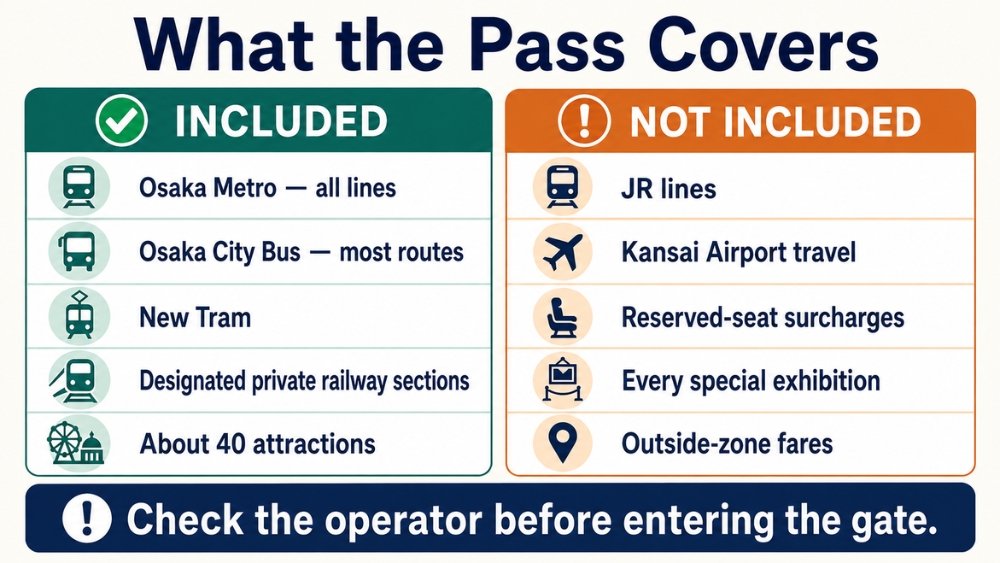
The standard one-day and two-day passes include unlimited rides on:
- all Osaka Metro lines;
- most Osaka City Bus routes;
- New Tram;
- designated sections of Hankyu, Hanshin, Keihan, Kintetsu, and Nankai railways, mainly within Osaka City.
The phrase “unlimited transport” does not mean every train in Osaka. The pass does not cover JR lines, travel to or from Kansai Airport, routes outside the designated area, or every private railway section. Reserved-seat or limited-express supplements on listed private railways also cost extra.
Large stations make this easy to misunderstand. Namba, for example, brings Osaka Metro, Nankai, Kintetsu, Hanshin, and JR services into one area. Check the operator before entering the gate. If the route is outside the covered area, use an IC card or buy the correct separate ticket. The Osaka transport guide explains how the city’s operators fit together.
Included attractions
The pass currently offers admission to about 40 participating attractions. The list includes observation decks, museums, cruises, gardens, historic sites, and smaller experiences.
Important rules are easy to miss:
- you may visit multiple participating attractions on the active day;
- each facility can normally be used once;
- with a two-day pass, the once-per-facility limit applies across both consecutive days;
- some attractions have excluded dates, time limits, reservation priority, or ticket-exchange procedures;
- special exhibitions may require an extra charge;
- an included facility can still be closed, full, or suspended because of weather or maintenance;
- there is no refund merely because a planned attraction becomes unavailable after activation.
Check the official participating-attraction list for your exact date. Do not rely on an old screenshot or a social post.
Is the Osaka Amazing Pass worth it?
It is worth it when the total cost of attractions you genuinely intend to visit, plus covered rides you genuinely need, reaches the pass price without forcing an exhausting route.
A useful calculation has three steps:
- List only the included attractions you would pay to visit anyway.
- Add their current individual admission fees.
- Add the covered transport fares for the route you would actually take.
Ignore any attraction added only because it is “free” with the pass. If you would not visit it without the pass, it does not belong in your savings calculation.
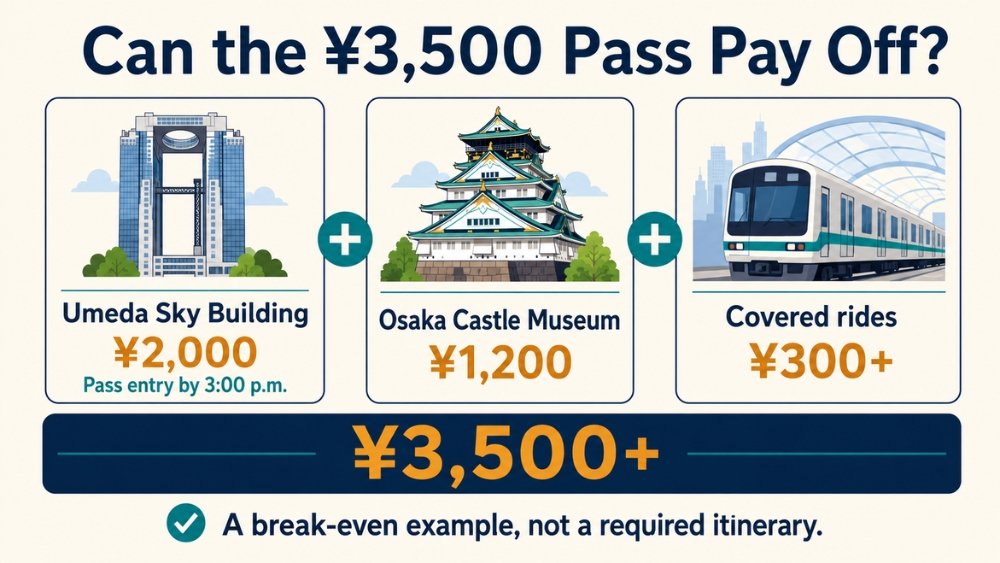
A simple one-day break-even example
The official reference fees currently list:
- Umeda Sky Building: ¥2,000, with pass admission limited to entry by 3:00 p.m.;
- Osaka Castle Museum: ¥1,200;
- covered rides: ¥300 or more, depending on the route.
Those two attractions plus at least ¥300 in covered rides reach ¥3,500, the price of the standard one-day pass.
This is a calculation example, not a required itinerary. Umeda Sky Building and Osaka Castle fit into one day, but the value depends on entry times, queues, closures, and whether you truly want both. Read the Umeda Sky Building guide before building the day around its time restriction.
When the pass usually performs well
The one-day pass is strongest when you:
- start in the morning;
- choose two or three paid attractions you already want;
- group stops by area instead of crossing the city repeatedly;
- use Osaka Metro several times;
- place timed cruises or restricted-entry attractions first;
- keep one nearby backup for a closure or long queue.
An observation deck, a paid museum or castle visit, and one cruise can create strong value. The danger is assuming that every included facility will fit. Opening hours, last admission, reservation priority, and travel time matter more than the raw count.
When the pass usually does not save money
Skip it when your day is mainly:
- Dotonbori, Shinsaibashi, Kuromon Market, Amerikamura, or other free walking areas;
- shopping, cafés, or food stops in one neighborhood;
- Universal Studios Japan;
- one major attraction followed by a relaxed evening;
- a Kyoto, Nara, Kobe, or other regional day trip;
- travel from Kansai Airport;
- JR-based movement rather than the included network.
The pass should support your itinerary. Your itinerary should not become a race designed to justify the pass.
One-day or two-day Osaka Amazing Pass?
Choose the one-day pass for a focused city day
The standard one-day pass is the safer choice for most first-time visitors. It concentrates the calculation into one day and leaves the rest of the trip free for food streets, neighborhoods, shopping, day trips, or attractions outside the pass.
A realistic plan uses two anchor attractions and one optional stop. For example:
- morning: Osaka Castle Museum;
- midday: lunch and travel to Umeda;
- early afternoon: Umeda Sky Building before the pass-entry cutoff;
- evening: one included attraction near Namba, only if energy and operations allow.
This route is intentionally less ambitious than a six-stop checklist. A missed cruise or a long queue will not destroy the entire day.
Choose the two-day pass only when both days are strong
The two-day pass costs ¥5,000, only ¥1,500 more than the one-day pass. That sounds easy to justify, but the two days must be consecutive and each attraction is still available only once during the entire validity period.
The two-day version makes sense when:
- day one and day two each contain several included attractions;
- you want a calmer pace without abandoning the savings calculation;
- your hotel is convenient for the covered network;
- you have checked both days for closures and operating hours.
It is weak when the second day is mostly shopping, a free neighborhood walk, or a regional excursion. Do not buy it simply because the price difference looks small.
Consider the Itami Airport version only for an ITM itinerary
The airport version is designed for Osaka Itami Airport and the extended northern network. It can make sense when an ITM arrival or departure combines naturally with the Expo area. It is not an airport pass for KIX.
If you are flying through KIX, use the Kansai Airport to Osaka guide and budget that journey separately.
How to buy and use the digital pass
The Osaka Amazing Pass is an electronic ticket using the SURUTTO QRtto system. The official purchase route requires account registration. Klook also lists the pass. Whichever route you use, read the exact product conditions on the checkout page and keep the confirmation accessible.
Check the Osaka Amazing Pass on Klook when you are ready to compare the current versions and complete the purchase.
The official process is:
- Buy the correct version and confirm the validity period.
- On the active day, open the ticket on an internet-connected smartphone or tablet.
- Press “Start using” only when you are ready to begin.
- Display the live QR code for trains, buses, and attractions.
- Scan at a compatible gate or show the live ticket to staff when instructed.
For trains, one person should pass through the gate at a time. For buses, authentication is required when exiting. At attractions, show the QR code to staff or scan it at the designated terminal.
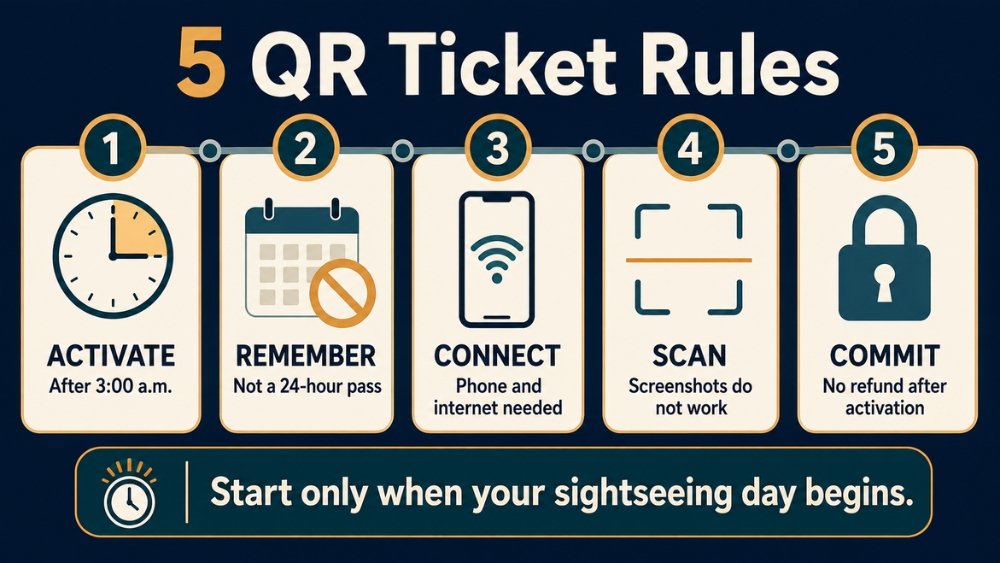
Five QR ticket rules that prevent expensive mistakes
1. Activate after 3:00 a.m.
The service day runs from 3:00 a.m. to 2:59 a.m. the following day. If you activate between midnight and 2:59 a.m., the ticket will not continue after 3:00 a.m.
2. It is not a rolling 24-hour or 48-hour pass
Transport is available from the first to the last service on each valid day. Activating late in the afternoon does not extend the pass into the following afternoon.
3. Keep your phone powered and online
The live ticket needs a compatible smartphone or tablet, network access, and browser-camera permission. Carry a power bank and make sure your data connection works before approaching the gate.
4. A screenshot is not a ticket
Screenshots and printed copies are not accepted. Open the live ticket screen. At a station without a QR-compatible gate, show it to the attendant; if no attendant is present, follow the visual-inspection instructions at the gate.
5. Activation ends the refund option
Unused tickets may be refundable within their validity period through the place of purchase. Once the pass is activated or used for transport or an attraction, it is non-refundable. Weather, a temporary closure, or a disrupted service does not restore the refund.
Read the official purchase and use instructions before the morning of your sightseeing day.
Common Osaka Amazing Pass mistakes
Mistake 1: treating it as an all-Osaka rail pass
JR, KIX travel, outside-zone fares, and some private railway journeys are separate. Confirm the operator and covered section.
Mistake 2: counting attractions instead of checking conditions
“Included” does not always mean walk-in access at any time. Umeda Sky Building has a pass-entry cutoff, some cruises prioritize reservations, and weather can suspend outdoor operations.
Mistake 3: planning distant areas in one day
Umeda, Osaka Castle, Tempozan, Shinsekai, and Namba may look close on a city map. Walking inside stations, transfers, queues, and meals make the real day longer. Group nearby stops.
Mistake 4: buying the two-day pass for one strong day
The second day must also contain enough value. A cheap upgrade still wastes money when the second day is mostly free activities.
Mistake 5: assuming children automatically save
There is no child price for the pass. Compare the full pass price with child transport and attraction fares before buying for every family member.
Mistake 6: activating before the plan is stable
After activation, refunds are unavailable. Confirm weather-sensitive attractions, planned closures, and reservation instructions first.
Final verdict: should you buy the Osaka Amazing Pass?
Buy the one-day Osaka Amazing Pass when you have two or three included paid attractions, several covered rides, an early start, and a route that does not zigzag across the city.
Buy the two-day pass when both consecutive days pass the same test and you value a slower pace more than keeping the second day flexible.
Choose Klook when you want to compare the currently listed pass versions through a familiar booking interface, then verify the official attraction and transport conditions for your dates before activation.
Use the official SURUTTO QRtto route when you prefer to buy directly from the pass system. No affiliate marker is assigned to that route.
Skip the pass when your day is slow, mostly free, dominated by JR or KIX travel, or built around one attraction. In that case, individual tickets and an IC card are simpler.
The best Osaka Amazing Pass day is not the day with the most checkmarks. It is the day when every included stop already belonged in your Osaka plan.