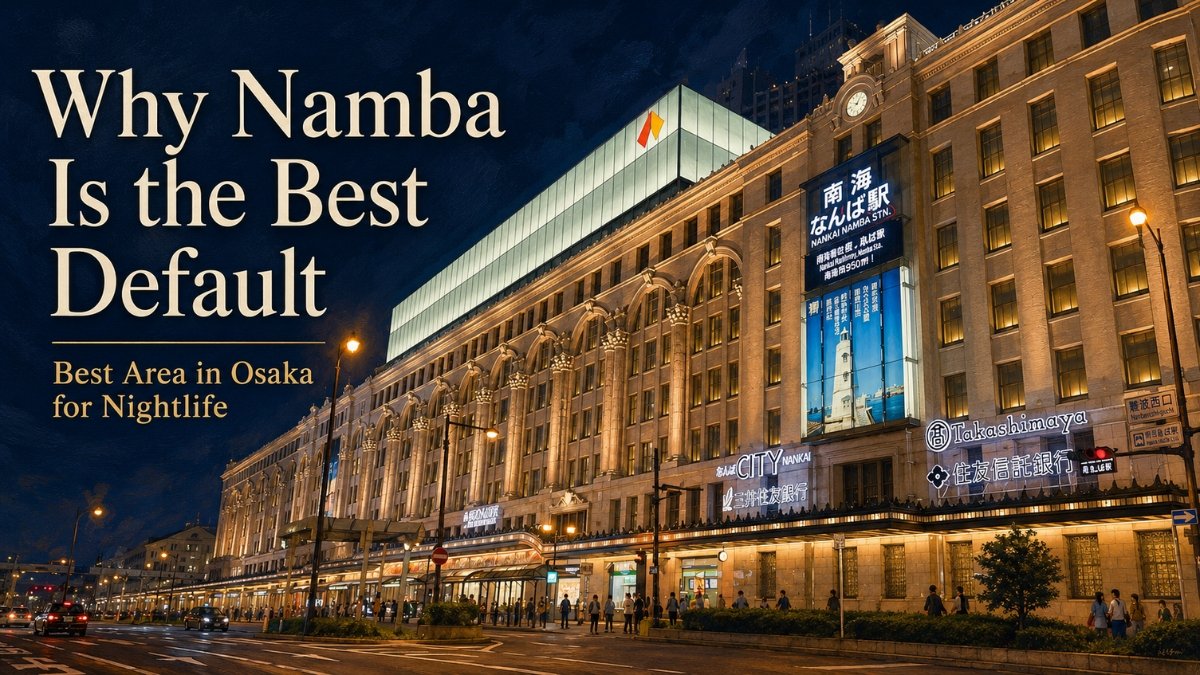
If you have one free night and no must-visit venue, Namba is the best default area for nightlife in Osaka. It anchors the connected Minami entertainment zone, so dinner, bright riverside streets, small bars, karaoke, and music-led venues can all fit into one evening without repeatedly crossing the city.
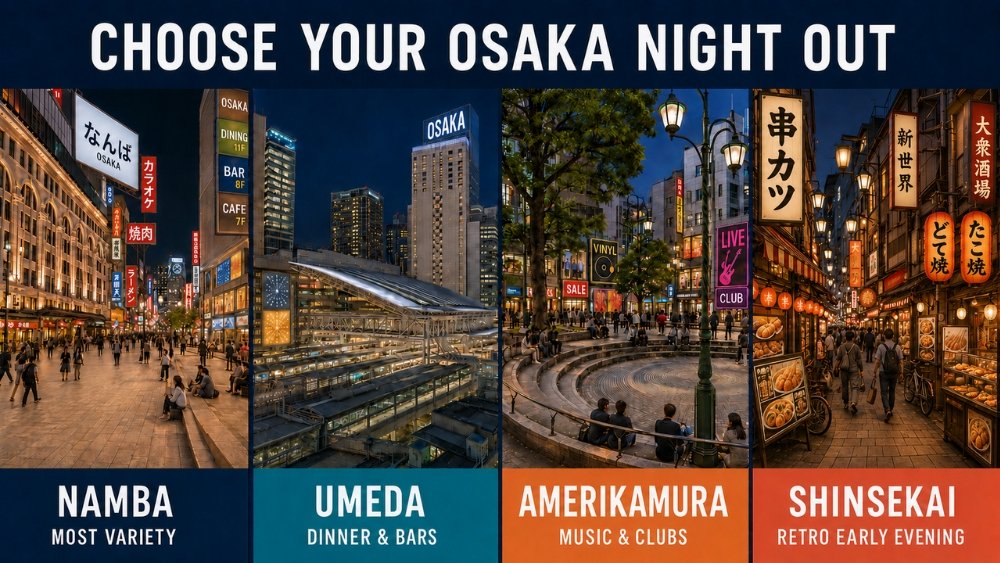
Namba is not the best answer for everyone. Choose Umeda when your hotel is near Osaka Station and you want dinner followed by a more composed bar evening. Choose Amerikamura when a specific club, DJ, or live event is the reason for going out. Choose Shinsekai for a retro food-and-drink evening that starts earlier. Your hotel location and ride home should break any tie.
Choose the night you actually want
- Start with Namba for the widest choice and the easiest first-time introduction to Minami. The trade-off is heavy foot traffic, bright streets, and plenty of tourist-oriented venues.
- Choose Umeda for dinner, cocktails, hotel bars, and a convenient finish when you are staying near the northern rail hub. The trade-off is a large station complex and less of the continuous street-nightlife feel associated with Minami.
- Choose Amerikamura for a music-first or club-first plan. The trade-off is that the exact event matters more than the neighborhood label, so checking the venue calendar is essential.
- Choose Shinsekai for retro streets, casual food, and an earlier evening. The trade-off is less variety if your main goal is a long club night.
Why Namba is the best default—and what “Minami” means
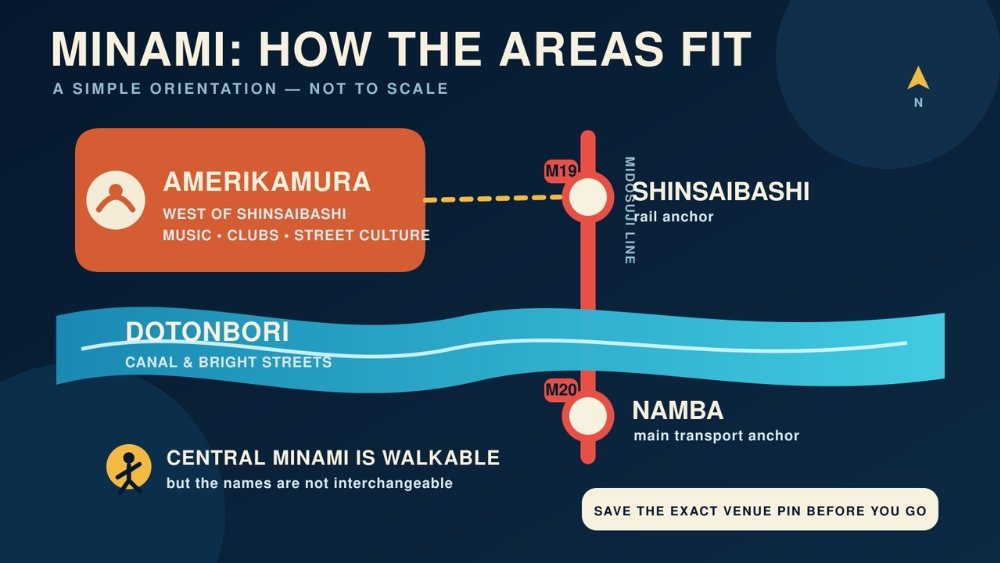
Minami is an informal name for Osaka’s southern downtown, not a single station or a district with one fixed border. Namba, Dotonbori, Shinsaibashi, and Amerikamura are close enough to combine, but they are not interchangeable.
Namba is the transport and decision anchor. It works well when your group has not chosen one type of nightlife because you can begin with dinner and decide what comes next. Osaka Metro’s Namba Station page provides live timetable links and transfer information for JR, Hanshin, Kintetsu, and Nankai services. Save the Namba Station map pin as an orientation point, but also save your venue’s exact entrance; the station has multiple lines and exits.
Dotonbori is the bright sightseeing core. The canal, signs, restaurants, and crowds make it an easy first stop, especially for a group that wants recognizable Osaka scenery before choosing a bar or activity. It is not a synonym for all Osaka nightlife, and the busiest stretch may be more useful as a meeting point than as the place you spend the entire night. Use the Dotonbori map pin to understand its position relative to Namba.
Shinsaibashi extends the evening north, while Amerikamura sits to the west. Shinsaibashi is a useful rail anchor for shopping, dining, and access to the surrounding evening streets; the official Shinsaibashi Station page has current route and timetable links. Amerikamura is the better label when your plan centers on music, clubs, or a particular event. Check the event and entry rules first, then use the Amerikamura map pin rather than assuming every venue is beside Shinsaibashi Station.
Two concrete places to start in Namba and Minami
The eight additions in this article form a deliberately short practical list, not paid placements or a claim that one rating settles the choice. Each was checked for current official presence, practical fit, and a solid Google Maps review signal on August 24, 2026. Ratings and recent comments change, so open the map link before committing.
- Matsusakagyu Yakiniku M, Hozenji Yokocho works as a planned dinner anchor close to Dotonbori. Its quieter Hozenji Yokocho setting makes sense for a group that wants a reservation and a full meal before walking into the brighter streets. It is a higher-budget, beef-centered choice rather than a casual bar-hop stop, so check the current course and cancellation terms. Google Maps
- Bible Club Osaka is a basement cocktail bar on Shinsaibashisuji, useful when the group wants a seated bar after dinner rather than another crowded sightseeing street. The official page lists limited seating and a cover charge, so it fits a small group better than a spontaneous large party. Google Maps
For a fuller explanation of how these names fit together, read the Osaka Minami, Namba, Dotonbori, and Shinsaibashi guide.
When another area is the smarter choice
Umeda: best when the north-side hotel and the evening match
Umeda can beat Namba when you are staying near Osaka Station, leaving early the next morning, or planning a dinner-and-bars evening rather than a street-to-street crawl. The area gives you restaurant floors, hotel lounges, cocktail bars, and access to Kitashinchi without adding a cross-city return at the end of the night.
Start with the official Umeda Station page for live transport information and the Osaka Station/Umeda map pin for orientation. If Kitashinchi is part of the plan, save the Kitashinchi map pin and the exact venue separately. “Near Umeda” can still involve a substantial walk through or around a large station complex.
Do not assume that a polished address means one standard price structure. Read the venue’s own menu and reservation terms, and confirm any cover, service charge, tax, or minimum order before committing.
Two practical anchors make the choice more concrete:
- KITTE Osaka is useful when a group wants several restaurant styles in one building beside JR Osaka Station rather than choosing a single bar in advance. Its official directory places restaurants on the fourth and fifth floors, with additional food and drink options elsewhere in the building. Individual tenants keep their own hours and reservation rules, so choose the restaurant before arriving. Google Maps
- adee Lounge & Bar at InterContinental Osaka suits a more composed drink with a high-floor city view. The official page states that guests under 20 cannot enter after 5 p.m. and that prices carry a service charge, making it a poor fit for a mixed-age group or a low-budget night. Google Maps
Amerikamura: best when the event is the destination
For clubbing or live music, the strongest plan begins with the venue, not with a general promise that the whole neighborhood will suit you. Check the official venue calendar for your date, door and last-entry times, age and ID rules, ticket conditions, re-entry policy, dress expectations, and whether cash or cards are accepted.
This is also why a traveler who dislikes loud rooms or uncertain door policies may enjoy walking through the area but prefer a reserved dinner or quieter bar elsewhere. The correct choice is the one that fits the event and your comfort level, not an age stereotype.
For a specific first stop, compare these two very different options:
- Bar Nayuta is a small cocktail bar near Triangle Park where the official site says reservations are not available. Its discreet fifth-floor entrance and limited space are part of the appeal for some visitors, but they also make it a weak choice for a large group or anyone who wants guaranteed seating. Google Maps
- clubJOULE is the event-led option: a multi-floor club whose program changes by date. Use the official calendar to choose the actual party first, then confirm the ticket, door time, age and ID requirements, and re-entry terms for that event. Do not go only because the neighborhood is busy. Google Maps
Shinsekai: best for a retro early evening
Shinsekai works well for casual food, illuminated streets, and a distinct retro atmosphere before returning to Namba or your hotel. Treat it as an early-evening destination unless you have confirmed a later venue; it is not a like-for-like substitute for the concentration of clubs and bars around central Minami.
Two concrete stops cover both a food-led night and a non-drinking alternative:
- Kushikatsu Daruma Shinsekai Sohonten is the chain’s compact Shinsekai main store and a direct way to make kushikatsu the purpose of the evening. The official page lists only counter seating, no reservations, cash payment, and a one-drink-per-person request, so a queue or a different branch may be more practical for a larger group. Google Maps
- SPAWORLD HOTEL & RESORT gives Shinsekai a substantial evening option that does not depend on alcohol. Check the current admission, operating notices, and bathing rules before going; the official regulations prohibit entry for people with tattoos, including tattoo seals. Google Maps
Ebisucho is one useful rail anchor, and Osaka Metro’s Ebisucho Station page provides current timetable links. The best stop depends on your route and exact destination, so save the Shinsekai map pin and the venue pin before leaving. The Shinsekai walking guide can help you shape the daytime-to-evening part of the visit.
Let the hotel location break the tie
The Midosuji Line connects Umeda, Shinsaibashi, Namba, and Dobutsuen-mae in sequence, which makes north-south movement straightforward in principle. A simple rail line does not make every late return simple, however. Your final train can change with the operator, direction, destination, date, and any required connection.
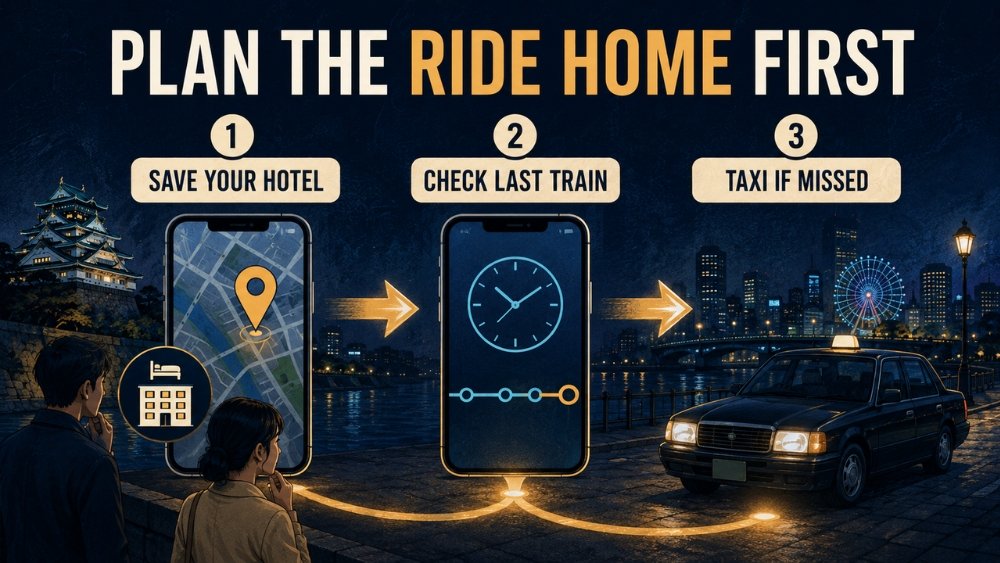
Before going out, save these three things on every traveler’s phone:
- The hotel’s exact name, address, phone number, and map pin.
- The correct station entrance and live last-train route for that night.
- A fallback plan and approximate taxi budget if the train is missed.
Use the Osaka Metro route and station list to reach the correct station page, then check the live timetable for your direction. Do not rely on a generic “Osaka last train” time. If your journey changes railway operators, check the full connection rather than only the final departure from the nightlife area.
Staying within a comfortable walk of your chosen area removes much of this friction. If nightlife is a priority, compare hotel location before comparing room extras; the first-time Osaka area guide can help. For the wider transport picture, use the Osaka transport guide and review how to use an ICOCA transit card.
Nightlife rules that prevent avoidable trouble
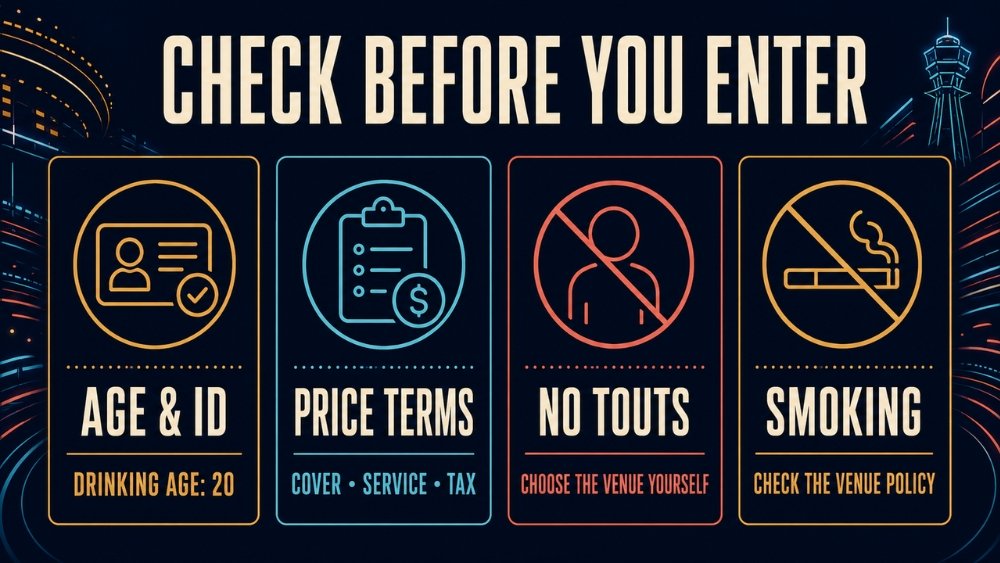
The legal drinking age is 20
Japan prohibits alcohol consumption by people under 20. The National Tax Agency’s current English report confirms the under-20 rule. A venue can also set its own admission and ID requirements, so carry an original government-issued photo ID and check what the venue accepts. Being 20 or older does not guarantee entry to every event.
An izakaya is a Japanese pub that serves food as well as drinks. It can be a practical group choice because the evening does not have to revolve around alcohol, but ordering systems and charges vary. Read the menu before ordering and ask about any cover, seating or service charge, tax, and minimum order if the terms are unclear.
Do not follow street touts
Osaka Prefectural Police warn that following street touts can lead to excessive-charge, fraud, or extortion-related trouble. Choose the venue independently, verify its name and location yourself, and walk away from pressure. If the venue, price, or conditions cannot be confirmed before entering, choose another place.
Street smoking is prohibited across Osaka City
Smoking is prohibited on public roads, squares, and parks throughout Osaka City. The city rule includes heated tobacco and carries a ¥1,000 administrative fine. Use a designated smoking place. Indoor rules are separate, so check a venue’s smoking policy if smoke exposure affects your choice.
Check the practical details on the venue’s own page
Opening days, final admission, ticket sales, dress rules, payment methods, step-free access, seating, and smoking conditions can change. Verify the date-specific details with the venue before crossing the city. A map listing is useful for navigation, but it should not replace the venue’s current terms.
Nightlife does not have to mean drinking or clubbing
Osaka at night can be dinner, dessert, karaoke, a live performance, an evening walk, or a hotel lounge. A non-drinker can use the same decision method: choose the atmosphere and exact activity first, then let hotel location and the return route settle the area. Check that the chosen activity works without an alcohol order rather than assuming.
If crowds, loud music, smoke, stairs, or compact rooms are difficult, make the plan more specific. Reserve a larger restaurant or hotel venue, confirm seating and access directly, choose an earlier time, and keep the return door-to-door. A quieter plan is not a lesser Osaka night; it is often the one that leaves enough energy for the next morning.
Make the decision before you leave the hotel
Choose one area, one first venue, and one return route. Save the exact pins, check the venue’s own terms, and verify the live timetable for your travel date. With those decisions made, Namba becomes an easy default rather than a vague promise—and any of the alternatives can be the better choice when it matches your hotel and the night you actually want.