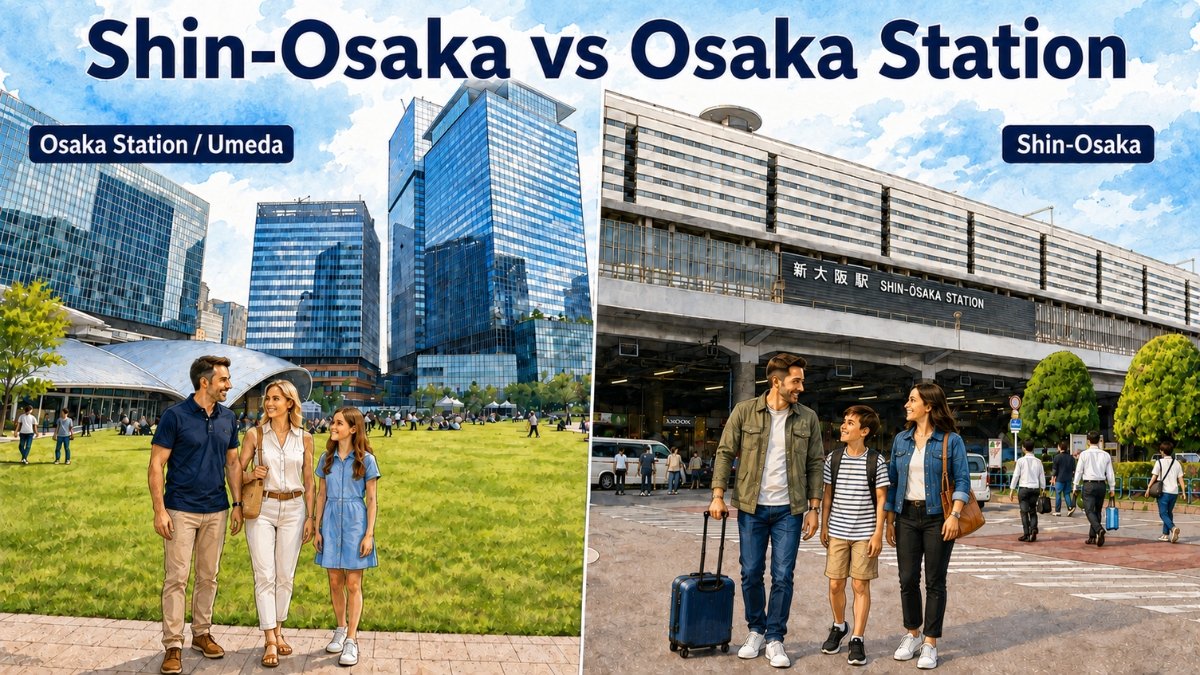
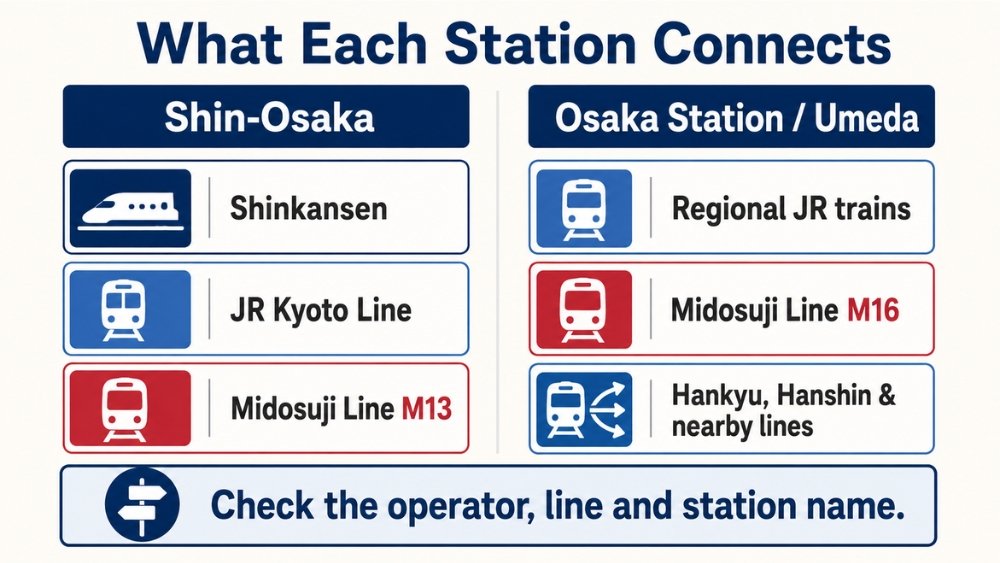
Shin-Osaka and Osaka Station are different stations with different jobs. Use Shin-Osaka for the Tokaido and Sanyo Shinkansen. Use Osaka Station for Umeda, central-city hotels, shopping, dining, and many regional JR trains.
The two stations are one stop apart on the JR Kyoto Line, but they are not close enough to treat as one complex. Most travelers arriving by bullet train should transfer at Shin-Osaka and continue to the hotel area. They do not need to visit Osaka Station unless Umeda is their destination or the next train leaves from there.
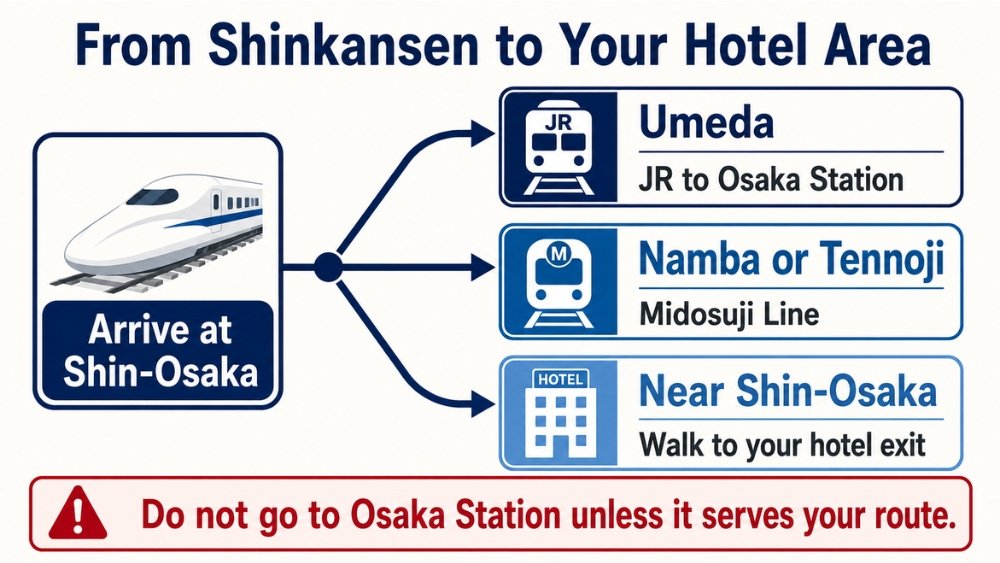
If your hotel is in Namba, Shinsaibashi, or Tennoji, the Osaka Metro Midosuji Line runs directly from Shin-Osaka. If your hotel is in Umeda, take the JR Kyoto Line to Osaka Station or the Midosuji Line to Umeda, depending on the exact building and nearest entrance.
Already know your long-distance route? Compare the official SmartEX service(Shinkansen ticket booking service) with Klook’s current Shinkansen ticket options before choosing a booking channel.
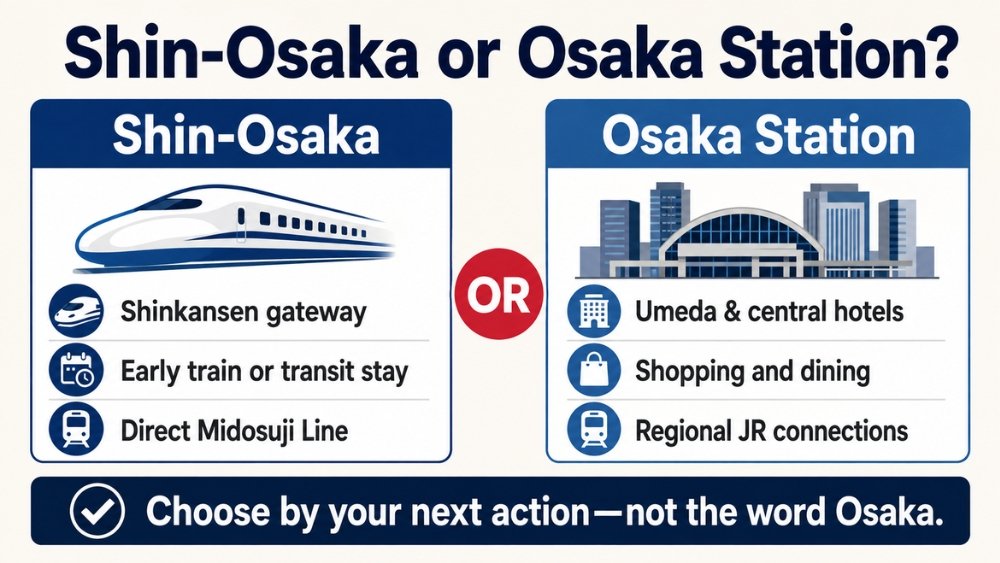
Shin-Osaka vs Osaka Station at a glance
| Question | Shin-Osaka Station | Osaka Station |
|---|---|---|
| Main role | Shinkansen gateway and transfer station | JR hub for Umeda and central Osaka |
| Shinkansen | Yes | No |
| Osaka Metro | Midosuji Line, station M13 | Use nearby Umeda Station, M16 |
| Best for | Arriving or departing by Shinkansen; early train; short transit stay | Umeda hotels; shopping; dining; regional JR trips |
| Direct subway to Namba | Yes, from M13 to M20 | Yes, from nearby Umeda M16 to Namba M20 |
| Immediate atmosphere | Functional transport district | Major business, shopping, and entertainment district |
| Biggest mistake | Expecting the surrounding area to feel like central Osaka | Expecting to board the Shinkansen here |
The names create the confusion: the city’s Shinkansen station uses “Shin,” meaning “new,” while the central JR station is simply Osaka Station. Always check the train operator, station name, and line before choosing a hotel or ticket.
Choose Shin-Osaka when the Shinkansen is the priority
Shin-Osaka is the correct station for Shinkansen services toward Kyoto, Nagoya, and Tokyo on the Tokaido route, and toward Shin-Kobe, Hiroshima, and Hakata on the Sanyo route.
It is a strong choice when:
- you arrive late by Shinkansen and want a simple final transfer;
- you have an early long-distance departure;
- you are staying only one night between cities;
- you have children or large luggage and want fewer steps before the bullet train;
- your hotel is near the Midosuji Line and you prefer a direct subway ride.
The station has JR conventional lines, the Osaka Metro Midosuji Line, shops, restaurants, lockers, and nearby hotels. It works well as a transport base. It is not the best area for travelers who want Osaka nightlife, department stores, or a wide choice of evening walks immediately outside the hotel.
Shin-Osaka is not a shortcut to every Osaka attraction
Seeing “Osaka” in the station name does not mean the station is beside Dotonbori, Osaka Castle, or Universal Studios Japan. Each requires onward travel.
- Umeda: one JR stop to Osaka Station, or three Midosuji Line stops to Umeda;
- Shinsaibashi: direct on the Midosuji Line to M19;
- Namba: direct on the Midosuji Line to M20;
- Tennoji: direct on the Midosuji Line to M23;
- Universal Studios Japan: use JR services and change within the JR network; there is no direct Shinkansen-to-park train.
Train times vary, but the direct subway ride from Shin-Osaka to Namba is usually around 15 minutes before station walking and exit-finding time. A route that looks short on a map can still take longer with luggage, escalators, gates, and an unfamiliar exit.
Choose Osaka Station when Umeda and city access matter more
Osaka Station is the main JR station in Umeda. Osaka Station and Umeda are essentially the same area, despite the different names. Osaka Station does not have Shinkansen platforms, but it is surrounded by hotels, department stores, malls, restaurants, office towers, and connections to multiple railway companies.
It is usually the better base when:
- you want to stay in Umeda;
- you plan several JR day trips around Kansai;
- you want shopping and dining near the hotel;
- different people in your group need different rail lines;
- your airport route or next regional train uses Osaka Station.
Osaka Station gives easy JR access toward Kyoto, Kobe, Himeji, and other parts of the region. Some destinations still require a transfer, so confirm the actual route rather than assuming every train is direct.
The area also suits travelers who want central convenience without staying in Namba. Our guide to Osaka areas for first-time visitors compares Umeda with Namba, Tennoji, and other hotel bases.
Osaka Station is not one simple building
“Osaka/Umeda” describes a connected transport district, not one set of ticket gates. The area includes:
- JR Osaka Station;
- Osaka Metro Umeda Station on the Midosuji Line;
- Higashi-Umeda Station on the Tanimachi Line;
- Nishi-Umeda Station on the Yotsubashi Line;
- Hankyu Osaka-Umeda Station;
- Hanshin Osaka-Umeda Station;
- Kitashinchi Station on the JR Tozai Line.
These stations are linked by streets, underground passages, commercial buildings, and signs, but a transfer still requires walking. Save the railway company, line, exit, and building name—not only “Umeda”—before arrival.
For a detailed arrival strategy, read how to navigate Osaka Station without stress.
How to transfer between Shin-Osaka and Osaka Station
JR: simplest for Osaka Station itself
Use a conventional JR Kyoto Line train between Shin-Osaka and Osaka Station. It is one stop and the ride is usually only a few minutes. Do not follow Shinkansen signs when making this local transfer.
At Shin-Osaka, follow signs for JR Lines after leaving the Shinkansen area. Check the departure board because different conventional trains use the corridor. At Osaka Station, note the exit or building needed before leaving the paid area.
JR is the natural choice when the destination is JR Osaka Station, a directly connected building, or another JR train.
Osaka Metro: simplest for Namba and the Midosuji corridor
Use the Midosuji Line when the destination is Umeda, Yodoyabashi, Hommachi, Shinsaibashi, Namba, or Tennoji and the hotel is closer to a subway entrance than a JR station.
The official station sequence is:
M13 Shin-Osaka → M16 Umeda → M18 Hommachi → M19 Shinsaibashi → M20 Namba → M23 Tennoji
The Midosuji Line and JR are separate systems with separate gates. Follow the red Midosuji Line signs, not the JR Lines signs.
Do not walk between the stations with luggage
Shin-Osaka and Osaka Station are several kilometres apart. Walking is not a practical station transfer, especially with suitcases, summer heat, rain, or a departure deadline. Use JR or Osaka Metro and budget time for the station interior.
Which station is better for your hotel?
Stay near Shin-Osaka if convenience has one specific purpose
A Shin-Osaka hotel works best for an early Shinkansen, late arrival, brief business stay, or one-night transit. The main advantage is reduced transfer risk on the long-distance travel day.
Check the hotel’s exact side of the station. Crossing the station complex or reaching a less convenient exit can still add walking. Confirm whether the route is step-free and whether breakfast starts early enough for the planned train.
Stay near Osaka Station for a broader first visit
Umeda is generally the stronger choice for a first Osaka trip when you want restaurants, shopping, regional rail connections, and multiple hotel categories nearby. The trade-off is navigation complexity.
Do not judge a hotel only by a listing that says “Umeda.” Check the nearest station, exit, and walking route. A property near Higashi-Umeda or Nishi-Umeda may not be equally convenient for every JR platform.
Choose Namba when southern Osaka is the trip focus
If Dotonbori, Kuromon Market, Shinsaibashi, and southern nightlife are the priority, Namba can be better than either station area. Arrive at Shin-Osaka by Shinkansen, then take the direct Midosuji Line to Namba.
Going to Osaka Station first usually adds an unnecessary transfer unless you have a separate reason to stop in Umeda.
Tickets: local IC card and Shinkansen booking are separate
An ICOCA or another compatible transport IC card is convenient for ordinary JR and Osaka Metro trips. Touch it at the local ticket gates and keep enough balance for the journey.
An ordinary ICOCA balance does not by itself cover a Shinkansen journey. JR West says a separate basic fare and limited express ticket are required. A compatible online reservation can be linked to an IC card, but that requires setting up the reservation correctly in advance.
For the Tokaido, Sanyo, and Kyushu Shinkansen, SmartEX is the official online service. It supports reservations before arrival, QR-ticket boarding on supported gates, designated IC cards, and ticket pickup when required. Read the current boarding method for the exact reservation rather than assuming every booking uses the same process.
Klook also currently sells Japan Shinkansen tickets and can be useful for travelers who want to compare schedules, seat types, payment options, and oversized-luggage seating in one international booking interface.
Our separate guide explains how to buy Shinkansen tickets in Osaka, including seat and oversized-baggage decisions.
Luggage and transfer strategy
Station choice matters more when you are carrying a large suitcase.
- Allow more time than the train ride alone suggests.
- Check which gate leads to JR Lines or Osaka Metro before moving.
- Use elevators rather than carrying luggage on stairs.
- Do not rely on finding a large locker at the last minute.
- Keep the ticket, QR code, or assigned IC card available before the gate.
- Confirm oversized-baggage seating rules before boarding the Shinkansen.
- Save the hotel’s nearest entrance and a street-level route.
If you land at Kansai International Airport, choose the airport route based on the hotel area rather than automatically traveling through Shin-Osaka. Our Kansai Airport to Osaka guide compares routes to Umeda, Namba, Tennoji, and other areas.
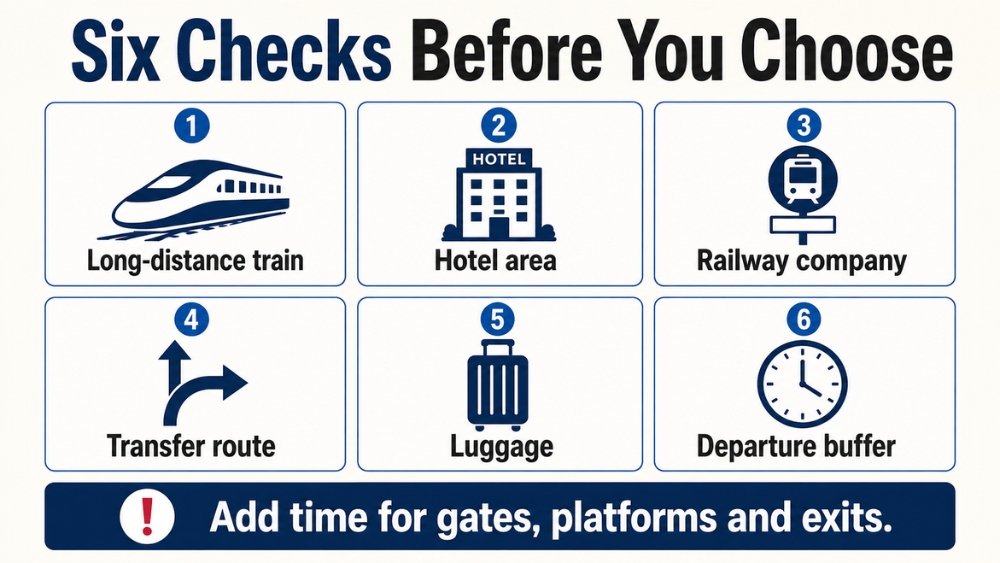
Six checks before choosing a station
- Long-distance train: Does your ticket actually say Shin-Osaka?
- Hotel area: Is the property in Umeda, Namba, Tennoji, or near Shin-Osaka?
- Railway company: Are you following JR or Osaka Metro signs?
- Transfer route: Is JR or the Midosuji Line closer to the hotel entrance?
- Luggage: Are elevators, walking distance, and oversized-baggage rules covered?
- Departure buffer: Have you added time for gates, platforms, and finding the correct exit?
Final verdict
Choose Shin-Osaka when the Shinkansen is the main reason for the station choice. Choose Osaka Station when you want Umeda, central-city convenience, shopping, dining, or regional JR connections. Choose Namba or another area instead when that location better matches the itinerary.
For most first-time visitors, the practical sequence is simple: arrive at Shin-Osaka by Shinkansen, transfer once to the hotel area, and return to Shin-Osaka only for the next bullet train. If you still need the long-distance ticket, compare Klook’s Shinkansen options with the official SmartEX conditions before paying.
Station layouts, service patterns, prices, and ticket rules can change. Recheck the relevant JR, Osaka Metro, SmartEX, or booking page shortly before travel.