Finding an Osaka ryokan is easy. Finding one that matches the stay you are picturing is harder.
Some Osaka properties offer tatami rooms and futon bedding in the middle of the city. Others add a communal bath, traditional meals, or family-run hospitality. Only one option in this comparison delivers the full countryside combination of historic architecture, a large Japanese garden, seasonal cuisine, and a natural hot spring.
The quick answer is simple:
- Best overall traditional stay: Amami Onsen Nanten-en
- Best for first-time visitors: Kaneyoshi Ryokan
- Best for a quiet, lower-key stay: Imazato Ryokan
- Best for families and groups of up to six: Osaka Ryokan Kuramoto
- Best for large groups and late nights in Dotonbori: Yamatoya Honten
Start by comparing the five Osaka ryokan on Klook for your actual dates and guest count. Room types, meal plans, cancellation terms, and availability can change independently.
First decide: city ryokan or onsen retreat?
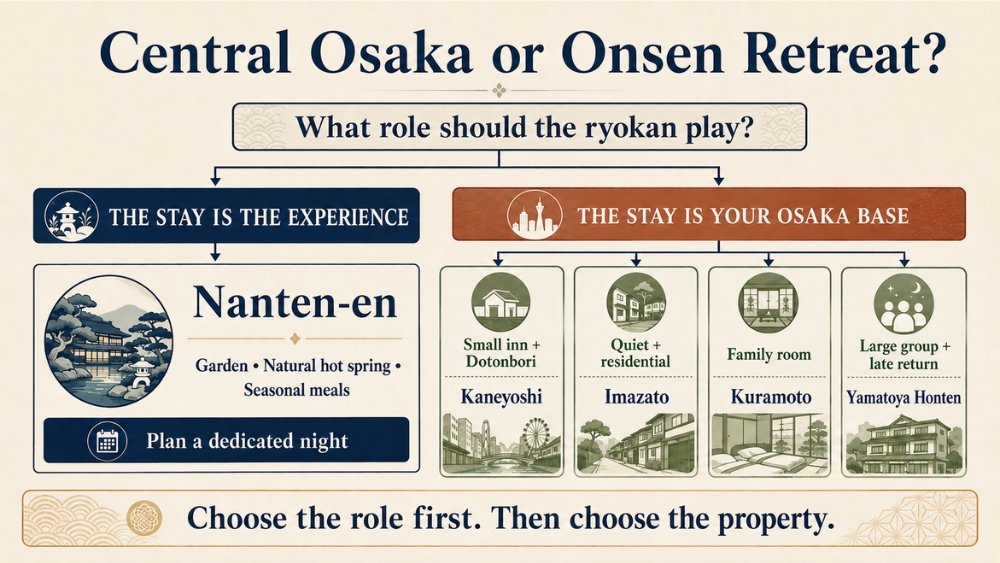
The biggest decision is not which property ranks first. It is whether the ryokan should be your Osaka base or a dedicated overnight experience.
Choose a central property if you want to walk to Dotonbori, return after dinner, and keep sightseeing logistics simple. Kaneyoshi, Kuramoto, and Yamatoya Honten all work for this purpose. Imazato is outside the main visitor district, but it offers a quieter residential setting with straightforward rail and metro access.
Choose Nanten-en if the inn itself is one of the main events of the trip. It is about 40 minutes by train from central Osaka, so the garden, hot spring, room, and meal deserve time rather than being squeezed between attractions.
If you are still choosing where to base yourself, read What Area Suits First-Time Osaka Travelers? before booking.
Who this guide is not for
A ryokan can be memorable, but it is not automatically more comfortable than a modern hotel.
Consider a conventional hotel instead if you:
- require a Western bed and do not want to sleep on a futon;
- have difficulty sitting, standing, or sleeping close to floor level;
- need a gym, executive lounge, or extensive business facilities;
- want a large international breakfast buffet;
- need several large suitcases open at the same time;
- prefer minimal interaction with staff;
- do not want to check meal times, bath rules, or room-specific bathroom arrangements.
A tatami room may look spacious during the day because the futons are stored away. Once the bedding is laid out, the usable floor area becomes smaller. For a longer Osaka stay, a sensible approach is often to combine a practical hotel with one or two ryokan nights.
How these Osaka ryokan were selected
This comparison was rebuilt from the current official information published by each property and Klook listings checked on August 3, 2026.
Each property had to offer a meaningful Japanese-style stay and a current Klook accommodation page. The ranking then considered:
- the type of ryokan experience;
- access from central Osaka;
- tatami rooms and futon bedding;
- natural hot spring versus ordinary communal bath;
- private bathroom availability;
- meal options;
- suitability for couples, families, solo travellers, and groups;
- practical booking risks.
Scores from excluded booking and review platforms are not used. Prices are also omitted because they can shift sharply by date, occupancy, meal plan, and room type. Compare the final payable price only after entering the correct dates and number of guests.
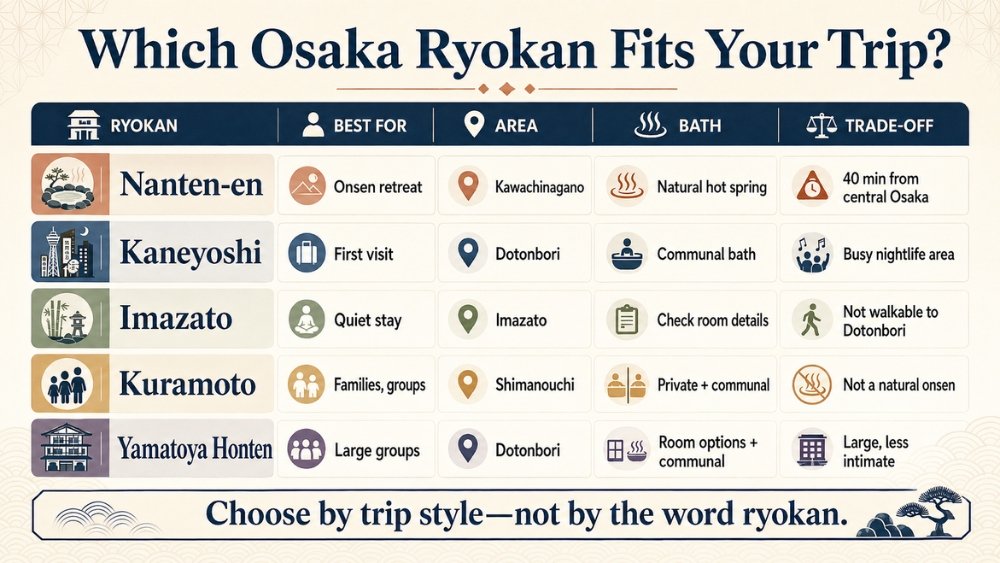
Osaka ryokan comparison table
| Osaka ryokan | Best for | Area and access | Bath setup | Main trade-off |
|---|---|---|---|---|
| Amami Onsen Nanten-en | A complete ryokan and onsen experience | Kawachinagano; close to Amami Station; about 40 minutes from central Osaka | Natural radium hot spring; one annex has a private open-air hot spring | Too far out for repeated Dotonbori trips |
| Kaneyoshi Ryokan | First-time visitors and couples | Dotonbori; about 3 minutes from Nipponbashi Station | Compact communal bath; most Japanese rooms have bath and toilet, but budget room types do not | Busy nightlife setting and scheduled closure periods |
| Imazato Ryokan | Quiet stays, solo travel, and longer visits | Residential Imazato; about 5 minutes from Osaka Metro or Kintetsu Imazato | Check the exact room listing and shared-facility details | Not walkable to Dotonbori |
| Osaka Ryokan Kuramoto | Families and groups of up to six | Shimanouchi; about 3 minutes from Dotonbori | Every room has a bath and toilet; separate communal bath | Functional urban ryokan rather than an onsen retreat |
| Yamatoya Honten | Large groups and late-night Dotonbori access | Dotonbori; about 3 minutes from Nipponbashi Station | Rooms with or without a private bath; communal bath; men’s sauna | Larger and less intimate than a small inn |
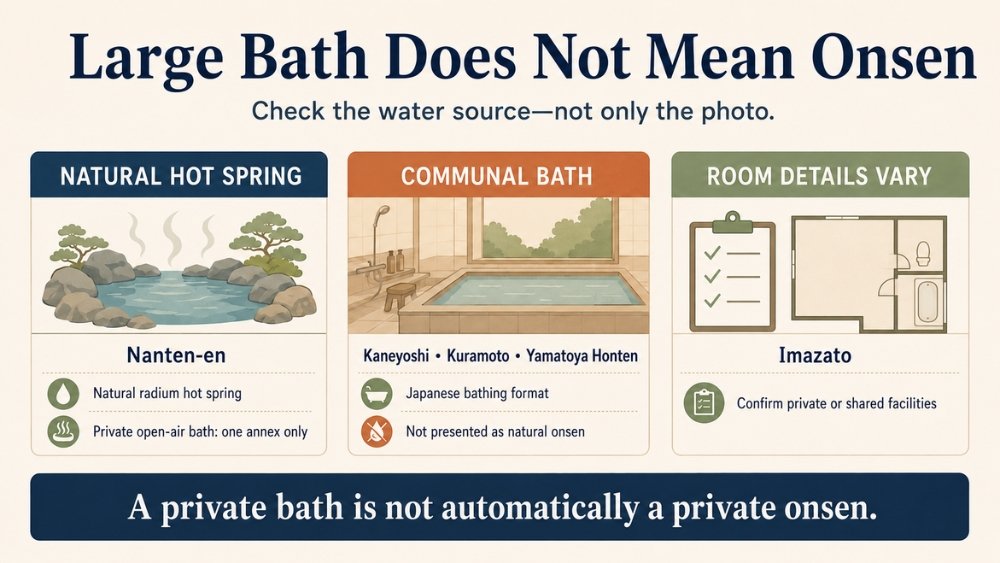
A large communal bath is not automatically an onsen
This distinction prevents one of the most common booking mismatches.
An onsen uses naturally sourced hot-spring water. A large communal bath may provide the same Japanese bathing format without natural hot-spring water.
Nanten-en explicitly offers a natural radium hot spring. Kaneyoshi, Kuramoto, and Yamatoya Honten advertise communal baths, but they should not be presented as destination onsen resorts. For Imazato, confirm the bathroom and bathing arrangement attached to the exact room you are considering.
1. Amami Onsen Nanten-en
Best overall for a traditional ryokan retreat
Amami Onsen Nanten-en is the clear first choice when the ryokan experience matters more than a central address.
The main building overlooks a large Japanese garden and is nationally registered as a tangible cultural property. The property attributes its design to Kingo Tatsuno, the architect associated with Tokyo Station. Guests stay in tatami rooms, sleep on futons, wear yukata, bathe in a natural radium hot spring, and can choose plans with seasonal Japanese cuisine.
One important room distinction is the Seiryuu-tei annex. It accepts one group per day and includes a private open-air hot spring. That feature does not apply to every room, so read the room name and bath description carefully.
Nanten-en can also prepare meatless meals and meals without pork or alcohol when requested in advance. Dietary accommodation is not automatic; send the property clear details before arrival and wait for confirmation.
The official site places the ryokan about 40 minutes by train from central Osaka. Klook currently lists Amami Station about 100 metres away. This makes Nanten-en unusually accessible for a countryside-style retreat, but it is still a poor choice for travellers who expect to move back and forth to Namba several times a day.
Best for: couples, anniversaries, a one-night retreat, travellers who value gardens, meals, architecture, and natural hot-spring bathing.
Not ideal for: nightlife-focused trips, late arrivals, or visitors who want a full Osaka itinerary immediately outside the door.
Official information: Amami Onsen Nanten-en
Check Amami Onsen Nanten-en on Klook for the room, bath, meal, and arrival conditions attached to your dates.
2. Kaneyoshi Ryokan
Best balance of tradition and Dotonbori convenience
Kaneyoshi Ryokan is the easiest recommendation for a first Osaka trip. It places a small, long-established inn beside the Dotonbori River, about three minutes on foot from Nipponbashi Station and within walking distance of Namba.
The main Japanese rooms are six, eight, or ten tatami mats. River-facing rooms look over Dotonbori, while street-side rooms use double windows to reduce noise. The property also has a compact communal bath with morning and evening hours.
Do not assume that every room includes the same facilities. The Japanese rooms list a bath and toilet, but the budget bunk-bed and semi-double rooms have no in-room bath, toilet, or window. Those guests use the communal bath and shared toilet. The cheaper room can therefore be a false economy for someone who expects a private bathroom.
Kaneyoshi is also unusually practical for families. The official site lists child amenities on request, a communal microwave, a water dispenser, and permission to bring in food or receive deliveries at the front desk.
Important 2026–2027 closure notice: the official site currently lists closures from October 12–23, 2026 and February 10–25, 2027. Check the latest notice even if a booking page appears to show inventory.
Best for: first-time visitors, couples, families, short stays, and travellers who want a ryokan without giving up Dotonbori.
Not ideal for: travellers seeking a natural hot spring, extensive gardens, or a quiet countryside atmosphere.
Official information: Kaneyoshi Ryokan rooms and current notices
Check Kaneyoshi Ryokan on Klook and confirm that the selected room includes the bathroom, view, and bedding arrangement you expect.
For evening planning nearby, see 12 Things to Do in Namba at Night.
3. Imazato Ryokan
Best for a quiet, local-feeling stay
Imazato Ryokan is the alternative for travellers who want a small Japanese inn without the constant movement and neon of Dotonbori.
The official site describes a quiet, home-like Japanese-style property suited to sightseeing, business trips, families, groups, and longer stays. It is around five minutes on foot from both Osaka Metro Imazato Station and Kintetsu Imazato Station, giving it useful connections even though the main visitor district is not within walking distance.
Breakfast is part of the property’s appeal, but meal availability must be checked against the booked plan. A current official notice says same-day reservations can accommodate breakfast only, while dinner requests need to be made by the previous day.
The main weakness is that the English-language detail is thinner than at the other properties. Do not infer bathroom privacy, meal inclusion, or upper-floor access from the phrase “Japanese-style room.” Read the complete Klook room details and contact the property if any accessibility or shared-facility point is unclear.
Best for: solo travellers, repeat Osaka visitors, budget-conscious couples, business stays, and guests who prefer a residential setting.
Not ideal for: a first visit built around walking home from Dotonbori late at night.
Official information: Imazato Ryokan
Check Imazato Ryokan on Klook and verify the exact bathroom, meal, and check-in conditions before paying.
4. Osaka Ryokan Kuramoto
Best for families and groups sharing one room
Osaka Ryokan Kuramoto combines a central location with some of the most useful room capacities in this comparison.
The property is about three minutes on foot from Dotonbori and around ten minutes from Nagahoribashi or Kintetsu-Nipponbashi stations. Its four Japanese-room categories range from six tatami mats for one or two guests to twelve tatami mats for four to six guests.
Every room has a bath and Western-style toilet. Guests can also use the separate communal bath, currently listed for 5:00 p.m.–midnight and 6:30–8:30 a.m. Handrails and bath seats are available in the communal bathing area, and the property lists an accessible restroom. Travellers with specific mobility requirements should still confirm the route to their room and the exact assistance available.
Kuramoto is also the only central property here whose official site gives detailed multi-course dinner options with Osaka flavours. Meal availability and advance-request conditions should be checked against the selected plan rather than assumed from the room name.
Best for: families, groups of friends, and travellers who want one shared tatami room with a private bathroom.
Not ideal for: couples seeking an intimate boutique atmosphere or anyone expecting a natural hot spring.
Official information: Osaka Ryokan Kuramoto rooms and facilities
Check Osaka Ryokan Kuramoto on Klook for the room capacity and meal plan available for your group.
5. Yamatoya Honten Ryokan Osaka
Best for large groups and late-night access
Yamatoya Honten is the largest and most hotel-like property in this comparison. That is a disadvantage if you want a small family-run inn, but a strength when you need more room configurations, group capacity, and flexible movement.
The ryokan has 39 rooms and lists capacity for 178 guests. It is about three minutes on foot from Nipponbashi Station and sits beside Dotonbori. Some rooms have a private bath and toilet, while lower-priced Japanese rooms may have a toilet but no bath. Those guests use the communal bathing area.
The large baths are separated by gender, and the men’s side includes a sauna. The official site also states that the property operates 24 hours without the curfew often associated with smaller ryokan. This is useful for travellers who plan to eat or go out late in Namba.
Yamatoya Honten also offers family rooms, river-view rooms, meal-inclusive and room-only plans, and six banquet rooms. The trade-off is scale: it feels closer to an urban ryokan-hotel than a quiet personal retreat.
Best for: extended families, tour groups, groups of friends, and visitors prioritising Dotonbori and late returns.
Not ideal for: a romantic small-inn atmosphere or a natural onsen stay.
Official information: Yamatoya Honten rooms and facilities
Check Yamatoya Honten Ryokan Osaka on Klook and compare private-bath and shared-bath room categories carefully.
Five checks before booking an Osaka ryokan
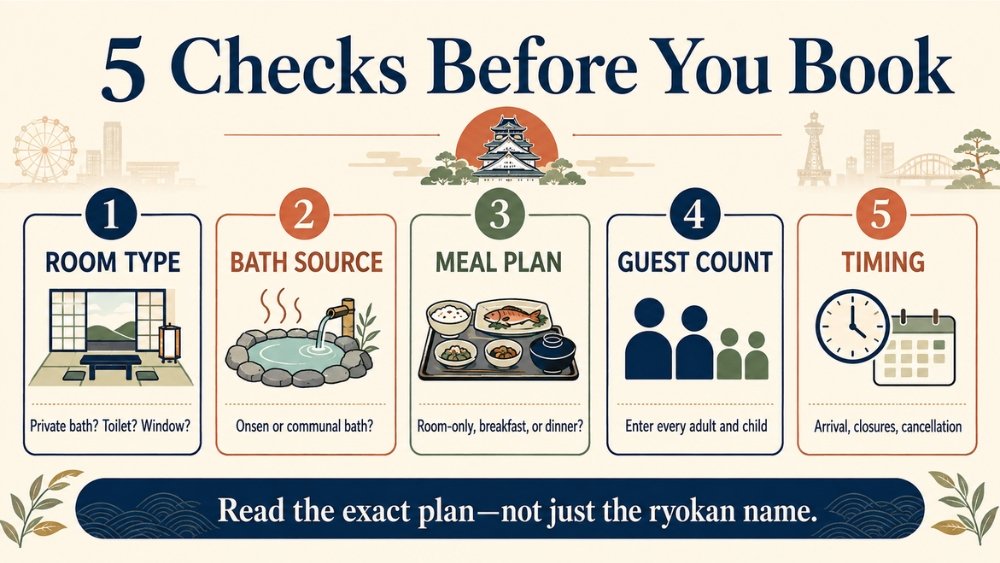
1. Read the complete room name
“Japanese-style room” confirms very little by itself. Look for the exact statements about:
- private bath;
- private toilet;
- shared bath;
- shared toilet;
- window;
- river view;
- open-air bath;
- futon or Western bed.
Kaneyoshi and Yamatoya Honten have especially important differences between room categories. Nanten-en’s private open-air hot spring belongs to a specific annex, not the whole property.
2. Confirm whether the bath is an onsen
If natural hot-spring water is important, verify that point directly. A photograph of a large bath does not prove that it is an onsen.
If you have tattoos, mobility needs, or discomfort with communal bathing, contact the property before booking. A room with a private bath may be the safer choice, but it is not necessarily a private onsen.
3. Check the meal plan and arrival time together
The lowest price may be room-only. At Nanten-en, dinner and breakfast can be central to the experience. In Dotonbori, room-only may be more practical because restaurants are outside the door.
Meal-inclusive plans often require an earlier arrival. Do not book dinner and then assume you can check in after a full evening of sightseeing.
4. Enter every adult and child correctly
Ryokan inventory and prices often change with the number and ages of guests. A room that appears available for two people may disappear for four, or the plan may change when children require meals and futons.
Enter the complete party before comparing the final price.
5. Recheck closures, cancellation terms, and transport
Read the cancellation deadline for the exact plan, not only the property summary. Also recheck current closure notices, especially for Kaneyoshi’s announced 2026 and 2027 closure periods.
For an arrival from Kansai International Airport, compare the luggage and transfer implications in How to Get from Kansai International Airport to Osaka before choosing a central property or Nanten-en.
Final verdict: which Osaka ryokan should you book?
There is no universal winner. The right Osaka ryokan depends on whether you value the inn itself, a central address, a quiet neighbourhood, or group capacity.
Choose Amami Onsen Nanten-en when you want the most complete traditional retreat, including a garden, seasonal cuisine, historic architecture, and natural hot-spring bathing.
Choose Kaneyoshi Ryokan when this is your first Osaka trip and you want the strongest balance of tatami-room atmosphere, a communal bath, and Dotonbori convenience.
Choose Imazato Ryokan when quiet surroundings, a home-like atmosphere, and value matter more than walking back from Namba.
Choose Osaka Ryokan Kuramoto when a family or group of up to six wants one Japanese room, an in-room bathroom, and central access.
Choose Yamatoya Honten Ryokan Osaka when a larger group needs more room types, a bigger communal bath, and the freedom to return late.
For most first-time visitors, Kaneyoshi is the practical answer. For the ryokan night you are likely to remember as a distinct part of the trip, Nanten-en is the stronger choice.