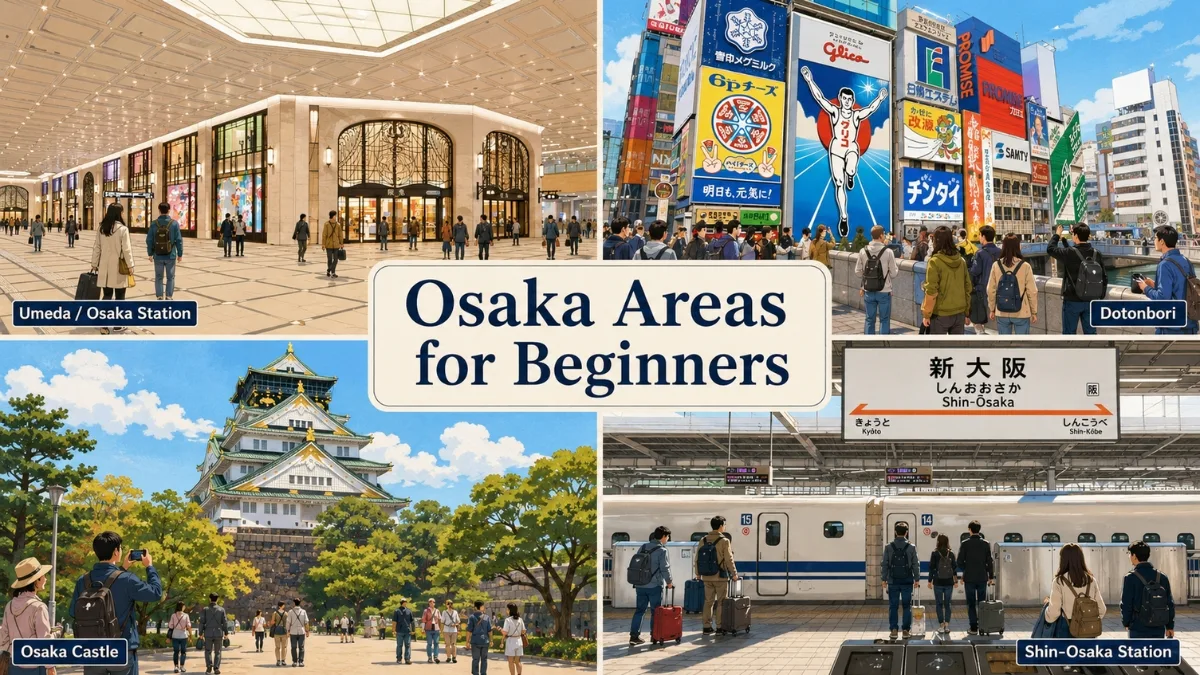
Osaka becomes much easier when you stop treating it as one huge sightseeing zone. For a first visit, think in connected districts: Umeda in the north; Namba, Dotonbori and Shinsaibashi in the south; Osaka Castle on the eastern side of the center; and Tennoji farther southeast. Shin-Osaka is primarily the city’s Shinkansen gateway, not another name for central Osaka.
The most useful beginner habit is to save four details before every move: area, railway operator, exact station name, and exit or gate. This matters because “Namba” can point to several stations, while “Osaka,” “Umeda,” “Tennoji,” and “Osaka-Abenobashi” may describe neighboring terminals rather than one shared platform.
| District | Best for | What beginners should notice |
|---|---|---|
| Umeda / Osaka Station | Major transfers, shopping, city views | Several railway companies and large underground passages |
| Namba / Dotonbori | Food, nightlife, classic first-visit energy | Four commonly used Namba station names |
| Shinsaibashi / Horie | Shopping, cafes, slower side streets | Better explored on foot from the south-center cluster |
| Tennoji / Abeno | Temples, museums, parks, southern rail links | Tennoji and Osaka-Abenobashi are neighboring but different stations |
| Osaka Castle area | History, park walks, museums | Different stations approach different sides of the park |
| Shin-Osaka | Shinkansen arrival and departure | Transfer point rather than a sightseeing district |
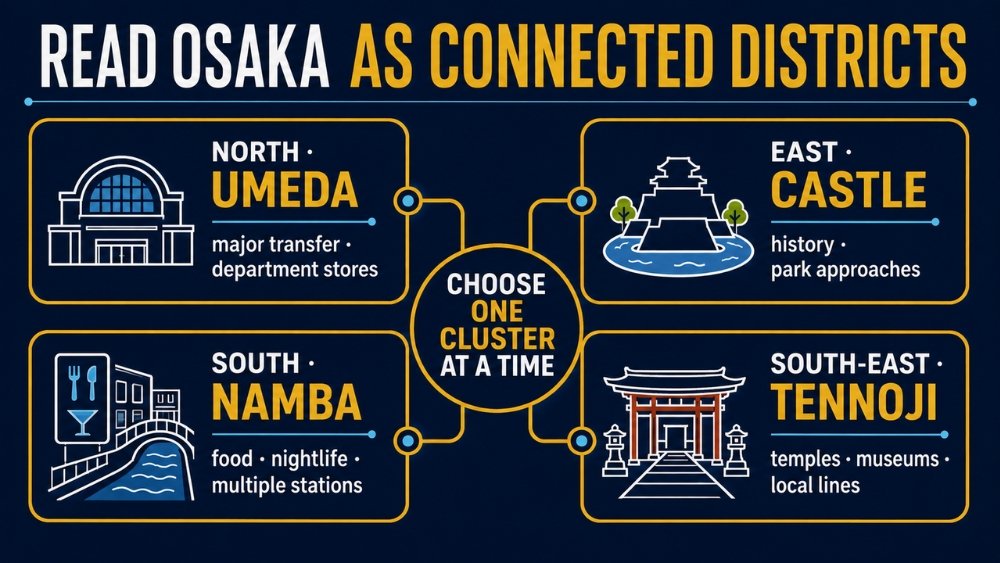
The simple mental map: north, south, east and southeast
You do not need to memorize Osaka’s full rail network. Start with four broad clusters.
North: Umeda and Osaka Station. This is the large commercial and transfer center used by JR, Osaka Metro, Hankyu and Hanshin services. It is convenient for Kyoto, Kobe and northern Osaka, but the station complex can feel like a district of its own.
South: Namba, Dotonbori and Shinsaibashi. This is the easiest cluster for food streets, neon, shopping and evening activity. The places are close enough to combine on foot, but the station names require attention.
East: Osaka Castle and its park. The castle grounds are broad. Morinomiya, Osakajokoen, Osaka Business Park and Tanimachi 4-chome serve different sides, so the best station depends on the gate, museum or next destination you have saved.
Southeast: Tennoji and Abeno. The area combines JR and subway connections with Tennoji Park, museums, Shitennoji and the Abeno commercial zone. It can be a full half-day rather than a quick add-on.
Use the Osaka Metro route map to move between these broad clusters, then switch to the exact station guide and exit for the place you have saved. Osaka works better as several walkable districts connected by rail than as one continuous walking route.
Umeda and Osaka Station: one district, several systems
Umeda is the name most people use for the commercial district around Osaka Station. Osaka Station is the main JR station. Umeda Station appears in the names of Osaka Metro and private-railway stations; nearby names also include Higashi-Umeda and Nishi-Umeda.
Before following a route, check the operator:
- JR services use Osaka Station.
- Osaka Metro’s Midosuji Line uses Umeda Station.
- The Tanimachi Line uses Higashi-Umeda.
- The Yotsubashi Line uses Nishi-Umeda.
- Hankyu and Hanshin have their own Osaka-Umeda stations.
These stations connect through streets and underground passages, but “connected” does not mean the transfer is immediate. With luggage, children or limited mobility, allow extra time and follow the operator name before the platform number.
Umeda suits a first day when you want an indoor-friendly district: department stores, dining floors and large commercial buildings sit close to transport. It also pairs naturally with Nakanoshima or Nakazakicho. It does not pair efficiently with every southern attraction simply because both are in Osaka.
Namba: match the station name before you walk
Namba is both a district and a family of station names. A route that says only “Namba” is incomplete.
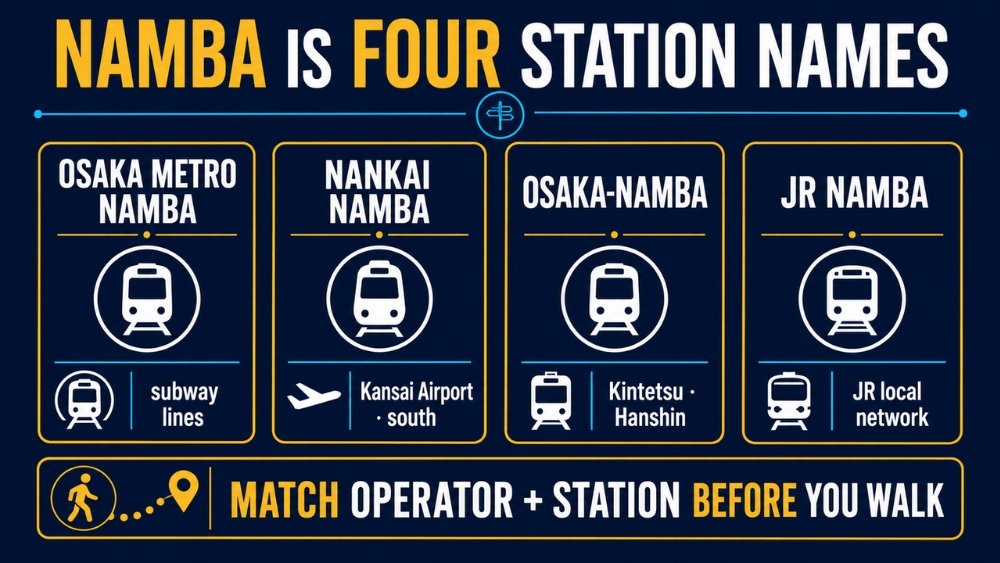
Osaka Metro Namba Station
This subway station serves the Midosuji, Yotsubashi and Sennichimae lines. It is usually the most useful Namba label for a subway trip to Umeda, Shinsaibashi or Tennoji. The Osaka Metro route guide lists the lines and transfers at Namba.
Nankai Namba Station
Nankai Namba is the terminal for Nankai services toward Kansai Airport, Wakayama and Koyasan connections. Nankai’s official timetable page describes the Rapi:t and Airport Express services between Kansai Airport and Namba. If your airport route says “Nankai,” do not walk toward a sign for Osaka-Namba merely because the names look similar.
Osaka-Namba Station
The hyphenated Osaka-Namba Station is used by Kintetsu and Hanshin. Kintetsu’s official network map places Osaka-Namba on the route toward Kintetsu-Nara. It is not the Nankai airport terminal.
JR Namba Station
JR Namba sits to the west in the OCAT area. It can be useful for JR routes and highway-bus connections, but it is not the closest starting point for every Dotonbori or Kuromon Market plan.
Save the exact entrance or exit after choosing the station. Dotonbori spreads along a canal; Kuromon Market lies east of the central Namba station area; Shinsaibashi is north; and Horie is west. A correct station with the wrong exit can still create an unnecessary underground walk.
Dotonbori and Shinsaibashi: treat them as a walking sequence
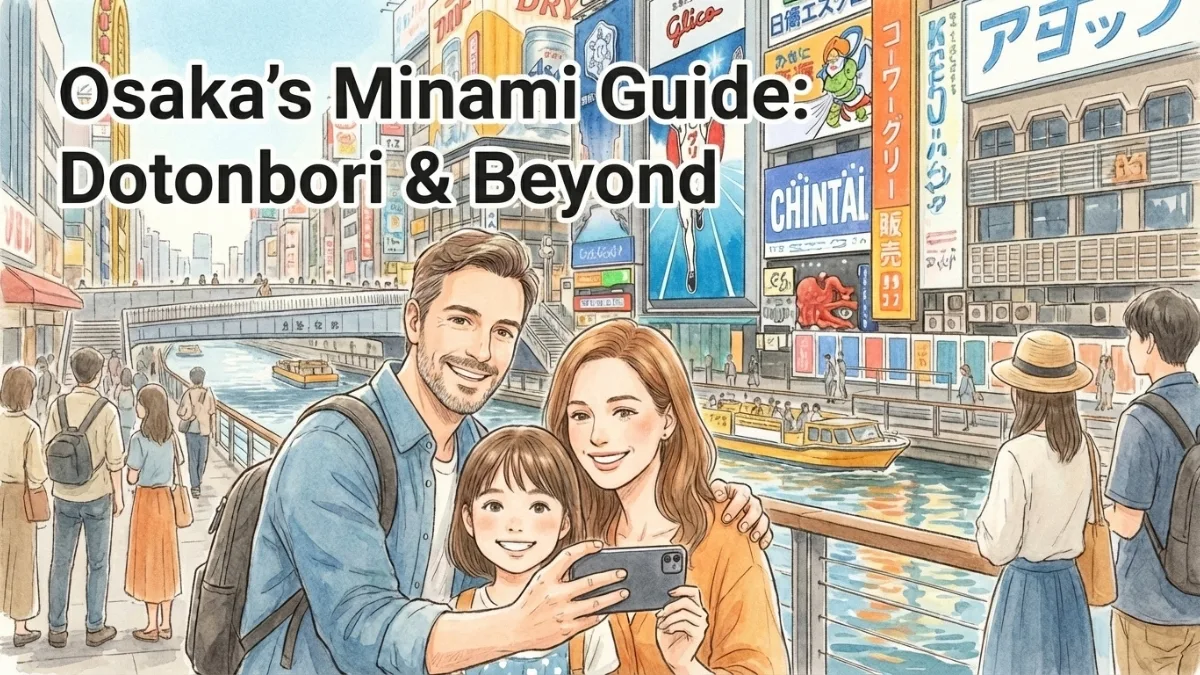
Dotonbori is the canal-side entertainment district associated with giant signs, restaurants and evening crowds. The Dotonbori Shopping Association provides the district’s current shop and area information.
Shinsaibashi lies north of the main Dotonbori canal. The covered Shinsaibashi-suji shopping arcade creates an easy north-south walking link, while America-mura and Horie extend the experience westward. The route is more useful than the labels:
- Start in Namba if food markets, Nankai arrival or southern shopping comes first.
- Walk through Dotonbori when you want the classic canal atmosphere.
- Continue north to Shinsaibashi for the arcade and department-store zone.
- Turn west toward Horie only if you still want cafes, boutiques and quieter side streets.
This sequence avoids boarding a train for a very short move and then losing time finding another exit. It also lets you stop early if heat, rain or crowds become tiring.
Shinsaibashi and Horie: close, but different in mood
Shinsaibashi is a major shopping district with the Midosuji Line and Nagahori Tsurumi-ryokuchi Line. It remains busy well beyond the covered arcade. Horie, west of Shinsaibashi and America-mura, has more independent shops, cafes and interior-design businesses, with Orange Street as the area’s best-known shopping spine.
For a first visit, combine them on foot rather than treating Horie as a separate cross-city destination. Save a specific shop, cafe or street; “go to Horie” is too vague because the district covers several blocks. If your feet are already tired, keep Horie as an optional extension instead of forcing a complete loop.
Tennoji and Abeno: neighboring names with different railway roles
Tennoji is a strong sightseeing cluster for travelers who want parks, museums and historic sites without returning to Namba between every stop. JR and Osaka Metro use Tennoji Station. The neighboring Kintetsu terminal is Osaka-Abenobashi Station.
The distinction matters for onward travel. Kintetsu’s official network map shows Osaka-Abenobashi on the network toward Yoshino, while Osaka-Namba and Osaka-Uehommachi sit on the route toward Kintetsu-Nara. Do not assume every Kintetsu station in central Osaka serves the same direction.
Within the district:
- Tennoji Park, Keitakuen Garden and the Osaka City Museum of Fine Arts sit west of the main station area.
- Abeno Harukas and the Abeno commercial zone sit beside the stations on the south side.
- Shitennoji is north of Tennoji; Shitennoji-mae Yuhigaoka Station can be more direct for a temple-first plan.
Choose one side before leaving the station. “Tennoji exit” is not enough guidance for a large terminal with several connected buildings and street levels.
Osaka Castle: choose the approach, not just the landmark
Osaka Castle Park is too large for a single universal “nearest station.” A route from Morinomiya feels different from an approach via Tanimachi 4-chome or Osakajokoen. The right choice depends on whether you want the castle tower, the museum area, a park walk or an onward trip.
Use the official Osaka Castle Park English guide to match the station side with the gate and facility you actually want. Save the return station too. Walking across the park and then trying to return to the original entrance can turn a focused visit into an exhausting detour.
The castle area can pair with Temmabashi, Tanimachi or a riverfront stop. It is less sensible to cross to Namba for lunch, return east for the castle, and then travel south to Tennoji in one afternoon.
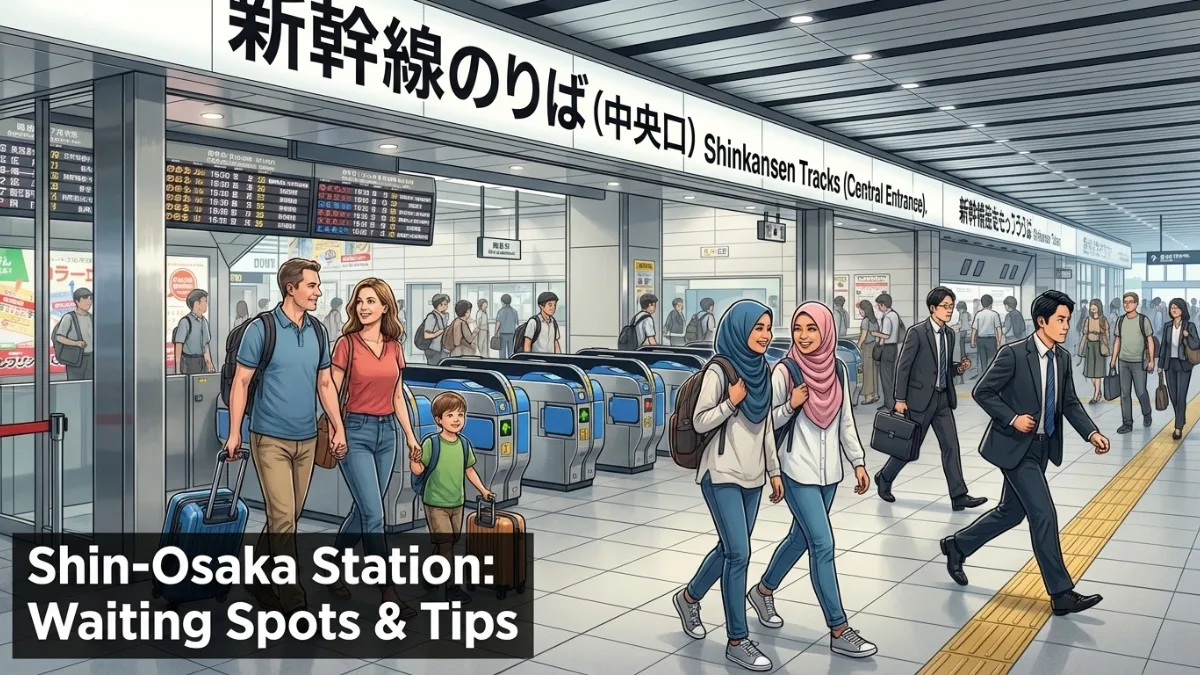
Shin-Osaka: a transport gateway, not Osaka Station
Shin-Osaka and Osaka Station are separate stations. Shin-Osaka is the Shinkansen gateway; Osaka Station is the large JR hub in Umeda. Osaka Metro’s Midosuji Line connects Shin-Osaka with Umeda, Shinsaibashi, Namba and Tennoji, which makes the transfer straightforward once you follow the correct line and direction.
Staying near Shin-Osaka can make sense for repeated Shinkansen day trips or an early departure. For sightseeing, however, do not assume that leaving the station means you have reached Umeda or Osaka’s main entertainment districts. Build in the subway or JR transfer.
When arriving with luggage, save the hotel entrance and the correct side of the station before leaving the concourse. A hotel described as “near Shin-Osaka” may be simple from one gate and awkward from another.
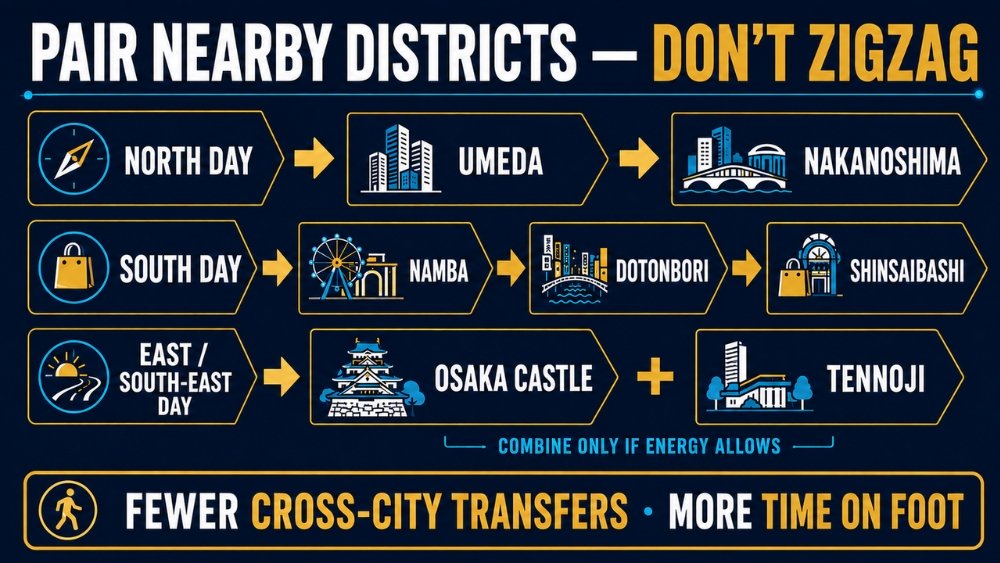
Build days by cluster, not by attraction ranking
An efficient itinerary groups places that share a side of the city:
- North day: Umeda, Nakazakicho and Nakanoshima.
- South day: Kuromon or Namba, Dotonbori, Shinsaibashi and an optional Horie extension.
- East day: Osaka Castle Park, Tanimachi or Temmabashi.
- Southeast day: Tennoji Park, Abeno and Shitennoji.
Osaka Castle and Tennoji can fit in one day if you start early and prefer landmarks over slow neighborhood wandering. Treat that as an optional combination, not a default. Families, photographers, shoppers and travelers visiting in summer heat will often enjoy less by trying to cross the city repeatedly.
One transfer is not automatically worse than a long walk. If rain is heavy, a traveler has luggage, or an accessible route matters, a simple rail connection may be the better choice. Osaka Metro states that an accessible route is available at all subway and New Tram stations, but the best transfer path can still require following lifts and signs rather than the shortest stairs.
The four-item check before every move
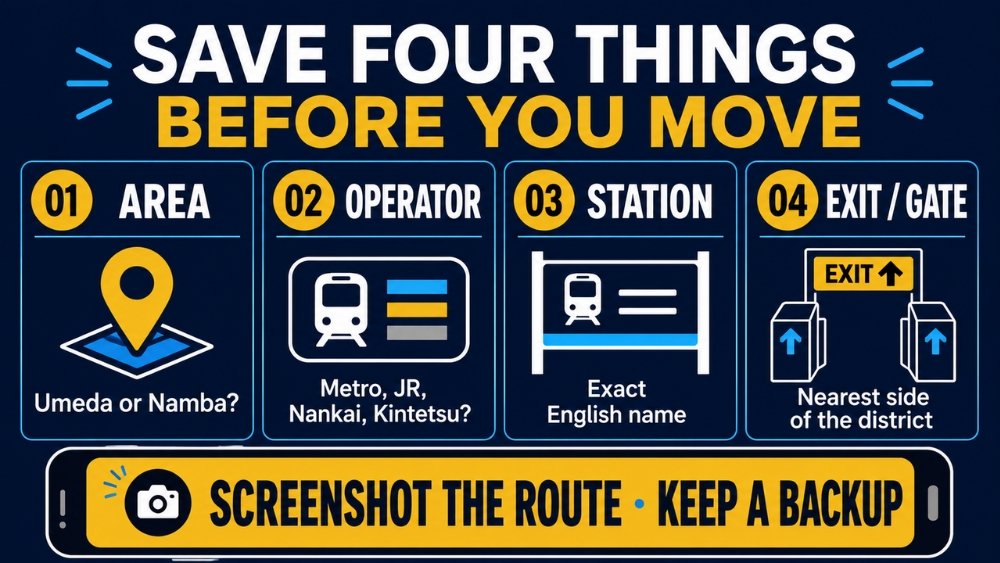
Before leaving a cafe, hotel or attraction, save:
- Area: the district you are entering, such as Umeda or Namba.
- Operator: Osaka Metro, JR, Nankai, Kintetsu, Hanshin, Hankyu or another railway.
- Station: the exact English name, including “Shin-,” “JR,” “Nankai” or the Osaka-Namba hyphen.
- Exit or gate: the side closest to your first real destination.
Take a screenshot in case mobile data drops underground. Keep the address in Japanese if a taxi or staff member may need it. An IC card—such as ICOCA—reduces ticket-machine decisions, but it does not choose the correct company, platform or limited-express ticket for you.
Check live service information and final admission times on the day. Do not rely on a saved itinerary for special-event crowds, weather disruption, temporary station work or a business that has changed its hours.
A beginner-friendly rhythm for three days
For a short first trip, a low-stress structure might look like this:
Day 1: South Osaka. Arrive at the correct Namba station, eat or shop nearby, walk Dotonbori to Shinsaibashi, and stop before adding Horie if energy is low.
Day 2: East or southeast. Choose Osaka Castle for a history-and-park day, or Tennoji for museums, temples and Abeno. Combine them only when the pace feels comfortable.
Day 3: North Osaka and departure planning. Explore Umeda and Nakanoshima, then confirm whether your final train leaves from Osaka Station, Shin-Osaka, Nankai Namba or another terminal.
This is not the only correct order. The important principle is to complete one district before crossing to another. Osaka feels less confusing when every move has a named area, operator, station and exit.