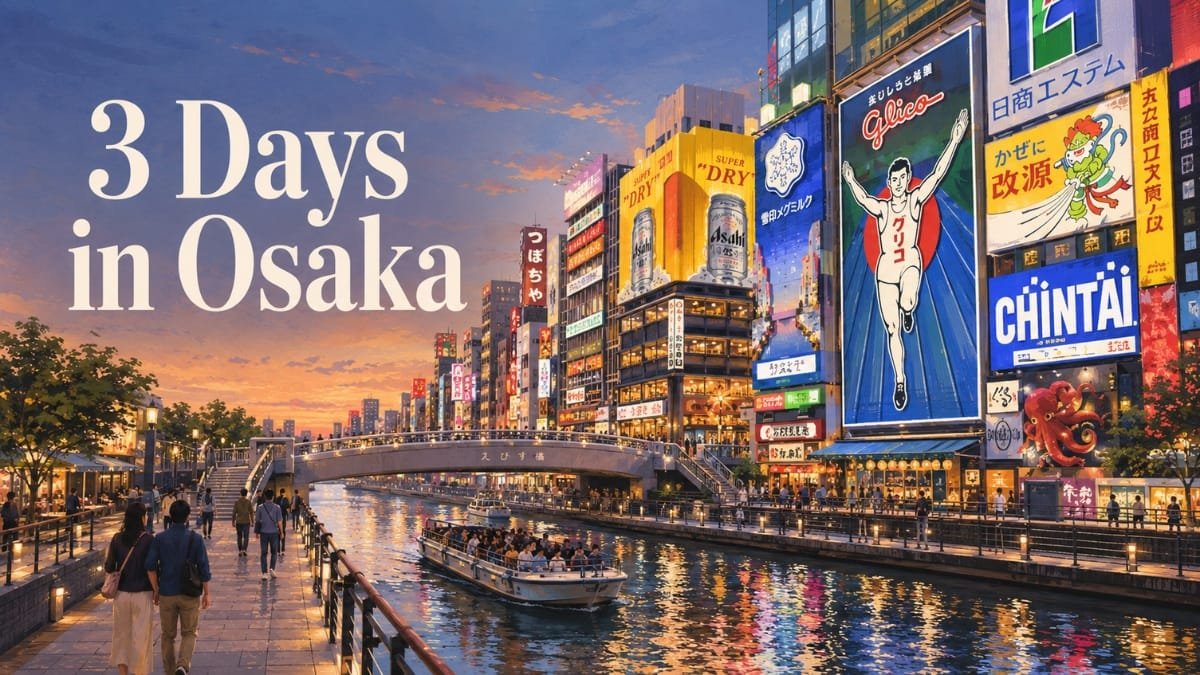
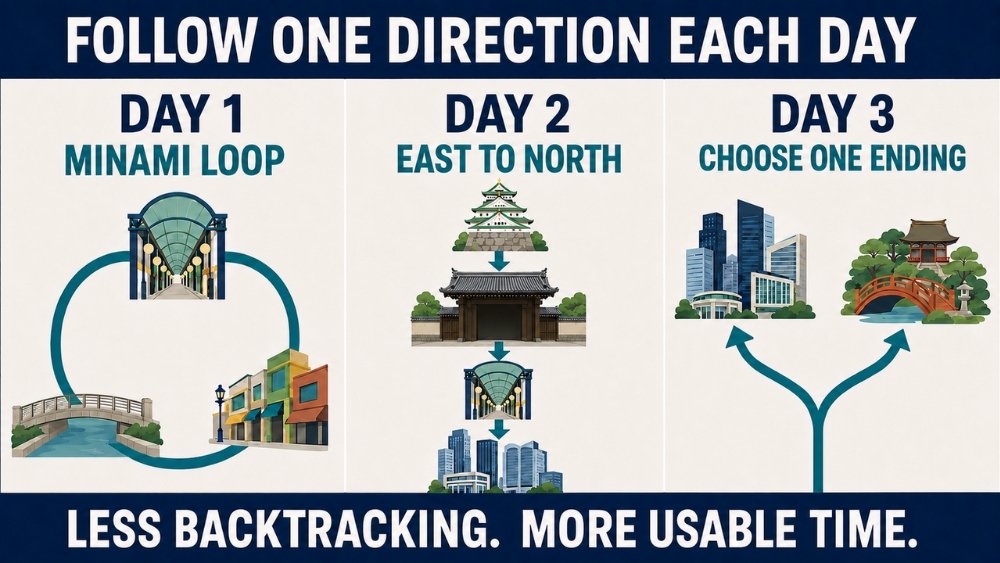
A good Osaka itinerary for three days does not need the maximum number of attractions. It needs one clear direction each day. Keep Day 1 inside Minami, move from Osaka Castle north toward Tenma and Umeda on Day 2, then use Day 3 for either an easy Umeda finish or a quieter morning at Sumiyoshi Taisha.
This plan is for a first visit with three usable sightseeing days and a base around Namba, Umeda or Osaka Station. If that decision is still open, compare the trade-offs in our guide to where to stay in Osaka. The route preserves Osaka’s essential contrasts—food streets, castle grounds, everyday shopping arcades, modern station buildings and an old shrine—without sending you back and forth across the city.
| Day | Route | What the day is for |
|---|---|---|
| 1 | Kuromon → Hozenji → Dotonbori → Shinsaibashi → Amerikamura → Dotonbori | Learn Minami in daylight, then enjoy its evening atmosphere |
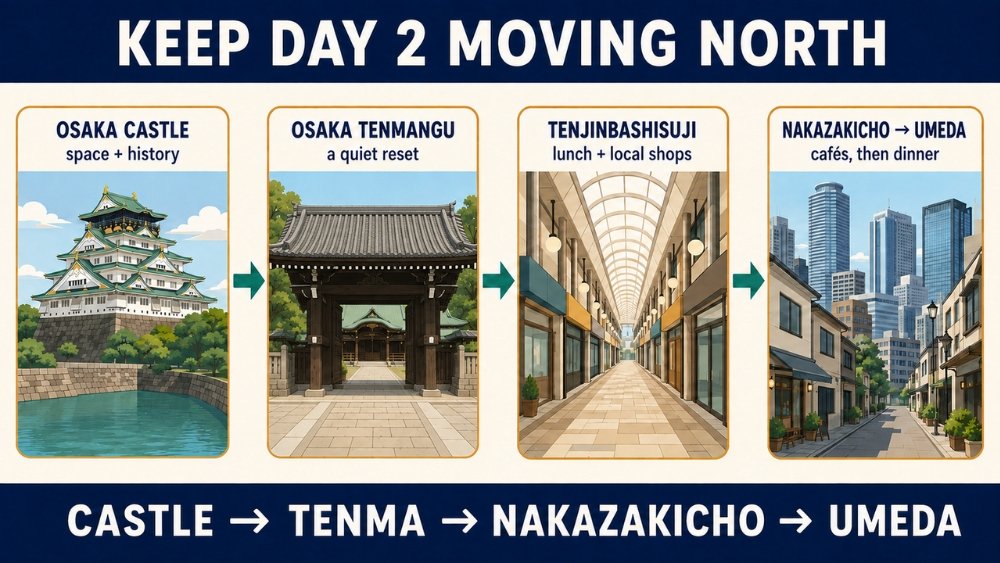
| 2 | Osaka Castle → Osaka Tenmangu → Tenjinbashisuji → Nakazakicho → Umeda | Move north from history into everyday city life |
| 3(PlanA) | Osaka Station City → LUCUA Osaka → Umeda Sky Building | A weather-resistant finish with shopping and onward JR travel |
| 3(PlanB) | Sumiyoshi Taisha → central Osaka | A calmer cultural finish with a deliberately light schedule |
Do not try to complete both Day 3 options. The choice is the point.
Why this Osaka three-day route flows
Osaka is compact on a regional map but not at street level. Namba, Umeda and Osaka Castle each contain large stations, long indoor passages and several possible exits. A route that looks short can still lose time to platform changes, underground navigation and walking back to a district you already left.
This itinerary reduces that friction in three ways:
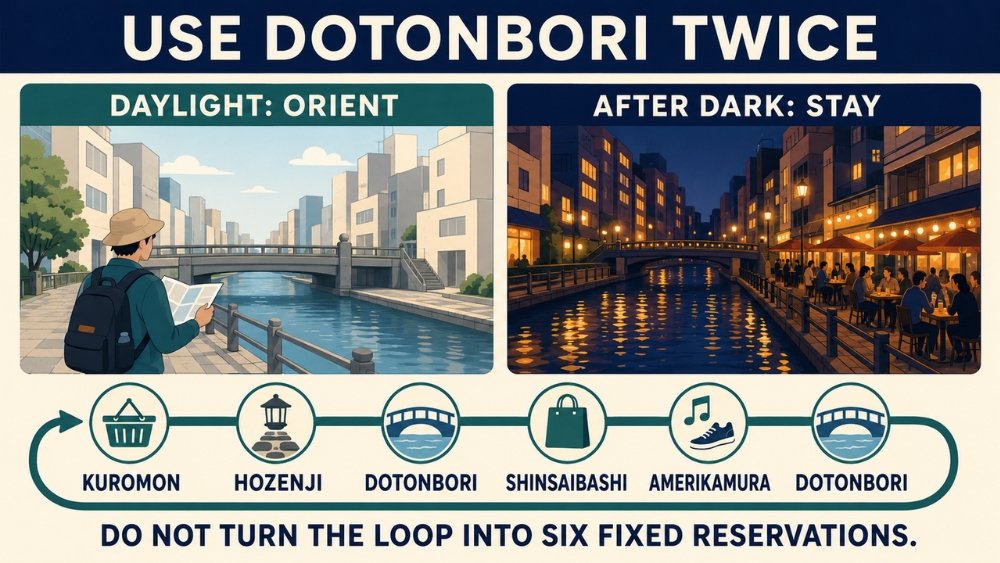
- Day 1 is a walkable Minami loop. You see Dotonbori once while you are orienting yourself and again when its evening character is strongest.
- Day 2 keeps moving north. The castle, Tenma, Nakazakicho and Umeda become one progression rather than four separate outings.
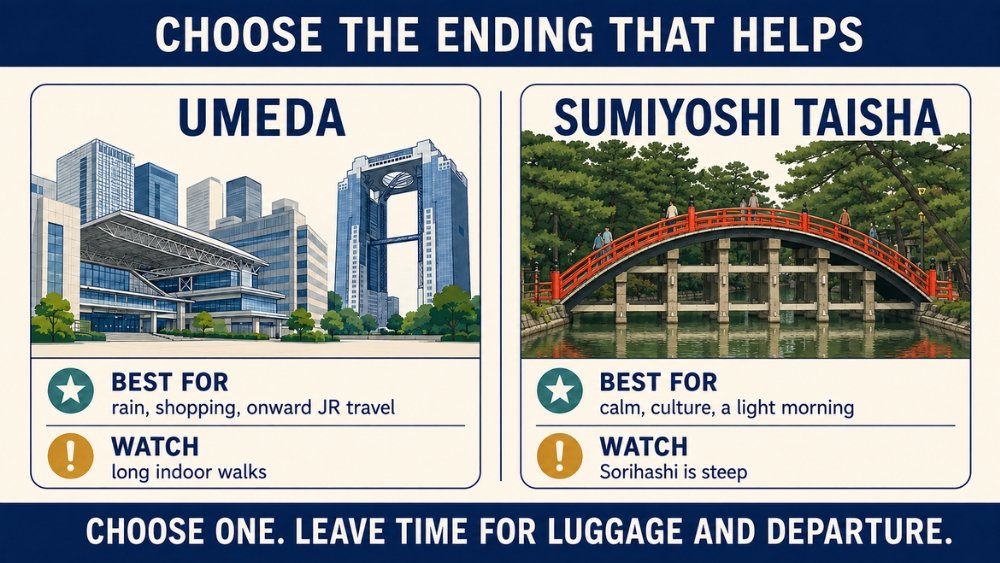
- Day 3 solves your final-day problem. Umeda is practical for rain, shopping and JR departures; Sumiyoshi Taisha is better when you want space and a slower morning.
If your first day begins after a long flight, swap Day 1 and Day 2 if necessary—but keep the Minami loop together. Splitting Dotonbori, Shinsaibashi and Amerikamura across different days creates needless repeat travel.
Day 1: make one Minami loop and see Dotonbori twice
Start in the morning, but treat the route as a flexible sequence rather than six fixed appointments. Minami rewards wandering; it becomes exhausting when every food stop has a reservation.
Start at Kuromon Ichiba Market
Kuromon Ichiba Market is a useful first stop because it introduces Osaka through produce, seafood and prepared food before the busiest evening streets wake up. Open Kuromon Ichiba Market in Google Maps.
The market’s information center currently publishes its own hours, but individual shops decide their opening days and times. Arrive with one or two foods in mind, check the displayed price before ordering and do not assume every stall accepts the same payment method. Eat where the shop permits it rather than blocking the arcade.
If a guided introduction would help with ordering, market etiquette or unfamiliar dishes, you can replace part of this self-guided morning with a food tour. Klook lets you switch the displayed language and currency, which can make comparison easier in a familiar format. Compare current Osaka food tours on Klook, then check the meeting point, language, included tastings, dietary limits and cancellation terms before booking. Do not stack a long tour on top of the complete walking loop.
Pause at Hozenji before entering Dotonbori
Walk toward Hozenji Temple, a small active temple beside the lanes south of Dotonbori. Open Hozenji Temple in Google Maps. Its compact scale is the appeal: it gives you a quiet transition between a market and one of Osaka’s busiest entertainment streets.
Keep voices low, avoid blocking worship and follow any photography signs. Nearby Hozenji Yokocho is a narrow restaurant lane, not a shortcut for wheeled luggage. If your suitcase is still with you, store it before beginning this loop.
Use Dotonbori first for orientation
Enter Dotonbori while there is still daylight. Open Dotonbori in Google Maps. This first pass is for learning the canal, bridges and direction of Namba—not for waiting in every famous queue.
For deeper street-by-street tactics, use our guide to exploring Dotonbori beyond the crowds. On this itinerary, keep moving north rather than finishing the night early.
Walk through Shinsaibashi-suji and Amerikamura
Continue into Shinsaibashi-suji Shopping Street, the covered arcade that makes the northbound part of the loop easy to follow. Open Shinsaibashi-suji Shopping Street in Google Maps. Browse selectively; carrying a full shopping load through the rest of the day defeats the low-friction route.
Turn west for Amerikamura and use Mitsu Park, commonly called Triangle Park, in Google Maps as a concrete anchor. Amerikamura is a youth-fashion and music district, but the atmosphere changes by street and time. Treat the park as an orientation point, not as an attraction that requires a long stop.
Our Osaka shopping streets guide is the better place to compare arcades and markets if shopping is a major goal. This day only needs enough browsing to understand how Shinsaibashi and Amerikamura differ.
Return to Dotonbori after dark
Loop south and east for a second Dotonbori pass. The canal reflections, illuminated signs and dinner crowds now provide the evening energy the district is known for. Choose one dinner priority—perhaps okonomiyaki, a savory cabbage-and-batter pancake cooked on a griddle, or takoyaki, hot round batter bites containing octopus—rather than turning the night into a queue contest.
Allow time for the walk back to the exact Namba station or hotel entrance you need. “Namba” can mean different railway stations, and the final underground transfer can be longer than the map suggests.
Day 2: move north from Osaka Castle to everyday Osaka
Day 2 works because every major stop moves you toward Umeda. Begin with the most structured attraction, then let the day become progressively looser.
Decide whether you want the castle grounds or the museum
Approach Osaka Castle Museum early enough to make a deliberate choice. Open Osaka Castle Museum in Google Maps. The present main tower is a museum with historical exhibitions and an upper observatory; it is not an untouched feudal interior.
If you enjoy history and want the exhibits, enter the museum and check current admission hours and closure information on the official site. If you mainly want architecture, moats and open space, the grounds may give you more value without committing to the museum queue. Either choice is valid; doing both hurriedly is not.
You can compare current Osaka Castle admission options on Klook, but confirm exactly what the listing covers. An offer may be for the main-tower museum, Nishinomaru Garden, a pass or a guided activity, and those are not interchangeable.
From the west side of the grounds, Tanimachi 4-chome Station (T23) provides a direct Osaka Metro Tanimachi Line ride to Minamimorimachi Station (T21). This is the route’s key efficiency move: do not return to Namba for lunch and then travel north again.
Reset at Osaka Tenmangu
From Minamimorimachi, walk to Osaka Tenmangu, an active Shinto shrine associated with learning and the Tenjin Matsuri festival. Open Osaka Tenmangu in Google Maps. A jinja, or Shinto shrine, is a place of worship rather than a themed attraction. Keep voices low, follow signs and avoid interrupting ceremonies.
The shrine works here as a calm reset after the castle. It does not need to become another long museum-style stop.
Eat and browse on Tenjinbashisuji
Move into Tenjinbashisuji Shopping Street’s 2- and 3-chome area. Open Tenjinbashisuji Shopping Street in Google Maps. This covered commercial street is a practical lunch zone with everyday shops, cafes and restaurants rather than a single must-eat venue.
Choose lunch by what solves the day: a quick set meal if the castle took longer than expected, or a slower cafe if heat and walking have caught up with you. Check the individual business’s current hours, smoking policy, allergens and payment methods. The shopping street is long; you do not need to walk every block to understand it.
Continue through Nakazakicho and finish in Umeda
Walk west toward Nakazakicho in Google Maps, a low-rise district of narrow lanes, small cafes and reused older buildings. It is still a residential neighborhood. Stay on public lanes, keep groups compact and do not photograph private doorways or residents as though the area were a set.
If energy is dropping, skip the cafe and continue to Umeda. The route does not fail when you remove a stop; it fails when you add backtracking to “make up” for one.
End at LUCUA Osaka, which is directly connected to JR Osaka Station and has broad restaurant choices. Open LUCUA Osaka in Google Maps. A station-connected dinner is especially useful in rain or when you want an uncomplicated trip back to the hotel.
Day 3: choose the ending that solves your last day
Your final day should reflect luggage, weather and departure direction. Choose Umeda when convenience and indoor options matter; choose Sumiyoshi Taisha when you want a quieter cultural morning. Do not combine them merely because both fit on a city map.
Option A: Umeda for rain, shopping and onward JR travel
Begin inside Osaka Station City, the station complex that connects rail facilities, shops and public spaces. Open Osaka Station City in Google Maps. Save one named building and one meeting point before separating from your group; “meet at Osaka Station” is too vague.
Use LUCUA for shopping or lunch, then choose one viewpoint if the weather supports it. Umeda Sky Building’s Kuchu Teien Observatory gives a broad city view from a building northwest of Osaka Station. Open Umeda Sky Building in Google Maps. It is not inside the station, so protect walking time in both directions. The rooftop can close in severe weather even when indoor areas remain available.
If the observatory is your one paid priority, compare current Umeda Sky Building observatory tickets on Klook and verify the date, admission conditions and cancellation terms before paying.
Our Osaka Station area guide explains the gates, buildings and levels in more detail. Use it if this option ends with a JR train or a hotel luggage pickup in Umeda.
Option B: Sumiyoshi Taisha for a quieter cultural morning
From Nankai Namba Station, take a Nankai Local train to Sumiyoshi Taisha Station. Local trains stop at every station; faster services may not stop there. Recheck the platform and stopping pattern on the day.
Sumiyoshi Taisha is one of Osaka’s major Shinto shrines and a strong counterpoint to central Osaka’s commercial districts. Open Sumiyoshi Taisha in Google Maps. General entry is free, while hours change seasonally; use the official site for the current opening time.
The arched Sorihashi bridge is steep. It is a visual landmark, not a required step on the route, and a level approach is available. Travelers with wheelchairs, strollers, balance concerns or slippery-weather conditions should use the easier path. Our Sumiyoshi Taisha access guide explains the Local-train rule, bridge choice and respectful visit in detail.
Return to central Osaka with enough time to collect luggage. This option should feel spacious. Adding another distant attraction immediately afterward removes the quality that made it worth choosing.
Change the plan without breaking the route
| Real condition | Keep | Change |
|---|---|---|
| Late arrival or jet lag | The Minami loop | Start at Hozenji or Dotonbori and skip Kuromon if the market day is effectively over |
| Heavy rain | Day 1’s covered Shinsaibashi arcade and Day 3 Umeda | Shorten exposed castle grounds, Amerikamura and the walk to Umeda Sky Building |
| Strong heat | One directional route | Add seated indoor breaks; remove Nakazakicho or the observatory rather than rushing |
| Limited mobility or a stroller | The neighborhood order | Use lifts, allow longer station transfers, avoid steep Sorihashi and do not treat map distance as walking time |
| Early Day 3 departure | One final area | Choose Umeda if it aligns with your luggage and JR route; skip the viewpoint if it creates a tight return |
| Food is the priority | One chosen district | Reserve one important meal and leave other snacks flexible; do not book consecutive tastings across town |
Save the exact station entrance, hotel address and luggage location in your phone. Build in more time than a route app’s train duration because the unfamiliar part is often inside the station, not on the train. An IC card helps with ordinary transit, but it does not decide which railway company, platform or stopping pattern you need.
Three days is enough when every day has one direction
This itinerary is not a claim that three days can exhaust Osaka. It is a way to leave with a coherent understanding of the city: Minami’s street energy, the castle and Tenma’s everyday texture, then a final choice between modern Umeda and quieter Sumiyoshi.
Depth beats coverage here. See Dotonbori twice for two different reasons. Let Day 2 change gradually rather than resetting at the hotel between every district. On Day 3, choose the ending that makes departure easier or the trip feel calmer. That is what makes the plan flow.