
The best Osaka night view depends on where you will finish your evening. Harukas 300 makes a straightforward indoor skyline visit near Tennoji. Kuchu Teien gives you an open-air rooftop near Osaka Station. HEP FIVE is a short Ferris wheel ride in Umeda. For a free stop, choose Toki no Hiroba at Osaka Station or an evening walk by Nakanoshima. The bay has a different atmosphere, but allow more time for the journey back.
If you have only one evening, choose one main view and add dinner or a short walk nearby. Crossing Osaka to collect several observatories tends to use up the best hour of light on trains. Check the venue’s current last admission and your return train before you set out; a posted closing time is not always the time of the last ticket sale or boarding.
Match the view to your evening
| Your evening | Start here | What changes the choice |
|---|---|---|
| Staying around Tennoji | Harukas 300 | A broad, mostly indoor view; an admission ticket is needed. |
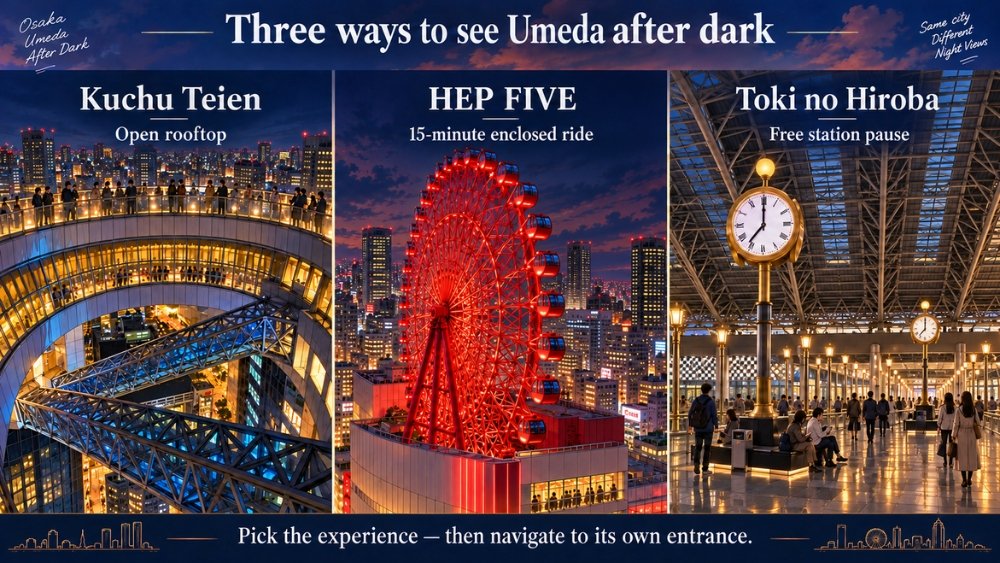
| Dinner around Osaka Station or Umeda | Kuchu Teien or HEP FIVE Ferris Wheel | Choose a long open-roof visit or a roughly 15-minute enclosed ride. They have different entrances. |
| Only 15–30 minutes to spare | Toki no Hiroba | Free station architecture and city lights, rather than a high panorama. |
| A quiet, free walk | Osaka City Central Public Hall and nearby Nakanoshima river paths | The exterior and river are the visit; indoor access is a separate matter. |
| Already at Osaka Port | Tempozan Giant Ferris Wheel | Best paired with an aquarium or harbor-area afternoon; operating times vary. |
| A high bay panorama | Sakishima Cosmo Tower Observatory | A separate trip toward Trade Center-mae, with a weekly closing day. |

These are different experiences, not a ranking of the tallest buildings. A clear evening can make an ordinary riverside walk more memorable than a costly deck in cloud. If you want sunset and city lights, arrive before sunset and allow time for the change; do not turn up at the last-admission deadline.
Tennoji: the easiest big skyline
Harukas 300 is inside Abeno Harukas beside the Tennoji/Osaka-Abenobashi station cluster. The main viewing area uses broad glass, making it a comfortable default in chilly or wet weather. Follow the Harukas 300 signs to the observatory entrance and ticket counter on the 16th floor; reaching the shopping floors is not yet admission to the view. Official hours and ticket information currently show a 9:00 a.m.–10:00 p.m. operating day and last admission 30 minutes before closing, subject to special dates. The operator’s ticket page is the place to check the fare and purchase arrangement for your date.
The official English information pages currently display inconsistent adult ticket amounts, so budget from the ticket page at purchase rather than from an old article price. Same-day tickets are sold at the 16th-floor counter, but queues or special-event limits can change availability. Standard single-entry tickets do not allow you to leave and come back for a later night view. Find Harukas 300 on Google Maps. Book tickets on Klook: Abeno Harukas 300
If you are spending the afternoon elsewhere, travel to Tennoji Station on JR (Japan Railways) or Osaka Metro, or Osaka-Abenobashi Station on Kintetsu. These are nearby facilities run by different operators, not two names for one platform. A rechargeable IC transit card such as ICOCA or Suica can cover ordinary train travel where accepted; it does not replace the separate observatory admission ticket.
Umeda: roof, wheel, or station plaza?
Umeda is the district around JR Osaka Station, with several other stations also called Umeda or Osaka-Umeda. Save the building name and entrance as well as the station name. Our Osaka Station area guide helps with the station-side decision if this is your first visit.
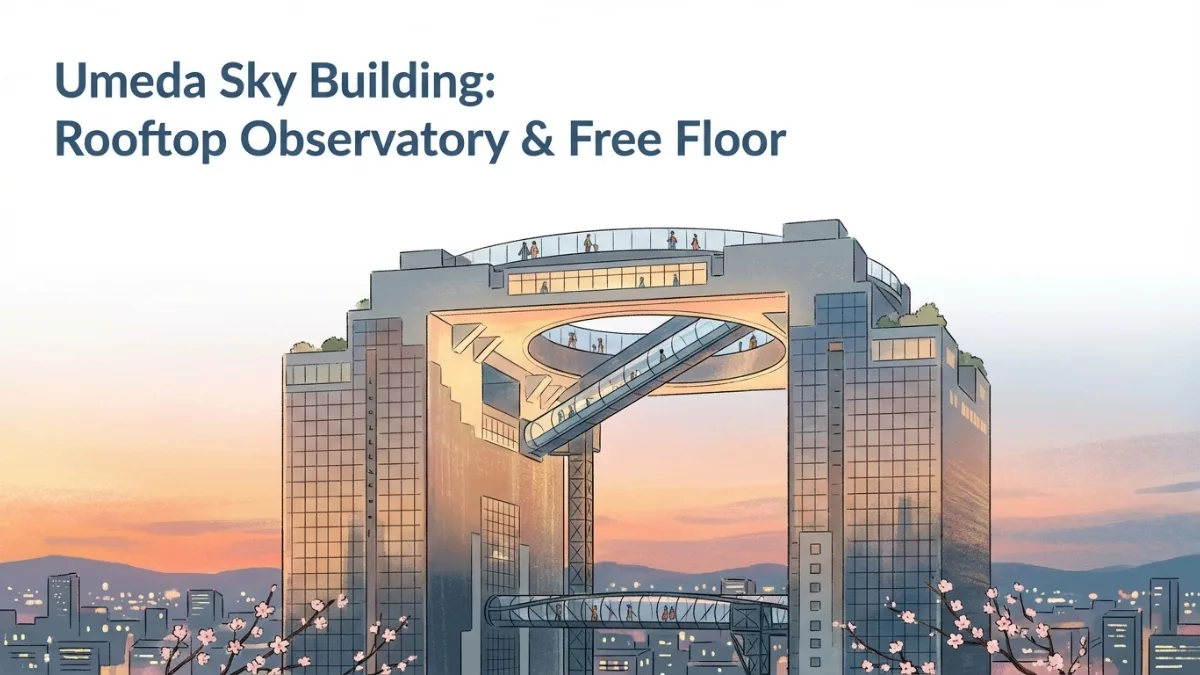
Kuchu Teien Observatory at Umeda Sky Building is the choice when you want an outdoor skyline and the architecture of the joined towers. The operator currently lists 9:30 a.m.–10:30 p.m., last admission 10:00 p.m., and ¥2,000 for an adult, subject to special operating days. Allow a walk from Osaka Station, then use the dedicated observatory entrance outside the building; the office-tower elevators do not lead to visitor admission. Tickets can be bought online or on the day at the 39th-floor counter. The open-air section may close in severe weather, and the roof can feel colder and windier than the streets below. If step-free access matters, the operator gives a different elevator approach for wheelchair users; consult its access instructions before arrival. Google Maps: Umeda Sky Building. Book tickets on Klook: Umeda Sky Building Kuchu Teien Observatory
HEP FIVE Ferris Wheel is a smaller time commitment. The red wheel sits on the shopping building east of the station cluster; go to the 7th-floor wheel counter. The operator’s current page gives ¥1,000 per person, about 15 minutes for a circuit, and normal operating hours of 11:00 a.m.–11:00 p.m., with 10:45 p.m. last boarding; heavy demand can move the boarding cutoff earlier. Cabins are enclosed and air-conditioned. It is a ride, with no option to pause at the top for a long photo session. Google Maps: HEP FIVE. Book tickets on Klook: HEP FIVE Ferris Wheel
For a free, unplanned pause, go to Toki no Hiroba on the 5th floor of Osaka Station City. The covered plaza spans the station area and has large clocks that make useful meeting points. You will see station architecture and nearby city lights, not the full panorama of a paid observatory. It is more convenient than either ticketed option if a train is approaching, though it remains a busy public station space. Google Maps: Toki no Hiroba.
If you plan to sit down after the view, our late Umeda café guide distinguishes venues by last order, which can be earlier than closing.
The bay: two trips with different starting stations
Tempozan Giant Ferris Wheel works particularly well after Kaiyukan Aquarium or a meal around Osaka Port. From Osakako Station on Osaka Metro’s Chuo Line, walk to the wheel beside Tempozan Marketplace. A circuit lasts roughly 15 minutes and the port, water and illuminated bridge structures give the view a different character from Umeda. Ordinary cabins work if a transparent-floor cabin would be uncomfortable. Check the wheel operator’s daily schedule and price before setting out; the last ticket sale or boarding can precede closing. Google Maps: Tempozan Giant Ferris Wheel. Book tickets on Klook: Tempozan Giant Ferris Wheel
Sakishima Cosmo Tower Observatory is a separate destination, near Trade Center-mae Station on Osaka Metro’s New Tram, also called the Nanko Port Town Line. It gives you a high indoor view over the port rather than a moving ride. The operator currently lists 11:00 a.m.–10:00 p.m., 9:30 p.m. last admission, Monday closure (following day when Monday is a holiday), and ¥1,200 adult admission. Confirm special closures and the current 52nd-to-55th-floor access arrangement before you go; operator notices have reported escalator work. Do not assume the Tempozan wheel and Sakishima observatory sit next to one another simply because both are in Osaka Bay. Google Maps: Sakishima observatory.

Universal CityWalk Osaka is an easier brightly lit bay-area evening for someone already staying by or visiting Universal Studios Japan. It is outside the theme park by JR Universal-City Station, so you can walk through the CityWalk shopping complex without a park ticket. Shop and restaurant hours are individual, and this is a lively street scene rather than a harbor panorama. Google Maps: Universal CityWalk.
Free viewpoints beyond the station
Higashiosaka City Hall’s 22nd-floor observation lobby is particularly good for lines of expressway light rather than a souvenir-style skyline. The city’s current information, updated in September 2026, says free admission, 9:00 a.m.–11:00 p.m., and closure from December 29 through January 3. Use the east-side high-rise elevator or the specified northeast elevator to reach the lobby. This is an active civic building with shared spaces; give other visitors room at the photo windows. Travel via Aramoto Station and check the route back. Google Maps: Higashiosaka City Hall.
If you are sightseeing south of Osaka, MI-TE Sakai, the renewed 21st-floor Sakai City Hall lobby, is a calm free addition near Nankai Sakaihigashi Station. Sakai City’s information currently says 9:00 a.m.–9:00 p.m., generally open daily apart from building shutdowns. The old article’s 360-degree outlook over Sakai remains the reason to stop, but the ancient burial mounds are easier to understand in daylight. Do not travel there at night expecting a close-up view of a kofun (an ancient burial mound). Google Maps: Sakai City Hall.
Walk by the river or the castle
At Nakanoshima, the night view comes from a series of short outdoor scenes rather than a single observation point. Start near Naniwabashi, Kitahama, or Yodoyabashi station, view the red-brick Osaka City Central Public Hall from public paths, and follow the river toward a bridge or Nakanoshima Park if the paths are comfortable. The hall’s official access page gives its address, but the building’s interior is used for events and is not an open, free nighttime museum. Suisho Bridge can be part of a longer riverside stroll; you do not need to find one exact photo spot. Google Maps: Central Public Hall · Google Maps: Suisho Bridge.
Hachikenyahama Pier, beside the Okawa River near Tenmabashi Station, offers a second easy riverside stop with bridges and boats. The riverside walk is free; a boat ride is a separate scheduled, ticketed activity. Do not arrive expecting a cruise simply because the pier is accessible. Google Maps: Hachikenyahama.
Osaka Castle is an exterior night-view option from the public park paths. The castle keep is a museum with its own daytime admission rules, not a late-night observatory. Choose a station and the route out before entering the large park; a photograph from a main path can be more rewarding than searching dim side paths for an exact angle. A museum ticket is unnecessary if you only want the outdoor night scene. Google Maps: Osaka Castle.
More specialized views need a return plan
- Senri River Bank near Osaka International Airport (Itami): aircraft on approach make this a plane-watching evening, not a city skyline. Toyonaka City lists a walk of about 2 km from Hankyu Sone Station. Its right bank is open after improvements, while the left bank by Toyonaka Tsubasa Park “ma-zika” is under construction; consult the current access notice. The partly open ma-zika park has a viewing shelter and facilities but its own entry hours. Aircraft activity, weather and the walk back determine whether this is worthwhile. Google Maps: Senri River Bank.
- Satsukiyama, Ikeda: a hilly local park and city-plain views, but uphill walking and dark approaches make it a poor spontaneous first-night detour. Go only with a specific viewpoint and return plan. Google Maps: Satsukiyama Park.
- Shigi-Ikoma Skyline: a paid mountain driving route with designated places to stop, not a pedestrian observation deck. The road operator’s closure notices report a section closure in 2026. Check the route actually open from your chosen entrance, its toll and the day’s closing time before driving. Do not assume you can drive through from one end to the other. Google Maps: Shigi-Ikoma Skyline.
- Hanna Road: some drivers see Osaka’s lights on the descent, but it is a road, not a place to stop for photographs. Keep it as a view during an existing drive. Google Maps: Hanna Road.
- Maishima Sports Island: open bay scenery if you are already at a booked island venue; late buses can be less convenient. Google Maps: Maishima.
- Minato Ohashi Bridge: distinctive red port bridge and industrial lights, but viewing locations are not a simple staffed attraction. Use public areas only; avoid restricted roads or quays. Google Maps: Minato Ohashi.
- Showayama in Chishima Park: a low neighborhood hill, not a dramatic high viewpoint. Its longer approach and darker park paths make it more sensible for nearby residents or repeat visitors than a first-night destination. Google Maps: Showayama.
Make the evening work in practice
For indoor glass, press your phone close to the window and shade the lens from lights behind you; avoid flash. On a rooftop, bring a layer even if the street feels warm. Do not block shared windows or set a tripod where it obstructs a path; follow the individual venue’s photography rules. Around a river, park or harbor, keep to public, lit routes and be considerate of residents.
Save the venue’s exact name, today’s operating notice, the nearest station, and a route back to your hotel before leaving Wi-Fi. Google Maps can locate a building, but the operator’s site settles whether a deck is operating or a wheel is boarding. Rail service after dinner depends on the line, day and destination; a reusable IC card covers many ordinary trips but does not guarantee that the last connection is still running. If stairs, crowds or long walks are difficult, start with a station-side indoor choice and check the venue’s accessibility route rather than assuming a rooftop, pier or hill offers a level approach.
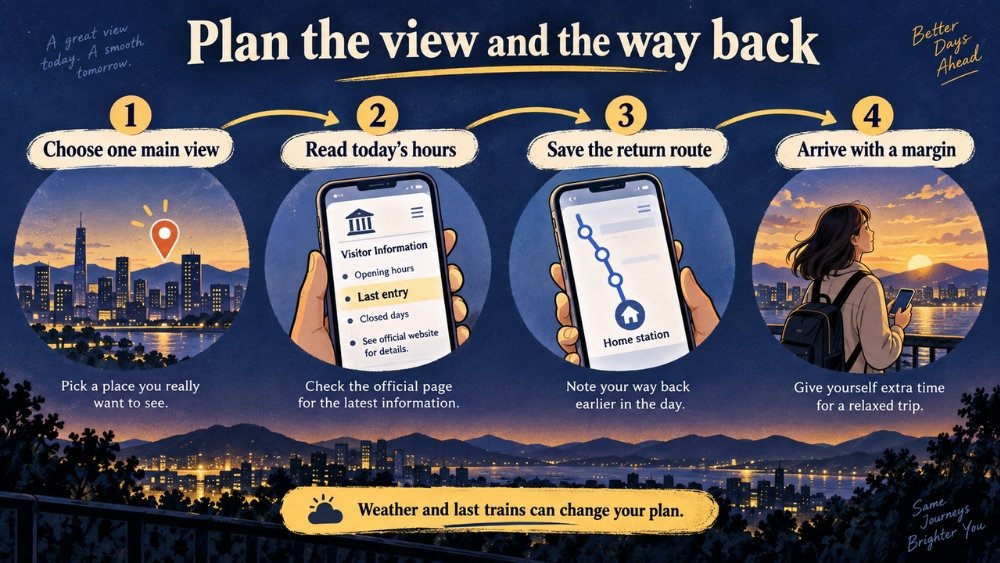
One good view, reached with enough time to enjoy it and followed by an easy journey home, is a better Osaka night than a rushed tour of closed doors.