
The best Osaka neighborhood is the one that makes your first arrival, ordinary mornings, and final departure easier. Namba is the strongest all-round choice for food and a direct Nankai airport connection. Umeda and Osaka Station suit travelers building several regional day trips. Tennoji offers excellent north-south access with a less nightlife-heavy base. Temmabashi works for riverside space and the Osaka Castle area, while Nakazakicho gives cafe-lined streets close to Umeda—but neither is as frictionless for every first-time visitor.
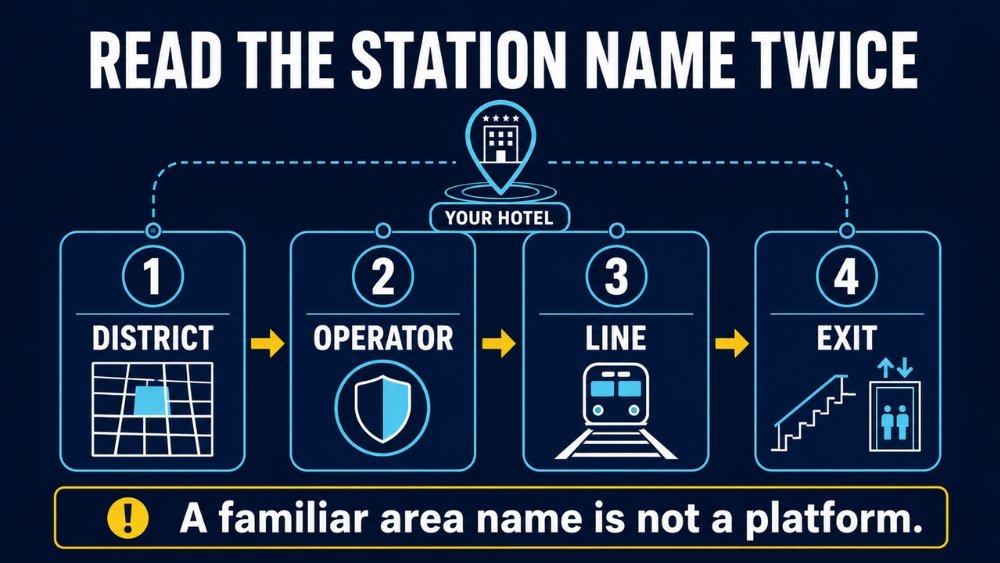
Do not book from the neighborhood name alone. Osaka’s major districts contain several stations, operators, exits and very different blocks. A hotel described as “Namba” may be near Nankai Namba, Osaka-Namba, JR Namba or Nippombashi. A property advertised as “Umeda” may still require a long underground walk to the platform you use most. Check the hotel address, station operator, line, exit and walking route with luggage before paying.
| Your trip pattern | Best base to check first | Main trade-off |
|---|---|---|
| First visit, food and evenings out | Namba | Busy streets, noise and several “Namba” stations |
| Kyoto, Kobe or other regional day trips | Umeda / Osaka Station | Huge station complex and less direct access to Dotonbori |
| Balanced transport and calmer nights | Tennoji | Fewer late-night choices than Namba; station sides differ |
| Osaka Castle, riverside walks and quieter evenings | Temmabashi | Less convenient for repeated south-Osaka nights |
| Cafes and a local-feeling street base near Umeda | Nakazakicho / east Umeda | Smaller hotel supply and more walking to major rail hubs |
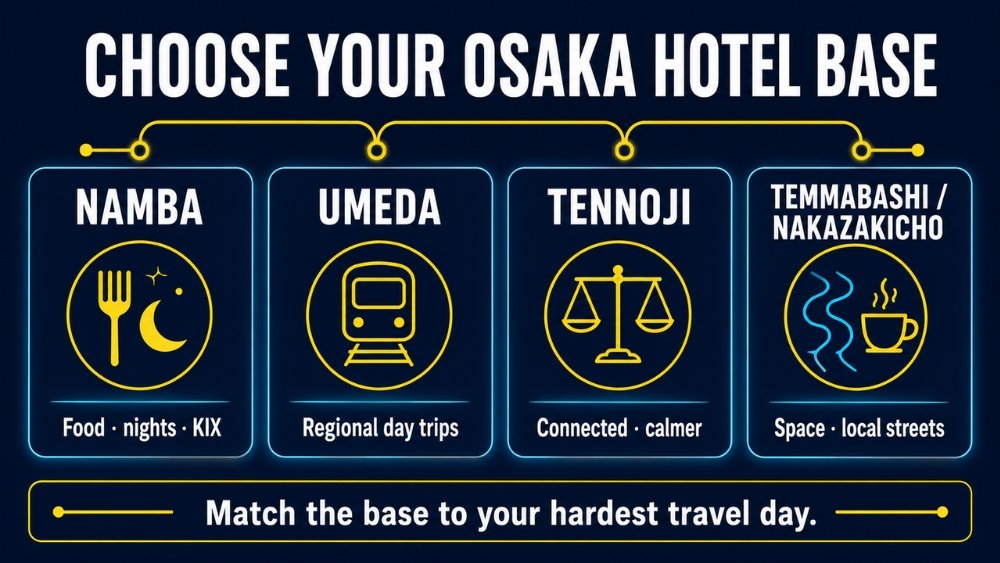
Choose the neighborhood by your hardest travel day
A neighborhood can look central on a map and still create a poor trip. Instead of averaging every attraction, identify the day with the most friction:
- Arrival with luggage: Which airport train or bus reaches the useful station, and what happens after you leave the platform?
- Earliest day trip: Can you reach the departure station without a stressful transfer before breakfast?
- Latest evening: Will you enjoy the walk back, or will noise, crowds and shuttered side streets make it uncomfortable?
- Departure day: Can you reach the airport or Shin-Osaka while carrying everything you bought?
- Accessibility: Is there an elevator on the route you will actually use, not merely somewhere in the station?
For a short first visit, reducing daily transfers usually matters more than saving a few minutes on one sightseeing ride. For a week with three regional excursions, access to the relevant railway may matter more than being beside Dotonbori.
Namba: best for food, nightlife and a simple KIX arrival
Namba is the easiest default for many first-time visitors. Dotonbori, Hozenji, Kuromon Market, Shinsaibashi and a large concentration of restaurants are within the wider south-central area. The Osaka Metro Midosuji Line runs directly north toward Umeda and Shin-Osaka, so the district also works for city sightseeing and a Shinkansen departure.
The airport advantage is specific: Nankai Railway operates the Rapi:t limited express and Airport Express between Kansai-Airport Station and Nankai Namba Station. Nankai states that the Rapi:t takes as little as 34 minutes and requires the applicable limited-express ticket; the Airport Express takes about 45 minutes and uses a regular ticket. Check the current timetable and fare rather than treating those fastest times as a promise for every departure.
The main trap is that “Namba Station” is not one simple point. The area includes Nankai Namba, Osaka Metro Namba, Osaka-Namba for Kintetsu and Hanshin services, and JR Namba. Nippombashi is also convenient for the eastern side of the district. They connect different networks and are separated by real walking time.
Choose the south side near Nankai Namba if airport convenience is the priority. Choose closer to Osaka Metro Namba if you expect frequent Midosuji Line trips. The Dotonbori side maximizes late dining and spectacle, but a hotel one or two blocks off the busiest pedestrian routes may sleep better. Read recent room-specific reviews for street noise, elevator waits and nightclub sound; a quiet lobby does not prove a quiet room.
Best fit: first-time visitors who want Osaka food and evenings close to the hotel, especially when flying through KIX.
Umeda and Osaka Station: best for a regional rail-heavy itinerary
Umeda is the commercial district around JR Osaka Station and several private-railway and subway stations. It is a practical base when Kyoto, Kobe or other northern and eastern connections dominate the itinerary. JR, Hankyu, Hanshin and Osaka Metro services are close together at city scale, but they are not one interchangeable gate.
This is the district where “five minutes from the station” needs the most scrutiny. Osaka Station is large, Umeda’s underground passages extend far beyond it, and construction or a wrong exit can change an easy walk into a tiring one. Match the hotel to the operator and line you will use in the morning. If three day trips start on JR, staying near a useful JR Osaka Station entrance is more valuable than a generic Umeda label.
Umeda is not a bad choice for KIX. JR’s Haruka serves Osaka and Tennoji from Kansai Airport, and other JR or bus options may suit your time and terminal. But the best airport route depends on the current timetable, ticket and exact hotel location. Compare the complete route from arrivals to reception, including the final walk, rather than comparing train minutes alone.
The neighborhood has department stores, underground dining, malls and nightlife, but it does not put you beside Dotonbori. The Midosuji Line makes Namba straightforward, yet repeated late-night returns add friction. Umeda works best when regional mobility is the main purpose of the stay, not when every evening ends in south Osaka.
Best fit: travelers taking multiple JR, Hankyu or Hanshin day trips and those who want major shopping and dining without staying in the Dotonbori zone.
Tennoji: best for balance, transport and a less intense night base
Tennoji combines JR and Osaka Metro services with shopping, restaurants, parks and cultural sights. The Midosuji Line gives a direct ride to Namba, Umeda and Shin-Osaka. JR services connect toward Kansai Airport and other parts of the region. This makes Tennoji especially useful for travelers who want strong transport but do not need Dotonbori outside the door.
Nearby Osaka-Abenobashi Station does not provide the central Kintetsu route to Nara Park. Kintetsu’s official network shows Osaka-Abenobashi on the Minami Osaka Line toward Furuichi, Asuka and Yoshino. The common Kintetsu route from central Osaka to Kintetsu-Nara starts at Osaka-Namba. That distinction matters when comparing hotels for a Nara-focused itinerary.
Tennoji also changes by side. The station and Abeno commercial zone can feel busy, while routes toward Shitennoji or quieter residential blocks have a different evening rhythm. Check whether the hotel is genuinely close to the station entrance you need and whether the walk crosses major roads. If you plan an early airport train, save the correct JR entrance and platform route the night before.
Tennoji’s trade-off is preference, not isolation. You can reach Namba quickly, but you will have fewer spontaneous late-night choices immediately around some hotel blocks. For families, repeat visitors or travelers who value a calmer return, that can be an advantage.
Best fit: visitors wanting a balanced base with direct north-south subway access, JR airport options and a less nightlife-centered evening.
Temmabashi and the Osaka Castle side: best for space and quieter evenings
Temmabashi sits by the Okawa River west of Osaka Castle. It is served by the Osaka Metro Tanimachi Line and Keihan Railway, making it useful for the castle area, riverside walks and some Kyoto-bound journeys on Keihan. Compared with Dotonbori or the busiest parts of Umeda, many nearby blocks settle earlier.
That calm comes with a route trade-off. Repeated nights in Namba usually require a transfer or a less direct journey, and the station does not replace Osaka or Shin-Osaka for every regional trip. The castle grounds are also large: “near Osaka Castle” does not mean a short walk to the tower entrance. Check the exact gate and walking distance you want.
Temmabashi is strongest when you deliberately prefer morning river walks, earlier evenings and a base outside the entertainment core. It is weaker when your saved restaurants, bars and late activities are concentrated around Namba.
Best fit: couples, repeat visitors and slower itineraries centered on the castle, river and central-east Osaka.
Nakazakicho and east Umeda: best for cafes near a major hub
Nakazakicho’s narrow streets, small cafes and converted older buildings create a more intimate atmosphere than Osaka Station’s malls. It is close enough to Umeda to use the northern hub, yet it feels like a distinct neighborhood rather than an extension of the station concourse.
The practical question is how often you will carry luggage or leave early. Nakazakicho Station is on the Osaka Metro Tanimachi Line, while many regional journeys begin from JR Osaka, Hankyu Osaka-Umeda or another nearby station. A pleasant daytime walk can feel much longer with suitcases, summer heat or rain.
Older buildings and small properties also vary more in lift access, sound insulation, front-desk hours and room size. Confirm those details directly. Do not assume “boutique” means staffed late, barrier-free or suitable for large luggage.
Best fit: repeat visitors and cafe-focused travelers who accept a longer walk to the major transport hub in exchange for smaller-scale streets.
Test the exact hotel, not just the district
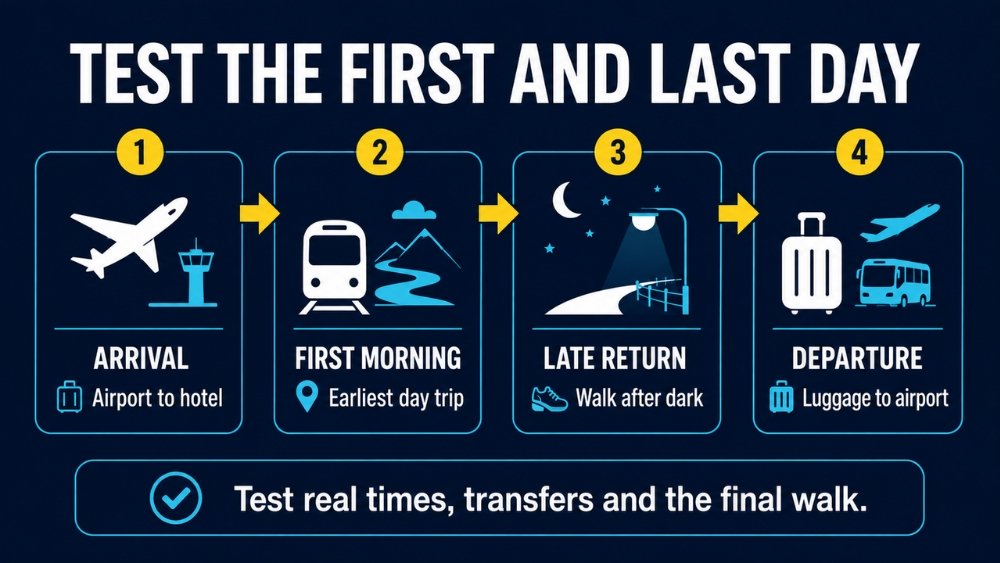
Once you have a neighborhood shortlist, run the same audit on each property:
- Pin the correct entrance. Use the hotel’s official address, not a neighborhood search result.
- Name the station fully. Record operator, station and line: for example, Nankai Namba is more useful than “Namba.”
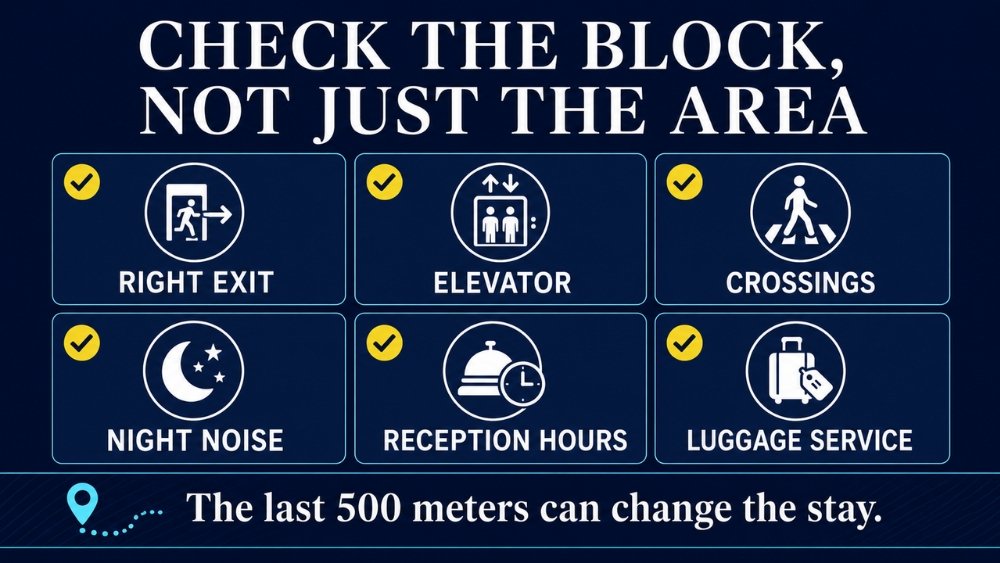
- Trace the luggage route. Check stairs, elevator locations, large crossings and covered sections.
- Test three journeys. Map airport arrival, the earliest day trip and the final departure at realistic times.
- Inspect the block at night. Look for bars, elevated roads, railway tracks, hospitals, construction and late-closing venues.
- Confirm hotel operations. Check reception hours, luggage storage rules, laundry, breakfast timing, room access and check-in procedure.
- Read the cancellation terms. A slightly higher flexible rate may be more useful than a non-refundable bargain before flights and day trips are fixed.
Maps often quote walking time under ideal conditions. Add a margin for station navigation, traffic lights, crowds, rain and luggage. A hotel eight minutes from the right entrance can outperform one advertised as three minutes from the wrong station complex.
Common booking mistakes to avoid
Treating every station with the same district name as identical
Always verify the operator and line. This prevents airport-route mistakes in Namba and long underground detours in Umeda.
Choosing for one famous night instead of the whole stay
You can visit Dotonbori without sleeping beside it. If only one evening is in Namba but three mornings start at Osaka Station, Umeda may reduce more travel overall.
Ignoring the first and last 500 meters
The transfer shown in an app ends at a platform, not the hotel. Stairs, exits, pedestrian bridges and wide roads often determine how the route feels with luggage.
Assuming a rail pass makes every route convenient
A pass changes cost eligibility, not station geometry or transfer effort. Choose the base from the journeys you will actually take, then decide whether a pass fits those journeys.
Booking “quiet” without checking the block
A quieter district can still have a noisy room above a road, beside tracks or near nightlife. Conversely, a busy district can have calmer rooms facing away from the street. Recent reviews and a direct question to the hotel are more useful than a district stereotype.
Final recommendation
For a typical first Osaka visit with KIX flights, food and evenings in the south, start with Namba. For a trip built around several regional rail days, start with Umeda or Osaka Station. Choose Tennoji when you want strong transport with less emphasis on late-night entertainment. Consider Temmabashi for river-and-castle calm, or Nakazakicho when cafes and neighborhood texture matter more than door-to-platform speed.
Then make the real decision at hotel level. Compare the exact station, operator, exit, luggage route, first morning and final departure. The best Osaka neighborhood is not simply the most famous one; it is the base that removes the most repeated friction from your own itinerary.
Once you have chosen the area and tested the station route, compare current Osaka hotel prices and availability on Klook. Before paying, match the exact property and room type to the hotel’s official terms, then check the cancellation policy and final total.